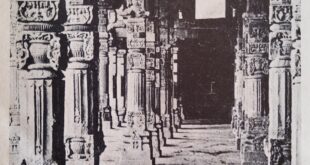
Ancient Greeks, is where the history of Europe and of Western civilization really began, with the arrival in the Aegean world of those invaders we call the Greeks. There, amid an earlier civilization that had been enriched by those of Egypt and Mesopotamia, the newcomers developed many city-states and democratic procedures. The culture that arose in the city-state of Athens became the crown jewel of ancient civilizations and the foundation of Western culture.
Through their study of man, the Greeks came to appreciate the dignity of man and the social contribution made by individuals – those individuals who had much to do with the development of Greece. Of note too, those elements of Greek civilization which have come down to us as our heritage and which are part of our culture today.
The love of freedom, so precious to us, was born in ancient Greece. The freedom of the individual to realize his innate possibilities, reached its finest expression in Athens. Most of the other achievements of the Greeks were made possible, by the growth of freedom. It led to the development of democratic practices in government, to freedom of religion, speech and to the free expression of ideas in architecture, drama, history, sculpture, science and philosophy.

Early Greeks and their Customs
Geography played a vital part in the development of Greek culture.
Present day Greece is located at the southern end of Europe’s jagged Balkan Peninsula. Its mountains divide the land into many small valleys, while the sea cuts into the coast with bays, inlets and the Gulf of Corinth. This division into many small valleys made communication difficult and resulted in each valley serving as a natural economic unit. The economic units ultimately developed into separate political units called city-states.
The second dominant influence of geography on the Greeks was the ever-present sea and the islands between Greece and the mainland of Asia. They served as steppingstones and opened the door to trade with Asia. Thus, the early contacts of the Greeks were eastward. Since Greek soil was too meager to provide a living for a large population, the Greek city-states used the sea as an avenue for the exchange of goods.

The third important geographic influence in ancient Greece was climate. The long, sunny summers and mild winters made possible year-round athletic contests, outdoor-meetings of the democratic assemblies of the people, religious festivals and dramatic productions. The winds favoured the use of sailing vessels.
Greek culture was preceded by an Aegean civilization.
For many years, historians could not piece together the story of the cultures and civilizations that developed in the region around the Aegean Sea.
According to tradition, c. B.C 800, Greece had a blind poet named Homer who wrote about a Trojan War between the Aegeans and Troy, a city in the northwest corner of Asia Minor. Homer had gathered into an epic poem, the Iliad, stories handed down from generation to generation.
Many scholars considered Homer’s story of the Trojan War a myth. In the 1800’s, more than 2,000 years after the Iliad was written, Heinrich Schliemann, decided to settle the controversy. He had studied Homer’s poems in the Greek and believed that there actually had been a Trojan War. A German by birth, Schliemann had become a successful businessman and an American citizen. In 1868 he took his fortune to Greece and set out to prove that Homer’s stories were true. He hired Turkish labourers and excavated until he had reached a buried treasure.
Schliemann believed he had found Troy. He had found the site all right, but later digging showed that nine Troys had existed on the site and Schliemann had dug down past the ruins he sought. Later he excavated parts of the walled cities of Mycenae and Tiryns on the mainland of Greece. These were the cities from which the heroes of the Trojan War went forth to conquer Troy.

At Mycenae the diggers uncovered an immense treasure-trove. Objects of gold, ivory, silver and stone – revealed many unknown facts about Aegean civilization.
About the year 1900, Sir Arthur Evans, an English archaeologist, unearthed the city of Knossos on the island of Crete. He uncovered the remains of an ancient building, which he named the “Palace of Minos”, after the legendary King Minos. Later digging by Evans and others, turned up thousands of tablets at Knossos and at various sites on the mainland of Greece. In the 1950s, the difficult task of deciphering these old tablets was begun by Michael Ventris, a young Englishman who had been interested in the tablets ever since, as a schoolboy, he had heard Evans lecture on them. The work of studying the tablets and of other remains unearthed by archaeologists still goes on. Enough has been learned, however, to clear up much of the story of the Aegean people.
Note on the map, the island of Crete, the mainland of Greece, the islands of the Aegean Sea and the coast of Asia Minor. This was the Aegean world. Neolithic tribes settled on Crete about the time that other Neolithic men were settling in the Nile Valley. These Cretan settlers advanced rapidly towards civilization, perhaps because of Crete’s position as a steppingstone between Asia, Africa and Europe. The islanders prospered by trading with the Egyptians, Phoenicians and Babylonians. Archaeologists find a blending of techniques and ideas from those peoples in the Cretan culture.
By B. C. 3000 or so, the Cretans were making bronze tools and weapons. Later, craftsmen turned out beautifully designed and decorated pottery, carved figurines and delicate jewellry. Buildings had walls of plaster, on some of which were painted colourful frescoes.
By B. C. 2500, the Cretans had a written language. By B. C. 1700, they controlled the Greek peninsula and the islands of the Aegean. They also controlled the trade routes in the eastern basin of the Mediterranean Sea.

About B. C. 2000 or 1900, Indo-European tribes invaded the mainland north of Crete.
They spoke a language called Greek. The newcomers are referred to as Achaeans, the name of one of their tribes. They soon built walled cities, the most important of which was Mycenae.
The Achaeans of Mycenae traded with Crete, came under her rule, revolted and for a time, held Knossos. Although it appears that they were finally driven out of Crete, the Mycenaeans had learned Cretan trade secrets. They were soon exporting weapons, tools and their own pottery. In their wider contact with other peoples, they developed the free spirit and love of beauty, which they gave as a heritage to the later Greeks. Numerous villages and towns were founded on the mainland, the forerunners of Greek citystates. Mycenaean colonies were established along the Aegean in Asia Minor and Syria.
There is still much difference of opinion among scholars as to a specific date, but probably between B. C. 1250 and B. C. 1170, the Mycenaeans led an attack on Troy, that resulted in the ten-year siege of Troy, described by Homer in the Iliad. The Mycenaeans were tired of paying the tribute that the Trojans had been collecting from ships which passed through the Hellespont (Dardanelles).
Soon after taking Troy, the Achaeans were conquered by the infiltrating Dorians. The Dorians were distant relatives of the Achaeans and spoke a form of Greek. They had lived in northwestern Greece at Epirus since about B. C. 2000 or B. C. 1900, but about B. C. 1400 or 1300, they moved southward. Taking Crete first, they gradually conquered the Achaean towns, including Mycenae. Refugees fled to Athens. Some went on to Asia Minor, where their settlements were called Ionia. Then, so far as recorded history goes, about B. C. 1100 much of the Greek world entered a “Dark Age,” which lasted more than 300 years.
In the Ionian towns and especially in Miletus, the former Mycenaeans kept their Aegean culture and to it added items from the cultures of their Middle Eastern neighbours. They learned from the Lydians, for example, to weave, dye in purple, use coined money and to work with metals.
The period when Homer lived is sometimes called the Homeric Age.
Most of the information we have about the years following the Doric infiltration and “Dark Age” is found in the Iliad and Odyssey. The latter tells of the wanderings of a Greek warrior, Ulysses, between the time Troy was defeated and his return to his home and wife ten years later.
The two poems reveal much about the religious beliefs of these ancient peoples. According to Homer, the Greeks believed that their gods lived on Mount Olympus. Zeus was the father and ruler of the gods and his wife, Hera, protected married women. Athena, the daughter of Zeus and goddess of wisdom, was much beloved as a symbol of self-control and dignity. Apollo, the sun god, was honoured for his wisdom and ability to foretell the future. Aphrodite, goddess of love and beauty, gave advice to people in their love affairs.
These five were among the most important Greek deities, but there were many more. The Greeks believed that the gods had great power over human affairs, so people spent much time and thought in trying to please them. They built temples in the gods’ honour, performed rites and ceremonies to gain their favour and made animal sacrifices. They also developed festivals in honour of the gods, such as the Olympic Games, which honoured Zeus by a display of individual human skill and bodily control.
The Greeks also believed that the gods would reveal one’s chances of success in love, war, or a business enterprise through certain priests and priestesses at various oracles. The term oracle was used for both the divine message and the place where the message was given.
The most famous oracle was that of Apollo at Delphi. Most of the Greek world consulted this oracle, the governments of citystates, as well as individuals. Since the oracle was human, it was subject to political and other influences and protected itself with ambiguous answers.
The gods of Greece have, of course, long since taken their places in the realm of fancy and belief. Yet poets and artists of many generations have been inspired by them and students of literature are handicapped, if they do not know myths and legends of the Greek and also Roman, gods and goddesses. In the Space Age, scientists have drawn on mythology for the names of missiles, such as Nike, Zeus, Atlas, Ajax and Hercules.
The early Greeks developed more than 150 city-states.
Most of these never occupied a large territory or had more than 10,000 inhabitants. Since the city-state was small in area and population, everyone knew everyone else. When the citizens met to discuss their affairs or their problems, any citizen could take part in the discussion. Each city-state thus developed its own ideas of law and order, individual responsibility in political affairs and a sense of being independent of the other city-states.
Although they developed independently, strangely enough, many of the Greek citystates passed through more than one stage of government and in a similar manner. The nobles who had been the kings’ advisors gained the right to govern. The nobles were considered the best people and their rule was called an aristocracy — aristo meaning best and cracy meaning rule. The land, which had been owned by the clan, was opened to private ownership. As the cities developed trade, a powerful and wealthy merchant class gained power. Rich merchants overthrew the aristocratic rule and set up a plutocracy, or rule by the wealthy (pluto). We still use the word plutocrat for a person who has power due to his wealth.
The fourth stage of government to develop was rule by tyrants (at that time, the word tyrant meant master). A tyrant was a political leader who illegally seized power outside of the constitution and set himself up as the ruler. Sometimes he won the support of the common people by promising them reforms and a better standard of living. An able tyrant, one working for the good of the people, was often justified at this stage in the development of the Greek citystates. Unfortunately, not all tyrants worked for the good of the people. Many were primarily interested in power. Gradually the citystates cast aside their tyrants and established governments by the people.
Sparta, a citystate in the southern part of Greece, was an exception to this transition of governments from monarchy to democracy. It could be thought of as a tight aristocracy. Although Sparta had only about 25,000 citizen-soldiers, she was a military state ruled by two kings who were also generals and high-priests. There was a Council of Elders, elected by the assembly of Spartan citizen-soldiers. The assembly elected five overseers as guardians of the military system.
There was no chance to criticize the government as in Athens. Sparta had a secret service system to spy on anyone who was disloyal.
In Sparta, the citizen-soldiers were the citizens of the first class. The large second class were craftsmen and had no share in the government. The third and largest class were almost slaves and lived wretched lives. They did all the hard work to support the citizen-soldiers. Whenever there was danger of an uprising of slave workers, the leaders were killed as in a dictatorship.
The Spartan and Communist systems of education may be compared. Above all, physical fitness and loyalty to the system were carefully examined. In Sparta young boys at seven years of age began their extensive military training. It included outdoor camping, sleeping on rushes and occasionally stealing food without being caught. If a boy was caught stealing he was whipped without mercy. At nineteen years of age, a boy joined the military clubs and at thirty, he became a first-class citizen-soldier. The Spartans were courageous fighters, but they contributed almost nothing to civilization except their military system.
The Spartan state regulated the lives of girls as well as boys. They had to take part in sports, such as wrestling, casting darts and throwing quoits. They were expected to develop strong bodies and characters. They had more freedom than women in other Greek communities. They could inherit, own and bequeath property. Plutarch says that Spartan women “were bold and masculine – speaking openly, on the most important subjects”.

PERICLES — (B. C. 490-429) Pericles belonged to one of the leading families in Athens. His father had a distinguished record as a general and his mother was related to one of the founders of Athenian democracy. He wisely used his background and talents to become the greatest leader in Athenian history. He was credited with being chiefly responsible for Athens Golden Age of achievement in literature, sculpture and architecture. As a result of his policies, Athens became the center of education and the most prosperous citystate in Greece. Pericles was the leader of the assembly, the law-making body of Athens. As the first citizen of the citystate, his hold on the voters was due to their respect for his ability and not to cheap showmanship or the promise of favours. Pericles was aloof and not often in the public eye. He made very few speeches, but when he spoke, his words were most effective.
GREEK ACHIEVEMENTS IN TRADE AND WAR
The Greeks sailed the seas and scattered colonies along their shores.
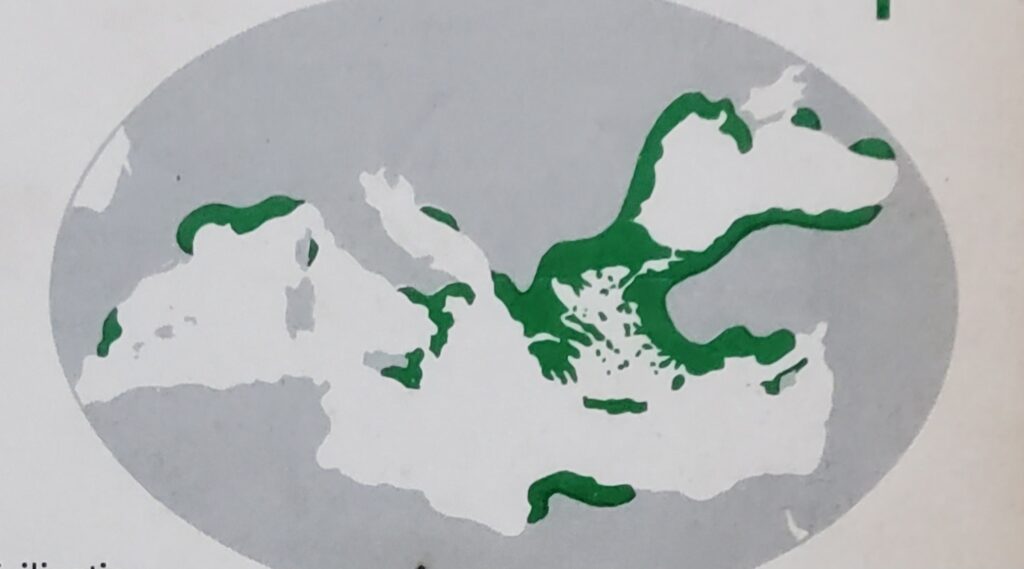
As known, the lack of good farm land, the shortage of food and the abundance of waterways in the Aegean basin conspired to push the ancient Greeks into building ships and making a living through trade. In time, their trading ships sailed beyond the island-studded Aegean basin into the broad waters of the Mediterranean Sea.
Stop for a moment and consider what that step meant. For several thousand years, the people of three continents have used the Mediterranean as a never-frozen water highway. Its importance to ancient peoples is indicated bv its name which means middle of the earth. The peoples you have already studied and others you have yet to meet, learned many of the arts of civilization from each other through their traders and the sailing men who voyaged on the Mediterranean. The Cretans dominated it first, then the Phoenicians. Greek dominance came naturally enough after her large-scale colonization program began to function about B. C. 750.
If we could animate the map as artists do in the movies, you could watch the Greck city-states establish trading posts on the islands of the Aegean and along the shores of the Black Sea. You could see trading posts spring up in eastern Sicily, in southern Italy, France, Spain and across the Mediterranean in northern Africa. In many cases, these trading posts developed into colonies, some of which became famous cities, such as Syracuse in Sicily.
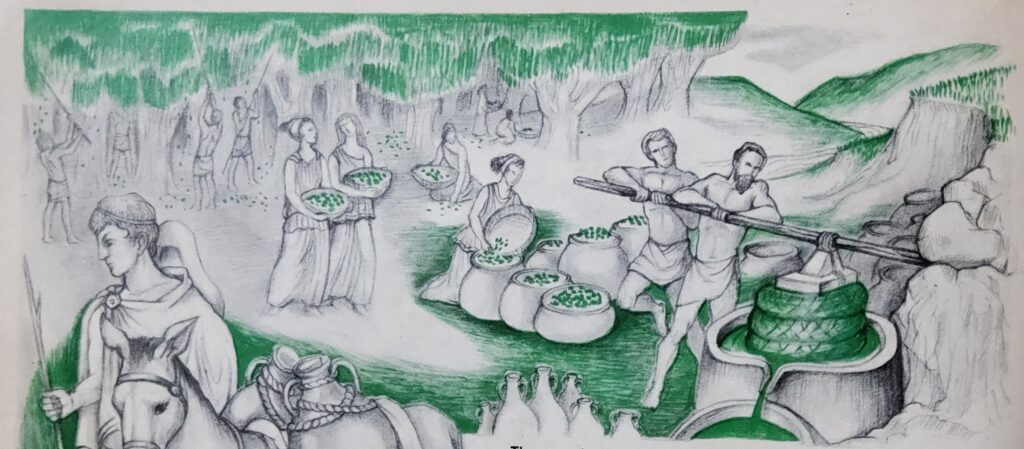
Since trade is an incentive to produce a wider variety of goods, it was natural that some of the Greek states should become workshops for many crafts, particularly the making of pottery and metal wares. Athenian vases were especially beautiful and a demand for them arose in markets throughout the Mediterranean world. Besides being beautiful because of their coloured decorations and shapes, these vases were used to export and to store the olive oil which was one of the chief exports of Athens.
Athens had an ideal location for a commercial city. She lay on a hill about five miles back from the seacoast. This position protected the city from attack by sea. Her port, Piraeus, was on the coast. The statesman Themistocles (c. B. C. 514 – 449), saw the advantages of sea power. He was responsible for building a fine navy and protecting the city and port from land invasion by constructing long walls from Piraeus to Athens.
Themistocles fought the political battle of army versus navy. Athens had placed her chief defense in her army, but Themistocles got the citizens to shift to naval defense by building a strong navy. Such naval power would defend Athens and also her expanding trade routes, he said.
In Themistocles’ time, the Greeks were building sailing ships far larger than those used by Columbus on his famous voyage in 1492. The construction of these ships, called triremes, was very different from that of the Santa Maria. They were propelled by three banks of oars; they were fast-moving and independent of the winds. In our day they have been reconstructed and demonstrated in films such as Ben Hur.
As time passed, Athens depended more and more upon trade for her prosperity. She exported olive oil, wine, figs and manufactured wares. Her merchants imported such necessary raw materials as timber for ships and metals for military equipment. They also imported needed foodstuffs, including dried fish, grains and salt. Slaves were imported to be domestics and to work in shops and mines.
Due to her merchant fleet and her navy, Athens became the most powerful of all the Greek city-states, although her trade and prosperity were based upon slave labour. Ultimately Athens became the richest and most cultured city-state in Greece.
The Greeks triumphed over a mighty Persian emperor.
During the age of Greek colonization, many colonies were set up along the coast of Asia Minor. These colonies were quite independent and traded with Lydia, a rich country which had introduced a system of coinage. The use of standard gold and silver coins greatly stimulated the exchange of goods and made Croesus, the Lydian king, very rich. Cyrus, the Persian ruler, conquered Croesus in B. C. 546, plundered the capital and made Lydia a Persian province. He also gained control of those Greek cities in Asia Minor which had been under Lydian control.
There had been a “cold war” between the Greeks and Persians for years. They differed in ideologies and were rivals in trade. This new association with Persia annoyed some of the citystates, who cherished their freedom. In a few years they revolted against Persia.
Although there had never been political unity among the Greek citystates, the Greek people shared a spiritual and cultural unity. This unity was compounded of such cultural elements as a common origin, a common language, a common religion, Homer’s poems, athletic contests and a similar way of life.
The revolt against Persia was headed by the leader of the colonial citystate Miletus. Athens and a few other Greek cities sent several ships to aid their relatives. The revolutionists burned Sardis, the Persian capital in Asia Minor (now Turkey).
Darius the Great, the Persian emperor at that time, was infuriated by this defiance of his power and the interference of Athens. He put down the revolt and burned Miletus. There is a legend that he ordered a slave to remind him three times a day at dinner time, “Lord, remember the Athenians!”
The Athenians were in turn greatly upset when they learned that Miletus had been burned. To them, the cultural unity previously mentioned had been attacked. Miletus had been a shining example of Greek culture for centuries. If Darius could destroy Miletus, what might he do to other Greek city-states? Was Athens itself safe?
On his part, Darius also felt insecure. Had Athenians not felt free to aid a revolt within his realm? Would they feel free to do it again? He had better punish the Athenians at once and show them he would brook no interference.
The Persians tried thrice, to whip Athens. The first time, a storm destroyed part of the fleet and the invaders returned home. In B. C. 490, Darius sent 600 ships with soldiers, to conquer Athens. The troops were landed on the east coast of Attica, at the Bay of Marathon. The Athenians and their allies controlled the narrow mountain passes and the main road to Athens. The Persian officers sized up the situation, decided they could not use their cavalry and decided to take the city by the back door. Part of their forces, including the cavalry, set sail to attack Athens.
The day of the Battle of Marathon, some 20,000 Persians were drawn up on the plain. A mile distant some 10,000 Athenians and 1,000 Plataeans were spread out to match them. The Greeks, clad in heavy bronze armour, moved down the sloping plain. There, as Herodotus tells it, the Athenians “charged the barbarians at a run… The Persians, therefore, . . . made ready to receive them, although it seemed to them that the Athenians were bereft of their senses, and bent upon their own destruction. . . .”. The Persian bowmen fired a shower of arrows, but the Greeks’ speed and armour helped them to reach the enemy with few losses. Their strength and better weapons enabled the Greeks to win a decisive victory. Then they hurried toward Athens, arriving in time to prevent the Persians’ main army from landing.
The Greek victory at Marathon in B. C. 490, was one of the most decisive outcomes in history. The Persians were stopped in their advance westward and the Greeks could hope to maintain their freedom and independence. The effect on the Athenians was tremendous. Their prestige was markedly increased.
The Persians did not forget their defeat at Marathon. In B. C. 480, Xerxes, the successor to Darius, launched an invasion of all Greece. Herodotus, the historian of the Persian Wars, writing to please his readers, gave us an entertaining account that is not always accurate. He estimated that Xerxes’ forces consisted of about 1,700,000 men, plus the women who followed the army. About 250,000 men is probably nearer the actual number.
At the Hellespont, which we know as the Dardanelles, Xerxes ordered a bridge built, so his army might cross. A bad storm destroyed the bridge. Xerxes had the engineers beheaded and ordered the Hellespont to be struck with lashes three hundred times. The Hellespont was unimpressed by the spanking.
Since the Persians were coming by land and sea, the Athenians faced a big problem. Should they defend the city or desert her and place her defense in their navy? The Athenian officials consulted the oracle at Delphi. The oracle gave them an ambiguous reply in rhyme. The leaders argued over the reply before the assembly. The assembly voted to desert Athens and to rely upon the defense of their navy.
While the Athenian people moved out of Athens, Xerxes’ army moved southward into Greece. The entrance was through the mountain pass of Thermopylae, which was narrow and difficult to penetrate. The Spartans held the pass. They fought bravely and died to a man, their king, Leonidas, dying with them. A Greek traitor had informed the Persians of a route around the pass, opening the way for the Spartans to be hit from the front and from the rear.
After the Persian army passed through narrow Thermopylae, it made an unopposed march to deserted Athens. The soldiers set fire to the city and sacked it. King Xerxes sat on a hill above the island of Salamis near the harbour of Piraeus. His mighty fleet lay below him, ready to destroy the combined Greek navies. There, in B. C. 480, Themistocles was the hero of the hour. In the Battle of Salamis, he forced the Persians to take the offensive, Their ships, jammed together in trying to enter a narrow bay, were picked off one by one by the swifter Greek triremes. Two hundred Persian ships, as well as many soldiers and seamen, were lost.
Xerxes withdrew to Asia, leaving an army in Greece for the winter. In the spring of B. C. 470, this army was defeated by a Greek army and Persia did not again invade Greece. Athens and Piraeus were rebuilt and fortified. Freed from the fear of Persia and exhilarated by her victories, Athens entered upon a golden age of achievement, that was to see the Acropolis crowned with the group of gleaming marble public buildings, whose ruins attract sightseers to Athens today.
Athens became an example of a limited form of democracy.
History shows, as a general movement, government in the Greek citystates passed through five stages, the last of which was democracy.
The word demos in Greek means people; kratein means to rule. The first step towards democracy — rule by the people – taken by Solon (c. B. C. 639 – 559) granted the power to reform the government in Athens when he was elected archon, or magistrate, in B. C. 594. His reforms were so good and strengthened law so much, that the word solon is now used to refer to a member of a lawmaking body, such as Congress.
Solon abolished the system by which a citizen could be put in jail or be made a slave because he could not pay his debts. He restored citizenship rights to many who had been forced to sell themselves as slaves in order to pay their debts. He limited the amount of land which one man could own.
Solon said what he thought should be the powers of the assembly and set up a Council of Four Hundred to help guide the work of the assembly. Property ownership, instead of birth, was made the qualification for office as archon or on the Council. This opened the way for more people to hold office. Finally, a law court was opened in which a judge heard appeals from decisions made by the archons.
Solon did not try to make Athens into a democracy, but he did try to prepare the people for more democratic practices. He had the laws codified, or standardized and had them placed in a public place where every citizen could read them.
Although Athens was larger than most of the other citystates, her total area was somewhat smaller than Rhode Island. It is estimated that at the end of Persian Wars, she had about 40,000 citizens, 150,000 slaves and some 10,000 “foreigners.”
Only men born in Attica of Athenian parentage could be citizens. Slaves and aliens, men from other Greek cities or the Middle East, could not become citizens, nor did women have the privileges of citizenship. The political power was held by the assembly, the popular court and the advisory committee, which had been raised to the Council of Five Hundred. Since the assembly made the laws and had power to elect and dismiss the advisory committee, the actual power lay in the assembly and its decisions. These decisions were those of the 40,000 citizens, so the government of Athens was really governed by a small part of the population. This was quite different from the democracy we know where nearly everyone may be a citizen and decisions are made by the majority of the people.

ATHENS, THE “SCHOOL OF HELLAS”
Under Pericles, Athens became the cultural centre of Greece.
The early Greeks called their country Hellas and themselves Hellenes. To them, anyone who did not speak Greek was a barbarian, or outsider. The civilization that they developed in the period from the eighth to the fourth centuries B.C., is spoken of as the Hellenic phase of Greek civilization.
Before the Persian Wars, the greatest progress in art, literature and industry, had been made in the Greek cities of Asia Minor, but after the wars, Athens became the educational and cultural centre of all Greece. Sculptors, dramatists, architects, orators, historians, philosophers and poets, found Athens the ideal centre in which to improve their talents.
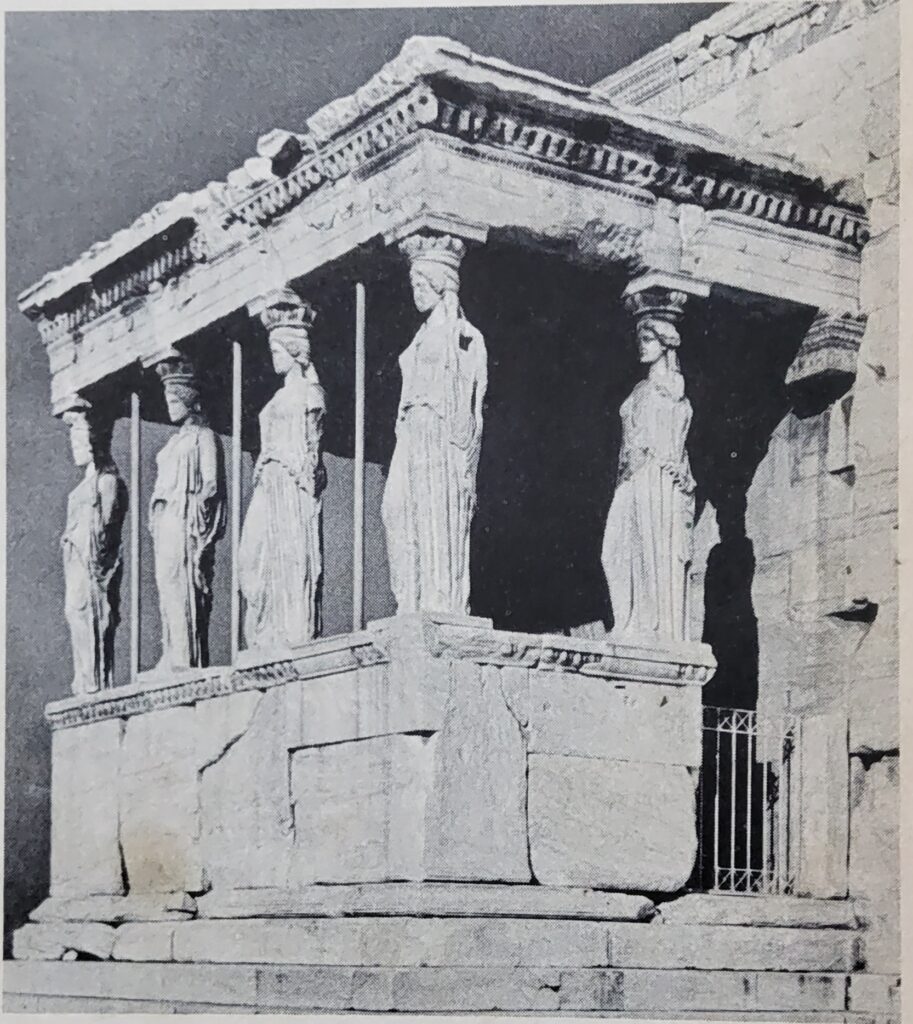
Of the “imperishable monuments” of Athens, Greek architecture is first and foremost. The Persian invasion left Athens in ruins. Under the leadership of Pericles, the Athenians crowned their Acropolis with temples and statues. Three of the temples were dedicated to the goddess Athena. The largest of these, the Parthenon, became celebrated as one of the most beautiful and pleasing buildings in the world. It probably has influenced architects down through the centuries, more than any other building.
Built of white marble, the Parthenon’s gabled roof was supported by forty-six Doric columns. A frieze, or band of carved marble reliefs, extended around the building inside the columns. The frieze pictured the yearly festival in honour of Athena — a stately procession that included maidens carrying garlands, youths on horseback and other worshipers bearing gifts for the goddess.
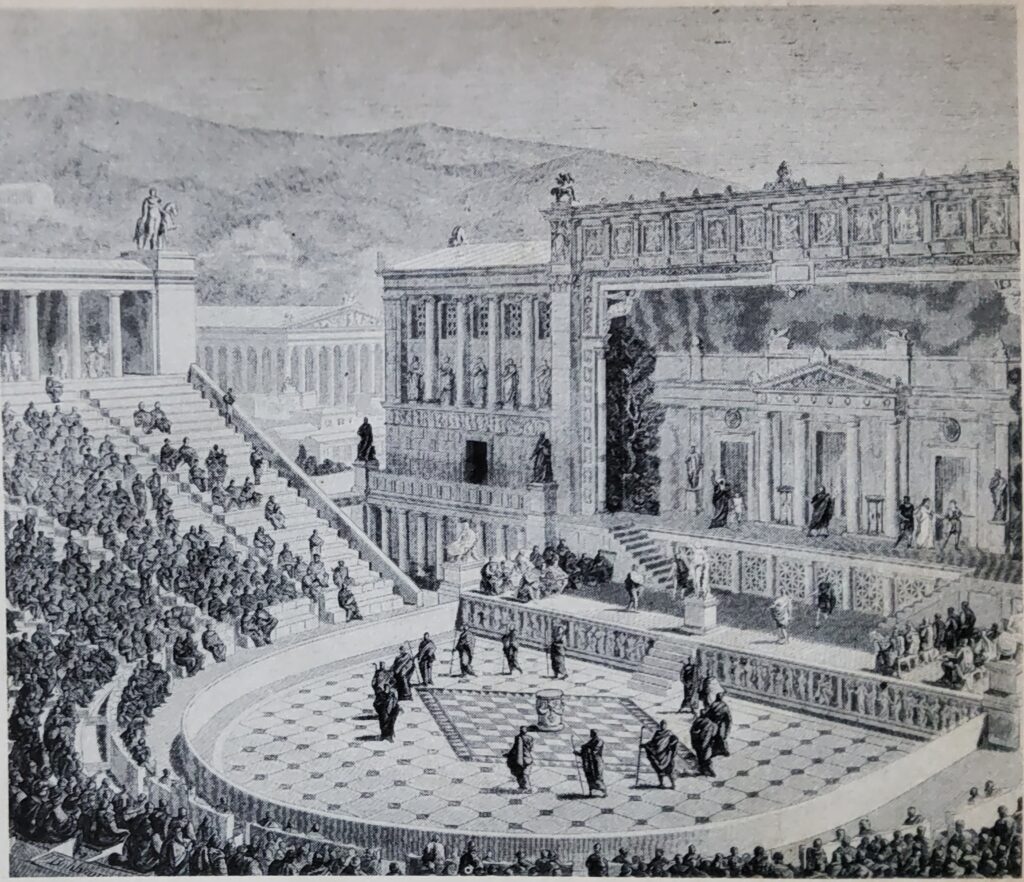
The Greeks carried their ideas of architectural beauty into their theaters, gymnasiums and stadiums too. The orchestra section of a Greek theatre and the circular shape of the spectators’ section, are features still copied today.

Greek architecture has endured and been copied because of its simplicity, balance and form. It offers three orders, or styles, of architecture based on the Doric, Ionic and Corinthian columns and the entablature above them. In the United States, the Lincoln Memorial and the Supreme Court Building in Washington D. C. and many state capitols, court houses, churches and private homes, reflect the lasting influence of Greek architecture.
The early Greeks excelled as sculptors, using mostly the splendid marbles of Greece for their statues. The early sculptors carved in a severe and formal style resembling that of the Egyptians. It was not long before freedom-loving sculptors learned to give movement and reality to the human form in their carving. They freed the arms from the body; learned to turn the head on the neck; gave movement to the shoulders and hips. Somewhat later they learned to give animation to the face.

The works of Myron, Phidias and Praxiteles, have seldom been equalled and never surpassed. Myron, whose masterpiece, the “Discobolos”, or Discus Thrower, caught the motion of athletes in action. Phidias, one of Myron’s contemporaries, was director of art for Pericles. He created the colossal statue of Athena in the Parthenon and designed the frieze of that noble building. One original work by Praxitetes, the graceful “Hermes with the Infant Dionysus,” has survived and is now on view at Olympia, where the Olympic Games originated. This sculptor, the greatest in the fourth century B.C., was a master of anatomy. His statues of gods andù goddesses were “Olympian,” or godlike, despite their human form.
Very few examples of Greek painting have come down to us, but students have learned some things about it from the painting on vases discovered by archaeologists. Early Greek potters were very skillful. Geometric designs and scenes from daily life and mythology were painted on the clay before it was glazed.
The early Greeks excelled in writing poetry, drama, history and geography.
Much of our knowledge of meter and rhyme goes back to the Greek poets, who have strongly influenced poets of the past and present, both in western Europe and in the United States.
Homer and the poets who followed him wrote in Asia Minor. Meanwhile, the neighbouring Aeolians had developed the lyric — short songs that treated their subject in a personal way and were to be sung to the lyre. Among the lyric poets was Sappho, a poetess of love, who even to our day, has inspired romance.
Contemporary with Sappho there arose a new school of poetry in Sparta, called choral lyric. Choral lyric poets did not sing of their own moods and experiences, but those of a group or a whole community. As time went on, this kind of lyric poetry was sung by a chorus or choir. The greatest lyricist was Pindar, who wrote choral songs, odes, hymns and other forms of lyric poetry.
The drama.
Dramatic art began in Greece. It grew out of the many religious festivals which honoured the important gods and goddesses. To celebrate these festivals, the peasants often dressed in goatskins and sang and danced on the grassy hills. A leader might sing, followed by a chorus. Gradually this developed into a dramatic performance. To make their dramatic performances more effective, the Greeks built outdoor theaters. Hundreds of plays were written in verse, of which only forty-one have been preserved.
By the fifth century B.C., the drama had evolved into tragedies and comedies. Audiences liked the tragedies best. Aeschylus, has been called the “Father of Greek Tragedy.” He added a plot, the use of costumes and some scenery. Among his great plays was The Persians, of whom he had first-hand knowledge: he had fought in three battles against them.
Some critics call Sophocles, the greatest of the Greek tragedians. He transformed the drama from a religious festival into pure dramatic art, adding to the suspense and the dialogue. His Oedipus Rex is regarded as the finest Greek tragedy. It is the study of a man overcome by fate.
The third in a trio of great Greek dramatists was Euripides. Electra, one of his great plays, deals with a man, who influenced by his sister Electra, avenges the murder of his father by killing his mother and her lover.
The plays of these three Greek dramatists were concerned with legendary stories, with man’s relations to the gods and with the influence of fate, on the lives of men. The Greeks believed that fate would catch up with any man who broke the rules of the universe. It would punish a man even to afflicting his children and grandchildren. A Greek audience found its chief interest at a play in a man’s response to his fate — in seeing how well he stood up against a chain of tragic events that might follow him even unto death.
Aristophanes, was the great writer of comedies in Athens. He used comedy to ridicule Greek religion and to satirize politicians and “show-offs”.

Historical writing.
What we call history, a written account of events and an explanation of their causes, was given its first development in ancient Greece. Egypt and the Middle East already had simple chronological records (chronicles) but no narrative histories. Herodotus, whose account of the Persian invasion previously was mentioned, is referred to as the “Father of History”. He wrote chiefly to entertain the people, hence he was more interested in a good story than in relating facts. His style was charming. His history of the Persian Wars made a deep impression on the Greeks and stimulated pride in their way of life. Herodotus was rewarded by Athens with a gift of ten talents, or about $12,000.
The greatest of Greek historians and one of the greatest of all times, was Thucydides. He was a little younger than Herodotus and his history, though unfinished when he died, related the story of the Peloponnesian Wars — the wars between the Greek states, after the victory over Persia. To some extent, Thucydides would measure up to our definition of a scientific historian. He aimed to sift the facts, to find the truth and to be impartial.
The third of the trio of Greek historians was Xenophon. His Anabasis was written after the fall of the Athenian Empire and is considered one of the greatest military historic and adventure stories ever written.
The philosophers.
The Greeks were the first peoples of ancient times who dared to think for themselves. The leaders of the “new school of thought” were not satisfied to accept pat ideas without challenging them. These men began using what we call a scientific approach to learning and were called philosophers.
Pericles came under the influence of this new school of thought. His teachers inspired him to think for himself and not to accept the childish beliefs and superstitions of his day. For example, the Greeks believed there were many gods. Pericles’ teacher, Anaxagoras, taught that the universe is the creation of an eternal mind. This same idea has been expressed by scientists in modern times.
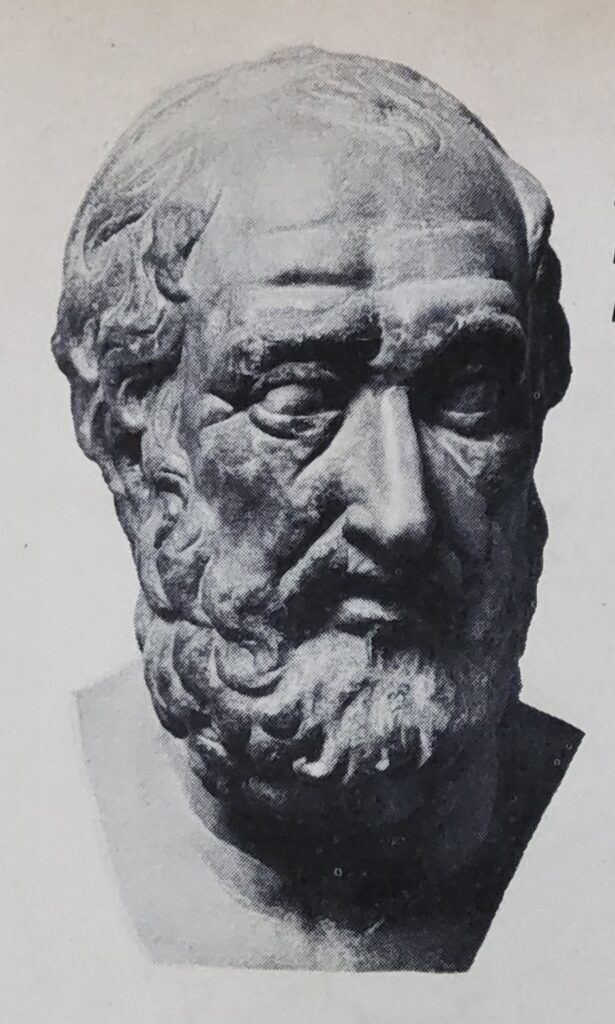
Democritus, one of the early Greek philosophers, believed that the earth and all things in it and on it, were made of very small particles, which he called atoms. While his idea of the atom differed from that of present-day experimenters, it indicates the approach of the early Greek thinkers to the question of matter.
You may have observed that the leading Greek leaders seem to have come in groups of three. For example, you have read about trios of sculptors, dramatists and historians. Now comes a trio of philosophers. Socrates (c. B. C. 470 – 399), Plato (c. B. C. 427 – 347) and Aristotle.
Socrates was a snub-nosed, bearded Athenian with bulging eyes, who spent much of his time talking with other persons. As a young man, he set out to study the knowledge at hand already gained by scientists, mathematicians and philosophers. He soon discovered that these thinkers lacked a critical method of studying the universe and its parts. He decided that instead of studying facts, he would study men’s statements about them.

As a result of this decision, we have what is called the Socratic method of finding the truth — a method now used in court trials and in teaching certain subjects. Socrates asked his fellow Athenians questions about their opinions, then challenged their answers. The people he questioned became confused in their answers in the way all of us do, when pressed in the classroom or elsewhere for an answer to a difficult question. Socrates thus tried to show his fellows that many of their opinions were not valid and they must recognize their ignorance before they could learn.
Socrates took as his motto “Know thyself.” He was quick to confess his own limitations. He compared himself to a gadfly who stung his fellow Athenians until they were willing to seek wisdom and a workable understanding of how to choose the good. You can readily understand that some persons would not appreciate being stung. In the end, his enemies used him as a scapegoat for their mistakes. They accused him of corrupting the young men of Athens and of arousing doubt in their minds concerning the gods.
Socrates, like other educated men of his day, regarded mythology as an invention of poets. He believed that God is the all-wise and all-good ruler of the universe and that one could believe this and still worship Him in the way the city’s customs required. When tried before 501 jurors, he was his own defense counsel, but he justified his beliefs. The jury, by a majority vote, declared him guilty and sentenced him to death. His friends would have helped him to escape from jail, but Socrates argued that the jury’s verdict must be obeyed, even though it ignored the facts in the case. To his judges he made some remarks about death, ending with the statement: “The hour of departure has arrived and we go our ways — I to die and you to live. Which is better, God only knows.”

Socrates was not a writer. We know of his teachings largely through the works of his pupil Plato, whose Dialogues include imaginary conversations between Socrates and those he quizzed in his search for truth. Plato was an aristocrat and a great teacher. In a grove outside the walls of Athens, he established the Academy, a school which lasted for almost nine hundred years and had a lasting influence on Greek and Roman education.
Plato believed that nothing experienced through the five physical senses is permanent, that truth alone is eternal. Truth can only be found in the realm of thought, in the spiritual realm of ideas and forms. In this world of ideas are universal and eternal concepts of Good, Justice, Beauty, et cetera, which man can accept and use.
Plato’s greatest pupil was Aristotle (B. C. 384 – 322). This man was born in Macedonia, but he won his fame as a teacher in Athens, where he lectured to the youth of the city in a park called the Lyceum.
Aristotle was interested in every field of study and with the help of his pupils, he made an attempt to bring all the knowledge of his day together in an encyclopedia. He was tutor to Alexander, young son of Philip of Macedon and taught the boy to love Greek learning. While conquering the Middle East, Alexander had his men collect biological specimens and data in the countries he conquered and send them to Aristotle.
Aristotle did not accept Plato’s teaching that truth is to be found in the world of ideas. Aristotle looked for truth in the concrete object, which he believed to be made up of form and matter. For example, in a bronze statue, the form is the shape put there by the sculptor and the matter is the bronze. Aristotle argued that the form and matter could not be separated; that neither existed apart from the other.
ATHENIAN LIFE AND THE WESTERN HERITAGE
The daily life of an Athenian was quite unlike ours.
Boys attended school from sunrise to sunset. Men left home early to follow business or other interests, to talk in the market place, or to attend a meeting of the assembly which took place about forty times a year. Of course, many men held public office or served on juries. An important trial always brought out a large audience. Unlike today’s 12-man jury, the Athenian jury had 501 men, or for a very unusual trial, a 1001-man jury.
The women and girls seldom left their homes except to buy food or go to a nearby well for water. There was an opportunity for gossip on such trips, but only with other women. Women had no share in public life. Married women could not attend athletic games or the theatre. They were only allowed to attend the religious festivals. When they went to market, women usually were accompanied by slaves. It was not considered proper for a girl or woman to be seen alone on the streets or in public places.
Whenever an Athenian had a male house guest, it was not proper for the women of the family to be seen by the guest. Marriages of boys and girls were always arranged by their parents. A dozen or more slaves did the housework in wealthy homes. Slaves were usually conquered people who might be far better educated than their masters. Usually they were treated well and were paid a small amount for their services. This enabled some slaves to purchase their freedom.
Most of the ships, shops and industries were operated by aliens, called metics. There were about 10,000 metics in Athens. Since Athenian citizens did not engage directly in business, they had much time for public affairs, conversation and recreation. Evenings were spent at different homes in lively discussions called symposiums. They often lasted late and sometimes too much wine was served.

There were annual and four-year religious festivals and athletic contests to attend. The greatest festival for Athenians was held every four years to honour Athena. For Greece as a whole, the greatest event was the festival in honour of Zeus, held at Olympia every four years. The Olympic Games were the feature of the festival. Athletes from all Greece, trained to compete in these games. A four-year period was called an Olympiad. The Greeks dated their calendar from B. C. 776, the first year the winners of the Olympic Games were recorded. The games were suppressed in 394 A. D. by a Roman emperor and revived in 1896 at Athens. In modern times many new events have been added, such as winter sports. Other features have been omitted, such as competition in sculpture and poetry.
The Athenians respected education and the development of a well-rounded man.
One of the most striking features of Greek life, except in Sparta, was high regard for learning. This love of learning was very evident in Athens, where those who were citizens were expected to be well-informed about civic affairs. The success of democratic procedures depends upon the knowledge of those who use them. The fall of Athens indicated how quickly a democracy can fail when its voters cease being well-informed and wise in their judgments.
Education in Athens differed markedly from Sparta where the main purpose was to develop physically-fit soldiers. Athens did not neglect physical training, but education was directed primarily toware the cultivation of the mind. Athens produced some of the greatest soldiers and athletes in Greece, but its fame rests more upon its brilliant cultural achievements.
The typical and formal education of an Athenian boy began at seven years of age. Before this age, he was trained at home. At seven he went off to school on foot, accompanied by a trusted slave, known as a pedagogue. The pedagogue was much more than an escort: he was picked by the family because of his education and cultural background. He taught the boy good manners and how to get on with other boys; he punished the boy when necessary.
Since schools were private, the Athenian boy might go to several schools each day. At one school he learned the fundamentals of reading and writing, at another he was instructed in music and at a third school, he took athletic training.
For writing materials, a boy used a wooden tablet covered with wax. With a stylus he scratched the words into the wax, which could be smoothed out and used repeatedly. When a boy learned to write well, he was permitted to write on papyrus, using a reed for a pen.
So much emphasis was placed upon singing and upon playing a musical instrument, that it became the mark of an Athenian gentleman to be able to sing and play. There were only a few musical instruments, among them the lyre, pipes, and flute.
Athenian school boys spent their afternoons at the palaestra, or wrestling school. The Greeks made wrestling one of their major sports, for it helped to develop strength and agility, two abilities which were the pride of all Greeks. Other favourite sports were running, jumping and discus throwing — now included among what we call track and field events. The Greeks admired grace of movement, or style, as much as brawn; they believed that education should develop “a sound mind in a sound body.”
When school days were over at eighteen of years of age, the Athenian youth entered military service. Before he left for the barracks, he took an oath and was given a shield and spear. In this oath before Athenian magistrates he pledged:
Never to disgrace his holy arms, never to forsake his comrade in the ranks, but to fight for the holy temples, alone or with others; to leave his country, not in a worse, but in a better state than he found it; to obey the magistrates and the laws, and defend them against attack; finally, to hold in honour the religion of his country.
After his term of military service, an Athenian citizen took an active part in the affairs of government. It was a disgrace not to be active in public affairs.
In B. C. 431, Pericles delivered an oration at a public funeral for soldiers killed in a war with Sparta. The following lines expressed the pride of Athenians in their city and in their way of life.
The individual Athenian in his own person, seems to have the power of adapting himself to the most varied forms of action with the utmost versatility and grace… There are mighty monuments of our power which will make us the wonder of this and of succeeding ages…. Such is the city for whose sake these men nobly fought and died; and every one of us who survive should gladly toil on her behalf. I would have you day by day fix your eyes on the greatness of Athens, until you become filled with the love of her; and when you are impressed by the spectacle of her glory, reflect that this empire has been acquired by men who knew their duty and had the courage to do it….

LINKING THE PAST AND THE PRESENT
We see that the Athenians developed democratic practices and processes while the Spartans clung to the concept that the individual must be subservient to the state. In modern day, during the ‘cold war’, one witnesses the same opposed ideologies and two teachers who aim to control the future of mankind.
One teacher is the free world, led by the United States. She teaches that individual man and the rising new nations can progress best and most safely by using democratic procedures and free enterprise. She recognizes the dignity and worth of individual man and uses government to protect individual rights and development.
The other teacher, the Communist world, teaches that state socialism offers the most benefits to the people. She repudiates democratic procedures and squelches free speech and a free press. She uses a secret police force and intimidation to maintain a state-controlled economic and political system.
To which of these teachers, the United States or the Communist countries, will the leaders of the rising new nations go to learn how to develop satisfying economic and political systems? The success of these training schools, demoracy or communism, will determine the kind of world in which we live.
The Western world’s heritage from Greece was a rich one.
A glance into your dictionary would give you this concept of heritage: anything passed on to succeeding generations, such as a tradition, an idea, a right, or possessions. For example, your American heritage includes freedom of speech, press and religion. With that definition in mind, one can readily see that our inheritance from the early Greeks and especially from the Athenians, is a rich and continuing one. The Greeks developed for us an appreciation of the value and dignity of the individual. All of the pre-Greek civilizations put the absolute power of the monarch above the rights of the individual, much as the Communists put the state and its demands above the individual and his rights and responsibilities today. During the centuries when Athenians were seeking the good life, they discovered man himself in the sense that they probed deeply, recorded exactly and explored freely man’s thoughts, his ideas, his ideals and his aspirations.
In discovering man, the Greeks discovered the worth and importance of individual contributions to the advancement of civilization. Out of these discoveries came some of the political ideas and institutions which have protected man’s need for individual freedom of thought, creativeness and accomplishment. Some of these ideas were incorporated in our Constitution by men who appreciated the heritage of democratic ideals, practices and procedures that had come down to them from ancient Greece.
Like heritage from the Hebrews, heritage from the ancient Greeks is intellectual and not material. They gave us ideas instead of things. This was particularly true of the philosophers, whose ideal man escaped excesses and did everything in moderation; who developed and cherished “a sound mind in a sound body.”
Many of our artists, poets, architects, dramatists and other writers, still feel the influence of Greek thought. If you are something of a detective, you may find the “fingerprints” of the Greeks on our architecture, literature and even in some television shows. Greek books are still read and Greek plays are still produced.
Certainly you will recognize the English language heritage. The alphabet was perfected by the Greeks from the Phoenicians and modified by the Romans. With the possible exception of one book, the New Testament was written in Greek. Whenever you speak or read or listen, you run into Greek terms such as democracy, atmosphere, aeronautics, comedy, arithmetic, physics, history and aristocracy.
The Hellenistic civilization, greatly adds to the list of ideas and achievements that have come down to us from the ancient Greeks.