Roman republic, for “westward the course of empire makes its way,” first to Rome and ultimately, by way of northern Europe, to the Americas. Civilization moved eastward and northward from Egypt, whose culture first met the requirements of a civilization. Rome – a bridge over which the contributions of Egypt, of the Fertile Crescent and of Greece, passed to form a base for Western civilization.
Rome is called the Eternal City, because it has existed as an important world city for more than 2,000 years, linking ancient times with modern. We usually divide Roman history into two fairly equal parts: the Republic from B. C. 509 to B. C. 30 and the Empire from B. C. 30 to 476 A.D. Recounting the history of a people and their rise from a simple farming community, to the mighty Roman Republic that dominated the Mediterranean worlld. We try to discover in what ways Rome was an intermediary for earlier cultures. Observing carefully the legal codes and the elements of government, which Romans developed and passed on to us, as their unique contribution to our culture and to our civilization.
ETERNAL ROME
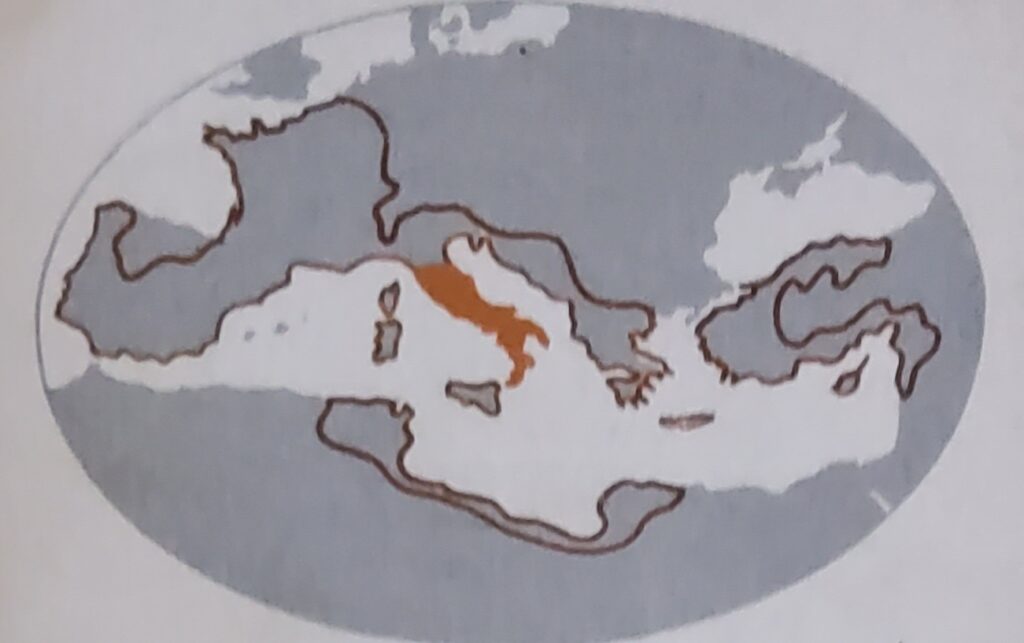
Unlike Athens and the Greeks, Rome and the Romans faced westward.
Nature was responsible for that — at least after the first settlements were made on the Tiber River, some twenty miles inland from the sea. The toe of the Italian Peninsula and the island of Sicily, divided the Mediterranean Sea into two basins. The Tiber poured its waters into the western basin. Since Rome faced westward, its early contacts were in the western basin and it was not caught up in the current of Greek and Middle Eastern history, for several centuries.
In the north, the Alp Mountains protected Italy from the cold winds of northern Europe and aided in giving the peninsula a Mediterranean climate. The Apennines, lower than the Alps, extended like a backbone down the peninsula. Steeper along the Adriatic Sea, the Apennines sloped Italy westward. The rivers south of the Po Valley, flowed westward generally and the best farm land, was west of the Apennines and in the Po Valley. This fertile soil and a shortage of good harbours, tended to make the early Romans into farmers, rather than seamen and traders.

The first Romans had been nomads farther north in Europe.
The Romans and the ancient Greeks, came from the same Indo-European stock. Both groups moved southward between B. C. 2000 and 1000. The eastern wing of this migration spread over part of the Balkan Peninsula. The western wing founded tiny colonies, on the Italian Peninsula, whose Italic inhabitants at that time, were still in the Neolithic stage of development.
One of these nomadic tribes, the Latins, finally settled south of the Tiber River in an area which came to be called the plain of Latium. Modern scholars believe that some of the tiny Latin settlements united, chose a common market or meeting place, the Forum and so laid the foundation, of the city of Rome. About B. C., 800 the Etruscans, a people who probably came from Asia Minor, appeared in Italy. They settled north of Latium, whereas the Greeks had established their colonies in southern Italy.
The Etruscans, dominated Roman life for about two hundred years after the founding of the city. Under Etruscan rule, temples were built, streets were paved and a sewer system was constructed. As the city grew, craftsmen worked in pottery, leather, metal, furniture and weapons. Even in Etruscan Rome, there were two distinct classes of citizens. Members of the upper class, or nobles, were called patricians. Members of the lower class were called plebeians.

ROMAN INSTITUTIONS
The Romans respected their families and their gods.
As it was in ancient China, the family was important in early Roman life. The Roman family included the head of the house (the paterfamilias), his wife, his sons with their wives and children and his unmarried daughters. If he had slaves, these were included in his family too. According to ancient Roman custom, the father had the power of life and death over his family.
The early Roman home usually had only one room. This room had only one door, with the hearth opposite it. As people grew wealthier, other rooms were added and sometimes a courtyard. After the Roman conquests, marble and brick were often used in construction.
The Roman religion and home life were closely connected, hence the Roman home took on some of the aspects of a temple. The Romans believed, that their household gods were spirits with divine powers, who could protect a household from harm. Every day in a Roman home, began with a sacrifice to the gods.
The Romans had developed certain prayers and offerings for use in family worship. They believed that unless the household ceremonies were carried out correctly and the prayers were said correctly, a god’s favour might not be given them. They also believed in auguries and omens as signs of the gods’ will, much as the Greeks did.
At a later time, the Romans became acquainted with the religion of the Greeks. After that, they tended to identify their gods and goddesses with the Greek deities.

The Greeks greatly influenced later Roman education.
Since the home was the basic unit of early Roman society, the father was responsible for the education of his children. In early times this training was rugged and discipline was strict. The father taught his children reading, writing, numbers and moral standards. The mother taught her daughters how to supervise a household. Both parents placed much emphasis on instilling in each child the virtues which Romans considered important — obedience, honour, loyalty, courage, self-control and reverence for law and Roman customs.
After the Romans had conquered Greece, the Greeks exerted a strong influence on Roman education. By that time, the Romans recognized the Greeks’ superior learning and Greek literature, was being translated into Latin. Roman parents who could afford a slave, often bought a Greek teacher for their children.
After grammar schools were established: mythology, geography, history and language, were taught in addition to the three R’s. Since the teachers in grammar schools were usually slaves or freemen from Greece, many Roman children learned to speak Greek.
After he completed grammar school, a Roman boy was sent to a school of rhetoric where literature, composition and oratory were stressed. Emphasis was placed on voice training, because Roman citizens of good breeding were trained for the Roman Senate.
Roman girls did not receive much formal education, but it was a common practice for mothers to teach their daughters to read, to weave and to spin. The more fortunate were taught some literature and philosophy and how to play musical instruments.
Rome developed a free government and protected human rights.
Under the Etruscans, Rome was ruled by a king, elected by a tribal assembly. The king had the power of life and death over the people, but was advised by a council called the Senate.
In B. C. 509, the nobles led a revolt against their king and set up a republic. The king’s power was given to two new officials called consuls. The consuls were patricians and held office for one year. Each could veto an act of the other. In times of danger the consuls, with the advice of the Senate, could appoint a dictator to rule for six months.
When the offices were first established, the consuls had much authority. They commanded the army, had charge of public funds, tried important cases and acted as priests.
The priesthood was an important part of the Roman government and religion, became an affair of the state. The chief duty of the priests, who were patricians and who often held other offices, was to perform temple ceremonies and divine the future.
The Senate and the Assembly.
The Senate of the early Republic was one of the most distinguished governing bodies the world has known. Its three hundred members held office for life. New senators were nominated by the consuls and until after B. C. 400, the members were always from the patrician class. Often those selected were former magistrates and other men who had held public office.
The Assembly was made up of all the citizens. It was largely under the control of the patricians during the early part of the Republic. It could not nominate consuls or propose laws, but it had the power to approve or prevent the selection of a consul and the passage of laws.
The plebeians were not satisfied with this form of government. They were drafted for military service and they paid taxes. “We should have a greater voice in government,” they said.

Gains of the plebeians.
Not long after the establishment of the Republic, the plebians secured the right to be protected by new officials, called tribunes. Approved by the Assembly, the tribunes were expected to protect the rights of the plebeians. They had power to stop the enforcement of a law, to veto the acts or orders of other officials, or to take any other action necessary to protect a plebeian’s rights. Later, the plebeians gained the power to veto the acts of the Senate. Thus, any plebeian who was being oppressed or mistreated, could get relief through a tribune.
About the middle of the fifth century B. C., the plebeians demanded that the Roman laws be written down and published so that all might read them. This would put an end to the interpreting of unwritten laws in favour of the patricians, they said. A committee was appointed. The laws were codified, inscribed on tablets of wood or brass and set up in the Forum, in B. C. 450. These became known as the Laws of the Twelve Tables.
In B. C. 445, the law against marriage between plebeians and patricians was replaced by a law that permitted intermarriage. In B. C. 366, a plebeian consul was elected. By B. C. 300, the priesthood was opened to plebeians. By B. C. 287, a separate assembly at plebeians was recognized.
The concepts of government and the laws of Rome, were among her greatest contributions to mankind. Roman law provided the background for the legal codes developed by most of the modern nations of western Europe and much of the Western Hemisphere. Roman government was by no means consistently good. There were periods when it was corrupt and harsh, but the Roman plan of electing the head of the state, of making laws, of giving governmental duties to paid civil servants, of recording the laws of the land, of free speech — all of these were important steps in the development of free government and the advancement of human liberty.
THE FALL OF THE REPUBLIC
Rome fought and won three wars with ancient Carthage.
One after another, the Romans conquered neighbouring city-states until, by B. C. 265, they ruled all of Italy. Wealth at home increased and the navy was expanded. Trade with other peoples led the Romans to absorb many new ideas. With the extension of her power, Rome became involved with other peoples, particularly the Carthaginians, whose ships controlled the western Mediterranean Sea.
The Romans were masters at defending themselves. Their camps were well-protected, clean and prepared to withstand siege. The soldiers used movable towers, when attacking walled cities and with their catapults, flung stones and burning objects at or over, the walls of enemy towns.
Of the Roman wars during this period, the three Punic Wars against Carthage are the most important. Punic, from the Latin word for Phoenician. Carthage, once a Phoenician colony, had become the strongest power in the western Mediterranean world. The Carthaginians ruled western Sicily. When they began to take over the Greek cities in eastern Sicily, the latter asked Rome to protect them. Rome used this as an excuse to attack her rival in B. C. 264. The First Punic War made Sicily the first Roman province.
The Second Punic War began in B. C. 218. It was in this war that Hannibal, leader of the Carthaginians, decided to attack Rome from the north. He led an army across Spain, southern France and over the Alps into the Po Valley. Advancing toward Rome, Hannibal won a number of victories over the Romans, but he was never able to deliver a knockout blow. Years later, in B. C. 202, he was completely defeated on Carthaginian soil, at Zama. Carthage was forced to give up Spain to the Romans and disarm her forces.
Fearful that Carthage might rise again, the Romans provoked a Third Punic War. They took Carthage, sold her defenders into slavery and burned the city, in B. C. 146. This ended the rivalry of the two peoples.
Between the fall of Carthage in B. C. 146 and the death of Julius Caesar in B. C. 44, the entire Mediterranean world came under Roman rule. In B. C. 133, the heirless king of Pergamum, in Asia Minor, willed his kingdom to Rome. Using this land as a start, Rome gradually took over Asia Minor and the Middle East and organized these lands as provinces of the Roman Republic. In addition, most of Gaul and much of the upper Rhine Valley, were conquered. Wherever the Roman armies went – Roman law, Roman customs and the Latin language followed, although Rome permitted considerable self-rule among conquered peoples.

Imperialism caused serious problems at home and in the provinces.
Rome had become the greatest power in the known world, but through her expansion she had taken on serious responsibilities, as nations in today’s world do, upon expansion.
During the Punic Wars, Rome decided not to make allies or Roman citizens of conquered Sicily or Carthage, but to handle them as provinces. Later, the lands taken from Macedonia were made provinces too. Each province was ruled by the Roman Senate, which made its laws. Part of a province’s income must be paid to Rome as taxes, to cover governmental expenses to provide roads and other services and to support Roman legions, stationed there for protection.
A governor was sent out from the Senate for one year to rule a province and to see that the taxes were collected. Away from the Senate’s appraising eyes, some governors ruled harshly and selfishly. They did all they could to make fortunes and return to Rome at the end of their terms, as rich men.
Roman businessmen also went to the provinces to make money. Like the one-year governors and the generals conquering new lands, these too returned to Rome with their riches. These rich men then became part of the wealthy class in Rome, which included the old patrician families. Another group of rich men would today be called war profiteers. They made excessive profits on war contracts for supplying the Roman legions with such items as meat, wheat, weapons and clothing.
While assuming more responsibilities, Rome faced changing conditions at home. At a time when the common people were starving, the rich often entertained at dinner parties which lasted all day long. While the poor were living in tenements, the rich were building elaborate villas and maintaining country estates, worked by hundreds of slaves. The rigour of the old Roman society gave way to a search for diversion. While the Romans spent vast sums of money on public holidays, temples, roads and aqueducts, they could not restore to themselves the things they needed most: a spirit of inquiry, an interest in life and a love of man.
In rural areas, always the strength of the Roman state, the new wealth also made itself felt, but in a different way. The most respectable form of wealth was land and it was therefore, that much of the new wealth was invested. The great estates were worked by slaves, purchased by the landowners from the government, which held them as captives of war.
Men who had served in the wars often came home to find their farms run down and neglected. Some of the land was worn out. Some farmers borrowed from the patricians, but too often they did not produce enough to pay their debts, so the patricians took the land, in lieu of the debts. Some found that large plantation owners, with many slaves, could sell grain cheaper than them. By B. C. 200, large slave plantations were common and many small farmers, had drifted to the city, to live as best they could.
By B. C. 150, the government was in the hands of a wealthy Senate which was not up to governing a world state. Many of the people were landless and poor. Rome was crowded with slaves, jobless war veterans, fortune hunters and unemployed, who argued that the city-state owed them a living.
To quiet the growing discontent of the poor, the government began to feed them. This was not enough. Entertainment was provided. Candidates for office, wealthy rulers and returning generals with political ambitions, filled the circuses and the arenas with crowds of people, eager to see the races and the wild beasts. Gladiators fought to the death to amuse the onlookers. Greek dramas, athletic contests and chariot races were regular events. None of these entertainments were planned to uplift and improve; they were planned to keep the masses quiet and to secure votes.

The Roman Republic was finally faced with civil war.
In the year B. C. 133, Tiberius Gracchus became tribune. He was a man of wealth and came of a distinguished family, yet he championed the cause of the poor. He proposed a law which provided for a redistribution of the public lands. The measure was passed by the Assembly in a way that was unconstitutional. When Gracchus sought re-election, with the idea of seeing that the law was carried out, he and three hundred followers were killed by a mob.
In B. C. 123. Gaius Gracchus, the younger brother of Tiberius, was elected tribune. He attempted not only to carry out a program of land reform, but also to weaken the powers of the Senate, which he considered to be the chief defender of the old order. These efforts of Gaius Gracchus were deeply resented by many Romans, especially the senatorial group. Gaius shared the fate of his brother Tiberius and died during a riot, brought on in B. C. 121, by the Senate’s hired assassins.
The Gracchi were well-meaning reformers, whose ideas won the approval of the masses, but it is doubtful if their remedies would have cured Rome’s condition. Redistribution of public lands to small farmers would not have gone to the roots of unemployment nor social unrest, for the basic cause of unemployment was the use of slave labour, on farms and in the shops.
After the death of the Gracchi, leadership of the people passed to military men. Among the first of these was Gaius Marius (B. C. 155 – 86). He had been elected consul and had been appointed by the Assembly, to take command of the army, which was fighting a stubborn war in Africa. Such appointments had been made previously by the Senate. Marius won popularity with the masses by permitting the unemployed to enlist in the army and to be paid for their services. Previously, the army had been open only to landowners, who served without pay. Lacking land, the new “professional” soldiers swore allegiance to their general, rather than to Rome. The ultimate outcome of this change, was that Marius held the consulship for several years, while he fought wars in several places and his veterans seized the government and murdered many senators.
The Senate’s champion was the Roman general Cornelius Sulla (B. C. 138 – 73). When he came home from a campaign in Asia Minor, he was appointed dictator by the Senate. Instead of serving the usual six months, he continued as dictator for three years. Putting down the opposition of Marius’ supporters, with great slaughter he forced through a series of laws, which took away the power of the popular Assembly and the tribunes and gave supreme authority to the Senate. Having thus tried to destroy popular rule, he retired.

Caesar crossed the Rubicon and ruled Rome as a dictator.
The next military leaders to achieve prominence were Pompey and Caesar. Pompey (B. C. 106 – 48) had gained fame by conquering the old kingdom of Syria and defeating the pirates who were a constant threat to shipping in the Mediterranean. On his return from the East, Pompey sought a reward for his soldiers in the form of public lands. His request was denied. At this point Julius Caesar, a rising leader of the people and a nephew of Marius, came to his aid. The two gained the alliance of a wealthy Roman named, Crassus. These three, each of whom had a purpose of his own, are known as the First Triumvirate.
It was Caesar rather than Pompey, for whom the association was to result in the greatest benefits. In the year B. C. 59, he was elected consul. Then he obtained an appointment as governor of Gaul for five years and turned his attention to that province.
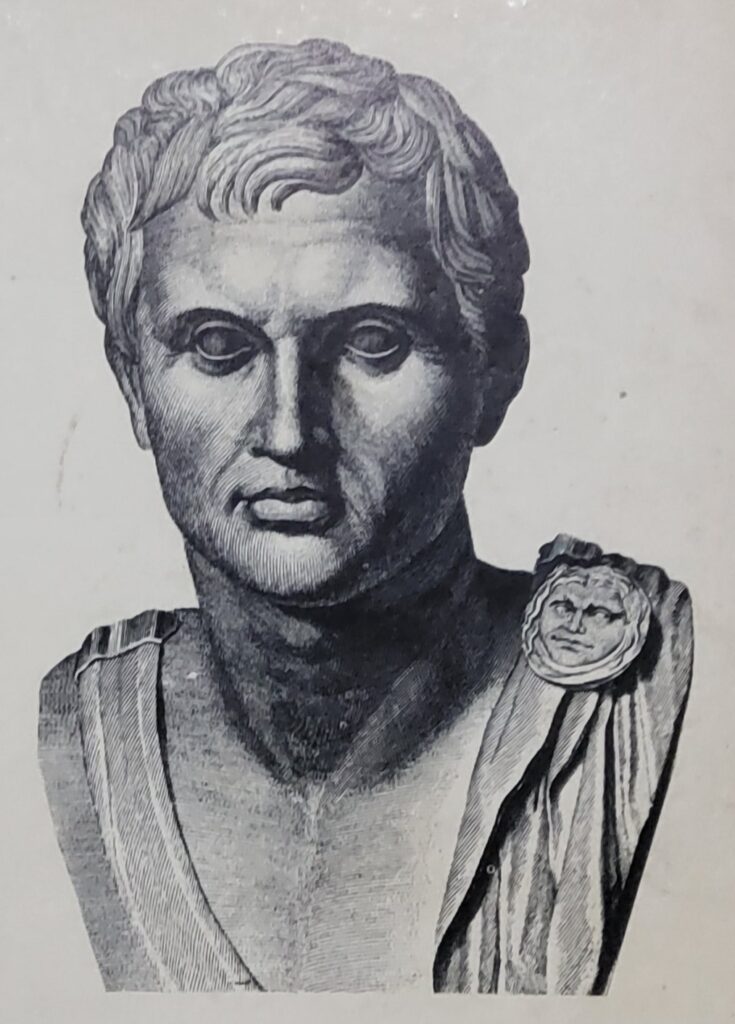
Caesar was a great soldier. He subdued the Gauls and extended the area controlled by Rome from the Atlantic Ocean and the English Channel, to the Rhine River in the east. He even crossed the Channel and invaded southern Britain. Caesar described these extraordinary achievements in a book called Commentaries on the Gallic War.
In Rome, the members of the Senate were fearful of the growing popularity of this soldier. They sought a military leader of their own and found him in Pompey, in spite of his former alliance with Caesar. The Senate ordered Caesar to give up his command and to return to Rome as a private citizen. Caesar did not want to give up his army; yet he knew that if he entered Italy with the army, it would mean civil war. After considering the consequences, he led his men across the Rubicon, the river which formed the boundary between his province and Italy. To this day, when one commits himself to some principle or takes some decisive step, it is said that he has “crossed the Rubicon”
When it became evident that Caesar was determined to win the upper hand, the senatorial leaders withdrew from Rome and took refuge in Greece. Having gained possession of Rome, Caesar was elected consul (B. C. 49) after a brief period of dictatorship. As consul, he was able to appear as defender of the state against the Senate, which had abandoned it.
In the struggle between Pompey and the Senate on one hand and Caesar and the peopie on the other, the advantage seemed to be with the former. Pompey not only commanded an army, he still had under his control large areas in the East, from which to draw men and supplies. Spain was in the hands of some of Pompey’s officers, so that Caesar had enemies in both the East and the West.
Caesar’s handling of the situation was characteristic of his strategy. He made rapid marches and fought his enemies one at a time. He struck first in Spain, where cutting off the enemy from his supplies, he won a victory without a battle. Turning eastward, he kept out of the way of Pompey’s ships and landed his troops on the coast of Epirus. He met Pompey’s army in Thessaly (B. C. 48) and defeated it.
During the following years, Caesar carried on a series of campaigns in Egypt, Syria, Asia Minor and again in Spain. The effectiveness with which these areas were reconquered and placed under Roman rule, is one of the most striking proofs of Caesar’s ability.
Early in B. C. 44, Caesar was made dictator for life. During his brief rule, he showed himself to be a wise and moderate ruler, as he had previously proved himself to be one of the world’s greatest generals. He retained the Senate, though it was largely under his control. He began important and much needed reforms in the government of the provinces and of the cities. He made plans for the rebuilding of Rome, for the construction of roads and for improving living conditions of the poor. He replaced the awkward Roman calendar with what was called the Julian calendar. Corrected in the sixteenth century by Pope Gregory XIII, this calendar is still in use.
On the Ides of March (March 15), B. C. 44, “great Caesar fell,” stabbed by senatorial conspirators who, because of envy and malice or —as some thought—high principle, would not put up with one-man rule. Italy was again, plunged into civil war and republican liberties, sincerely loved by many Romans, were finally lost.

GAIUS JULIUS CAESAR — (c. B. C. 102 – 44)
Up to the age of thirty-eight, Caesar was little more than political boss of the idle Roman mob, amusing its members with public games and spectacles. Seeing his opportunity to gain more respectable leadership, he allied himself with Rome’s top leaders: Pompey, the foremost military leader and Crassus, a man of enormous wealth.
Caesar realized that if he was to be topmost of the three leaders, he must have military fame and a loyal army to support him. He won both by conquering Gaul and all the while keeping his name before the public, by sending home written reports of his campaigns. When Pompey turned against him, Caesar conquered Italy, returned to Rome as a famous general and was made dictator, consul and tribune. He initiated many reforms for the Empire, but some of those who feared he might make himself king, stabbed Caesar to death on the Ides of March, in B. C. 44.

Linking the past and the present
S. P. Q. R., initials which a visitor to Rome sees on monuments, ruins and stone pavements, stand for Senatus Populusque Romanus (the Senate and the Roman People). These initials remind us that the Senate was for centuries, the chief governing body of Rome. Its members debated the issues which came before the Republic and made the necessary decisions. The senators were greatly respected by the people, because of their judgment and their good example.
The distinguished men who framed the Constitution of the United States were aware of the services of the Roman Senate and they delegated special powers, to the Senate. For example, the President may make treaties, choose foreign representatives, appoint Supreme Court justices and fill many federal posts, but the Senate must approve each act.
The honour of being a United States senator ranks next to being the President, VicePresident, or a justice of the Supreme Court. Like the senators of ancient Rome, senators are guardians of our freedoms, restraining excesses and unwise trends, which may tend to destroy our freedoms.

Though Greek temples were large and imposing, they were not colossal structures like Egyptian buildings. Nor were they built through fear of a god as many Egyptian temples had been. The Greek temple was the dwelling place of a god and as such, was thought of as an enlarged and idealized house. The Parthenon was such a temple, built fo honour Athena, patron goddess of Athens and constructed entirely without the use of mortar. The Parthenon is shown here as it may have looked to Pericles, about B. C. 400. This reproduction of the famous Greek temple is found in Nashville, Tennessee.

The Greek god, as portrayed by artists of the day, took the form of an ordinary man and was worshiped in a large house-like structure. A contrast to the simplicity of the Greek temple & the ornateness of the Shwe Dagon Pagoda area — the centre of Buddhist religious life in Rangoon, Burma. That the Buddhists did not think of Buddha as being in their own likeness is shown in the work of their artists. The elaborate gold-covered temples also reflect this difference. Buddhist worshipers believe that pagodas bring spiritual rewards to their builders.

Prehistoric man painted pictures of the game he hunted on the walls and ceilings of caves. While the purpose of these paintings is still relatively uncertain, it is thought unlikely that they were made for decorative purposes. Rather, it is believed that these primitive hunters drew pictures of their prey and threw their spears or stone axes at them, thinking that the real animals would also succumb to their power. The cave paintings below are from the Lascaux Cave, France.

The Egyptians believed that the body must be preserved if the soul were to live on in the hereafter. In order to make this possible, certain conditions were necessary: preservation of the mummy and the presence in the tomb of statues and paintings representing the departed. It was the artists’ task to preserve everything as clearly and permanently as possible. The painting from the tomb of Tutankhamen, shows the mummy of the Pharaoh in white, being subjected to the “Opening of the Mouth” ceremony. In it, the senses of a mummy were supposedly “restored” by means of magical instruments and mystical chants.

In Babylon, where wood and stone were scarce, glazed tile was used for building and art purposes. The tile above depicts the Dragon of Marduk, the spirit which plotted the downfall of evil Babylonians.

The Egyptian glass head of a royal personage indicates that the Egyptians already had a well-organized, skillful glass industry by B. C. 1375. (The headdress once carried the royal serpent.)

A Roman mosaic hunt scene (c. 450 A.D.) shows a rider dressed in a tunic and long stockings, anticipating the dress of the Middle Ages.

Scenes from mythology were often painted on Greek pottery. Here, Hercules is shown in Hades trying to capture Cerberus, the 50-headed monster.

The decorative value of Egyptian jewellery was usually overshadowed by its religious value. The medallion above was worn around the neck of Ramses Il, about B. C. 1275. The king’s name in hieroglyphics enclosed by hawk and falcon wings signified power and eternal life. The cobra was a symbol of royalty. Medallions, made of fused gold strips with inlaid glass, were of a size which could be easily seen by the king’s subjects at a respectful distance.

The way in which a culture’s gods are portrayed by its artists generally reveals much about a religion. The Phoenicians believed in a cruel, morbid religion — typified by a god called “Baal,” who supposedly delighted in human sacrifice. Notice the stern, almost smug, facial expression and commanding pose of the bronze Baal.

The Etruscan after-world was peopled by powerful, grotesque divinities like Turan. Etruscan priests told their people how to live after analyzing signs and omens which they believed their divinities sent to them. The bronze divinity’s clothing and small stature indicate that the Etruscans were probably related to an oriental culture.