Foundations of the Russian Empire involved: the Early Russians, Romanovs and the New Russia, Alexander and the Holy Alliance, Russian Culture and Western Influence. In 1500 A. D., the land known as Muscovy (Russia) was far removed from the affairs of western Europe. The few Englishmen or Frenchmen who had visited, reported that its customs were more Oriental than European; that most of the people were without schooling or culture. Between 1500 and 1825 A. D., Russia’s rulers pursued a policy of conquest and made it theirs; the world’s largest country and an active partner in the political affairs of Europe.
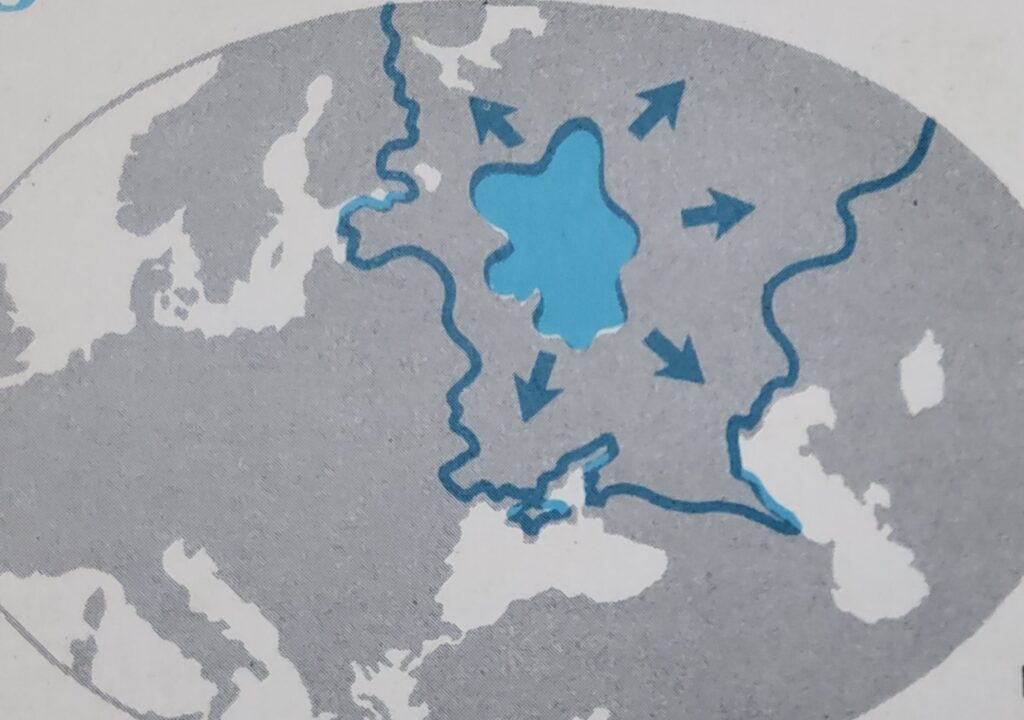
This physical expansion chronicles and relates to how one man, the amazing and barbaric Peter the Great, opened his country to the influences of Western Civilization and greeted the “know-how” of the West, as a welcome transformation in his far-flung empire. In turn, his country became “a member of the club” of strong European monarchies and participated actively, in international politics — too actively to suit those European rulers, who feared this growing power.
To understand present-day Russians, note carefully what was changed in the old system, what was left unchanged and how the changes were made, as Russia opened her “windows on the West” and consolidated an absolute monarchy with military power. Her most important cultural contribution to civilization before 1825, was the development of that lovely dance form called the ballet.
THE EARLY RUSSIANS
Russia was a land apart from events in western Europe and eastern Asia.
Russians are a Slavic people who have lived in eastern Europe since the early centuries of the Christian Era. They are related in language to the Poles, the Czechs and the Serbs.
As the Germanic tribes moved southwestward into the Roman Empire, the Slavs took their place in southeastern Europe. Since the lands of the Slavs were for the most part, outside the boundaries of the Roman Empire, the people were not much affected by the political, cultural and religious influences which we associate with Rome.
In the ninth century, Vikings from Denmark and Norway, made raiding voyages into the North Sea and the Atlantic. Those from Sweden, had been attracted by the Baltic and the river systems of Russia.
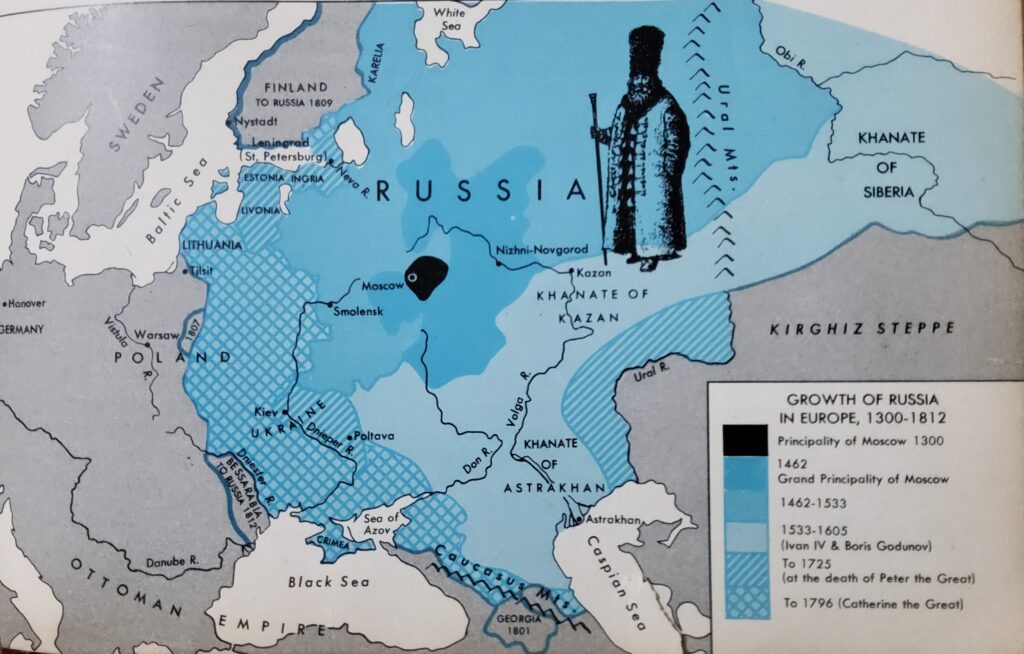
Soon after the arrival of the Vikings, the Russian tribesmen came under Byzantine cultural and religious influences. This promising start was almost extinguished in the thirteenth century, by warlike invasions by the Mongols or Tatars. A period of oppression and the payment of tribute, followed. The princes of Moscow rose to importance at this time; first, as tribute-collectors. Ivan (John) III, the Great, who ruled from 1462 to 1505, united under his rule various Russian territories – extending from the Arctic Ocean to the Ural Mountains. His work was carried on by his grandson, Ivan IV, called “the Terrible”, because of his uncontrolled temper and his great cruelties. He ruled from 1533 – 1584.
Under Ivan IV the Russians extended their rule toward the Caspian Sea and into western Siberia.
Ivan conquered much of the territory formerly held by the Mongols. In doing so, he was aided by the Don or eastern Cossacks; dashing horsemen who played a large part in Russian conquests. The Cossacks were frontiersmen, who had sought to escape from the restrictions of their old homes. They were practically self-governing in their communities, where they supported themselves by hunting, fishing and cattle raising. They had a saying, “The czar rules in Moscow and the Cossacks [rule] on the Don.” The folk music of these people is highly esteemed by critics and popular Cossack choral groups, have performed throughout the world.
ROMANOVS AND THE NEW RUSSIA
Peter the Great, opened Russia to the West.
The dynasty of rulers believed to be descended from the Vikings came to an end in 1580, when Ivan the Terrible, in a fit of insane rage, killed his son.
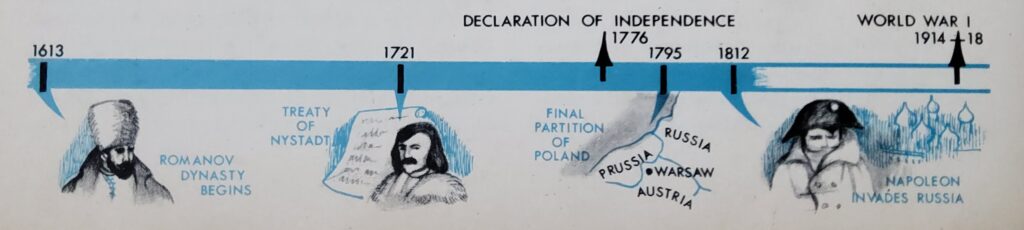
For a time during the early 1600’s, the country was in a confused state. Then in 1613, a nobleman named Michael Romanov, became emperor or czar. He founded a dynasty which ruled until monarchy was ended in Russia, during World War I. The strongest and most capable of the Romanov czars, was Peter I (The Great). His reign (1689 – 1725) was so important, that Russia could date its history as B.P.G. (Before Peter the Great) and A.P.G. (After Peter the Great).
During Peter’s boyhood, it would have been difficult to say, to which continent Russia really belonged. Some of its religion and culture related it to Europe. Its long period of Mongol subjugation or control had resulted in similarities to Asiatic countries. Peter’s attention was attracted to the West and he determined to visit those countries, of whose progress he had heard. It was planned that a commission should visit western Europe and seek assistance against the Turks, who were then, very powerful in southeastern Europe.
Peter, who was a giant of a man, accompanied the commission, travelling incognito as a sailor named Peter Mikhailov. The commission failed to obtain help against the Turks, but Peter learned much from the countries he visited. He was eager to learn western “know-how,” especially naval skiil. In Holland, he studied shipbuilding, actuaily working as a labourer at the docks of Holland. In England, he learned much about industry, commerce and received an honorary degree at Oxford. In Prussia, he observed the army, recently built up by the Great Elector. In France, he saw the workings of a model monarchy, headed by the great Louis XIV. Peter hired several hundred workmen, engineers and sailors, whom he induced to go to Russia, to train the Russian people in the skills of western Europe.
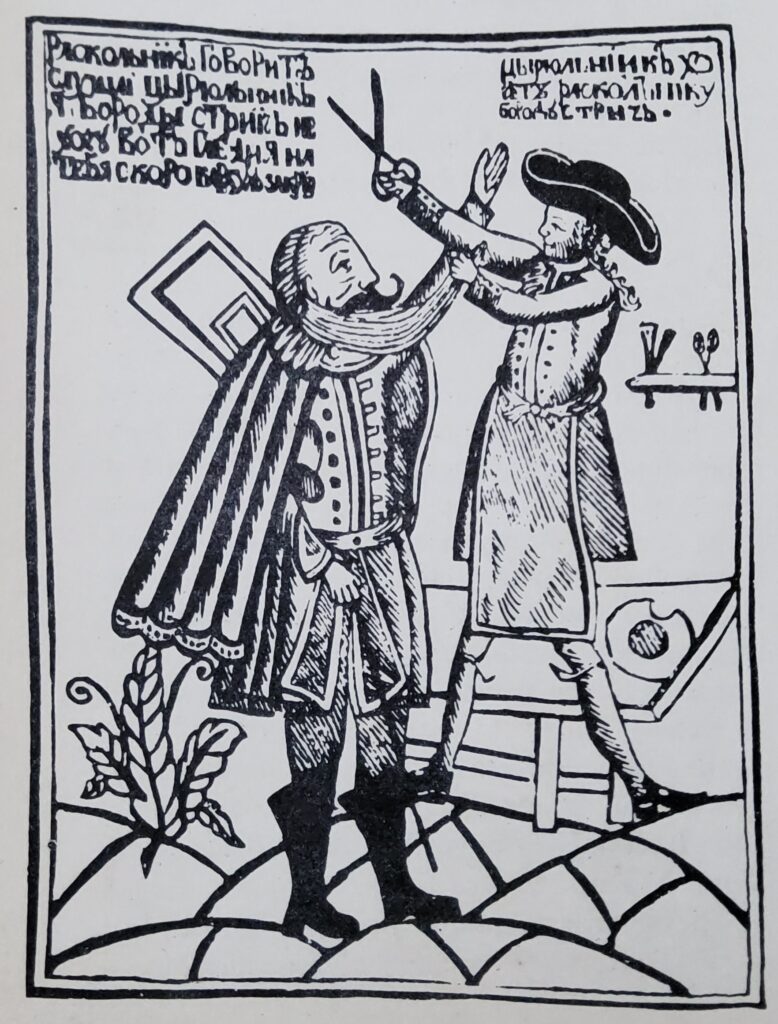
Upon his return to Russia, Peter began to modernize Russia and the Russians.
He forced the men to cut off their beards, to shave and give up the long, Eastern-style coats they wore. He wanted them to have the dress and appearance of western Europeans. The decree on shaving scandalized the men, for the Orthodox Church held the tradition, that Christ had a beard and man must also have a beard. Peter also ordered the Russian women to follow the custom of women in France and England, by entertaining and entering more into general social life.
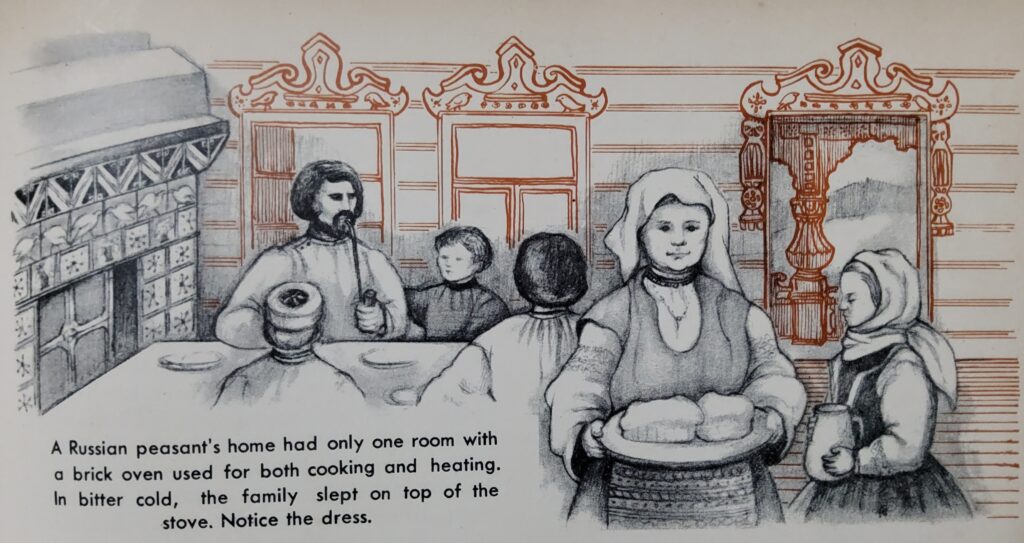
A strong standing army was created. Though the rank and file of the new army was recruited from the Russian masses, the officers were chosen from among the imported foreign military experts, who were completely dependent upon the czar. Peter made an effort to improve agriculture and promote industry; but serfdom long continued to be the lot of the peasants.
Peter was convinced that absolute monarchy was the best form of government for his numerous and for the most part, illiterate subjects. The people had no voice in the making of the laws or in their administration. The czar’s will was the law.
When the Patriarch of Moscow died, Peter did not appoint a successor. In order to gain more control of the Church, he placed it under a governing body known as the Holy [Directing] Synod, which was headed by a layman. No important question relating to the Church could be answered, no appointment to a Church office could be made, without the consent of the Synod. This meant that the official religion of Russia, Greek Orthodox Christianity, was under the control of the czar.
Peter the Great, fought Sweden for control of the Baltic.
In Peter’s day, Russia had no ocean outlet, except for a remote and inaccessible port on the White Sea. The Ottoman Empire controlled the Black Sea on the south. Sweden controlled the Baltic.
Charles XII, a boy of fifteen, became king of Sweden in 1697. It seemed a good time for Peter to obtain the northern coastline he so desired — the eastern shores of the Baltic. He had made an alliance with Poland and with Denmark, to conquer Sweden and divide her Baltic territories. Charles did not wait to be attacked, but began the Great Northern War by invading Denmark. Denmark was soon overcome and Charles hurried to meet and defeat, Peter’s army at Narva. Then, instead of carrying the war into Russia, Charles spent six years trying to overcome Poland.
The Russians learned from their defeats and at Poltava and in 1709, won a decisive victory. Charles fled to Turkey and induced the Turks to declare war on Russia. The Turks finally trapped Peter and forced him to surrender at Azov. Prussia, Saxony and Hanover, joined Russia and finally forced Sweden, to seek peace in 1721.
By the Treaty of Nystadt in 1721, Russia secured the territories of Karelia and Ingria, the Baltic provinces of Estonia, Livonia and a narrow strip of southern Finland. The “window” which Peter had sought, was at hand — a window through which Russia might look out upon the West. Then, on the marshes of the Neva River and at an enormous cost, Peter built a new capital city and named it St. Petersburg. In 1914, the city’s name was changed to the Russian form Petrograd: after the Revolution of 1917, it was renamed Leningrad, to honour the leader of the Revolution, Nikolay Lenin.
A woman ruled in masculine fashion and added vast areas to the Russian Empire.
Catherine the Great, a German princess, was Russia’s ruler from 1762 to 1796. In foreign affairs, she followed in Peter’s footsteps. Since he had secured a window on the Baltic Sea, she determined to gain one on the Black Sea. In order to secure access to the Black Sea, she went to war with Turkey, who controlled the sea and forced Turkey, to surrender the Sea of Azof and surrounding territories. Russian ships were given the right to navigate in Turkish waters.
Later, Catherine gained control of the lands north of the Black Sea – and the Dniester River, was recognized as the boundary between the Russian and Turkish Empires.
These were enormous gains for Russia, but since Turkey still controlled Constantinople and the Straits, Russia was barred from access to the Mediterranean. There were later struggles for this great strategic location, but Turkey always managed to hold it.
Poland disappeared from the map of Europe for more than a hundred years.
Poland became the next nation to be partitioned by strong neighbouring countries. In 1772, the rulers of Russia, Prussia and Austria, began to take those portions of Poland, each wanted.
In the first partition, about one fourth of Poland was taken by the unfriendly neighbours, but it was followed by a second partition in 1793 and a third in 1795. Russia received the largest share in these divisions of territory. The destruction of the Polish state by no means destroyed Polish nationalism. The Poles continued to think of themselves as a distinct people and their nationalistic pride, increased as efforts to stamp it out were made by their conquerors. Men of letters and great musicians, helped to keep alive the patriotic feeling of the people.
ALEXANDER AND THE HOLY ALLIANCE
Napoleon’s army met disaster in its Russian campaign.
From 1796 to 1801, Russia was ruled by Catherine the Great’s son, Paul. He was better educated than any former Russian ruler and seems to have been eager to serve his people, in an orderly way. Unfortunately for him, he was unstable of mind and his policies were unpopular with the nobles. He was murdered by his enemies and replaced by his handsome, liberal minded son, Alexander I.
The Napoleonic Wars were in progress and Napoleon who was a skillful negotiator, knew how to play upon the psychology of other men, “stage-managed” a dramatic meeting at Tilsit, where he impressed and fascinated Alexander. It is said that he proposed a division of Europe, with a revival of a Roman Empire of the East for Alexander; the West, of course, would be for himself. Alexander agreed and assisted him, with his economic boycott of England.
Russia sought complete control of Sweden and Turkey.
In 1809, Alexander took Finland from Sweden and in 1812, took Bessarabia from Turkey, but Napoleon prevented further annexation or possession of Swedish territory by Alexander and would not permit him to take Constantinople.
Alexander soon found too, that his agricultural country was largely dependent upon English manufactured goods and that the boycott, was wholly impracticable. Napoleon and Alexander, met at a little German town in 1808. Napoleon would not listen to Alexander’s arguments and insisted that Alexander enforce the Continental System. Their growing differences, resulted in the French invasion of Russia in 1812.
When Alexander got to the Congress of Vienna in 1815, he found that Russia’s part in the defeat of Napoleon’s Grand Army had given him a position of prestige and influence at the Congress. He was an idealist at the time and proposed the Holy Alliance, which was implemented by the more realistic military Quadruple Alliance. His liberal ideas led to his granting a constitution to Finland and liberties to the Poles, such as an advanced constitution, their own army and free use of their own language. Later, between 1820 and his death in 1825, Alexander became a foe of liberalism and democracy, due to the influence of Prince Metternich.
In spite of his good intentions, Alexander left his country little better off than when he became czar. He had had a constitutional plan drafted, that would have made Russia a limited monarchy with an elected national assembly and a system of courts. At that critical moment in Russia’s history, the czar seemed unable to carry out what he knew, was best for his people. He made a couple of minor reforms, but shelved the plan for a reform of Russian government.
It was during Alexander’s reign, that the Russians considered expanding their territory in North America, southward to include California. That situation was a factor in the enunciation of the Monroe Doctrine.
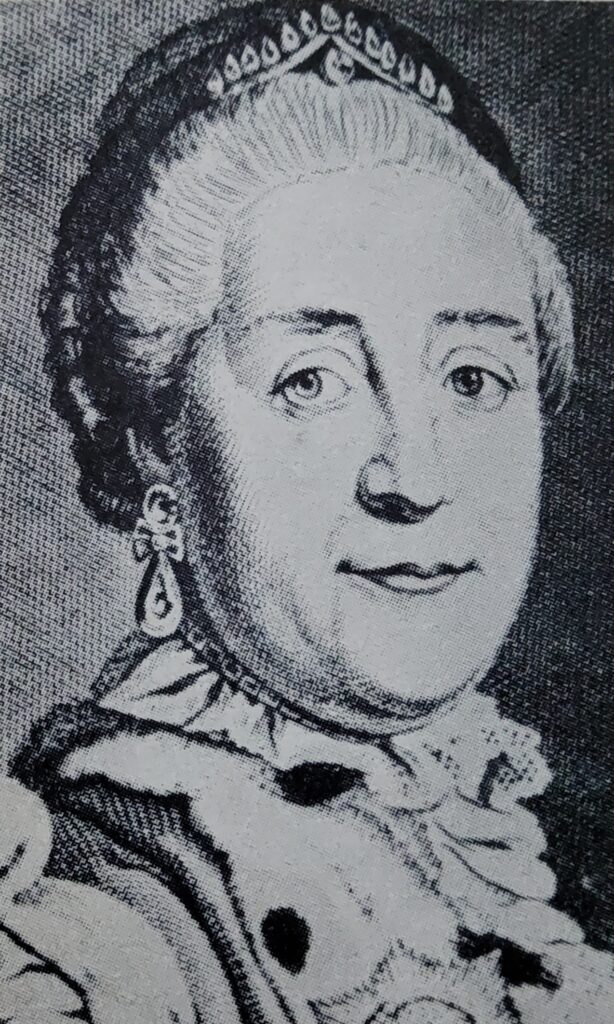
CATHERINE THE GREAT — (1729-1796)
Catherine Il, usually called “the Great,” was a German princess. She was married when still a young girl of 15, to a prince who became czar of Russia as Peter III, in 1762. She found him stupid and repulsive. Soon after his accession, she plotted to have him imprisoned, where he was put to death. Catherine then seized power as an absolute monarch and was empress for nearly thirty-five years.
Catherine the Great, had a good mind and read widely. She wrote well and tried her hand at writing Russian History, as well as tales and proverbs. She practiced sculpturing and painting. Her burning ambitions were to make Russian society, as cultured as that in Paris and to expand the Russian territory. The latter she accomplished. Catherine was a far cry, from our ideals of femininity. Much was disliked in her political methods — traits that even repelled, when observed in the most brutal men. Yet, she did much to promote the arts and sciences among her people.
RUSSIAN CULTURE AND WESTERN INFLUENCE
The cultural influences of the West did not reach Russia, until the seventeenth century.
For centuries, Russia was an isolated and backward land, without seaports. The Renaissance and the Reformation bypassed it. The cultural influences of the West gradually seeped into the country after Peter the Great, visited western Europe in 1697. He had the old Russian alphabet simplified, printing presses set up and many young men, sent to Europe for study. Russians were encouraged to study foreign languages. Schools were opened where young men could study accounting, engineering and navigation, even though Russia had no system of primary education in those days.
Catherine the Great, copied the court life of France. Palaces in immitation of Versailles were built and art was imported from France, Italy and elsewhere. Many of the nobles learned to speak and to read French.
This upper class culture had little effect upon the general population, which was without schooling and deeply ignorant. Folk stories and songs were handed down from generation to generation. At a later date, Russian writers and composers drew upon these and gave us a collection of legends and myths, some exotic, some imaginative.
Folk dancing was a pastime for many peasants. A school of ballet was founded in the eighteenth century and Russia became a leader, in this form of dance.
The Russians engaged in an important “Eastward Movement.”
In the seventeenth century, Cossack fur traders moved across Siberia, going from river system to river system. In 1638, they reached the Sea of Okhotsk. As they moved down the Amur valley, they established contact with China. The Russians and Chinese, even signed a treaty in 1689.
Unlike the American Westward Movement, there was no rush of settlers to the frontiers in search of farmland. As time went on, convicts were sent to Siberia, but right upto the end of the nineteenth century, transportation and communication were very poor.
The Russians explored the Pacific coast of Siberia and some of the nearby islands. In the time of Peter the Great, navigators were dispatched to this area. Many of them were foreigners like the Dane, Vitus Bering, who in 1733, sailed through a fog between Siberia and Alaska; and decided that the two continents were separated by salt water. In 1741, Bering visited the Alaskan mainland and established Russia’s claim to the land.
By 1750, furs from these northern regions were appearing on the Chinese market in large quantities. Europeans noted the fact and the North Pacific was being explored after centuries of neglect. By 1825, Russia was the world’s largest country. Her great growth and political power were a matter of increasing concern to the rulers of other European countries. Perhaps, that concern motivated some of their interest in Russia’s eastward movement and her influence on the lands facing the Pacific.
LINKING THE PAST AND THE PRESENT
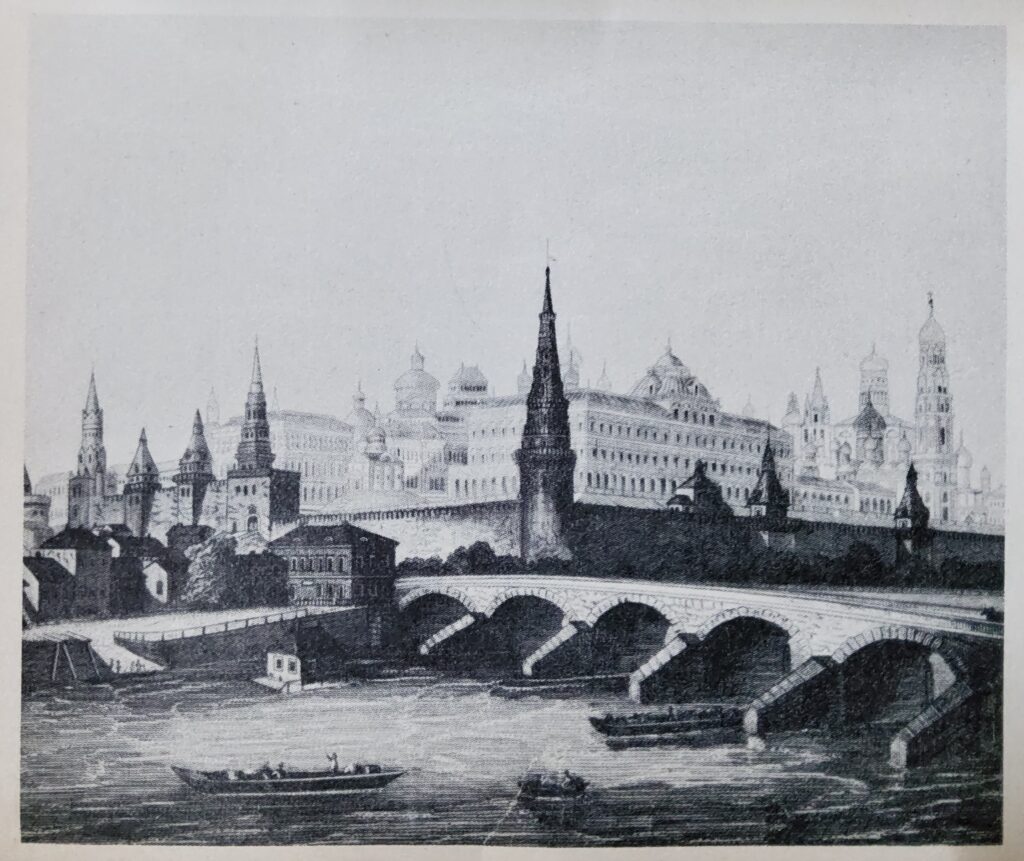
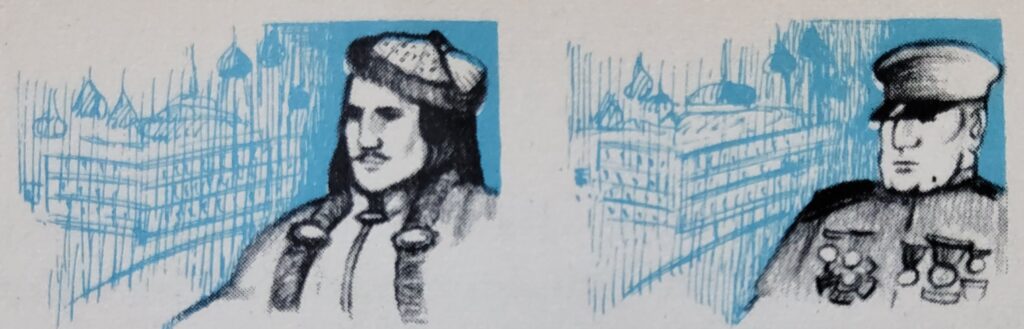
In early Russia, the central part of most cities was surrounded by walls and fortified, hence its name of Kremlin or fortress. The Kremlin of Moscow is a large triangular enclosure, with walls topped by towers built in 1492. It was built by princes of Moscow for protection against Tatar raiders and marauding neighbours. It contained a variety of buildings, constructed at different dates and in a variety of styles. These included the ducal palace, houses for the duke’s guard and court officers, cathedrals, churches and tombs of the czars. In our day, Joseph Stalin lived within its walls. So many government activities take place there still, that newspapers, radio and TV, refer to the government as the Kremlin, much as “the White House,” or “Capitol Hill.”