Reformation, revolt and division in the church – conflicts over Christian Doctrine, the religious revolt in Germany, the Catholic reformation and the Protestant revolt outside Germany.
The fourteenth and fifteenth centuries saw in many categories of manifestation the full medieval effort. Material progress, the rise of the new nobility and the merchantmen of the cities — saw upheaval on every level of society. This was true also on the level of religion, where many churchmen had not kept abreast of the changes in society. Very often, the Church was thought of as associated with the old order of things. The dominant factor in the fourteenth and fifteenth centuries was the development of a religion of kings and the State, which put them above the old moral teachings, which were so essentially a part of the Christian tradition. The old idea of a united Europe, was gradually pushed aside and the individual aspirations of monarchs and the various European states, took precedence over a common cause.
The sixteenth century was a century of strong political alignments. The Italian city-states which had been so long associated with the Renaissance, were being invaded by the powers of the North and the West. Politics and statecraft were in many areas, secondary to great social upheavals such as were seen in Germany and eastern Europe. Strong and dominant individuals, seized the opportunity to express their resentments. This was true on every level. This was also true on the level of Protestantism, which revolted against many of the abuses in the Catholic Church.
CONFLICTS OVER CHRISTIAN DOCTRINE
Disputes over Church teachings had occurred throughout the history of the Christian Church.
Soon after Jesus’ followers began to spread his teachings, questions arose on such issues as the course a man must take, in order to obtain salvation. In time, many councils of churchmen were called to consider such issues. If a council decided that a proposed doctrine was wrong, it was denounced as heresy and people who persisted in it, were excluded from the body of believers.
The medieval Christian Church and its missionaries, gradually brought most of western Europe under the authority of the Church. The Church believed that it included all Christian society; therefore, almost all western Europeans were subject to its authority. By the twelfth century it had become such a powerful organization, that it was dangerous for a man to criticize it. The Church could make him an outcast, or even have him burned at the stake as a heretic.
During the twelfth century there lived in Lyons, France, a rich merchant named Peter Waldo. Waldo sold his property and founded a religious group known as the Poor Men of Lyons, sometimes called the Waldensians. The Waldensians preached against certain powers of the pope. They believed in a more just distribution of wealth. Waldo believed that everyone should follow his own interpretation of the biblical text and not that of the teachers of the Church.
These ideas were unpopular with the nobles and the clergy, so the Waldensians were excommunicated or cut off from the Church, in 1184.
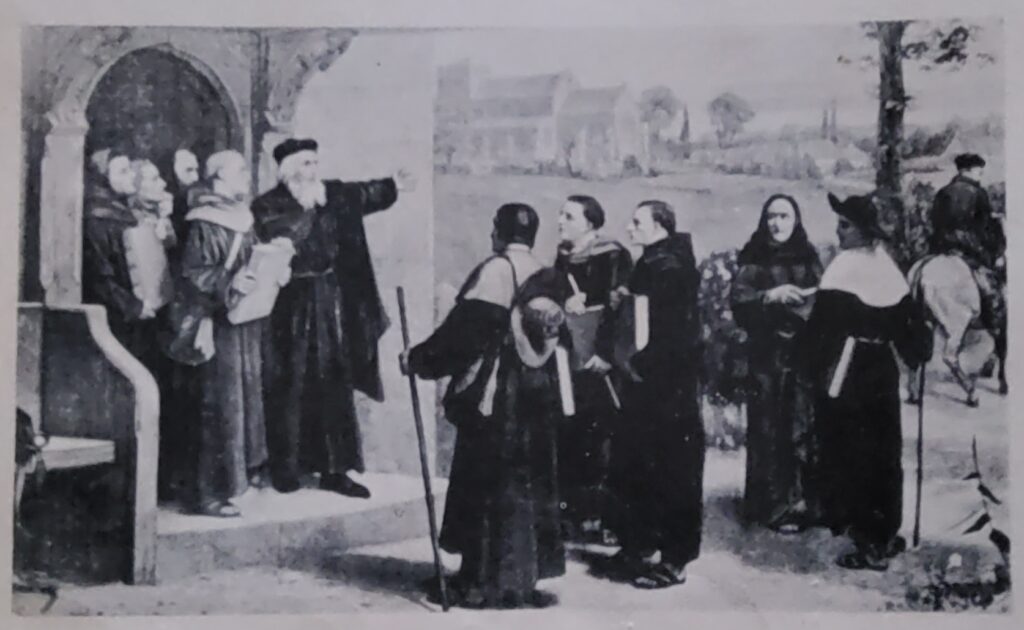
From time to time, faithful churchmen pointed out practices among the clergy, that they believed should be corrected. In the fourteenth century, John Wycliffe (c. 1320 – 1384) launched a fiery attack upon Church abuses in England. Wycliffe, a former professor at Oxford, insisted that private revelation out of the Bible and not the traditional teachings of the Church, was the basis of Christianity. Wycliffe also attacked the wealth of the Church and insisted that the priests should live in abject poverty. Though there were previous translations of the Bible into English, Wycliffe made another translation from the Latin into English. Then he sent out priests, to preach his ideas.
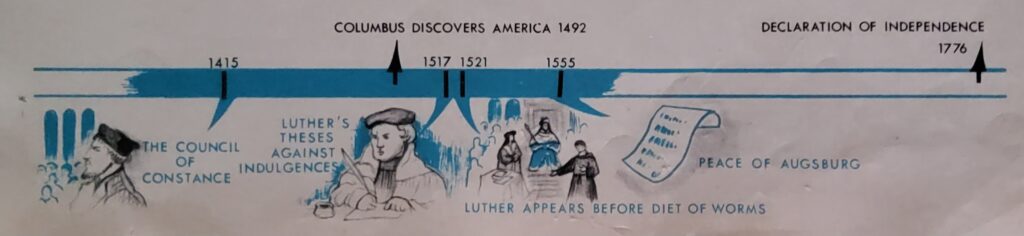
Needless to say, the Church condemned Wycliffe, who died shortly thereafter. A church council, the Council of Constance, meeting in 1415, denounced the teachings of Wycliffe and had his body removed from its grave and burned, its ashes scattered. It ordered the Bohemian reformer, John Huss, a follower of Wycliffe, to be burned at the stake. Huss had maintained that the Bible alone should be the model for Christian living. He had attacked the pope, confession and other practices of the Church. His death did not stamp out his heresy. Instead, it made those who believed in his teachings, resolve to spread them.
The demand for Church reform was coupled with a trend toward social change.
During this time, there was growing discontent among the peasants in many parts of Europe. Without doubt, their standard of living was higher than it had been before the growth of towns and trade, but they experienced great hardship in wartime and when crops failed. There was much tension and economic depression between 1350 and 1450. The suffering caused by the Black Death (1347) and the armies of the Hundred Years’ War (1337 -1453), brought on a revolt of French peasants called the Jacquerie. It was suppressed.
England witnessed a rebellion led by Wat Tyler, in 1381. So many peasants had died in the Black Death, that the wages of day labourers went up. The peasants resented Parliament’s attempt to stop the pay raise. A mob marched on London. The king heard their pleas; salaries were too low and restrictions on freedom of labour and trade, be removed. He made some promises. While the proper papers were being drawn up, Tyler’s followers subjected London to plunder and slaughter. The king’s agreements with Tyler were revoked by Parliament, so the revolt gained no permanent good for the peasants.
Between 1490 and 1510, severe droughts in Germany reduced the peasants to poverty, discontent and revolt. Besides the nobles’ demands for heavy taxes, worldly clergymen made further financial demands upon the peasants. The feeling grew among them that their lot would be much improved, were it not for the money demands of the rulers and of the Church.
LINKING THE PAST AND THE PRESENT
During the Middle Ages, man’s attention was focused more on the life to come. Then came the Renaissance, which was a much more worldly period. Man began to demand freedom of thought and conscience.
Three instances come to mind, when freedom of thought and conscience have been denied to millions of people in the twentieth century. This happened in Italy under Mussolini and in Germany under Hitler. Citizens of the United States, recognizing freedom as their priceless heritage, need a Renaissance of interest in the nature of freedom and how to retain it.
Abuses by some worldly clergy opened the doors to criticism.
The real power and influence of the Church and the popes for centuries had been spiritual, based upon the teachings of poverty, humility and expressed in the title “servant of the servants of God.” Individuals who disposed of their material possessions to lead lives of service, were greatly admired.
The revival of trade and commerce, the growth of towns and the general increase of prosperity of the late Middle Ages, brought increased revenues to the popes through titles and gifts. The Renaissance brought great emphasis upon wealth, splendour and temporal power. Certain men joined the clergy less from religious motives, than from a desire to reap rich rewards. Frequently, these churchmen were drawn from the ranks of the nobility. They lived in princely splendour and spent Church moneys on new buildings, elaborate decorations and rich robes.
There was growing criticism and dissatisfaction over the manner in which indulgences were being granted. An indulgence was believed to free a person, wholly or in part, of temporal punishment due to sin. It could be secured after confession and sincere repentance by a promise of good work, alms, or a money payment applied to a good work. Some members of the clergy, in defiance of the teachings of the Church, abused the power of granting indulgences.
Within the Church itself, there had long been the realization that some reform was necessary and that a better discipline was required, for the most part on the top level of the clergy. Some men voiced the hope that the Church would return to the simplicity of the apostolic age. Some others insisted that one of the main causes for abuse, was a disregard of the traditional practices. Others however felt, that even on the level of doctrine, the Church had departed from the Christian teaching.
THE RELIGIOUS REVOLT IN GERMANY
Martin Luther challenged Tetzel’s sale of indulgences.
Martin Luther (1483 – 1546 A. D.), was the son of a miner of peasant origin. His ambitious father, wanting him to be a lawyer, had him go to college. Interest in religion however, led Martin to become a monk. After serving for a time as lecturer at the University of Wittenberg, he was appointed a professor of theology. Thus, he began to study and ponder the problem of how to obtain eternal salvation. He came to believe that salvation resulted from faith — from acceptance of God’s mercy freely given — and that “good works” had no part in it. Now, if Luther were correct in this view, if a sinful man might accept the mercy of God and be saved, what happened to the Roman Catholic view – that Salvation is attained by demonstrating one’s faith through good deeds, accepting Church doctrines and taking part in Church ritual?

The Church’s view was spoken of as “justification by faith and good works.” Luthers view was referred to as “justification by faith.” In his classes at Wittenberg, with no idea of revolt against the Church, he talked much about salvation through faith.
In 1517, John Tetzel, a Dominican friar in the service of the Archbishop of Mainz, began preaching on indulgence near Wittenberg. The money he received was to be used, in part, for the completion of St. Peter’s Church in Rome. Tetzel preached that indulgences would release souls from purgatory, at once. This was of course, contrary to the teaching of the Church.
Indulgences had long been a controversial subject. Martin Luther had strong opinions about them and he was dismayed at Tetzel’s sales tactics. In keeping with a university custom, he wrote out ninety-five theses or statements about indulgences and posted them on the door of the castle church in Wittenberg. The theses were written in Latin, the language of scholarship and of the Church, intended to provoke discussion by scholars and churchmen.
The current interest in indulgences and the university’s new printing press turned Luther’s invitation to debate into a national controversy. The theses were translated into German, printed and distributed throughout Germany.
During the months that followed, Luther’s ideas about a number of things were brought out by discussion, by debate and by the pamphlets which he wrote. If Luther were right, people wondered of what value was the priesthood? Luther believed that every Christian was in a sense, a priest with the right to interpret the Bible for himself. He claimed that prayers for the dead and the celebration of saints’ days, were not desirable. He pleaded that indulgences and dispensations, be abolished. He said that he believed clergymen should be allowed to marry; that the popes should live simply and humbly.

A pamphlet addressed to the pope brought matters to a head.
In this pamphlet, Luther compared Rome with the ancient and wicked pagan city of Babylon. He set forth his views on salvation and proper behaviour for a Christian. In July of 1520, Pope Leo X condemned Luther and his writings; and gave him sixty days within which to confess his errors. If he did not recant, he was to be cut off from the Church and turned over to the secular authorities, for punishment.
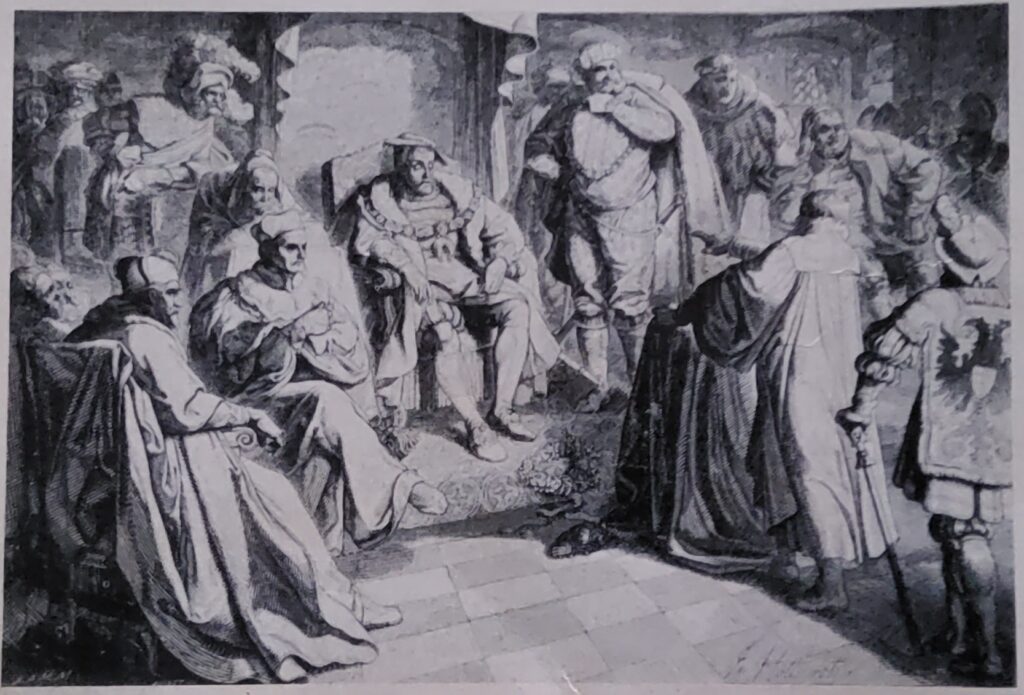
The time limit passed. In December of 1520, believing that the greater part of Germany was on his side, Luther burned the document containing the pope’s demands in the presence of students and townsmen. In January, 1521, Pope Leo X cut Luther off from the Church. Soon afterward Charles V, head of the Holy Roman Empire, demanded that Luther appear before the Diet (or parliament) to be held in the city of Worms.
Few incidents in history are more dramatic than the appearance of this German monk before his emperor. Surrounded by leading princes, nobles and bishops of the day, Charles V demanded that Luther revoke his teachings and what he had written. The young monk faced the charges against him calmly; he was neither obdurate nor rebellious. Among other things, he replied: “Unless I am convicted of error by . . . Scripture and plain reason … I cannot and I will not recant anything, for to go against conscience is neither right nor safe . . . On this I take my stand. I can do no other. God help me. Amen.”
Charles V, was a young man of twenty-one and his empire were strongly loyal to the Church. He considered well his reply. When it was given, he said:
My predecessors, the most Christian Emperors of the German race, the Austrian archdukes, the dukes of Burgundy, were until death the truest sons of the Catholic Church, defending and extending their belief to the glory of God, the propagation of the faith, the salvation of their souls… . For myself and you, sprung from the holy German nation, appointed by peculiar privilege defenders of the faith, it would be a grievous disgrace, and eternal stain upon ourselves and our posterity, if in this our day, not only heresy, but its very suspicion, were due to our neglect. After Luther’s stiffnecked reply in my presence yesterday, I now repent that I have so long delayed proceedings against him and his false doctrines. I have now resolved never again, under any circumstances, to hear him. Under protection of his safe-conduct he shall be escorted home, but forbidden to preach and to seduce men with his evil doctrines and incite them to rebellion.
Luther disappeared. Some thought he had been murdered, but he had been “kidnapped” for his own safety by his friend, Frederick the Wise, ruler of Saxony. Luther lived in Frederick’s castle for nearly a year, organizing a new evangelical church and translating the New Testament from Greek into German. Besides speeding the Reformation, Luther’s translation became recognized as a standard, or accepted form, of modern German.
The Peace of Augsburg marked the beginning of state religion.
Luther’s teachings spread rapidly in central and northern Germany and many persons aligned themselves with his church. The Diet of 1526 found itself split into two parties, the Catholic and the Lutheran. At its meeting in 1530, the Lutherans presented a statement of Chistian beliefs which they hoped would be acceptable to all. This statement, the Augsburg Confession, was turned down by the Diet, showing that the Catholic and Lutheran viewpoints could not be harmonized. Thus arose the Lutheran Church, whose creed was the Augsburg Confession. In time it became the dominant faith in Germany and the state church in Denmark, Norway and Sweden. Later many Lutherans came to America.
Luther died in 1546 during a period of religious conflict which ended in 1555, with the religious Peace of Augsburg. This was a compromise which gave the German princes the right to choose either Catholicism or Lutheranism, as the religion of their respective states. The Peace also ruled that Protestant princes might keep the lands they had seized from the Roman Church prior to 1562, but no more Church lands could be seized. Only the Latheran form of Protestantism should be recognized in Germany. A subject who did not wish to accept the religion of his prince, should be permitted to emigrate. Religious liberty for the individual was yet a long way off in Europe.
The Peace of Augsburg, an uneasy truce satisfactory to neither party, lasted for sixty years. It revealed the strength the Lutherans had gained in a relatively short period. It also reflected the many defeats and misfortunes suffered by Charles V, in his attempts to rule a vast and unwieldly empire.


THE CATHOLIC REFORMATION
The Catholic Reformation was planned for inward reform and to check the spread of Protestantism.
Some historians call it the Counter Reformation. It is stated that the terms Reformation and Counter Reformation are not satisfactory in all respects to present-day Protestants and Roman Catholics. Nevertheless, since the terms have been used by generations of historians in writing accounts of the period, it is impracticable to use others.
The Roman Catholic Church did not sit idly by while Protestantism was spreading in Europe. It held councils of Church leaders to reform the Church from within, to improve its organization and to wipe out the practices of its less worthy members. The Council of Trent, meeting [with interruptions] from 1545 to 1563, reaffirmed and carefully stated Roman Catholic doctrine. It provided for Church reforms and for a more critical edition of The Vulgate, a Latin Bible. It recommended that the pope issue a list of books that loyal Catholics should not read.
The courts of the Inquisition tried thousands of persons accused of heresy. Since there was no distinct separation of Church and State in those days, temporal rulers treated heresy as a crime against the State, as well as a sin. The torture and punishments of medieval law systems were often used.
A new religious order, founded by Ignatius Loyola, helped strengthen the Church.
Loyola (1491 – 1556) had been a soldier with the crusading zeal that characterized Spanish nobles and knights. While recovering from battle wounds, he read religious works and found a vocation to which he could apply his energies and organizing talents. He went to the University of Paris to train himself in theology.
In Paris, some of Loyola’s fellow students joined him in founding the Society of Jesus. His life as a soldier is reflected in the discipline he enjoined upon his followers. Pledged to obedience to the pope and to the leaders of the Society, they willingly faced privation and danger, in whatever part of the world they might be sent.
Loyola saw an opportunity to spread Catholicism in the newly opened regions of the world. Jesuit missionaries became active in the Americas and converted many Indians to Christianity. Father Ricci went to the court of the emperor of China, made many converts and won popularity by adopting some of the customs of the country. Francis Xavier, was active in India and in Japan, establishing himself as one of history’s great missionaries.
In Europe, the Jesuits gained influence by a careful study of education and the subsequent establishment of some of the best schools of the period. These were attended by the sons of noble and influential families.

THE PROTESTAN REVOLT OUTSIDE GERMANY
The Reformation produced strong religious leaders besides Martin Luther.
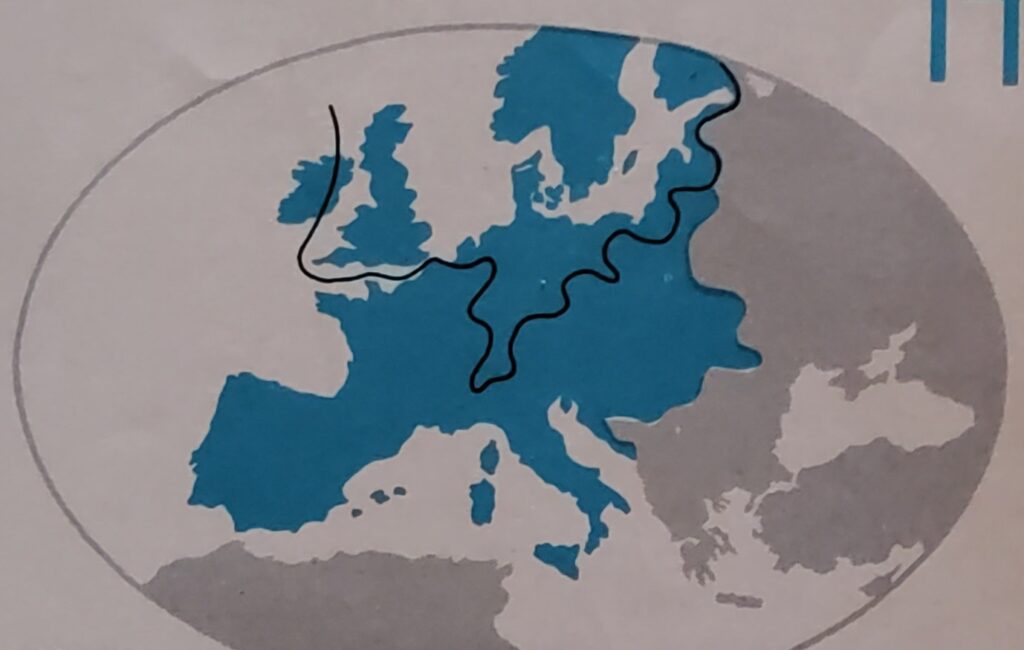
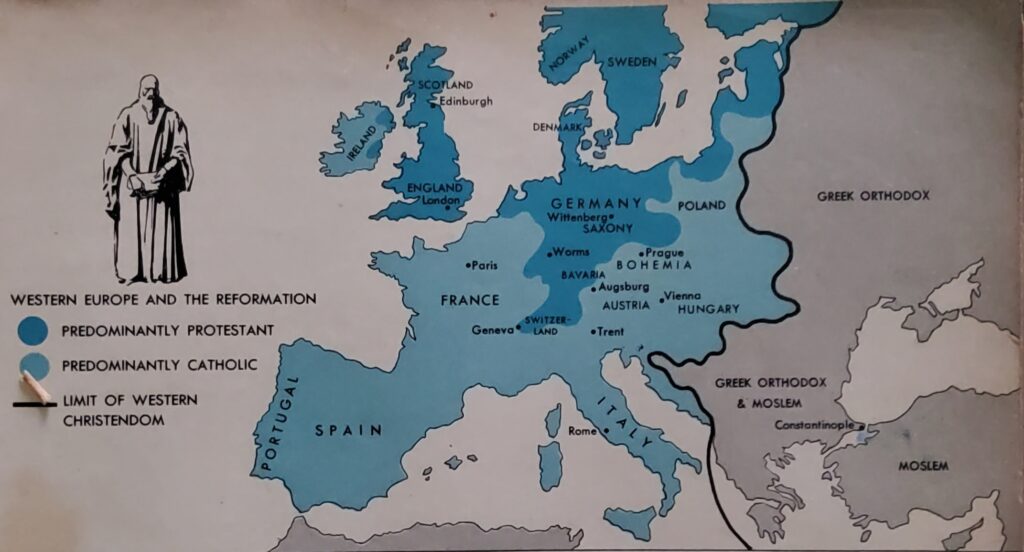
The Protestant movement had reached its peak in western Europe before Luther died. In general, northern Europe had embraced Protestantism; southern Europe remained predominantly Roman Catholic. In the East, the Orthodox Church continued on its way. The medieval religious unity of Europe had been shattered and religious wars were to flare up here and there for some time.
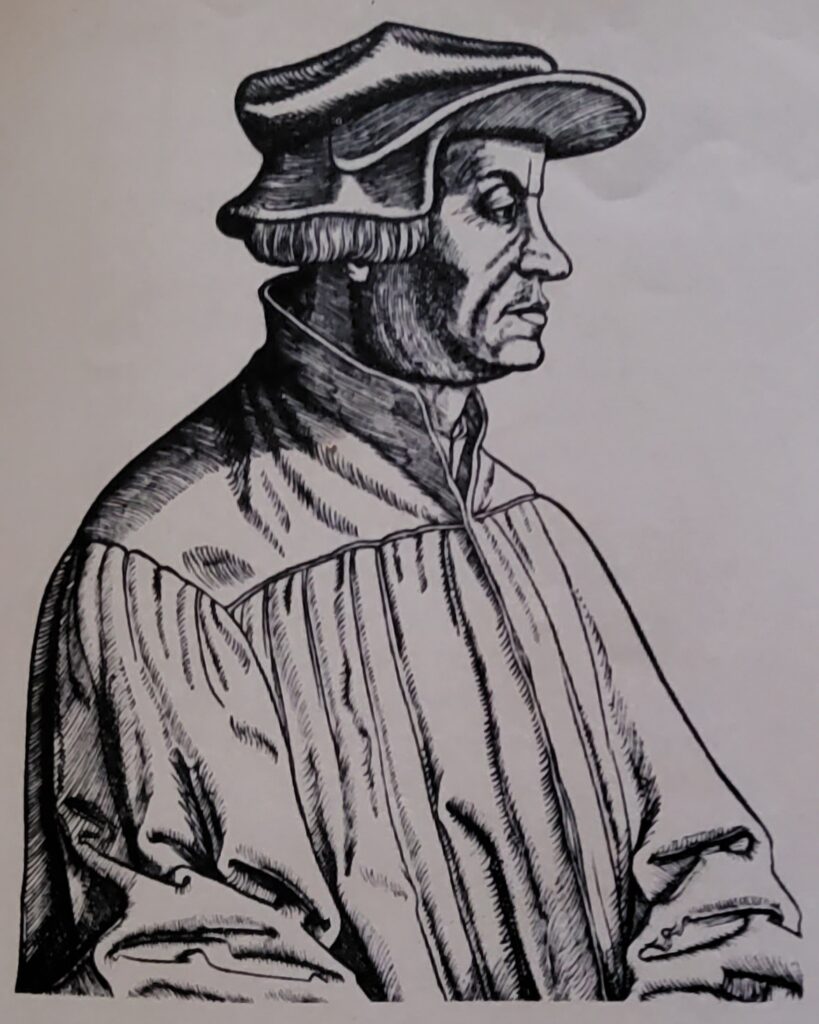
Ulrich Zwingli (1484 – 1531 A. D.), was one of the most influential leaders in the movement to reform the Church. About Luther’s age and a student of theology, he championed the Protestant cause in Switzerland, although his religious views differed somewhat from Luther’s. He denied the pope’s authority, preached justification of faith and attacked monasticism.
The Swiss Confederation was composed of thirteen small states, or cantons. Religious wars developed in which Zwingli was killed. Partly as a result of his work, each canton won the right to choose its own form of religion. This decision helped to keep Switzerland from becoming involved in the religious wars that later tormented Europe and paved the way for the neutrality, she has long maintained in international affairs.
John Calvin became an influential religious and secular leader.
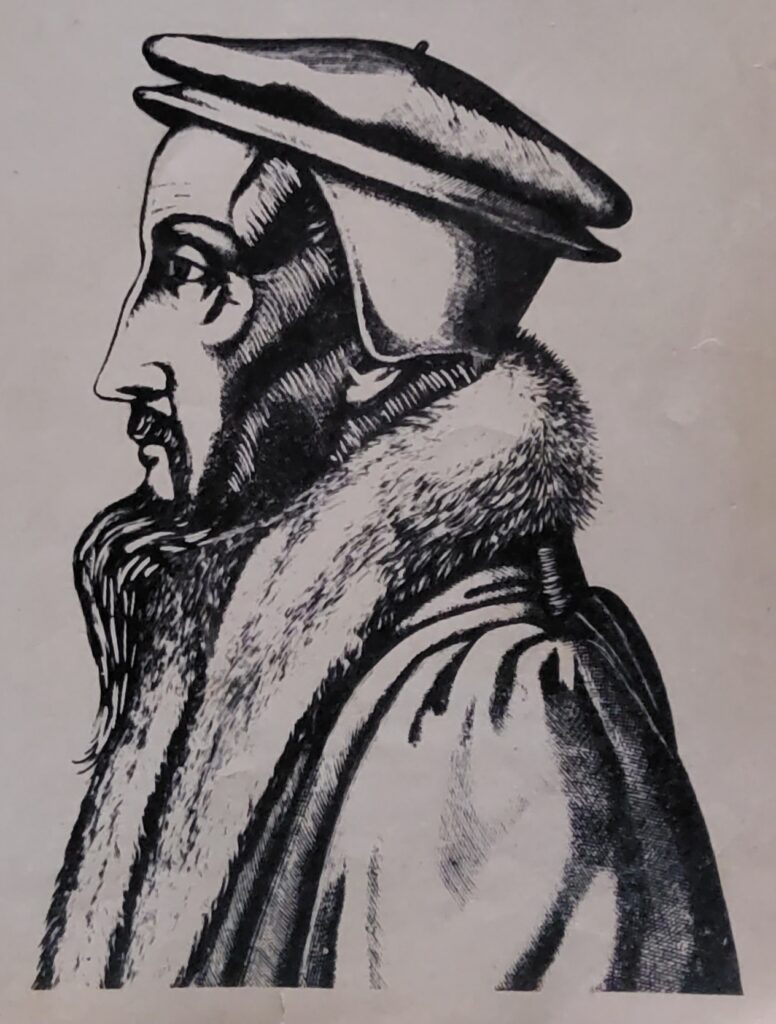
A French lawyer’s son, Calvin (1509 – 1564 A. D.), studied theology and law at the University of Paris. There he came under the influence of Lefévre, a teacher with advanced ideas much like Luther’s. He joined with those who were questioning the practices of the Church and left France, when the king began to punish heretics.
Calvin first settled in Basel, Switzerland, which had become a centre of Protestantism. There, in 1536, he issued his Institutes of the Christian Religion. The book was noteworthy for its lawyerlike logic, its clearness of expression and its emphasis upon ethics. As the first complete statement of Christian principles from a Protestant basis, it became widely read and used.
Calvin’s next stop was Geneva, where the reform movement was strong. At that time, Switzerland was included in the Holy Roman Empire. Geneva, like some of the other districts and cities, had gained independence from the Hapsburgs and other feudal families; and was self-governing. It had abolished Catholic worship and was a haven for Protestants. The people of Geneva were gay and pleasure loving. They enjoyed music, dancing, playing cards and festivals.
Calvin became a reform preacher and virtually controlled the city government. He introduced and enforced a life of severe self-denial, tolerating no dissent or difference of opinion. A century later, his ideas would appear in America and be known as Puritanism. Calvin advanced a doctrine known as predestination. He believed that God, being all-knowing and all-powerful, must know beforehand, what persons would go to heaven and who would be punished, eternally in hell.
Calvin’s ideas spread rapidly. The Calvinists in France became a strong minority under the name of Huguenots. In the Low Countries, the Calvinists formed the Dutch Reformed Church. There were many followers in the Rhine region of western Germany. John Knox, was successful in making Calvinism the accepted state church of Scotland, where it developed into the Presbyterian faith. Presbyterianism gained considerable influence in England and from there the Westminster Confession of Faith and the Westminster Catechism, were brought to America. These religious documents were among the self-governing measures adopted by new Protestant churches, after their break with Rome.
Calvin, like many of the men who had criticized the Church, wanted a return to the simplicity that characterized early Christianity. He believed that the church congregation itself, should be the source of moral authority. Each unit should be a self-governing body. As in New Testament days, a church should be supervised by its minister and elders (presbyters), rather than by a bishop. This democratic procedure in timely, attracted many wealthy and middle-class groups to the Calvinist religion.
The Reformation was indeed a time of great and fundamental changes.
The Christian Church was divided into many groups with different beliefs. The Protestant churches greatly increased in number with the passing of time.
As the medieval Church grew weaker, European monarchies became stronger. State churches of Protestant denomination replaced the Roman Catholic Church in a number of European countries. Among these changeovers was England. Nationalism in politics and intense patriotism grew stronger, with the rise of national monarchies.
Protestantism favoured the rise of business. It emphasized hard work. It encouraged the individual’s right to provide security for himself and his family. The medieval Church frowned on charging interest for unproductive loans. Gentlemen of Greece, Rome and medieval Europe, looked with scorn upon work. Calvin’s views were different: “For nothing is more unseemly than a man that is idle or good for nothing… .” The idle brain was regarded as the devil’s workshop; work was encouraged. As nations became Protestant, much Church property was confiscated and nations and individuals, profited by it. The fact that so many different kinds of Protestantism emerged even before 1600 caused many persons to believe that each individual, had a right to his own judgment in matters of religion.
We have surveyed two important periods in man’s development and achievement, the Renaissance and the Reformation. Since both movements involved the demonstration of ideas, the two together greatly altered the course of history and became the transitional period from the Middle Ages to the Modern Period of World History.
The Renaissance began with a renewal of interest in the humanities, in the literature of classical Greece and Rome. The humanists, as these scholars were called, brought back to Western culture an appreciation of man as an individual with a place to fill in the world. They began to think of the ideal man as a “universal man,” who would combine in himself, the well-rounded individual of the Greeks and Romans [“the sound mind in the sound body”] and the modern man, with a liberal education, who is steeped in the humanities.
In trying to be the universal man, hundreds of individuals of widely varying talents and skills, made outstanding contributions to the arts and sciences. Other humanists, tackled the problems of everyday existence. They became active in pushing back geographical boundaries and in improving their politics, economics and religion. Their examination of the doctrines and practices of the Christian Church, led to a demand for reform and the consequent division of the Church into – Roman Catholicism and Protestantism.

CHARLES V (1500 – 1558 A. D.)
Charles V was one of those men of good intentions who found himself placed in a situation too complex for one man to handle successfully. As the grandson of Ferdinand and Isabella, he inherited their Netherlands possessions and Spain at sixteen. He was elected emperor of the Holy Roman Empire at nineteen. As heir of his grandfather, Maximilian, he came into control of the Hapsburg domains in Austria and elsewhere. He thus tried to unify an unnatural conglomeration of peoples and races into an empire, at a time when the trend was to the establishment of strong individual nations, instead of to empires.
At his first Diet, when only 21, the young emperor had to decide what to do with the defiant religious reformer, Martin Luther. Luther was so popular in Germany, that Charles dared do little more than declare him an outlaw and refuse him the right to teach or preach. Throughout his reign, he was faced with the ambitions of Henry VIII and Francis I on one side and those of the Turks, under Suleiman the Magnificent, on the other. The Turks, allied with France, conquered Hungary and even attacked Vienna. He led his troops manfully against his foes in many scattered situations, but in the end he was worn out by wars and other problems. He resigned his kingdoms to his sons and lived in a Portuguese monastery until his death, making him one of the few rulers, who quit of their own free will.