Spain, Portugal and the New World: the Hispanic Century, Spain and Europe, the Dutch Revolt and Spanish decline, the Spanish and Portuguese Colonies and Spanish Cultural Achievements. The future looked very promising for Spain and Portugal in the year 1500 A. D. Their navigators had opened new lands, that held unlimited opportunities for development. The long struggle with Islam for possession of the Iberian Penninsula had come to an end, when the Spanish captured the last Moorish stronghold, Granada, in 1492. With the homeland freed of the Moors, the Spaniards were particularly eager to colonize and to Christianise, the natives in their new possessions.

After a brief period of glory, in which these nations made settlements in portions of Africa, North America, South America and some Pacific islands, their promising future failed to materialize. The misguided policies of one king, Philip Il of Spain, did much in setting back both Spanish and Portuguese progress. World leadership passed to nations in northwestern Europe and remained there for a long time.
An outstanding fact becomes evident. Even though Spain and Portugal became minor powers and lagged behind in political, social and economic development, they could point to a great and lasting achievement. They had transplanted their languages and cultures so successfully in North and South America, that they remain the dominant influences in the areas they settled.
HISPANIC CENTURY
Spain and Portugal established rival colonial empires.
In the late medieval period, the Mediterranean became a school for sailors. Improved navigation instruments and maps were available and ships became larger and more seaworthy. Navigators ventured into the Atlantic and skirted the coasts of northern Europe, developing more trade than would have been possible with overland routes.
The Spanish and Portuguese were among the first to learn from their Italian neighbours. Genoese seamen, reached the Canary and Azores Islands between 1275 and 1345 A. D. and the Portuguese were alert enough, to follow their example. A great impetus to exploration was given by Prince Henry the Navigator. Portugal claimed the Canary Islands, the Azores, the Madeiras and the Gold Coast of Africa (Modern Ghana). Trading posts were set up and Portuguese merchants exchanged their goods, for the products of these areas.
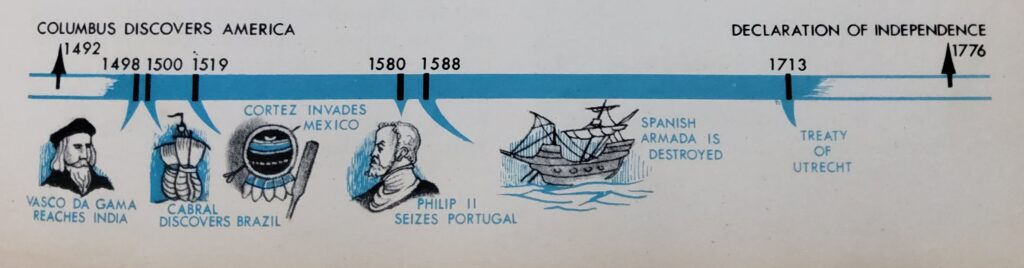
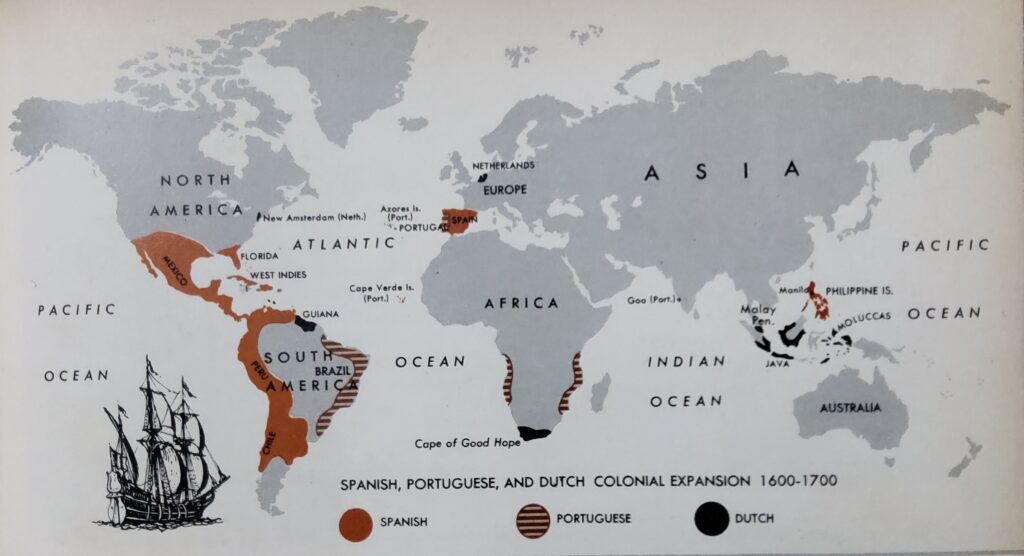
After Vasco da Gama rounded the Cape of Good Hope and reached the shores of India in 1498, the Portuguese developed a prosperous trade with the Hindus and with the Chinese. The Portuguese Empire soon extended from the Cape of Good Hope along the East African coast to India, Ceylon, the Malay Peninsula and the Moluccas — the famous “Spice Islands” of the East Indies. Here the Portuguese established many trading posts, ruled their new colonies through a viceroy — an official appointed by the king — and almost completely controlled the spice and silk markets of the Orient for a century.
Cabral discovered Brazil in 1500 A. D. and claimed it for the Portuguese king.
The agricultural resources of the Brazilian colonies and the business with the Orient combined to enrich the kingdom of Portugal and to make her the envy of European nations.
Other countries, among them Spain, were quick to see the advantage of overseas possessions. Spain became the rival of Portugal in empire building. She soon possessed most of the islands in the Caribbean Sea, including Cuba, Puerto Rico and Jamaica. Her gold-seeking explorers discovered the mainland of South America (the Spanish Main) and claimed Mexico, Central America and most of South America. By 1600 A. D., Spain had claimed large parts of North America as well.
Like the Portuguese, the Spanish were active in the Orient too. Spaniards occupied the Philippines and established Manila. A trade route was marked from Manila to the Isthmus of Panama and from there, to Spain. To protect her cargoes from pirates and the marauding seamen of other countries, Spain required her ships to assemble at Havana and go to Spain in one of two annual convoys.
In 1580, Portugal and her possessions were seized by Philip II of Spain. This marked a beginning in the decline of Portugal’s overseas strength. Shortly thereafter, Spain became involved in a war with England and lost much of her naval power, when her Armada was defeated in 1588.
SPAIN AND EUROPE
Marriages, arranged between monarchs, often influenced the destinies of European nations.
This was true in Spain. In their efforts to strengthen Spain’s position in Europe before the Reformation, Ferdinand and Isabella arranged political marriages for their daughters. One was married to the king of Portugal; Catherine was married to Henry VIII of England; Joanna was paired with Philip of Hapsburg. Joanna’s son, Charles V, inherited the throne of Spain and the scattered Hapsburg lands.
To Spain’s detriment, for about forty years, Charles V poured Spanish soldiers and Spanish gold into unhappy attempts, to carry out his political and religious program in the Holy Roman Empire. Recognizing his failure, he divided his realm between his brother and his son Philip I and retired to a monastery.
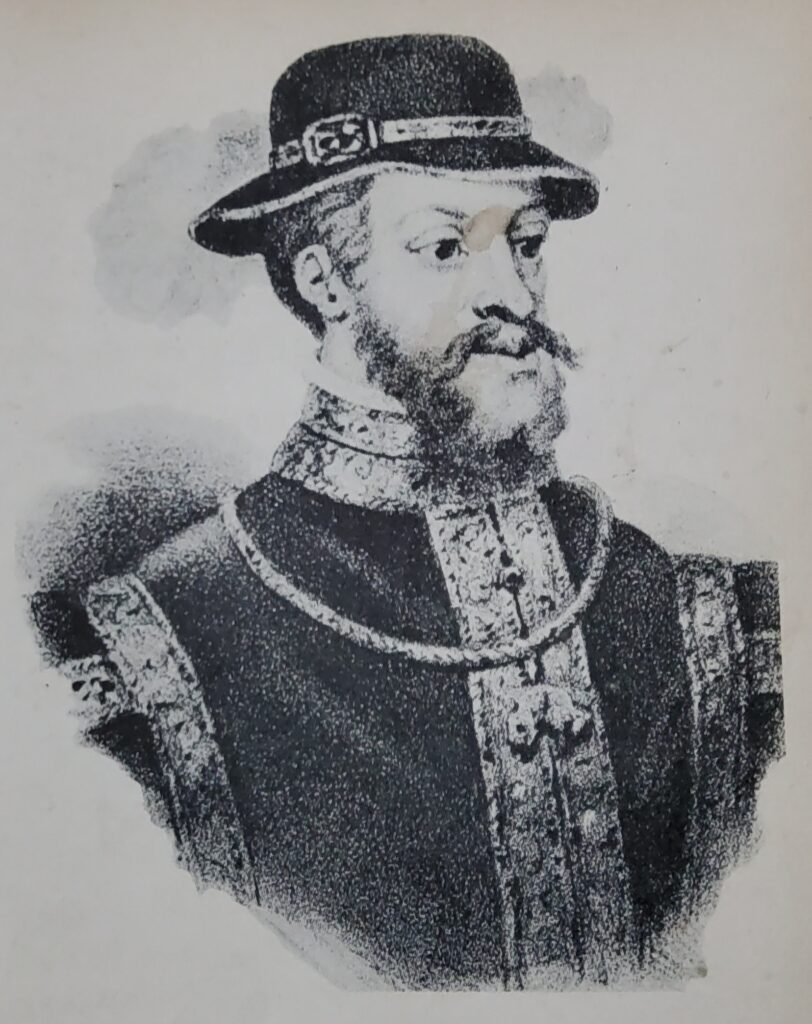
Unhappily for Spain, Philip Il used Spanish power to attain personal goals.
Since Philip had received from his father an unwieldy realm, including lands in the Netherlands and Italy, his attention was often diverted from Spain. He wanted: (1) to make Catholicism supreme in his domain and exclude other forms of religion; (2) to consolidate the government in his own hands; and (3) to make Spain the dominant power in Europe. His efforts to accomplish these goals were much opposed and contributed to the decline of Spanish power and influence.
In his efforts to make Catholicism supreme, Philip used the courts of the Inquisition. Within Spain, Philip personally administered the government. He himself made the laws, levied the taxes, controlled the army, the navy and directed foreign affairs.
The last male heir to the Portuguese throne died in 1580. Since Philip was related to the ruling family, he succeeded to the throne of Portugal. He took control of the Portuguese empire in America and in the Orient. This union was unpopular with the Portuguese and was ended in 1640. During these sixty years of Spanish control, Portugal lost some colonies to enemies of Spain.
Philip could not resist involving himself in French affairs. His convictions led him to support the Roman Catholic faction against the French Calvinists (Huguenots). Eventually, the Huguenot leader, Henry of Navarre, was victorious and became king as Henry IV.
Philip also met with disaster in his relations with England; his marriage with his cousin, Mary, the daughter of Henry VIII and Catherine of Aragon. His hopes of controlling events in England, particularly in religious matters had been heightened, until his invincible Armada was defeated and almost totally destroyed.
THE DUTCH REVOLT AND SPANISH DECLINE
Philip’s despotic rule brought a revolt in the Dutch Netherlands.
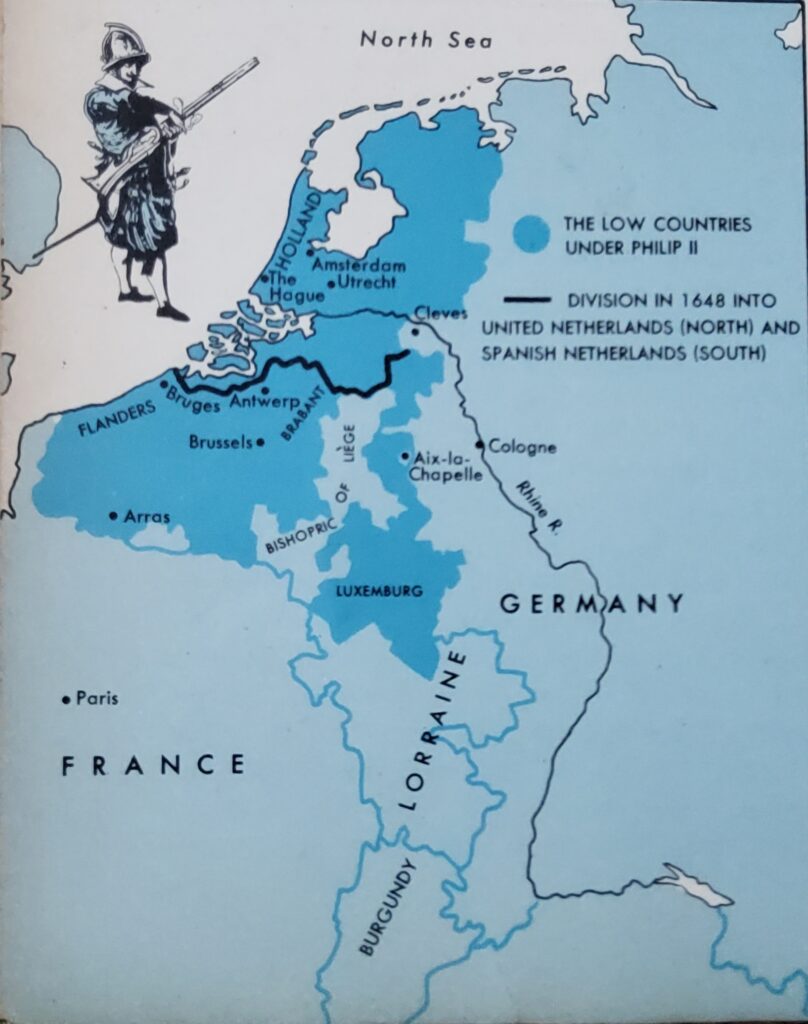
The map helps understand the geographic background of the Dutch revolt. The belt of land lying between what are now France and Germany was called Lotharingia, when Charlemagne’s empire was divided after his death. The modern term, Lorraine, was derived from that. The region has led to more than one dispute between the two countries.
In Philip’s day, the northern part of this region, the Low Countries, was particularly important. Here were a number of cities that had become wealthy, through trade and such industries as clothweaving. For a time, the port of Antwerp was the leading European centre of trade and finance. Cities like Ghent and Bruges, important in textiles, also became highly prosperous.
In his efforts to centralize his government, Philip met with trouble in the Netherlands. His heavy taxes, which brought in a very important part of his income, were resented. He attempted to take away the local rights of cities and provinces. Many of the people had become Calvinists and again, it was Philip’s general policy to tolerate only the Roman Catholic faith. When some of the Dutch nobles rebelled in 1567, Philip sent the feared Spanish infantry into the land. It was led by a noted soldier, the Duke of Alva. A special court, the “Council of Blood,” was set up, for the trial of persons accused of disloyalty to the “best of kings.”
The Dutch resisted Spain with great courage. They were aided by the low, semiflooded nature of their country and by a clever and astute leader, William of Orange, who is also called William the Silent. His career parallels that of George Washington in some respects: he was a man of position and wealth; he struggled against great odds; he was austere and silent; he held his followers together through his personal character and integrity.
Formal acknowledgement of Dutch independence was not made until long after it had become an accomplished fact. The southern provinces of the Netherlands remained under Spanish rule and eventually became the country of Belgium. The family of William of Orange became the rulers of the Dutch and continued as the royal family.
The New Dutch nation became almost at once, a strong naval power.
During the 1600’s, the Dutch became a trading people and gained an extensive colonial empire in North and South America, Africa and the East Indies – mainly at Portugal’s expense. It was during this period that New Amsterdam was founded, lost to England and henceforth considered, one of the English colonies.
The Low Countries reached a high point in culture. Such Dutch and Flemish painters as Rembrandt and Hals, Rubens and Van Dyck achieved eminence in the use of colour, in portraiture, in etching, in ink and wash sketches.
The Bourbons replaced the Hapsburgs as the ruling dynasty in Spain.
The Hapsburgs of the 1600’s were weak rulers and Spain continued to experience misfortune in foreign affairs. The death of the last male Spanish Hapsburg, gave Louis XIV of France a pretext to make his grandson king of Spain. The resulting War of the Spanish Succession was a costly one for France, with many military defeats. Still, Louis had his way and the French Dynasty was established in Spain, to continue with some interruptions, to the current century.
Spain was the heavy loser in the terms of the Treaty of Utrecht (1713), which closed the war. She gave up the Spanish Netherlands and Italian possessions to Austria. England retained Gibraltar, the rock-fortress commanding the entrance to the Mediterranean.
The continuous weakening of Spain and Portugal is revealed, by the easy but illusive conquest, by Napoleon. He rapidly subdued the region, made his brother Joseph king and introduced some of the reforms of the French Revolution. The Spanish however, did not like foreign rule even though it promised better government. They revolted; English forces came in and the French were driven out of Spain, after six years of the Peninsular War.
The Congress of Vienna returned to power, the rulers whom Napoleon had displaced. The restored Bourbon monarch, Ferdinand VII, proved to be one of the rulers who had “learned nothing and forgotten nothing”, from the events of the preceding twenty-five years. He revived the feudal privileges of the nobles, restored the Inquisition and abolished parliamentary government.
Revolts broke out against Ferdinand in Spain and in the Spanish colonies in America. European diplomats met at Verona and in accordance with Metternich’s policy of suppressing reform, asked Louis XVIII of France to rescue his Bourbon relative, Ferdinand. So ironically, a force of Napoleonic veterans and generals, were in Spain again in a very different cause. Ferdinand regained his throne and continued his thoroughly incompetent rule.
Spain declined through faulty economic policies, as much as from the political factor. Merchants, bankers and artisans, enjoyed little status since the ideal was the feudal landowner, the “hidalgo”. It was easy to buy manufactured goods with the gold and silver from the colonies, so the development of Spanish industry was neglected. Finally, the cost of the continuous participation in foreign wars, resulted in heavy taxation. Spain remained largely a nation of poor nobles and peasants. It did not have the rising, aggressive middle-class that was giving new strength to England, France and the Netherlands.
THE SPANISH AND PORTUGUESE COLONIES
Spain encountered two advanced cultures in the Americas.
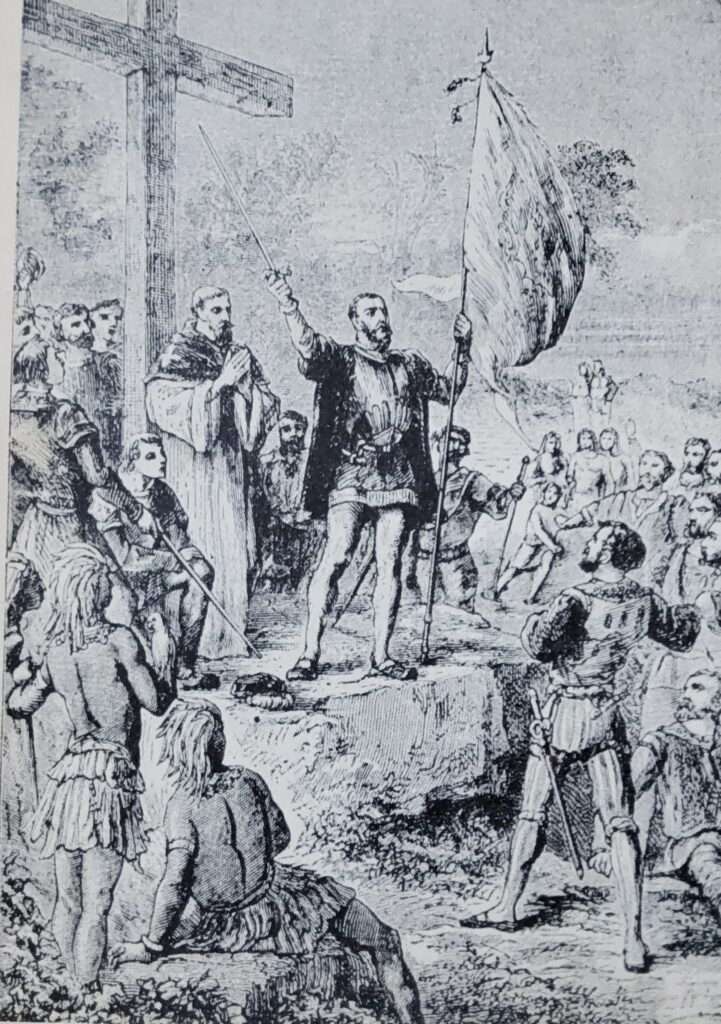
When Hernando Cortes landed on the coast of Mexico in 1519, with a handful of adventurous knights and soldiers, he approached an Indian civilization of high achievement. He had been sent by the Spanish governor of Cuba to explore the Aztec empire and convert the Indians to Roman Catholicism. Instead, he overcame a strong tribal confederation, made up of a numerous and warlike people.
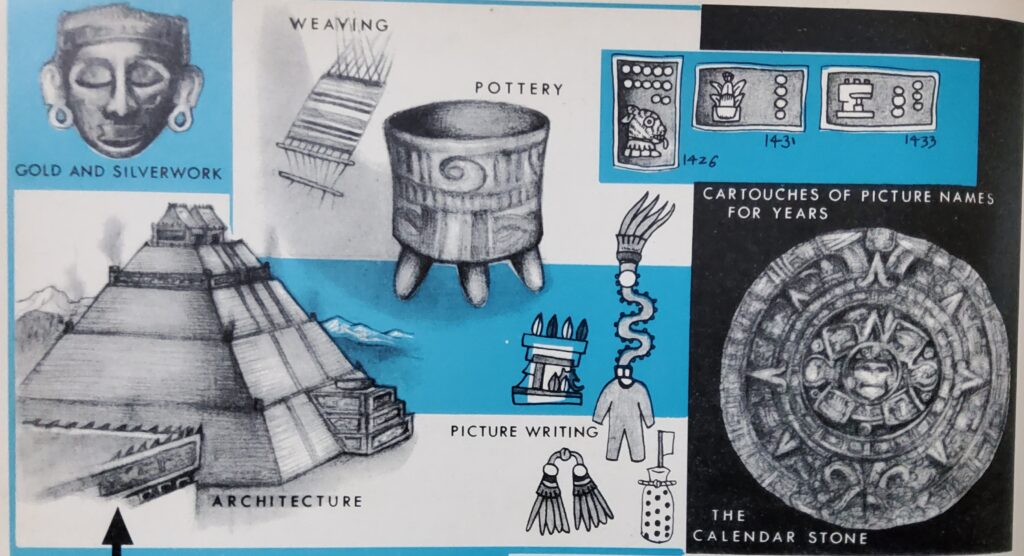
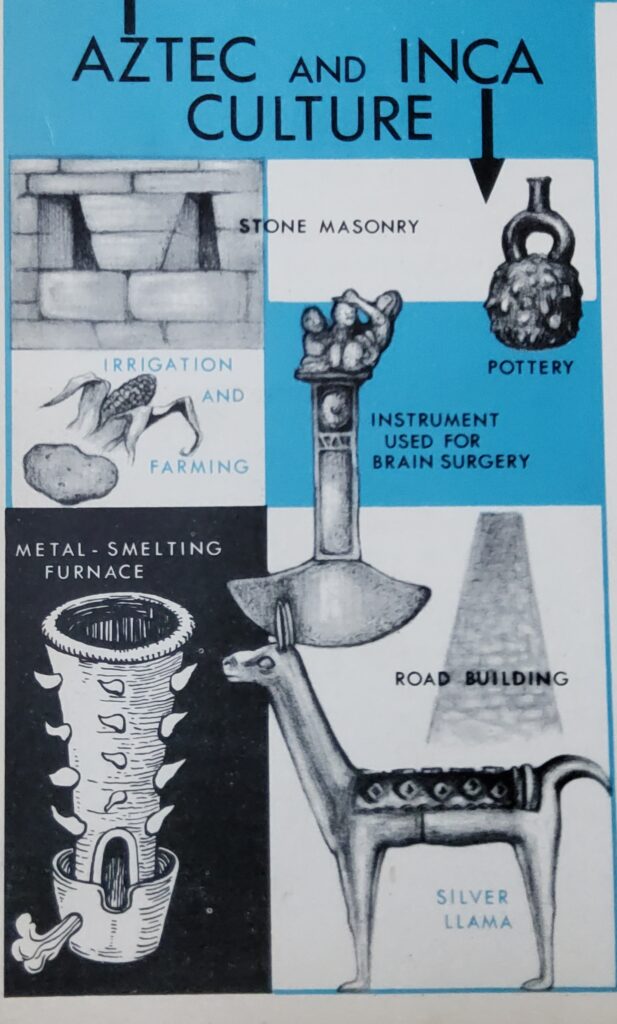
The Aztecs were ruled by a rich and powerful chieftain named Montezuma, who maintained a luxurious palace and a large army. The Aztecs had impressive temples, rich gold and silver mines and cities with paved streets such as the capital, Tenochtitlan. They were skilled farmers, weavers and workers in precious metals. They had a calendar, a system of writing and considerable knowledge of architecture.
The military advantages of Cortes were few, but important. He had steel armour and weapons. For a time, his horses were regarded by the Aztecs with superstitious awe. Most important, an ancient Aztec legend had predicted the return of a light-complected god called the Plumed Serpent, who had once lived among them. The first Aztec reaction to Cortes was that he was fulfilling the prophecy and bringing warriors with him.
Montezuma received his visitors with honour and rich presents. In a few days, his hospitality was rewarded by his being seized and put in chains. When his people could not buy off their conquerors, they broke out in fierce, despairing resistance. Cortes fought his way out of the city, secured more soldiers, returned and conquered the capital, in 1521. The Spaniards took possession of a fabulous treasure, tore down Tenochtitlan and divided the land amongst themselves. Within a few years, the Spaniards had reduced the Aztecs to the level of European serfs. Large estates were given to the Spaniards, establishing a feudalism that has continued in some areas, to present day.
The story of the Spanish conquest of Peru is identical in many respects, with that of Mexico. Like the Aztecs, the Inca Indians of Peru had a rich culture evidenced in agriculture, stone masonry and metalwork. Peru’s conquistador, Francisco Pizarro was like Cortes in military skill and in courage. Once again, a tremendous accumulation of gold and silver was seized and the land apportioned among the Spanish victors.
In the course of time, the Spaniards extended their rule over Central America. They founded colonies in Ecuador, Argentina, Chile, Colombia and Venezuela, to use modern terms.
The Spanish worked out a complicated, but effective system of colonial government.
At the beginning, two capitals were established — Mexico City and Lima. Each was the seat of a viceroy appointed by the king.
The problems of colonial government proved difficult to cope with. The tremendous area was divided by mountain ranges and deserts. Transportation and communication were primitive in most regions. Consequently, subdivisions of authority were made from time to time, to administer smaller areas. The fact that Latin America today, is divided into many independent nations, is traceable to these separated colonial governments.
The king of Spain maintained close control of his colonies through the Council of the Indies, which he appointed and gave complete authority, over colonial affairs. Later, a Minister of the Indies assumed some of the duties, formerly performed by the Council. Spain’s colonists had little opportunity to learn the duties and functions of citizenship, as we know it.
The economic system established in the colonies was planned for Spain’s benefit.
It was required that goods must be shipped in Spanish ships from a certain designated port of Spain, to certain designated ports in the colonies. Goods produced in countries other than Spain, were not absolutely prohibited, but they had to be first brought to Spain and then reshipped to the colonies. It was also required that colonial goods purchased by foreigners, must be obtained through a Spanish port, not a colonial one.
The colonial exports in which the Spanish were most interested, were gold and silver. The great treasures accumulated by the Incas and the Aztecs, were sent to Spain. Spain’s search for new deposits, resulted in discoveries such as the rich silver mines of Potosi.
There was a great and growing demand in Europe for the products of the tropics. Coffee, sugar, cotton, tobacco, cabinet woods, cacao, vanilla and dyes, such as indigo and cochineal became important items of trade.
Since Spain and other European countries were mainly agricultural and able to produce their own food, there was less demand for the products of a temperate climate. As a result, Argentina, Chile and Mexico, were not extensively developed and settled until late in the colonial period. There was some trade in hides, corn and salted or smoked meats, but the great cattle industry of South America did not appear as we know it, until the invention of refrigerator ships, late in the nineteenth century.
In Mexico and Peru, the Indians reduced to serfdom, furnished the labour supply. In some areas, the Indian population was sparse, or had been exterminated. In those areas, Negro slaves were introduced, adding a racial element which greatly affected the population of the Spanish colonies.
At the close of the War of the Spanish Succession, an important break occurred in Spain’s monopoly of her colonial trade. The English gained the exclusive right to carry on a slave trade with the colonies and to send a single ship a year, to the South American coast. English manufactured goods were in demand as time went on and the weakness of Spain, encouraged smuggling.
The Church was an active participant in Spanish colonial life.
One of the purposes of Spanish colonization, was the conversion of the natives to Christianity and this missionary effort was not neglected. The Church was closely associated with the Spanish government, which originally furnished the funds necessary for carrying on the work of the missions. Many priests were sent to the New World. Although their work was primarily religious, they established schools for the Indians and taught them many practical arts, including agriculture.
The Portuguese system in Brazil was similar to that of its Spanish neighbours.
Brazil was the only Portuguese colony on the American mainlands, but it was a rich possession, taking up half of South America. The Portuguese found no advanced Indian cultures like those in Mexico and Peru. A large part of Brazil was hot, wet and covered with tropical jungle. Many settlers went there in the eighteenth century, when gold and diamonds were discovered.
Portugal modelled her system of colonial government, after that of Spain. For about ten years, Brazil was divided into fifteen areas called captaincies. The Portuguese king appointed men to rule the captaincies with complete authority. This system did not work well. Later, a governor was appointed, giving the colony a more centralized government. Settlers began to come in larger numbers. They found that the northern part of Brazil provided excellent soil and climate for raising sugar, tobacco and cotton, but many Indians, when forced on plantations, ran away. The plantation owsers therefore imported Negro slaves, who came to form a larger element in the population of Brazil, than in any other South American country.
SPANISH CULTURAL ACHIEVEMENTS
Spain enjoyed a richer cultural life during the period of her political importance.
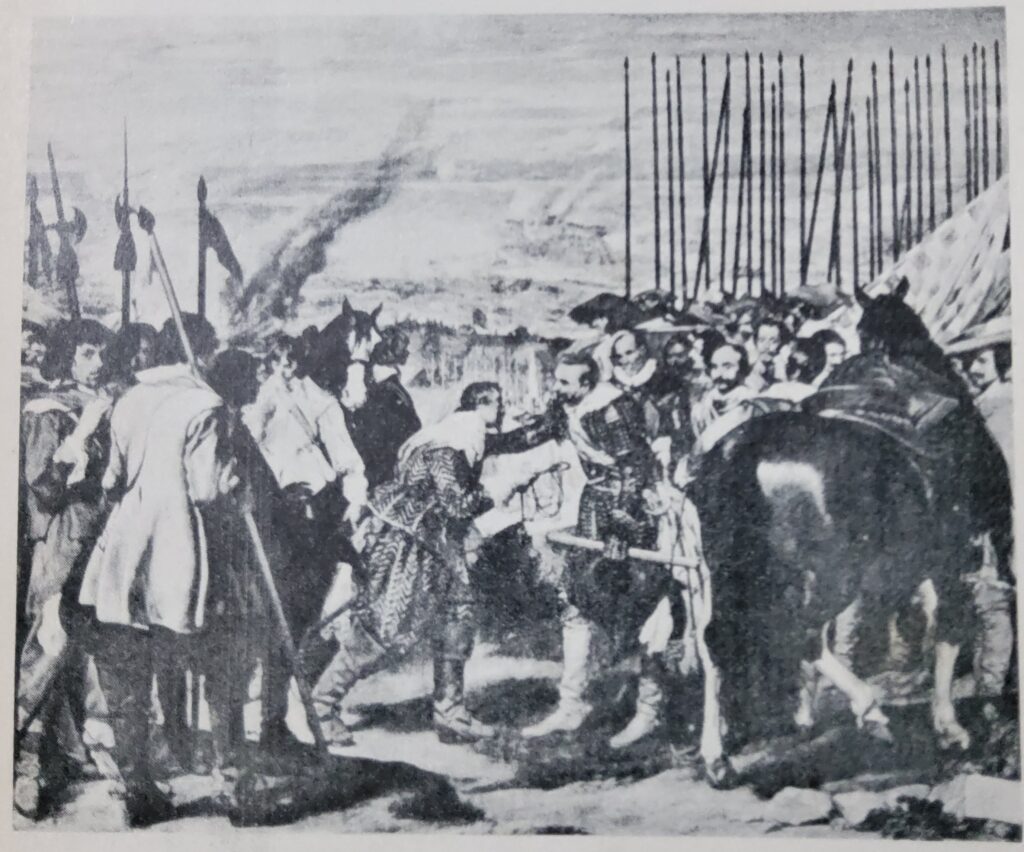
Several of the world’s great artists and writers enhanced her fame under Philip II and his successors. Diego Velasquez and Murillo, were associated with the Renaissance. Murillo was a court painter who left many portraits of the royal family. He has been widely studied because of the swiftness and surety, with which he painted the values of light and colour.
EI Greco was a Cretan who had studied in Italy under Titian before he settled in Spain. He is associated with the Reformation period.
His unmistakable style combined some Byzantine influences, with a strange, mystical element that was descriptive of Spanish religious feeling in his day. Goya’s work is mentioned in his biography.
Miguel de Cervantes wrote one of the world’s most famous satires on ‘Don Quixote’. Though outdated, the customs of knighthood and chivalry had lingered in Spain. Cervantes made them appear ridiculous. (The word ‘quixotic’ comes from the novel and means idealistic but impractical.)
Spain is proud of her art collections and museums.
Philip II built a monument to himself, that is as typical of the man, as Versailles was of Louis XIV. It is called the Escorial and was intended to be a combination monastery, palace and burial place (mausoleum). Today it ranks as one of the world’s largest buildings, it contains an art collection and the tombs of all Spanish kings. Spain is likewise proud of her museum called the Prado which, like the Louvre in Paris, houses one of the world’s great art collections.
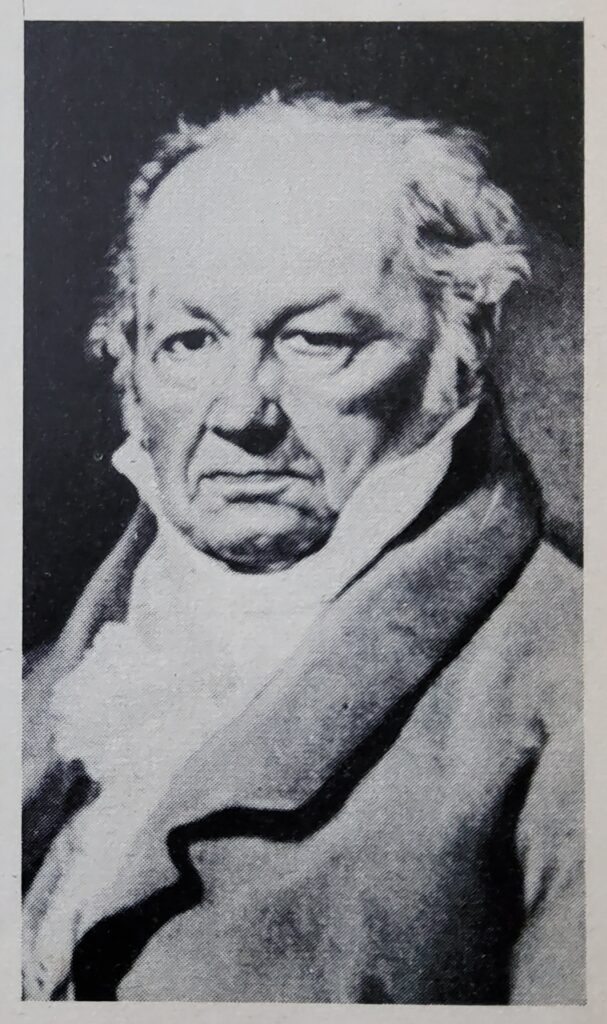
FRANCISCO GOYA Y LUCIENTES (1746 – 1828)
Goya’s life ran the gamut from adolescent street fighting and bull fighting to being director of the Academy of Arts and a painter of the royal family. His lack of class consciousness made him equally at home in the slum tavern and in the royal court.
Goya was well-trained in drawing and painting and he painted rapidly. At heart a social and political critic, he produced etchings and paintings which display a savage contempt for the life of his period. His portraits of Charles IV of Spain and his family make them look like imbeciles and criminals, yet they actually paid him for them instead of jailinghim for his impertinence. Goya was a horrified witness of the Napoleonic Wars. His painting ‘The Third Day of May, 1808’ and his series of etchings the ‘Disasters of War’, can be an antidote for anyone who thinks of this period solely in terms of glory and excitement. Late in life when he was lonely, exiled, stone-deaf and when his mind was affected by disease, he painted the eerie fantasy, ‘Witches Sabbath’, a grouping of evil, sinister figures. This and other Goya works have influenced the Expressionist painters of our day.
LINKING THE PAST AND THE PRESENT
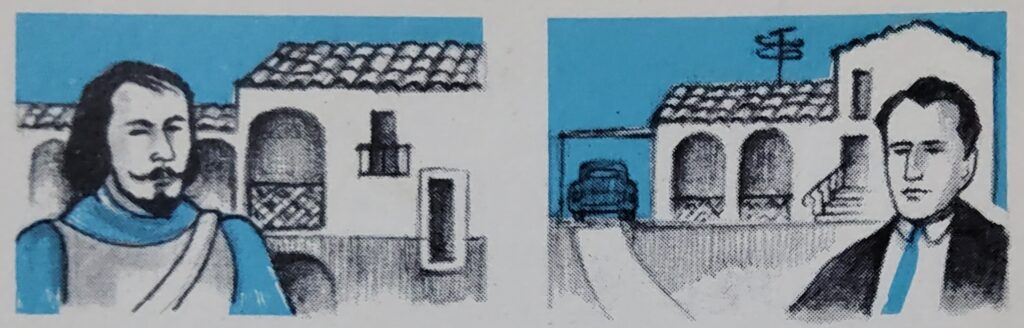
Those who live in the eastern or northern parts of American country, have had a novel and valuable experience when they travelled into the southwestern states. The place names of many cities, mountains and rivers are different. We hear a different language. Many homes and churches are built in the Spanish style, an architectural style to which we are less accustomed. We see the remains of the civilization that peoples from the Old World overran and sought to supplant. We are reminded that Spain is a nation that once had a vast colonial empire and that part of America was included in it.
This category surveys the rule of strong Tudor monarchs, weak Stuart rulers and the final establishment of constitutional government in England. Parliament became the real ruler of England; sovereigns could reign but not rule. During this period, Great Britain began building what became the world’s greatest empire of the nineteenth century.
Meanwhile, France was dominated by absolute monarchs until a bloody revolution was staged and Napoleon ultimately ruled, while he conquered much of Europe. His dream of empire was finally shattered by the British navy and a four-power alliance was formed by Great Britain, Austria, Prussia and Russia in the hope of keeping the world at peace.
While England and France were emerging from the Middle Ages as strong centralized nations, the German and Italian states remained weak and disunited. Germany had hundreds of independent states until Napoleon cut them to thirty-eight. Italy had powerful city-states but no sense of unity. The foundations of a Russian Empire were being laid during this period, but the Russian people did not share in the democratic reforms which were beginning to sweep over Europe. Spain and Portugal dared to explore new trade routes, discovered the New World and acquired the makings of an empire. Philip I, who ruled both countries for years, Was forced te acknowledge Dutch independence.