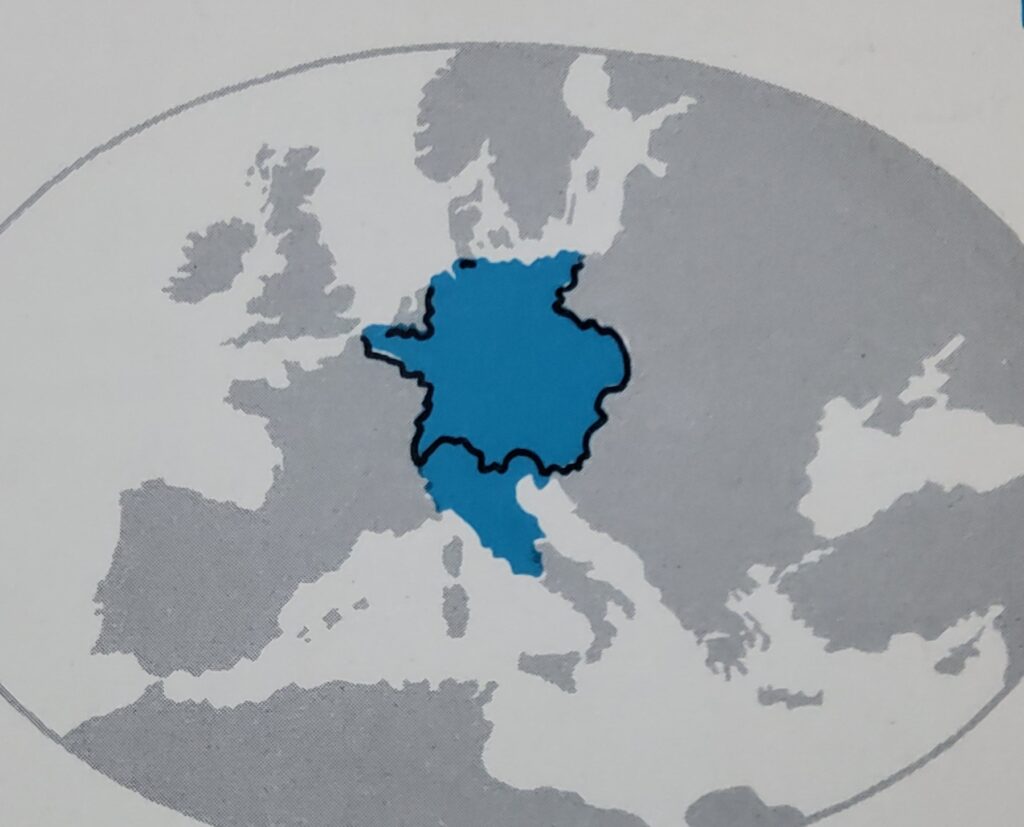
Division and weakness in Germany and Italy points up the difference between geographic unity and national unity. It concerns itself with the development of Germany and Italy, both of which were important as geographic regions, long before either area became a nation in the modern sense of that term.
During the Middle Ages and the early Modern Period, Germans and Italians proved themselves equal to any people in intellect and achievement, but they lived under a political system that neighbouring national states, had outgrown. As late as 1800, there were hundreds of independent German states, but no German nation or sense of national unity. In Italy there were a number of independent city-states, such as Venice and Florence, but much of the peninsula was ruled by Austria and the pope in Rome. The Austrian statesman, Prince Metternich, squelched every movement of the Germans and Italians toward nationalism and independence.
The contest between the Hapsburg and Hohenzollern families for the control of this section of Europe, the rivalries of Austrians, Prussians and other national groups – kept changing the map of Europe by their wars and territorial thefts. Notable too, was the intellectual and artistic achievement of both the Germans and the Italians.
THE DIVIDED GERMAN STATES
The failure of the Holy Roman Empire, left central Europe in political chaos.
The imposing title for this federation of states became an empty one, in the medieval period. It was an overly ambitious organization for combining too vast an area, inhabited by people with several languages and diverse interests. The struggle between the emperors and popes had weakened both.
Four powerful princes and three archbishops were entitled to meet and select the new emperor. Lesser princes ruled in many states, as independent sovereigns. Some cities were free and managed their own affairs. There was very little unity.
The national assembly of the Empire, was made up of representatives from the various states and met at irregular intervals. It was never a strong legislative body, but rather a congress of diplomats who represented the peculiar interests of their home states.
The interests of the emperors were divided between Germany and Italy, for the emperors claimed Italy as part of the Empire. This claim often brought them into conflict with other rulers interested in Italy, especially the kings of France and Spain, the popes of Rome and the violently independent Italian cities.
The Holy Roman emperors and the rulers of the many other German and Italian states, were more concerned with their own domestic affairs and rivalries, than they were with colonial expansion. Therefore, they were left out of the vast colonial enterprises of the sixteenth and seventeenth centuries, although Germans and Italians were active as navigators and colonists, for other countries.
The Thirty Years’ War left Germany almost devastated.
This conflict began when a powerful Protestant ruler, the Palatine Elector, was chosen king of Bohemia in 1618. His increased power, alarmed the Hapsburgs and other German princes. Ignoring the truce made between German Catholics and Protestants by the Peace of Augsburg in the sixteenth century, the fearful ones, began one of the most destructive wars of modern times. Many foreign countries were ultimately drawn into it.
The Thirty Years’ War was known as a religious war. To some extent, the opposing forces were grouped on the basis of Catholic states versus Protestant states, but strong political and economic motives were involved as well.
Unfortunately for Germany, most of the war was fought on her soil. Disorganized soldiers went about looting and pillaging. There was much disease and famine.
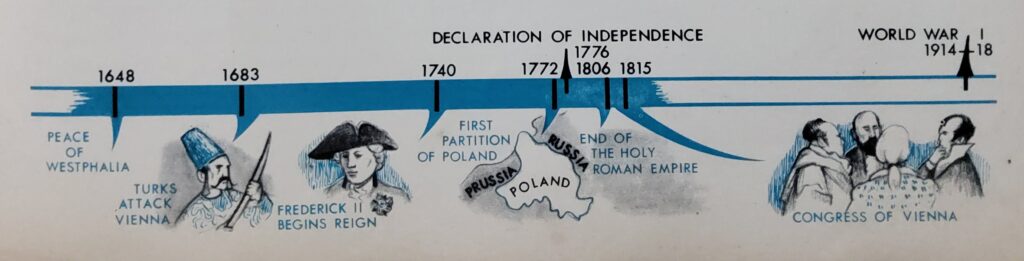
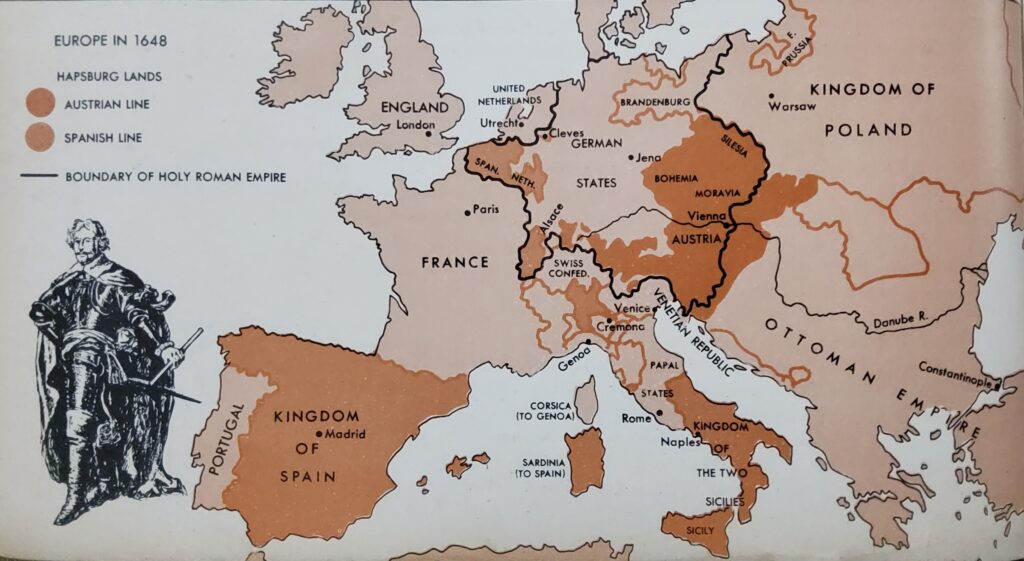
The war ended with the Peace of Westphalia in 1648. The treaty further weakened the chance for German unity, by making it possible for the individual German states to negotiate treaties with foreign powers, as well as among themselves. They could coin money, maintain armies and make war. Calvinism was added to Catholicism and Lutheranism, as recognized religions. Alsace was annexed by France and some northern territory by Sweden. Switzerland and Holland, which had proclaimed their independence at a much earlier date, were now acknowledged as independent states by the European powers.
Napoleon brought the Holy Roman Empire to an end in 1806.
As a political unit, the Holy Roman Empire had existed about a thousand years since the coronation of Charlemagne. Inspite of the fondness of the Congress of Vienna – for returning to the conditions existing before the wars of Napoleon – it did not revive the Empire. A strong German union was proposed, but was rejected by some German rulers. Austria especially, opposed the plan because her territories were occupied by various groups, including Slavs, Hungarians and Italians, who could not well be brought into a truly German state. After discussion, a loose union was established under the title of the German Confederation.
For a period after 1815, Austria was the leading German state.
It was originally founded by Charlemagne and its name means, the East Mark or march — a frontier area. As a frontier, it was hard hit by many invaders from Asia. Among these were the Magyars who settled in Hungary and the Turks. After the capture of Constantinople in 1453, the Turks moved northward and westward into Europe. The Ottoman Empire which they created, was for about four centuries, one of the leading powers of Europe. The year 1683 is sometimes considered to mark, the high tide of Turkish conquests. In that year, the Turks made their last assault on the city of Vienna, but they did not take the city. Infact, the Turkish drive was followed by collapse. Huge Austrian offensives, which culminated in the Treaty of Passarowitz in 1718, carried the Austrians below the Danube into present Yugoslavia.
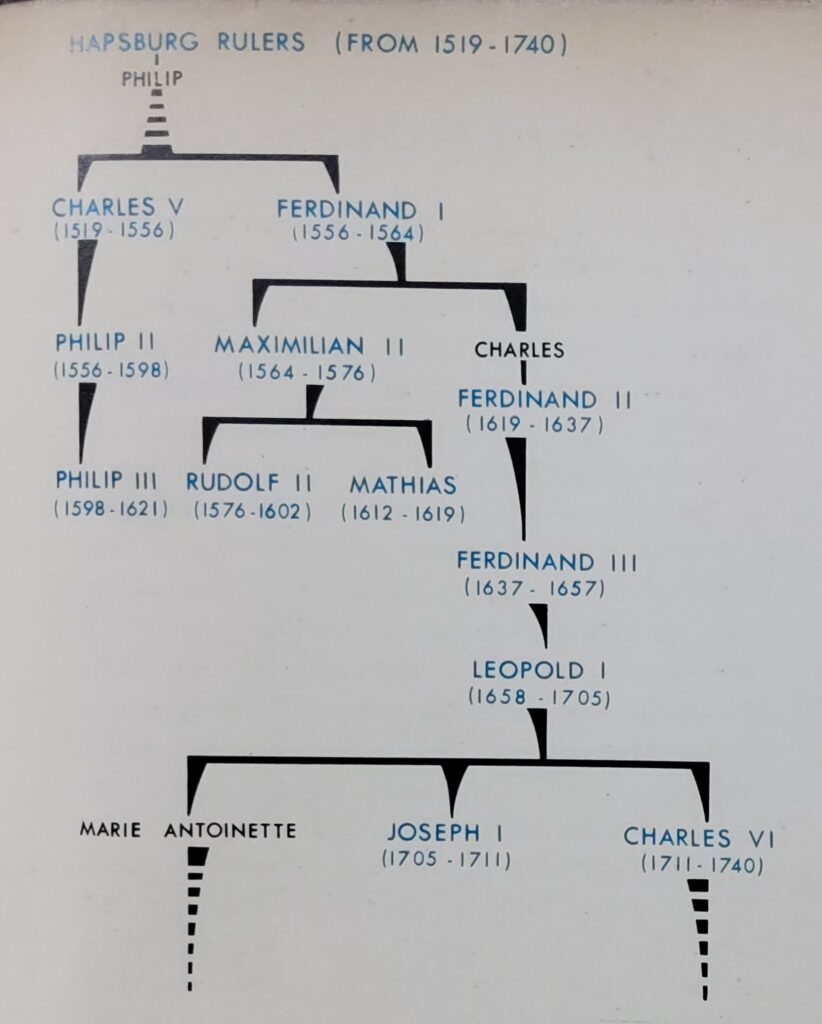
The Hapsburgs, the ruling family, made Austria an increasingly important state. By means of war, diplomacy and marriage, they gained possession of many territories, including Bohemia, Silesia, Moravia, Hungary, the Netherlands and various states in Italy. Not all of those territories were within the boundaries of the Holy Roman Empire, nor in the German Confederation.
The Hohenzollern Dynasty built Prussia, into a strong military power.
Early in the fifteenth century, the Hohenzollern family came into possession of Brandenburg, in northern Germany. Brandenburg had been another “mark” of the Empire and its ruler was called, a “margrave” meaning count of the border. Brandenburg was an electorate, hence its rulers had a vote in choosing the Holy Roman emperor.
Like the Hapsburgs, the Hohenzollern family had a burning desire to rule over more lands and people. It was inevitable that a fierce rivalry would develop between the two families. Fortunately, Hohenzollerns first began to develop their power in northern Germany; and did not come into immediate conflict with the Hapsburgs. That area consisted of a sandy plain which was not very fertile. There were some merchant cities, members of the Hanseatic League, but northern Germany was mainly a region of forests and small farms at that time.
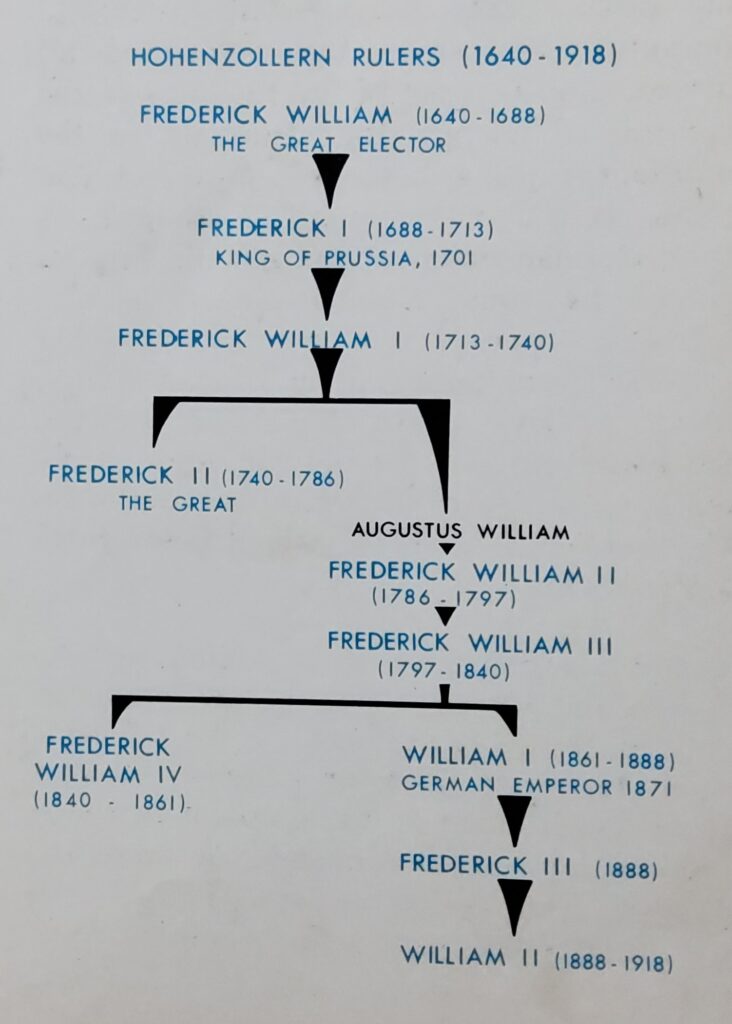
Frederick William (1620 – 1688), known as the Great Elector, gained some advantages from the Thirty Years’ War. He ruled a number of scattered territories from Cleves, on the lower Rhine, to East Prussia on the Baltic. He united these territories into one monarchy, known as Brandenburg-Prussia.
In 1713, the Great Elector’s grandson became king as Frederick William I. Frederick developed a strong army and built up Prussia as a military power. It is said that he was fond of tall soldiers, recruiting them from all over Europe by, paying them bonuses. He hated to risk these high-priced troops in battle.
Frederick was an eccentric, boorish fellow, who scorned the cultural side of life. His son, Prince Frederick, was not an heir after his father’s heart, for he was interested in art, music, literature and was a skillful performer, on the flute. All this worried the king, who feared that his son was lacking in the hardy virtues, which he deemed necessary in a ruler of Prussia.
Frederick I’s fears were ill-founded, for when his son became king in 1740, he proved to be one of the most able rulers of the century. The year he began his reign, the male line of the Hapsburgs came to an end in Austria, as it had done earlier in Spain. The last Austrian emperor, having no sons, decreed that his daughter, Maria Theresa, should succeed him. Most of the major European powers agreed, but after the emperor died, they broke their promise and attacked her. Frederick II moved into her territory without warning and conquered the rich province of Silesia. Soon afterward, in the Seven Years’ War, when Maria Theresa tried to regain Silesia, England was Prussia’s only ally against most of Europe. Frederick’s success in this struggle against great odds, won for him the title of “the Great.” In this war, Prussia and Austria, were fighting for the control of Germany.
Maria Theresa deserves admiration for her dauntless courage and tireless energy in a conflict with male rulers. Her figure was majestic, but her charm was feminine. Although she was forced to accept the loss of Silesia in 1772, she joined Frederick and Catherine the Great of Russia in seizing parts of Poland, then the second largest kingdom in Europe. Prussia gained the area of West Prussia, which had previously separated East Prussia and Brandenburg. This partition, or dismemberment of Poland continued, until Poland ceased to exist as an independent state, in 1795.
Frederick established schools and improved education. He granted religious freedom. He saw to it that justice was done in the courts of the realm. He encouraged scientific farming. He insisted on fairness in taxation and improved the position of the middle class. He furthered the economic progress of Prussia by encouraging immigration: many craftsmen, including Huguenot refugees, settled there. He devoted himself to learning, literature and invited celebrated men of letters, to visit him.
A surge of nationalist feeling swept over Germany, in the period of the Napoleonic Wars.
Shortly after the death of Frederick the Great, the French Revolution began. From that time until the overthrow of Napoleon in 1815, Prussia was frequently at war with France. In 1806, Napoleon crushed the Prussian armies at Jena. This defeat was humiliating to the Prussians, who remembered Frederick’s successes.
In the hope of regaining their military power, the Prussians set up universal military training and used the schools, to help develop better soldiers. It is said that as a result, more people could read and write in Prussia than in other European countries.
The great minister, Baron vom Stein, was mainly responsible for the program of reform, sometimes referred to as the “regeneration” of Prussia. In 1807, the remnants of serfdon, were abolished. The old social distinction, were swept away. All occupations were opened to everyone.
The reform movement in Prussia was accompanied by a surge of national feeling in all of Germany. One of the leaders in this movement, was the philosopher Fichte. An effective speaker, he told his audiences that the Germans were the one superior people and that the future, belonged to them. This idea made a deep impression upon the German people.
It was Napoleon himself, however, who made future German unity possible. He reorganized the German states, adding some to France and combining others into larger units. By 1815, Germany’s 300 separate states, had become only 38.
THE GERMAN RENAISSANCE
The Renaissance was very slow in reaching Germany.
The turbulence of political and religious wars long retarded cultural progress, but greatness in literature came in the days of Frederick the Great and immediately afterward. Among the outstanding writers of the eighteenth century were Lessing, Goethe and Schiller. Lessing was a dramatist and critic. Schiller was a poet whose best-known work is the drama William Tell. This story of the Swiss struggle for independence, put the Hapsburgs in a bad light since they had been the oppressors. The play contributed its part, to making the Hapsburgs become more and more the symbol of disunity and tyranny, in Germany and Italy.
Goethe (1749 -1832), probably Germany’s most noted writer, achieved distinction in almost every field of writing. He became world-famous at 25 when his novel, The Sorrows of Young Werther, was published. One of the greatest poets in world literature, he wrote verses throughout his life. His plays are still produced. The best known is the tragedy, Faust, a supreme statement of eighteenth-century ideals.
German composers made magnificent contributions to the world’s music.
German music had its origins in the ceremonies of the Roman Catholic Church. Luther, recognizing the importance of music in church services, wrote many hymns for which composers supplied fine melodies.
In the eighteenth century, the brilliant Bach family produced a number of musicians and composers. Johann Sebastian Bach, who composed church music, was the most famous. Handel was a court composer for the king of England. His oratorio, the Messiah, is often sung at Christmas and Easter.
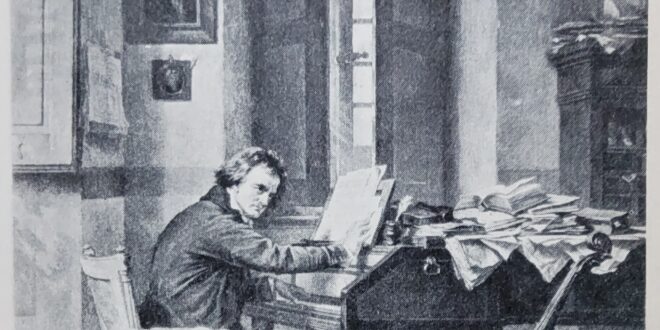
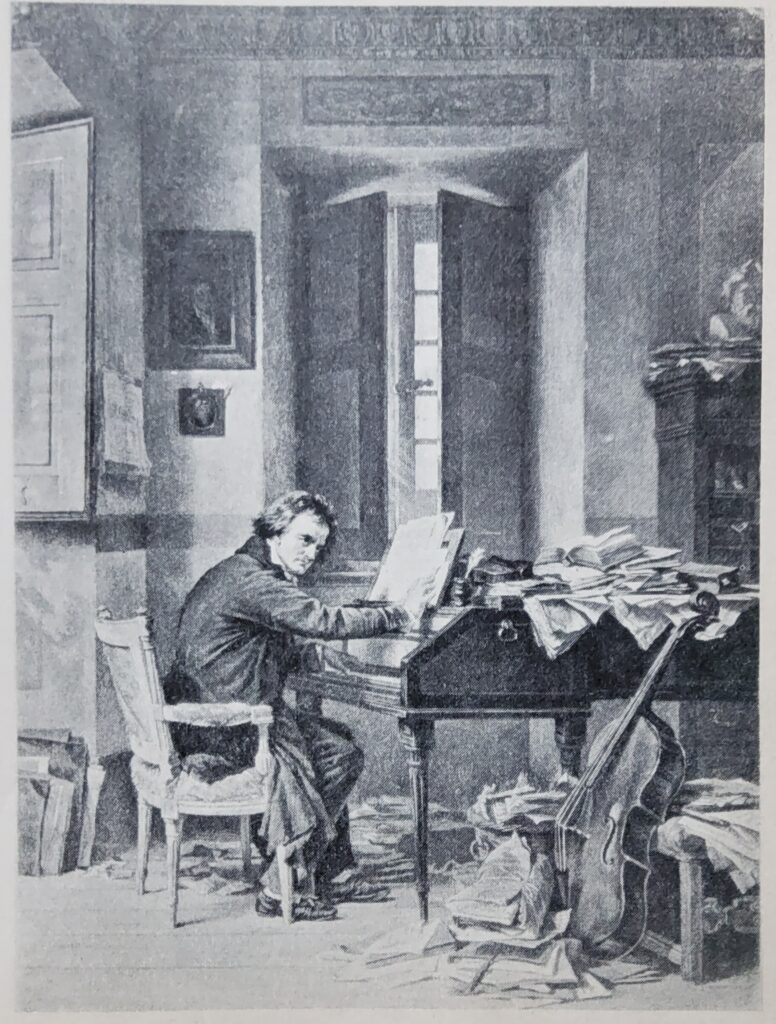
A little later came the Austrians, Mozart and Haydn. Beethoven, born at Bonn in Prussia, produced nine symphonies and other splendid works. He is considered by critics to have reached the highest peak of musical perfection, that the world has ever known. His lonely, troubled life and his triumph over the affliction of deafness, makes for a fascinating biography.
Radio, television and “hi-fi”, have made the works of these and other great composers known to millions. We can well understand why the German people have prided themselves on their music and their composers.
The German universities produced some outstanding scientists and thinkers.
Many German students left their classrooms to fight against Napoleon in the final stages of the wars against him. They went on to become distinguished poets and writers of the nationalist movement. Their lives testify to the vitality of the universities of the time.
Kant, a German philosopher who spent the greater part of his life teaching in the University of Koenigsberg, advanced scientific theories about the universe at about the time of the American Revolution.
Another thinker who dominated the German mind was Georg W. F. Hegel (1770 – 1831), who became professor of philosophy at the University of Berlin. Hegel taught that the State “has the supreme right against the individual, whose supreme duty is to be a member of the State.” His beliefs influenced the thinking of Marx, Lenin and Adolph Hitler.
Upon the foundation thus established by writers, musicians and thinkers such as these, the German universities became, in the nineteenth century, centres of philosophy, mathematics, science and political thought.
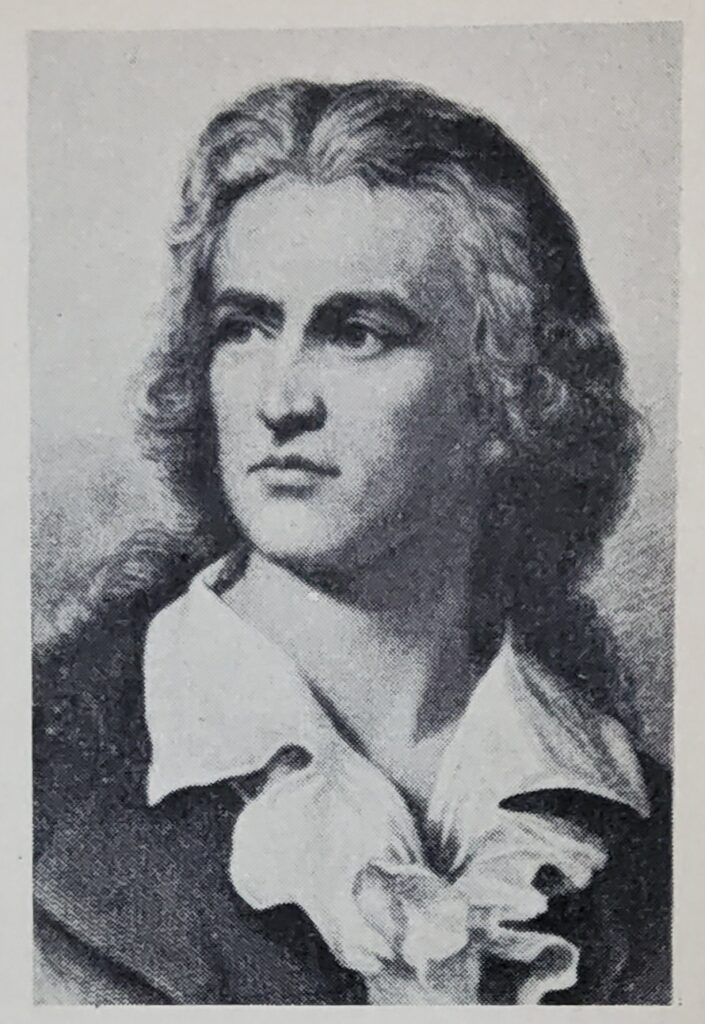
JOHANN CHRISTOPH SCHILLER — (1759 – 1809)
Schiller belonged to the brilliant group of writers who surrounded Goethe at Weimar and made that little city, the cultural centre of the German states, in the late eighteenth and early nineteenth centuries. Schiller was a strong believer in freedom and hated with a passion, all forms of absolute rule. He became a foremost leader in arousing a spirit of liberty and unity, among the German states and did his part in laying a foundation for the creation, of a German nation.
Schiller is best known for his drama William Tell, which was based upon an incident involving the Swiss hero of that name. This play, published in 1804, is considered his most popular and important achievement. The Italian composer, Rossini, was inspired to base an opera on the drama.
DISUNITED ITALY
Its medieval inheritance of strife and disunity continued to handicap modern Italy.
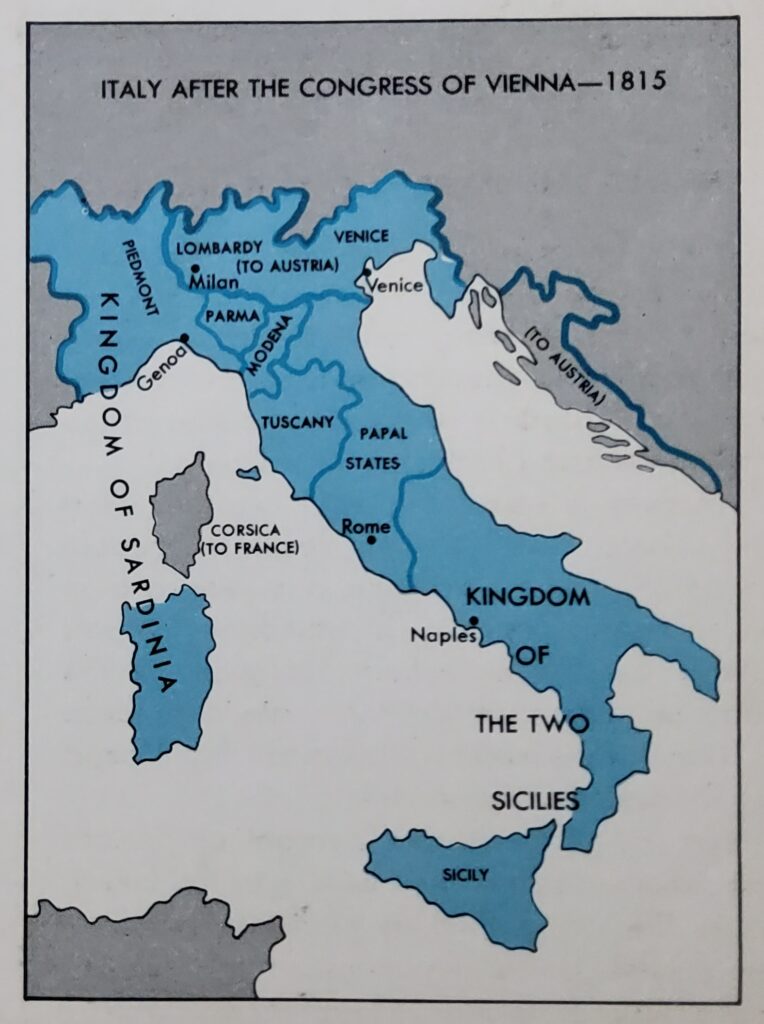
Until the middle of the nineteenth century, a map of Italy looked much as it had in the Renaissance period. The popes ruled the Papal States in central Italy. In southern Italy was the Kingdom of Naples or as it was sometimes called, the Kingdom of the Two Sicilies. Northern Italy continued to be broken into a number of small states and city-states. Venice was one of the largest and most important, although her commerce fell-off after 1500, when the Atlantic replaced the Mediterranean, as the chief artery of trade. In the area between France and Italy, the territory of Savoy slowly gained prominence, until it became the Kingdom of Sardinia.
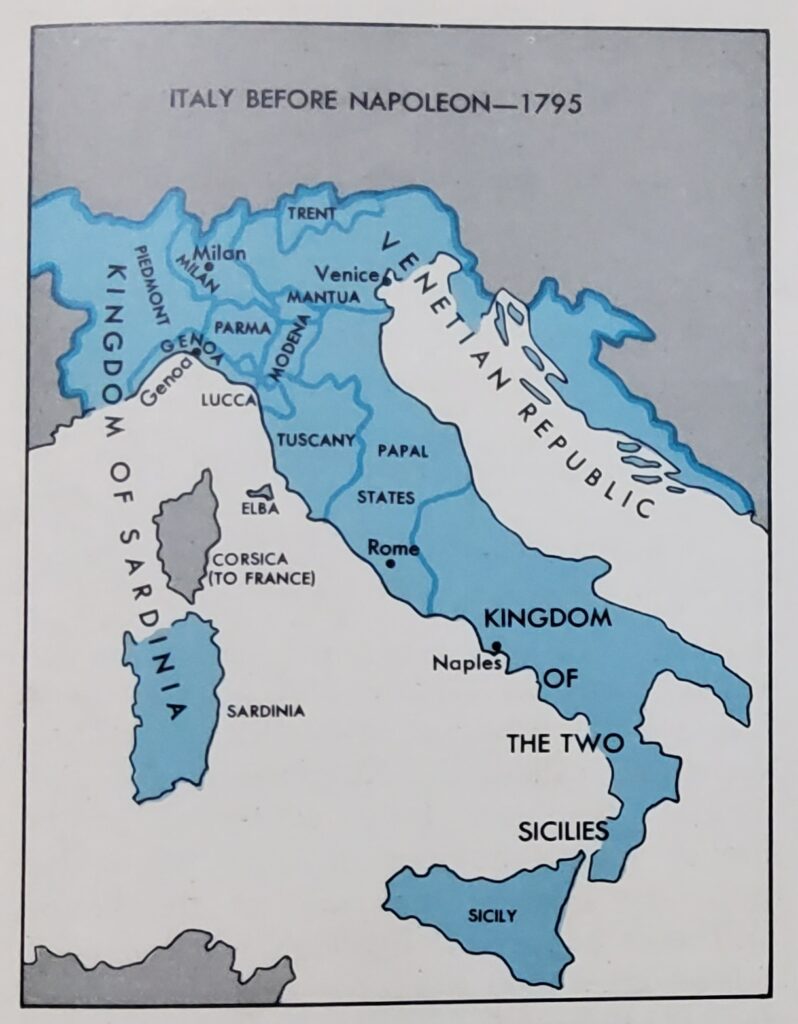
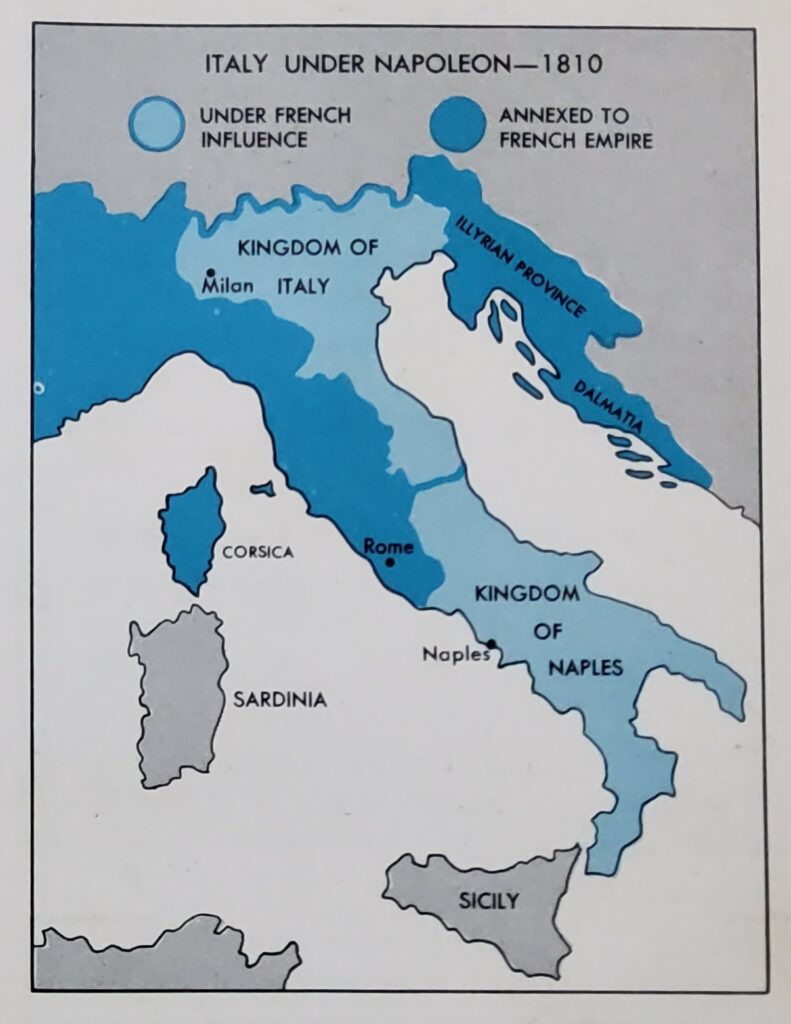
Napoleon transformed Italy and laid the foundations for a nation.
He began his career with a series of brilliant victories over the Austrians in northern Italy. He ended the existence of the Republic of Venice. He took the pope as a prisoner to France. Except for the island of Sicily, he conquered all of Italy with comparative ease and held it until his downfall. He introduced some benefits such as the Code Napoleon.
In 1815, the Congress of Vienna restored the conditions of 1789, for the most part, in Italy. In the northwest, the Kingdom of Sardinia reappeared. It had been a kingdom of minor importance since the Treaty of Utrecht, in 1713. Most of northern Italy went to the Hapsburgs. Lombardy and Veneti,a became the Lombardo-Venetian Kingdom. Modena, Parma and Tuscany, were given to members of the Hapsburg family. The pope was restored to the Papal States. The “Two Sicilies” were placed under a Bourbon ruler allied with Austria. Sardinia was the only Italian state, which remained independent and under the rule of an Italian prince.
During a thirty-year period following the Congress of Vienna, Prince Metternich was the leading statesman of Europe. As the chief minister of the Emperor of Austria, he was determined to hold down revolutionary and nationalistic movements in the lands controlled by Austria and the countries under her influence. His policy could be termed divisa et impera, divide and rule; through its central position, Austria could control a large region. The time was to come, when German and Italian nationalism could not be denied.
Italy has remained an important centre of culture.
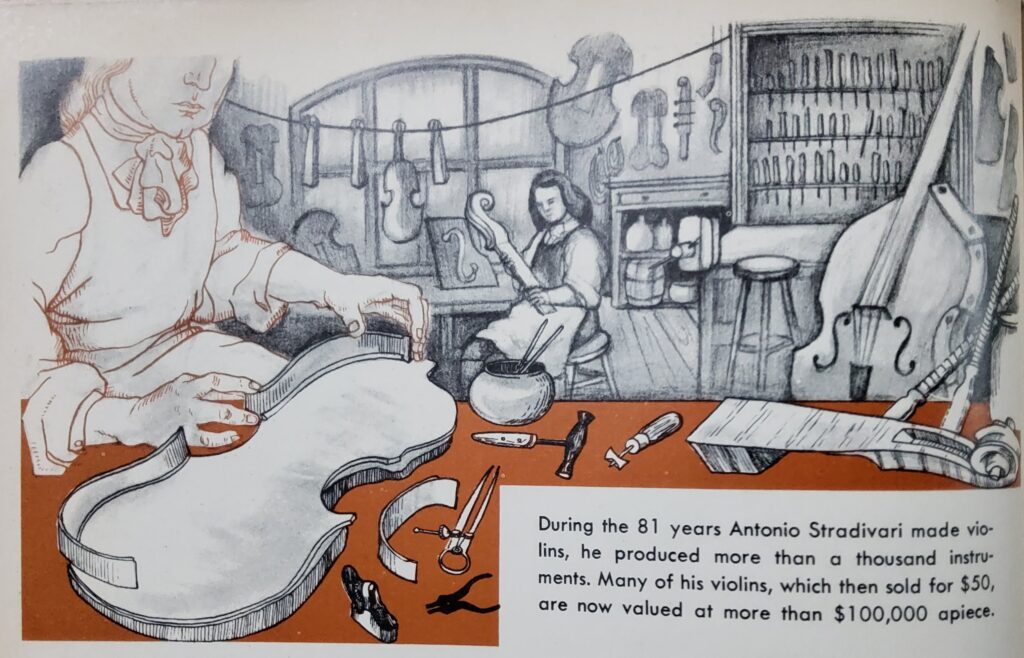
Although the peak of the Renaissance has long since passed, the masterpieces of Italian painting, sculpture and architecture, have continued to lure tourists and students to Italy. For a time, the opera was almost the exclusive development of Italian composers and singers. Also in Italy, a perfection in the making of violins was achieved at Cremona, by the Stradivarius and Guarnerius families.
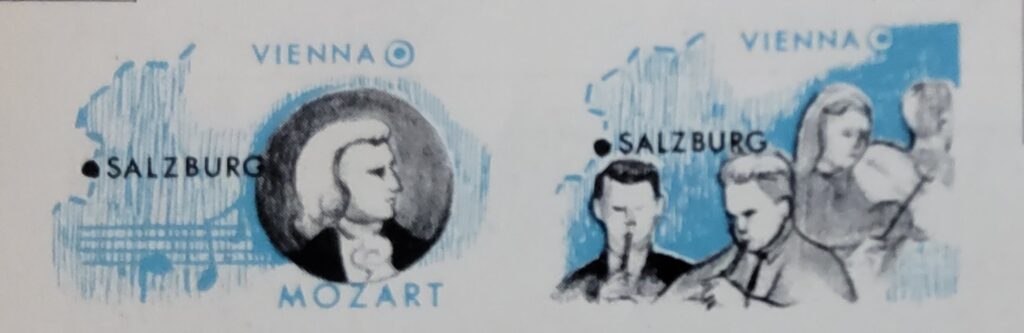
LINKING THE PAST AND THE PRESENT
The stupendous achievements of the eighteenth-century German composers — Bach, Handel, Haydn, Mozart and Beethoven — gave their land a rich musical heritage and a tradition. An illustration of the preservation of the tradition, is found in the city of Salzburg.
Salzburg is associated with Mozart’s short and unhappy life. After his death, the people honoured him with monuments, a museum and an annual music festival. Thousands of visitors attend the latter, to hear his music in the beautiful alpine setting that helped produce it. Many of the medieval buildings that Mozart knew, have been preserved.
Thus, at Salzburg, the Germans perpetuate one precious item in their culture as the French do in the art collections of the Louvre and the English do in the constant renewal of Shakespearean drama at Stratford-on-Avon.
EVENTS IN THE THIRTY YEARS’ WAR (1618 – 1648)
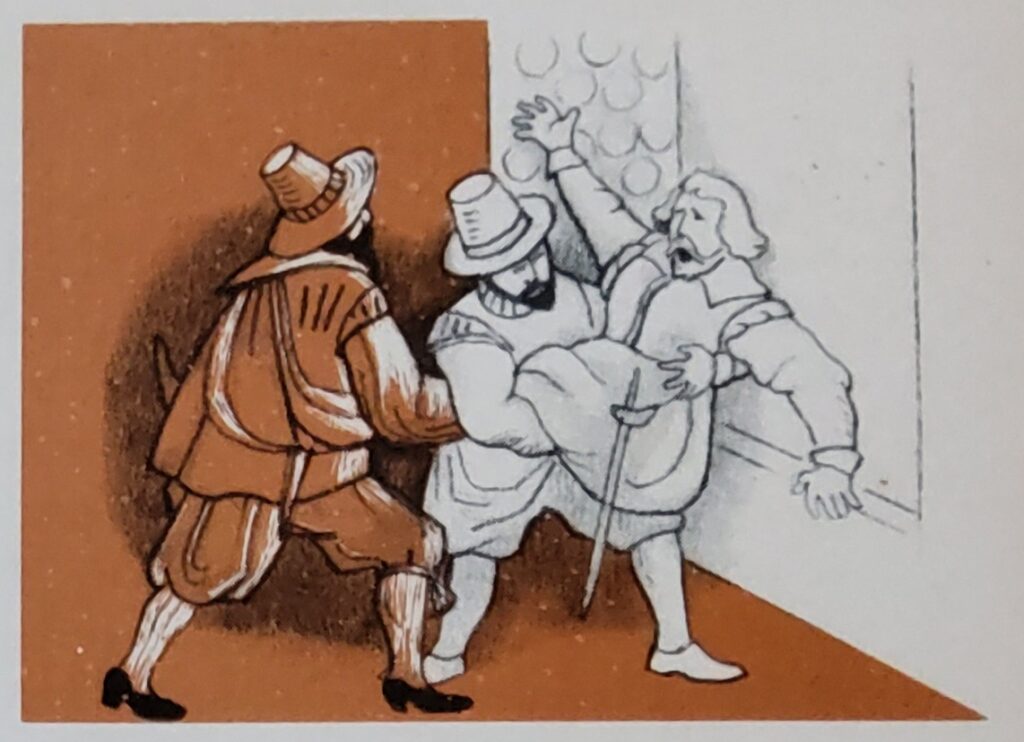
1618 -1620 Outbreak in Bohemia
Protestant leaders revolt against the Catholic king, Ferdinand Il and choose Frederick V, elector of Palatine, for their king.
Defenestration of Prague takes place. Offending officials are punished by an old Bohemian custom called defenestration, literally, being thrown out of a window.
Ferdinand is made Holy Roman Emperor. In 1620, his general, Johan Tserclaes, Count of Tilly, defeats the Bohemians in the Battle of the White Mountain. As a result of this battle, the Bohemians lose their independence and Catholicism again becomes the state religion.
1625 – 1629 The Danish Period
Anxious to gain control over the North Sea ports, Christian IV, king of Denmark, invades Germany and opposes the forces of Ferdinand II, in Saxony. The Danes are defeated by forces commanded by General Tilly.
Both sides sign the Treaty of Lübeck (1629), which is soon nullified by Ferdinand’s Edict of Restitution. The Edict provides that all Catholic Church property which the Protestants have acquired, shall be returned. This order becomes a new source of irritation and friction.
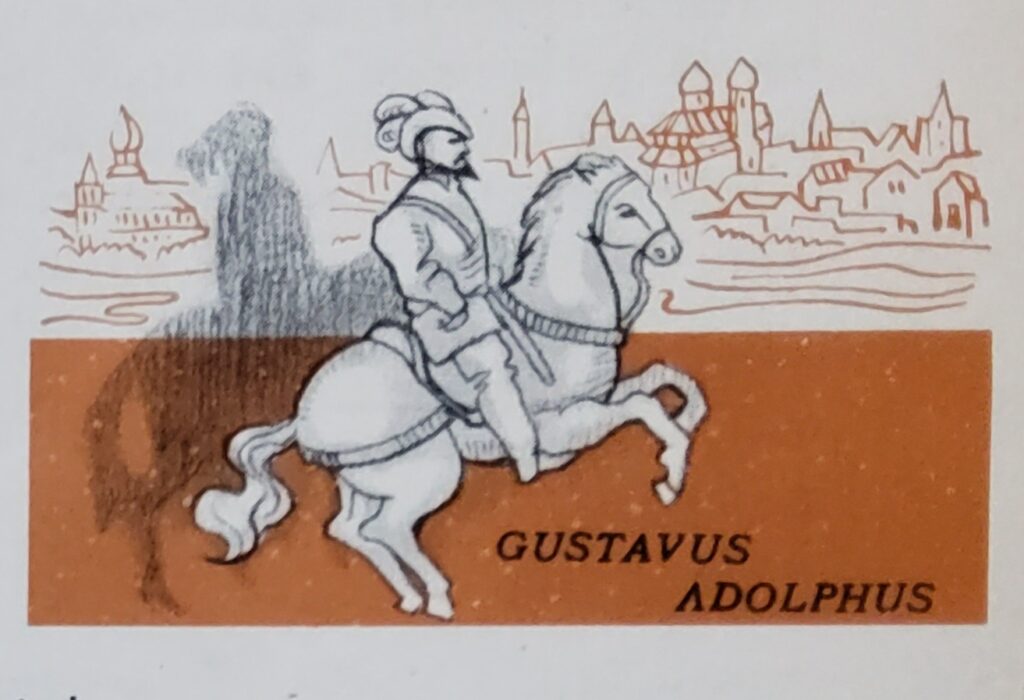
1630 – 1635 The Swedish Period
The Swedish king, Gustavus Adolphus, brings politics into the war. A zealous Protestant, he sees Sweden endangered if Emperor Ferdinand gains more power. He sails for Germany with 13,000 men and defeats General Tilly’s army in the Battle of Breitenfeld (1631). Emperor Ferdinand recruits another army. It is defeated by the SWedes in the Battle of Lützen (1632). Gustavus Adolphus is killed.
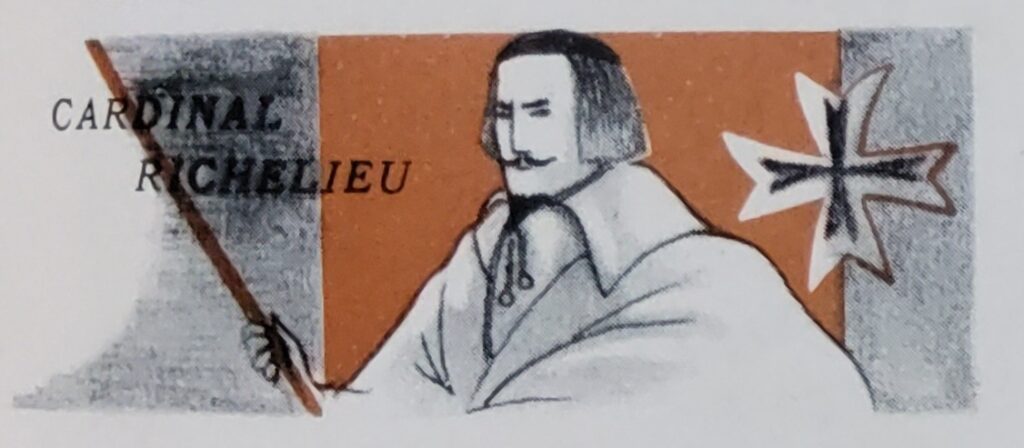
1635-1648 The French Period
At this stage, the war becomes purely political. Wanting to block the growth of Hapsburg power, Cardinal Richelieu aids the Protestants. The war becomes a struggle between the French Bourbons and the Austrian Hapsburgs.
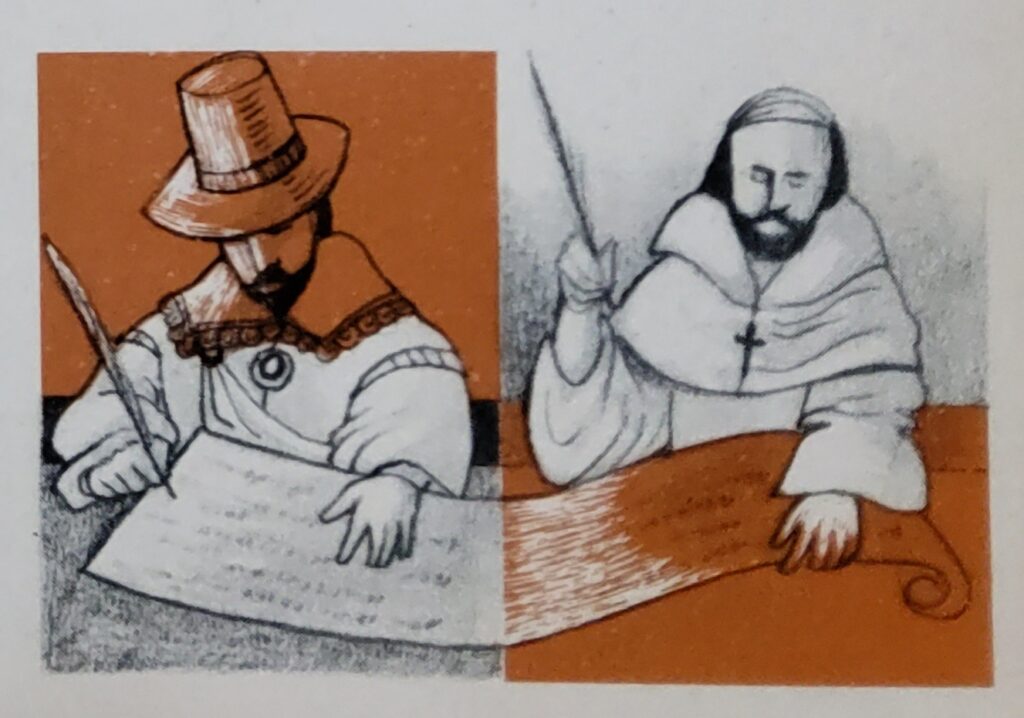
1648 The Peace of Westphalia
In 1644, the European countries send representatives to a peace conference. Catholic and Protestant delegates meet separately in two different cities of Westphalia. After four years of negotiations, the Peace of Westphalia is signed in 1648. Under this treaty: properties and authority are returned to the Protestant princes of Germany; France acquires Alsace and Lorraine; Sweden obtains extensive territories on the German coasts of the Baltic and North Sea; Calvinism is put on an equal footing with Catholicism and Lutheranism in Germany.