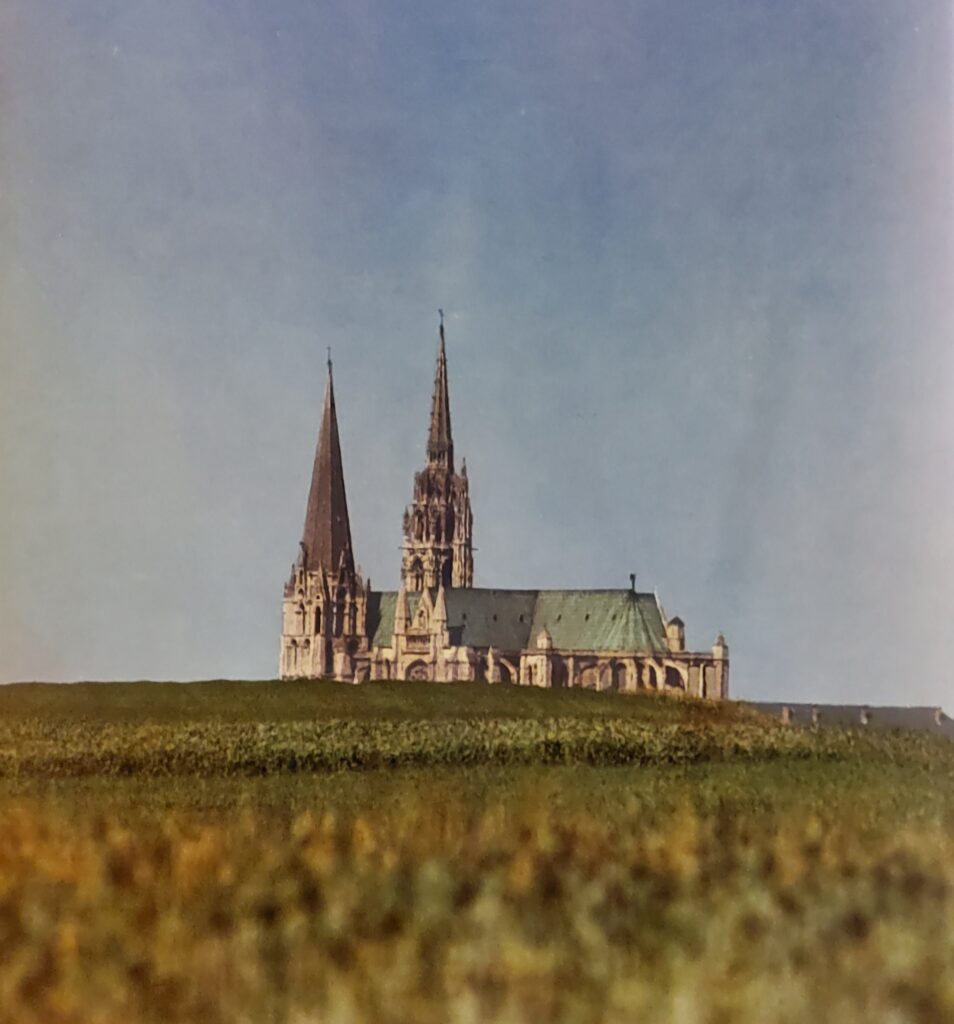
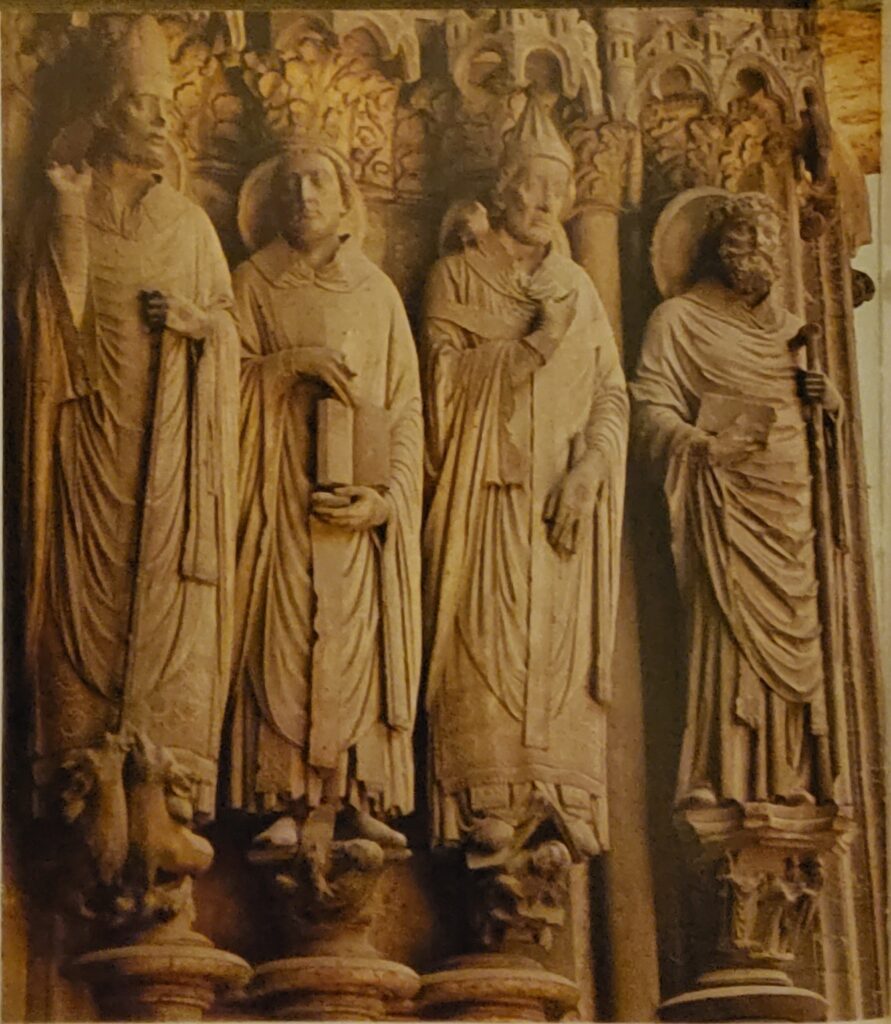
Notre-Dame, Palace of the Virgin, with its clusters of columns, its soaring arches, its superb stone carvings and its matchless stained-glass windows, the cathedral of Notre-Dame de Chartres, is perhaps the finest achievement of the Gothic movement that swept Europe, in the thirteenth century. A disastrous fire of 1194, left little more of Chartres’ old cathedral, other than the western towers and the crypt. In a great burst of energy and artistic creativity, the reverent people of the small French town, rebuilt their “palace of the Virgin”, in the remarkably short span of twenty-five years — for this reason, Chartres Cathedral shows more unity of design, than most Gothic cathedrals. Notre-Dame de Chartres, has been called a Bible for those who cannot read: the saints appear immortalized in stone at the portals; the glorious windows present Old and New Testament stories; and the arches and columns carry their eyes — along with their thoughts — heavenward.
On June 10, 1194, the cathedral of Notre-Dame de Chartres, rebuilt in the eleventh century by Bishop Fulbert, was destroyed by fire. Only the crypt, the narthex, the two western towers and the Portail Royal — built early in the twelfth century — were spared in the disaster, which also engulfed a great part of the small city, some fifty miles southwest of Paris. From this catastrophe, there arose a cathedral that in its architectural design, its sculptures and its stained glass windows, constitutes one of the outstanding proofs of the Gothic genius and one of its most original in expression.
Thanks to the religious faith of the Middle Ages, Notre-Dame de Chartres was largely rebuilt in a quarter of a century. The Book of the Miracles of Notre-Dame, tells of the enthusiasm of the enormous number of staunch Christians, who took part in the rebuilding of the cathedral. They transported the materials across the flat country of Beauce and even harnessed themselves, to the heavy wagons of lime, timber and stone.
Everything favoured the immediate rebuilding of the cathedral, which was achieved through the generosity both of anonymous believers in the diocese of Chartres and the whole of northern France, as well as the munificence of French and foreign rulers. Among the royal patrons of Chartres, was Richard Coeur-de-Lion, who although he was at war with Philip Augustus, was eager to make his offering and to contribute to the restoration of this famous cathedral, dedicated to the Virgin Mary. Christian unity was not yet an empty phrase.
From 1210 onwards, services could be held in the new nave. On January I, 1221, the choir was handed over to the cathedral chapter. Between 1230 and 1235, the transepts were finished and in 1260, with the solemn consecration of the rebuilt cathedral, the work had virtually been completed.
Perhaps the brilliant but anonymous architect responsible for the plan of the new cathedral, came originally from Laon or Soissons, that is to say, from northern France, where Gothic art had recently emerged with such striking innovations. The consecration of the abbey church of Saint-Denis on June 11, 1144, had ensured the transmission of the Gothic style to the whole of France and its influence at Chartres, can be seen in the transverse ribbing of the cathedral towers. More so in the Portail Royal, which was inspired by Saint-Denis and escaped the fire of 1194.
The second half of the twelfth century, had been an age of rich and promising architectural experiments. Cathedrals were planned and built with widely differing plans — Laon, with its single aisles. Paris, with its double aisles. Sens, with no transepts, Noyon, with the ends of the transepts semicircular in form and Senlis, with an ambulatory surrounded by chapels. With the exception of Sens, all these cathedrals have great galleries or triforia above their aisles and all of them, including Sens, have sexpartite nave vaults.
The architect of Chartres had no wish to copy these designs, splendid as they were. To understand his intentions, one must bear in mind the existence of the great crypt built in the eleventh century by Bishop Fulbert and the considerable limitations this imposed on the ground plan. The architect was sufficiently ingenious, to overcome all these practical problems — in fact they provided him with inspiration. The interior of the building, which is some four hundred and thirty feet long, has a complete unity of conception, because of the speed with which it was built – apparently with no second thoughts or regrets. The nave, fifty-four feet across, is wider than that of any other cathedral, because of the Romanesque foundations of the existing crypt. It is divided into seven bays, not counting those between the two towers on the west front and is flanked by single aisles, which are repeated again in the transepts. The transepts, over two hundred feet long, almost form a second cathedral, at the centre of this vast church. The choir has four rectangular vaults and a semicircular apse with seven bays. It has also a double ambulatory with seven shallow apsidal chapels.
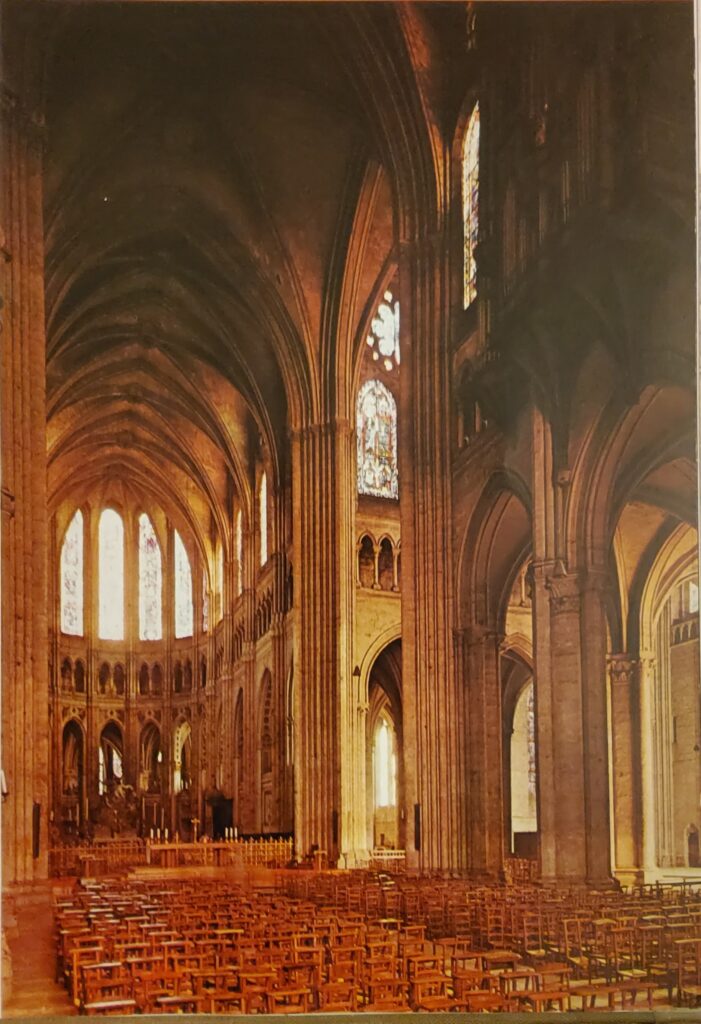
Had it not been for the exceptional width of the main structure, the architect would almost certainly have given the cathedral greater height. As it is, the main vault is about one hundred and twenty feet high, surpassing those of Senlis, Laon and Paris. Chartres itself was soon to be surpassed by Reims, Amiens and above all, Beauvais – the most daring structure ever attempted by Gothic architects. Thanks to the unknown architect of Chartres at the end of the twelfth century, the way was opened up for a new style which most of Europe eventually embraced.
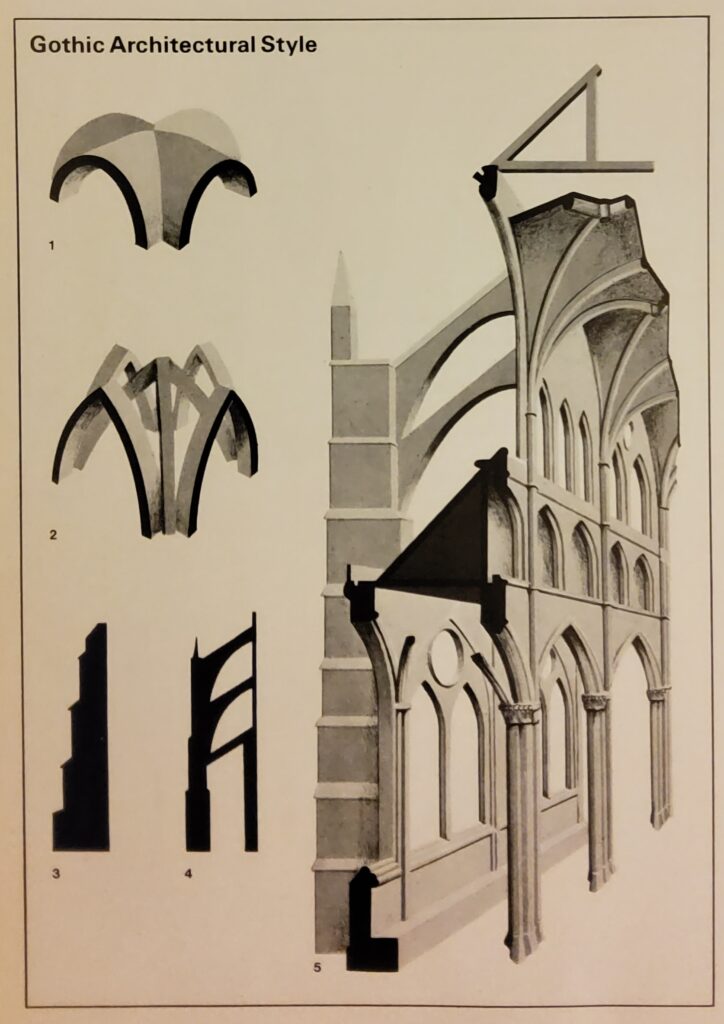
It was a vital turning point both from the esthetic and the spiritual point of view, a decisive flowering that was to dominate all others. It was the master builder of Chartres who designed the pure Gothic style. He discarded excessively wide spans covered by sexpartite vaults and built the main structure with rectangular quadripartite vaults. He abandoned the triforia, which reduced the amount of light in other buildings. At Chartres, the simple and graccful arcades are above the great archways of the nave and choir and in the clerestory he replaced the small, timid windows of the carly Gothic period, with two large vertical windows surmounted by a rose, thus reducing the wall at this point, almost entirely to glass. He also replaced the cylindrical columns such as may be seen at Laon, Durham or Paris, by shafts divided into small columns which foreshadowed the later column clusters of Amiens, Reims and Beauvais. Finally, on the exterior, he was the first architect to devise a systematic use of the flying buttress, to withstand and counterbalance the forces exerted by the vaults.
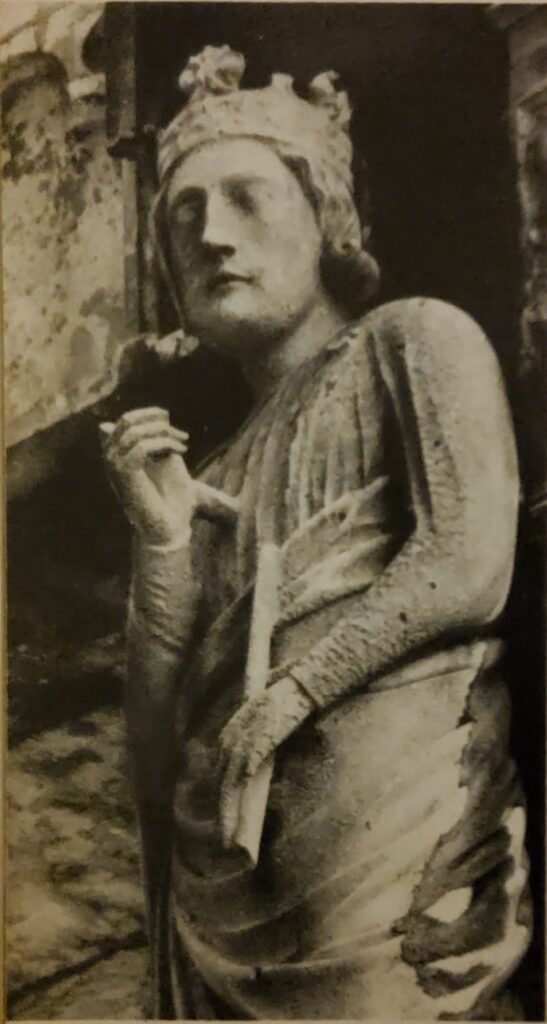
“Cathedrals inevitably remain unfinished…”
The whole building was as sound as it was daring. This new predominance of void over solid was used in an equally masterly fashion on the façades of the transepts, which were pierced with five large lancet windows, surmounted by glowing rose windows. This feature was derived from Laon, developed at Chartres and soon afterwards, brought to even greater magnificence in Paris. It was from Laon, too, that the architect of Chartres took the idea of a multiplicity of towers. He had inherited from the Romanesque period, the two towers on the western façade, but this was not enough. He began the construction of further towers on either side of the façades, of the transepts. In addition to and following a Carolingian tradition, two further towers were erected at the springing of the apse. Both are incomplete. If one adds the lantern, doubtless intended above the crossing, there would eventually have been nine towers soaring above the city. No one had the courage to complete this imposing project. “Cathedrals,” said Auguste Rodin in a later age, “inevitably remains unfinished. . . .”.
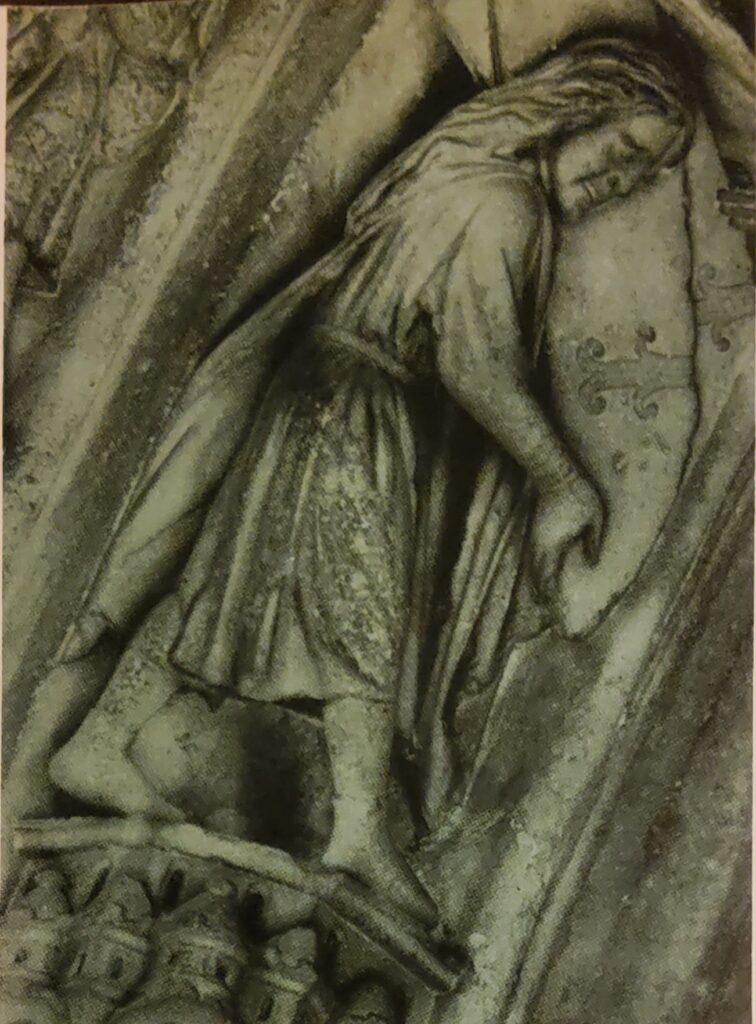
Nevertheless, the “Classic” cathedral had been born and now imposed itself, on the Christianity of the thirteenth century. The ceaseless craving for light sprang into life at Chartres and what Chartres symbolizes above all — with boldness, but not recklessness — is the victory of the spiritual, over the material. The time was not yet ripe for the next leap forward: time was, in every accepted sense of the term, at a stop, a divine moment within which the whole spirit of the century of St. Louis was embraced.
More than any other cathedral, that of Chartres is the living proof of the magnificence, which the Church of the thirteenth century wished to confer upon the house of God. The Abbé Suger, a century before, had declared his intentions without ambiguity at the time of the reconstruction of Saint-Denis; and in this he was faithful to the explicit instructions, which he had been given by the Order of St. Benedict, to which he belonged and even more precisely, to the policy laid down by Hugues de Cluny. “The spirit in its blindness, strives towards the truth through the medium of material things and upon seeing the light, recovers from its previous despondency.” These words of Suger were carved on the very portal of his abbey church and in this way, he repudiated that latent craving for austerity, which was sometimes carried to the point of schism or even to the heresy of iconoclasm – which had always been condemned by Rome, but which had held so much attraction for successive Church reformers.
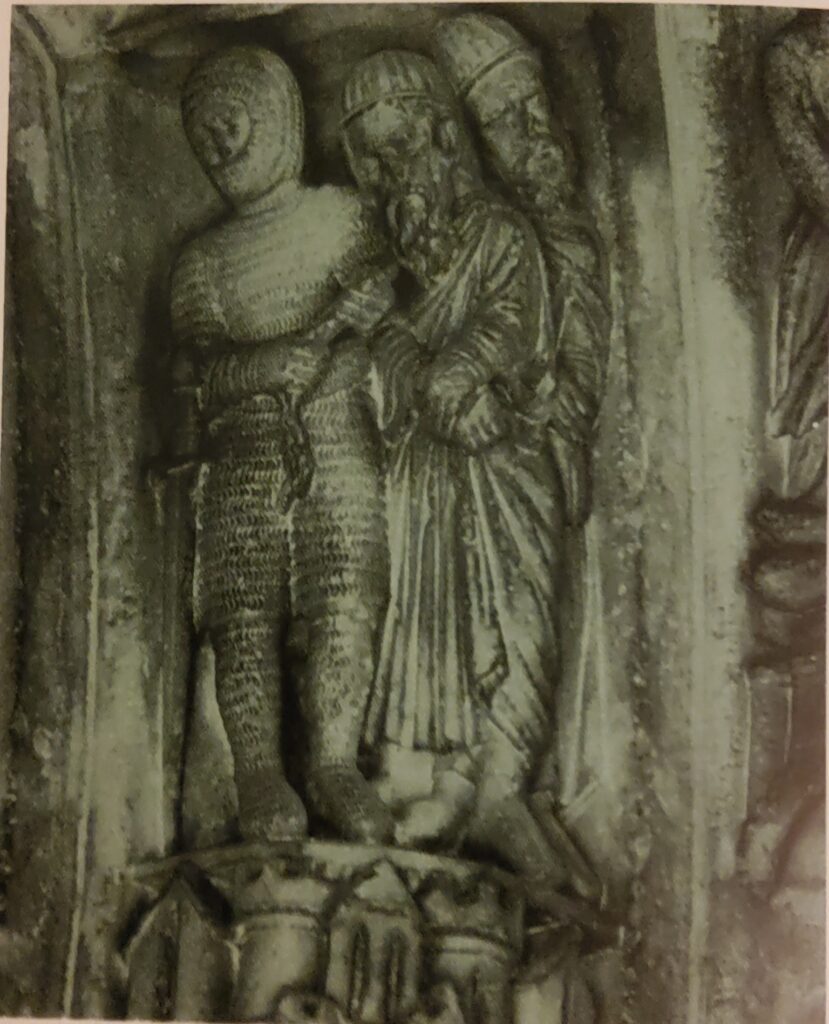
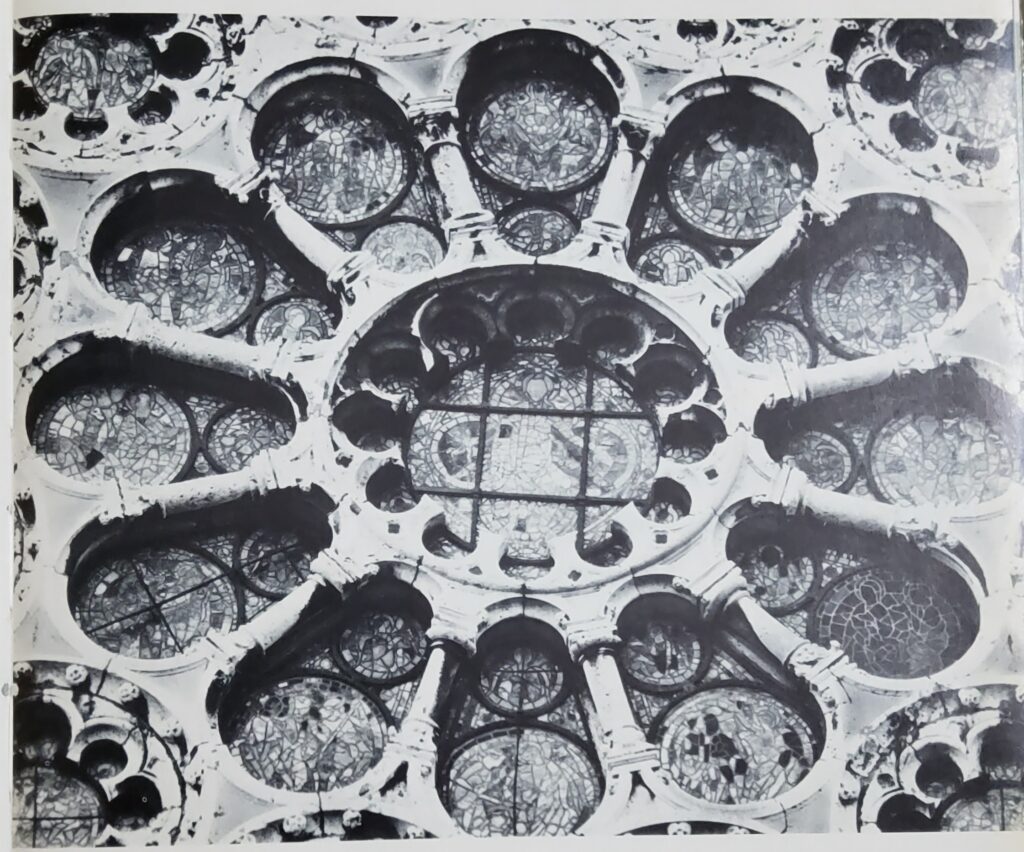
This magnificence, which transformed the cathedral of the thirteenth century into a forerunner of the heavenly city, had its most obvious manifestation in the glory of its stained glass windows. The Abbé Suger had, once again, been the innovator, but the introduction of stained glass was also a direct consequence of the technical achievements of Gothic architects. The windows and rose windows, of the cathedrals of the thirteenth century, never ceased to increase in surface area. Walls were constantly lightened and reduced to a simple tracery of stone and so, the stained glass window acquired supreme importance. This tendency had already been foreshadowed at Saint-Denis, but first came to fruition and made its greatest impact at Chartres. The attenuation of the masonry reached its ultimate perfection in St. Louis’ Saint-Chapelle at Paris, which was consecrated in 1248, but it is impossible to comprehend this quest for translucency, without examining Notre-Dame de Chartres.
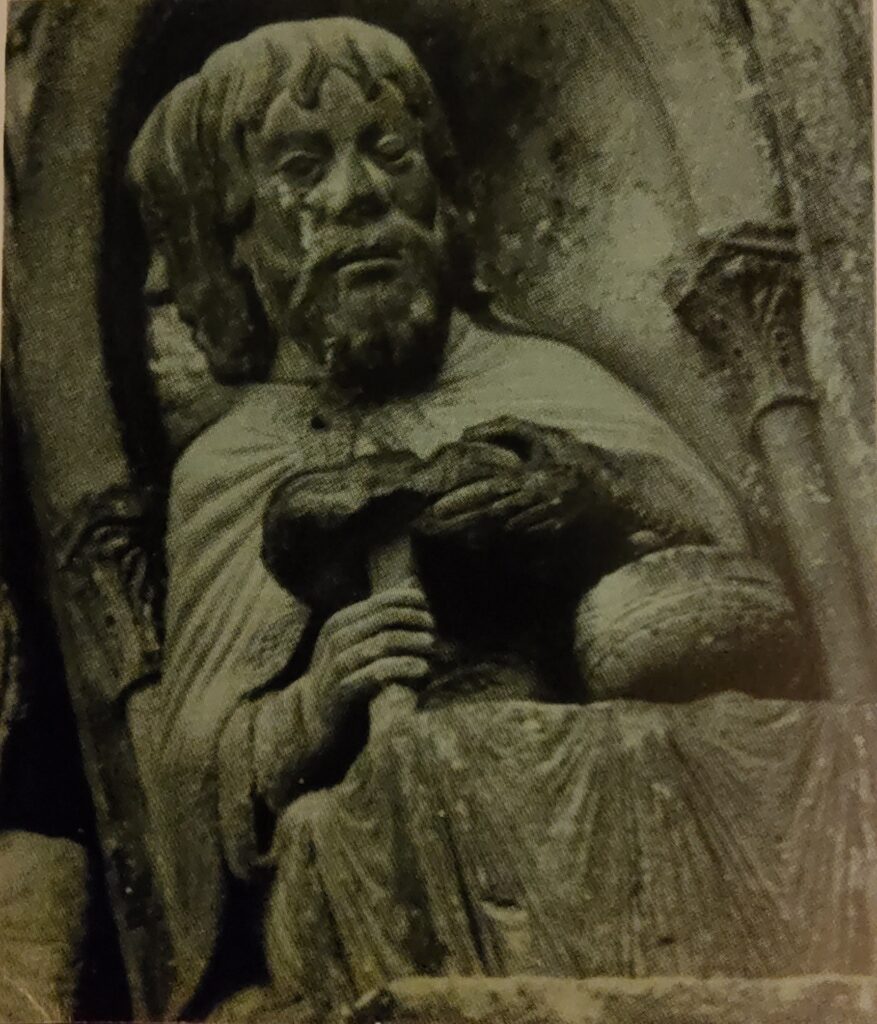
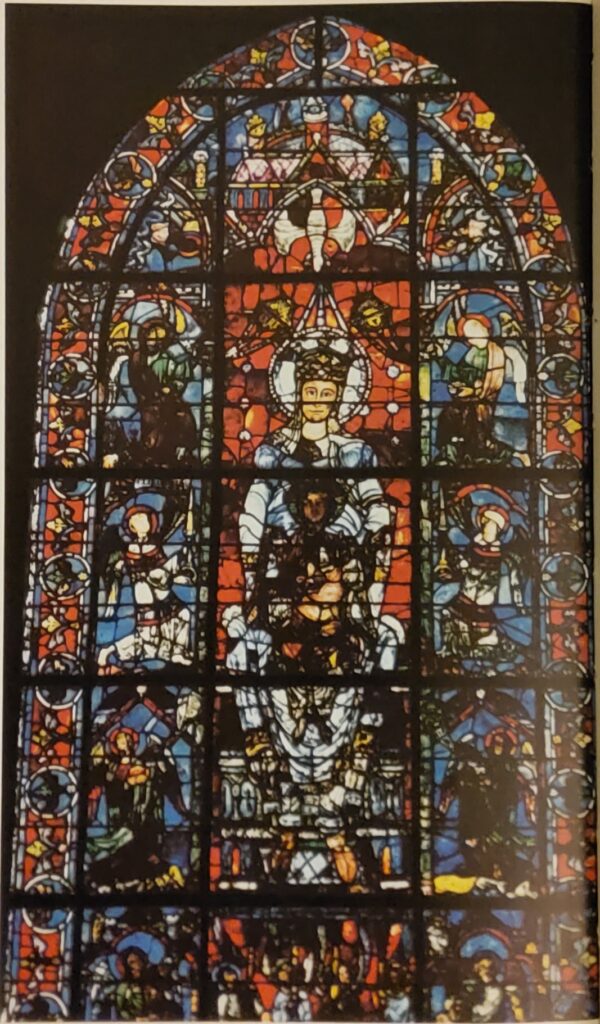
The stained glass was not simply a form of decoration, but was also a history book of religious teaching. There was nothing superfluous in this feature which was directed, as Gerson says, “to those who cannot read what they should believe.” In the entrance portals at Chartres, the Old and New Testaments are strictly interpreted as evidence of the fulfillment of the divine promise. The stained glass windows above the choir are devoted to the mysteries of the Virgin, the patron saint of Chartres: just as in those of the north rose window, the Virgin Mary is honoured as the Mother of Jesus and is acclaimed by the kings and prophets, of the ancient law. The prophets, symbolically carrving the evangelists on their shoulders, also appear in the south rose window, which presents the eternal Christ as described in the Apocalypse of St. John. Finally, the lives of the saints occupy a prominent place.
Many of these legendary windows, parucularly those in the aisles where they are more easily seen in detail, were donated by the city guilds: blacksmiths, furriers, bakers, innkeepers, money-changers – donors from all walks of life, who were anxious to play their part in the building of the cathedral, just as in their daily lives they dedicated their work to God. In accordance with religious teaching and with the time, their donations were contributions towards the achievement of redemption.
The cathedral of the thirteenth century was the product of enthusiastic and sustained cooperation, a house of God above all, but in that very capacity – a house of the people of God. It was the result of a degree of “participation,” in the full sense of the term, that the twentieth century is anxious to reinstate. In the heyday of Christian Europe in the Middle Ages, on the other hand, the term “participation” was applied quite literally by the administrators of Chartres, Paris, Amiens, Reims, Bourges and Strasbourg and by all those who appointed themselves, pioneers of the Gothic message beyond the confines of the kingdom of St. Louis.
Asserting the unity of Christian dogma
In fact, the thirteenth century was above all an age of synthesis — theological, philosophical, historical, literary and esthetic. The cathedral was the material and spiritual embodiment of all the scholastic summa of men like Thomas Aquinas and Albertus Magnus, of that “universal mirror” of a Vincent de Beauvais, that brought together in a single group, dedicated to God, the riches of nature, the achievements of thought, the victory of virtue over vice and the divinely inspired development of mankind, from the ancient law to the new. This then was the cathedral, an epitome of all the wonders of the world, a torchbearer for that medieval humanism, which devoted itself to finding a common ground between nature and reason — an ethic that could only come into being on an esthetic basis. It was on this basis, that the Gothic genius was to embody in full measure.
The cathedral was a creation of theologians who strove above all, to uphold the orthodox faith against all the outbreaks of heresy. The whole of its presentation was intended to assert the unity and permanence of Christian dogma. If it was aggressive, it fought only to reaffirm the truth. Its aim was to afford proof and if in the end it proved attractive too, it was because it had succeeded in proving the goodness and beauty of truth — two ideas that from then on became inseparable.
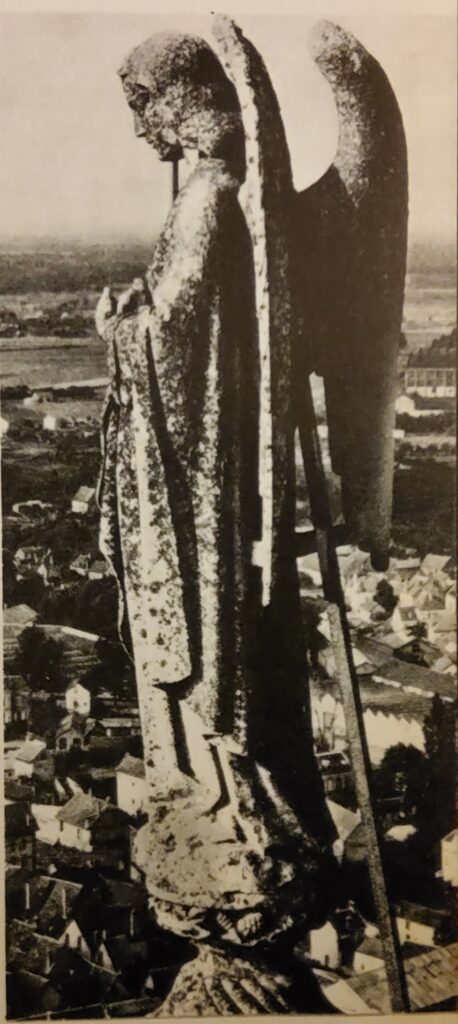
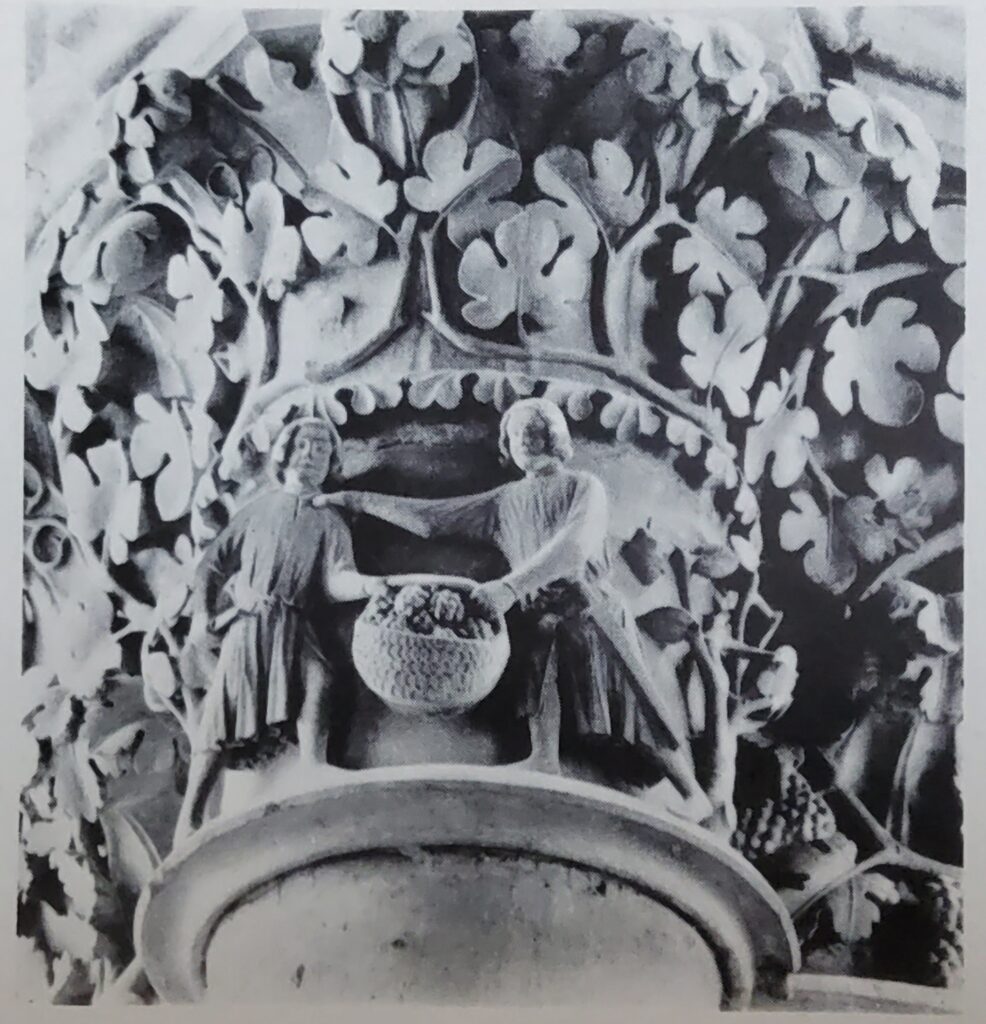
In the comprehensive iconography of its portals, the builders of the cathedral, which was conceived as the home of divine majesty and its omnipotence, dwelt inexhaustibly on the solemn theme of the Last Judgment, with which is associated the glorification of the Virgin Mary, her death, assumption and crowning. It is worth noting, that most of these figures were originally coloured in an attempt at realism designed to emphasize to the faithful, the truths of dogma. (The sculptures of the Parthenon were similarly treated in the Athens of the fifth century B.C.) However, the medieval cathedral was equally intended to cater to human weakness, in the most humble aspects of the daily round and in those seasonal occupations of the lives of men, as God had first decreed. When extolled by St. Francis of Assisi, nature revealed herself in all her beauty and pristine freshness: in the sculptor’s repertoire of decorative motifs — watercress, oak, ferns, strawberry plants, vines and wild roses – replaced the conventional acanthus derived from antiquity and taken over by Romanesque artists. If images of the saints appear on all sides, between God, who is omnipresent in the cathedral and man, it is because they are the essential intermediaries – the Church Triumphant, opening the way for the bodies and souls of the Church Militant.
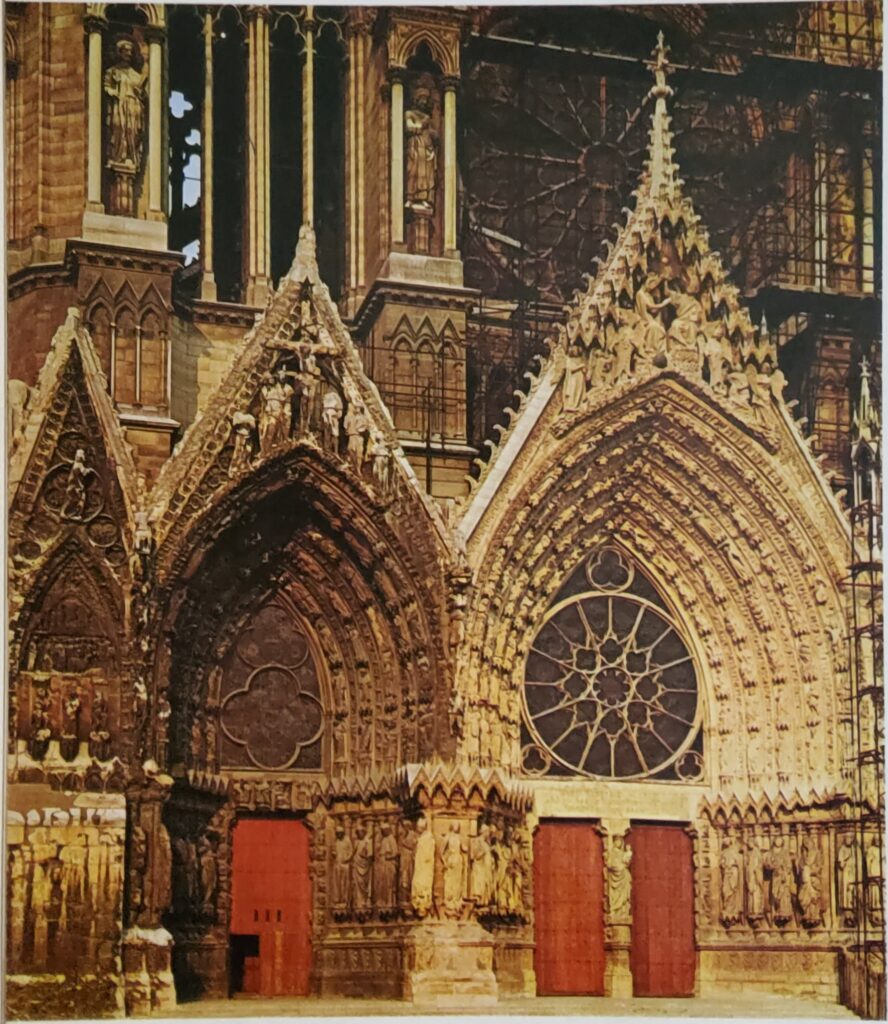
Political life begins in the Cathedral
By derivation, religion means a bond. The cathedral is the material link of this bond, established by God for all time. Nothing in it is comparable to a pagan temple or even a Jewish temple, which were almost exclusively reserved for the divinity and his priests. The cathedral is the heart, soul and brain of the Christian city and although it is above all a temple, it is also a refuge. In a cathedral one might pray, weep or laugh, for it embraced all aspects of life. The cathedral church was the scene of performances of the liturgy, the seat of power of the bishop and the place for his cathedra or throne and was not only a sanctuary for the clergy, but also for the whole diocese. What’s more, as a result of the tendency toward universality that marked the thirteenth century, the cathedral was ready to gather under its aegis, all those who although outside the limits of the diocese, nevertheless looked upon it as theirs and had considerable respect for its celebrated relics, or for the pilgrimages that set off from it. The enormous size of the medieval cathedrals and some of them were quite disproportionately large, in relation to the towns they towered over, cannot otherwise be explained. The cathedral was an offering to God and an offering to his people.
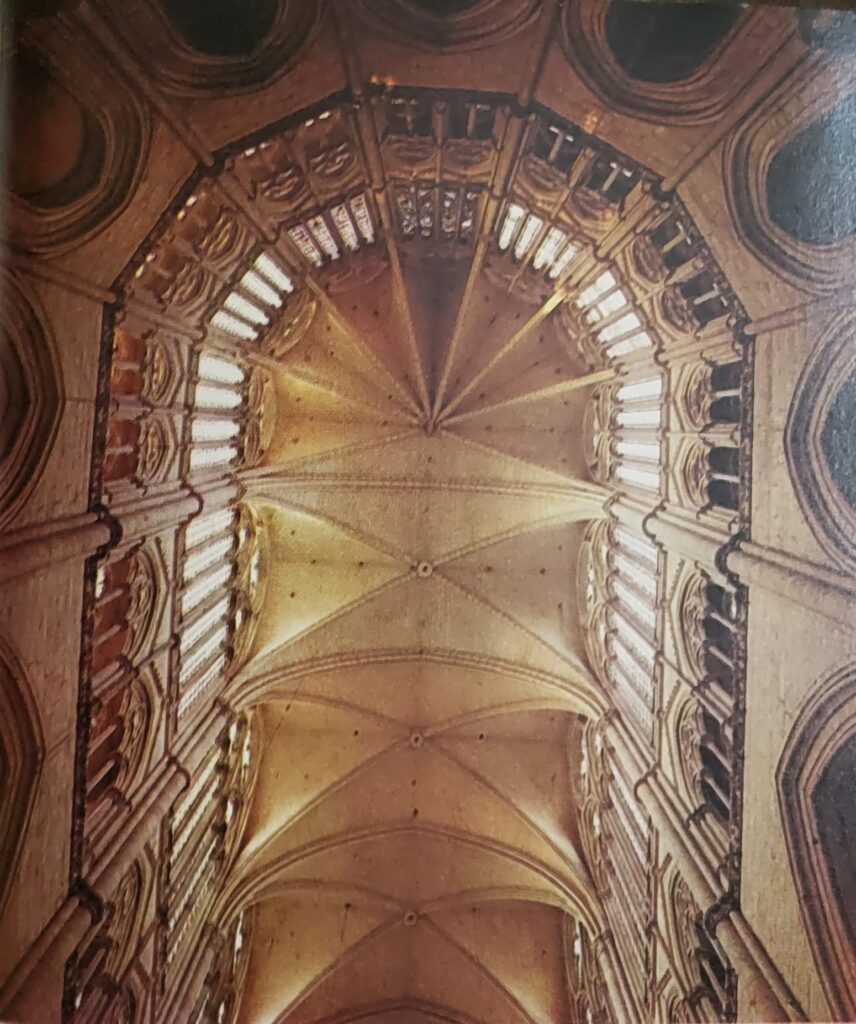
Nor was this all. Inseparable as it was from religious life proper, political life had its first burgeonings in the cathedral and it was in the cathedrals as a whole, that corporate life became aware of the part it had to play. It was under the vaulted roofs or in front of the cathedral portals, that the arts of drama and music were reborn and that popular art had full play. It was in the shadow of the cathedrals too, that intellectual life had new beginnings. As a prelude to the rise of the universities, the newly established church schools were, litile by little, brought to perfection. The cathedral was at once a Christian church, a national temple, the scene of festivities, the asylum of the sciences and a refuge for suffering humanity. It was the true communal house, in the very heart of the city. It was the Arc of the Covenant and its support.
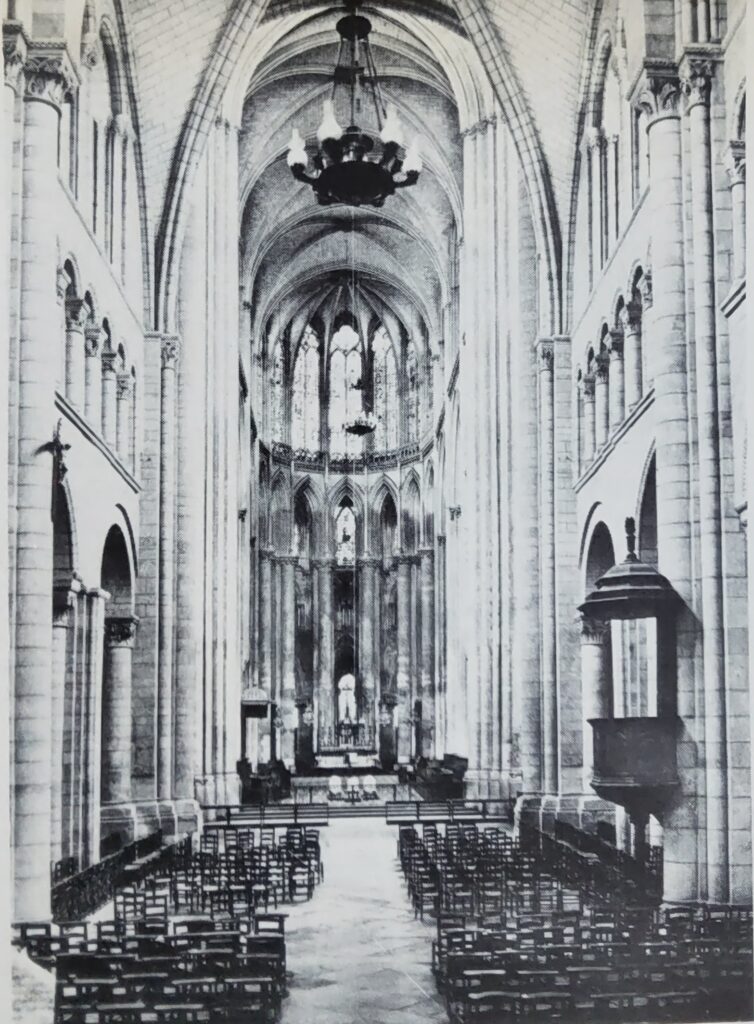
Later ages termed the cathedral style, given such impetus at Chartres, Gothic art. There was, of course, something critical in this name. The term “Gothic,” in the derogatory sense of barbarian, was the product of the Italian Renaissance, which created a new type of humanism, to replace that medieval humanism, of which the cathedral was the embodiment. Gothic art was an art of the cities. From the middle of the twelfth century onwards, Europe was being completely transformed economically and socially. The reign of the middle classes was beginning. As Pierre Gaxotte has put it: “The old social orders were becoming distorted before they finally broke up. The great estates lost their importance, the bonds of country life were being loosened and the towns were being reborn.” The lay clergy exhibited a spirit of enterprise which equalled that of the growing towns and the bishops who rebuilt the cathedrals, were men of discernment and ambition. It would not, however, be true to assert that the age of monasticism had passed: apart from the Cistercians, to whom in large part, Gothic art owes its international influence, the Franciscans and Dominicans began a great age of expansion in thirteenth-century Europe. Nevertheless, the established order of things, which had held sway during the Romanesque period, was during the Gothic era, successfully challenged by secular power. Such was the new state of things.
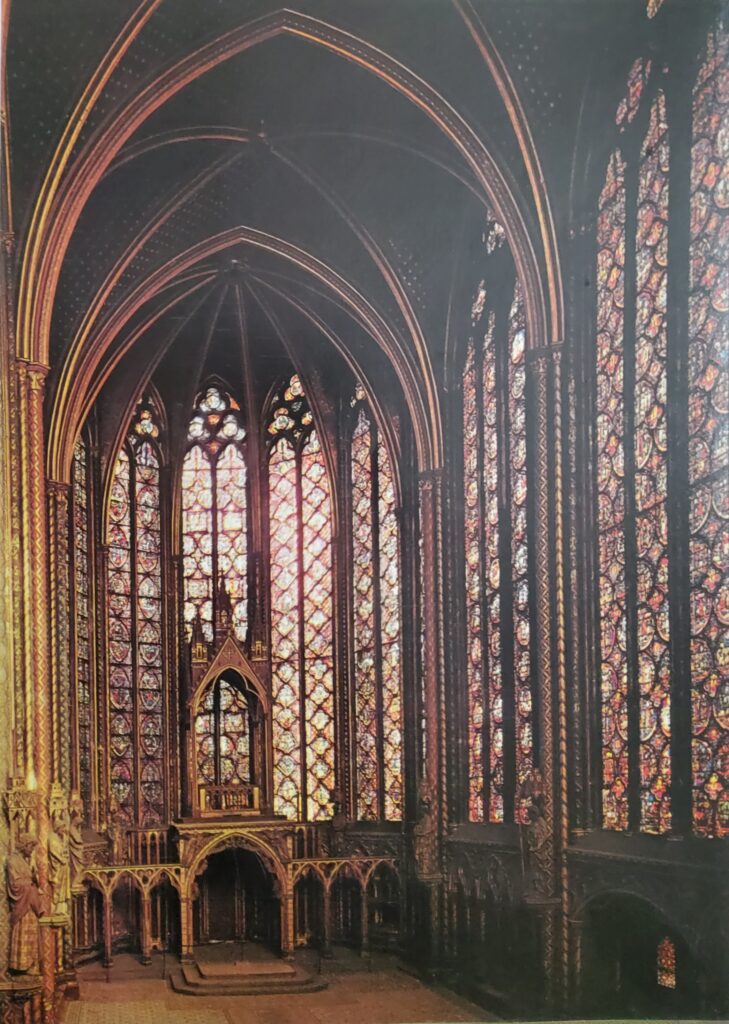
A papal legate of the thirteenth century declared: “France is the oven where the intellectual bread of humanity is baked.” Gothic art was more than a French art, it was international; and such was the universality of its message that all the nations of Christendom modified it and interpreted it according to their own traditions and temperament — from Canterbury to Lincoln and Westminster, from Marburg to Cologne, from Toledo to Leon, from Genoa to Siena and Orvieto, from Nicosia to Famagusta and Jerusalem, to the very limits of those hard-fought regions where, as a result of the Crusades, the Cross had prevailed over the Crescent.
The thirteenth century, had achieved in the esthetic and spiritual spheres, that sense of unity for which the twentieth century still groped. As a permanent reminder of its technical virtuosity and perfection of form, the cathedral with its subtle blend of realism and idealism, with its lyrical qualities and its luminous sense of mystery, bears witness to a “period of greatness comparable to that which Greece experienced at her zenith.” It would serve as a model for us, if we could still believe in the return of a Golden Age.