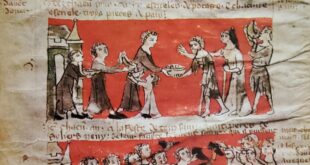
Fall of Constantinople begins – the crusaders from the West had taken an oath to free the Holy Land from the Moslems, but now they were stranded at Constantinople, unable to pay the Venetians for the ships that were carrying them eastward. Easily deflected from their religious mission, the knights and nobles of the Fourth Crusade agreed to help the deposed Byzantine Emperor regain his throne.
Thus in the spring of 1204, the walls of Constantinople — never before breached by an enemy — fell to the crusaders. The sack of the city, culmination of this senseless war of Christian against Christian, lasted for three days and when it was over, Christendom’s most splendid city lay in ruins. All Europe was shocked by this rapacious diversion of the crusading movement and the breach between Eastern and Western Christianity widened to a permanent split. In the succeeding centuries, this fatal division could only work to the advantage of the Moslem Turks advancing from the East.

During the winter of 1203-4, a large army of crusading knights, brought by a Venetian fleet, was encamped around the city of Constantinople. Their ultimate purpose was to reconquer the Holy Land, but since they did not have the neccssary money to pay the Venctians for the ships, it had been agreed that the crusaders should postpone their conquest of the Holy Land and first use their armed might to accomplish a task dear to Venice: that was to place Alexius, the son of Isaac Angelus, on the throne of Byzantium. Alexius and his father had been the victims of a palace revolution: the Emperor Isaac was dethroned by his brother — another Alexius and blinded, in the Byzantine fashion, to render him helpless. He was then thrown into prison with his son, but the son Alexius, managed to escape and make his way to the court of his brother-in-law, Philip of Swabia, King of Germany. He made good use of his connections and when it became known that the crusading army, for lack of money, was stranded in Venice, Alexius seized his opportunity. He promised to pay the crusaders’ debt to the Venetians if he were placed on the throne of his father in Constantinople.
The Venetians and crusaders had carried out their side of the bargain. In July, 1203, they laid siege to Constantinople. The usurper, Alexius III, fled and his officials released the old Emperor from his prison. On August 1, his son was solemnly crowned as Alexius IV in the church of Hagia Sophia.

Installed on the throne, Alexius IV soon discovered that he could not pay the Venetians. The crusaders were therefore still stranded in Constantinople. As time went by, their relations with the Byzantines became further more strained and when the crusaders presented an ultimatum in February, 1204, another palace revolution took place and Alexius IV was deposed. The crusaders now decided to install one of their own leaders as emperor. They stormed the city and in the middle of April made their first successful landing on the Golden Horn. A fire in the city, started by accident or treachery, made defense impossible. The members of the imperial family, many nobles and the Patriarch fled and before long, Enrico Dandolo, the Doge of Venice and the other leaders of the crusaders, entered the Great Palace. The rank and file were allowed to sack the city.
The sack lasted for three days. Neither the Venetians nor the crusaders, coming from the West, had seen such riches before. Drunk with greed and lust they let themselves go. They seized everything that seemed precious and carried it away; the rest they destroyed. They ransacked palaces and dwellings; they killed, raped and looted. Countless books and works of art were destroyed —until Christendom’s largest and most splendid city lay in ruins. On May 16, Count Baldwin IX of Flanders and Hainault, was made Emperor of Romania, as the Latins chose to call it, but his power was negligible. Constantinople was in ruins and his power over the princes who established themselves in the western parts of old Byzantium became nebulous, for they only owed him some kind of feudal allegiance, whereas many of the outlying parts of the old Empire, rallied to various members of the former imperial family.

The plan to continue the crusade, meanwhile, was abandoned and the papal legate, Peter of Saint-Marcel, absolved all crusaders from their oath to fight for the delivery of the Holy Land from the Moslems.
The Imperial Centre moves East
The city of Constantinople had been founded by the Roman Emperor Constantine in A.D. 328-37. It had been consecrated on May 11, 330, as the new Rome, a city that contained no traces of ancient paganism. The site was chosen for its strategic importance, at the spot where Asia and Europe meet on the Bosphorus — the significance of which had been obvious to Herodotus in the fifth century B. C. A great many churches were built and the city was richly endowed with fountains and statues and soon became the administrative and commercial centre of the Eastern Roman Empire.
Less than a hundred years after the founding of the new Rome, the city on the Tiber was sacked by the barbarian invaders of the Western Empire and from then on, Constantinople alone, carried on the traditions of Roman government.

The transfer of the capital to Constantinople was, of course, an explicit admission of the fact that the ancient Roman Empire was becoming orientalized. In the East, the Greek language was predominant and eventually, the reigning culture of Constantinople and its Empire became an amalgam of Oriental and Greek influences. It was inevitable that in the eastern half of the old Roman Empire the form and content of Christianity should develop along lines different from those followed in the West. The Patriarch of Constantinople, presiding over his Church under the immediate eye of the Emperor, in a city vastly richer and more alive than medieval Rome, naturally became the head of the Eastern Church and became more and more reluctant to concede any claims the Bishop of Rome advanced, as the successor of St. Peter. It is impossible to define the differences between Eastern and Western Christendom in one single principle; but in the East, Semitic traditions of uncompromising monotheism and of objection to religious imagery frequently came to the fore. There were strong Oriental currents of cosmic mysticism apparent in the shape of the liturgy and even in the shape of the Cross, which in the East came to have four equal arms.

When the imperial centre was shifted to Constantinople, the threat from central Europe was only peripheral. When it became stronger in the fifth century, Byzantine diplomats took steps to direct the invaders westward, away from Constantinople, into Italy and Spain. When Byzantine influence in the West was completely extinguished in the seventh and eighth centuries, it became apparent that a threat far greater than that of the Teutonic invaders was about to engulf the Eastern Empire. The Teutonic invaders had not only displayed a certain respect for Roman traditions, but had actually accepted Christianity. Their invasions of the Roman Empire therefore laid the foundations for an eventual assimilation. In the eighth and ninth centuries however, the Arabs — newly converted to Islam, erupted from the interior of their peninsula, into the Mcditerranean regions and swiftly conquered Egypt, Syria and Palestine —seriously weakening the power of Byzantium.

Islam was a religion even more fiercely prophetic and missionary than Christianity and there was no possibility of assimilation. The Emperors in Constantinople had to watch their dominions shrink; they fought valiantly and for as long as they straddled the Bosphorus they kept a firm hold on Greece in the west and Asia Minor in the east. However, in the course of the eleventh century, another wave of Asian invaders came forward: the Seljuk Turks – a horde of nomads from the steppes of Turkestan – seeking their fortune by pillage. They conquered Syria, Palestine and though they dealt a heavy blow to the power of the Moslem caliphs, they soon accommodated themselves with their Arabic subjects because they too, embraced Islam. They advanced into Asia Minor and were confronted by a Byzantine army — which they defeated decisively on the field of Manzikert in Armenia in 1071. The whole eastern wing of the Byzantine Empire immediately collapsed.
Ten years later, a palace revolution in Constantinople brought to power Alexius I Comnenus, an intelligent and enterprising new Emperor — the first of a dynasty that was to rule for over a century. As part of his program of internal as well as external restoration, he wrote a letter to Pope Urban II asking for military help from the West in order to assist with the defense of Eastern Christendom against the Moslems. At that time, the papacy was experiencing the full swing of the Gregorian reform movement; Urban eagerly welcomed this opportunity of leadership and promptly appealed to the newly stimulated religious fervour of the masses.

Naturally, the papal invitation to go on a crusade — issued at Clermont, France, in November, 1095 — was not intended to rescue Alexius I Comnenus and support the tottering edifice of Byzantium. The purpose of the crusade launchcd by Urban’s appeal in 1095 was, therefore, different from Alexius’ purpose when he had written for help. The crusaders were to fight the Moslems, not to save the dynasty at Constantinople, but to conquer the Holy Land. The two purposes were, of course, not necessarily incompatible, but the differences in emphasis were strong enough to lead to deep mistrust and to ultimate dissension between Alexius and the crusaders.
As it was, the papal appeal met with enthusiastic response from all classes of people. Christians in Europe had never before experienced the liberating zest of religious evangelism. Religion had meant, if it was not an invitation to monasticism, the worship of relics and a certain amount of communal ceremonial, in the shape of the Mass. There was hardly any clergy capable of giving spiritual nourishment and no popular edification of any kind. Hence the papal appeal, carried by countless preachers into every corner of Christendom, stimulated the pentup religious enthusiasm; and people rushed to save Jerusalem. The reconquest of the Holy Land was indeed a stimulating goal; but it received substance from the papal idea that to go on a crusade meant to “take the Cross” and was therefore, an act of penance: a crusader’s vow would assure eternal salvation.

The idea of a pilgrimage to the Holy Land in expiation of sins was a very old Western tradition, even though the Moslem conquest of Jerusalem had made such pilgrimages very hazardous. Now the tradition received not only a new vitality, but a new emphasis. The crusading pilgrim was also a fighter for God and the old pilgrimage was turned into a holy war.
The First Crusade, which departed for Jerusalem in 1096, made its way down the Balkans. It was a large number of poor people following an inarticulate religious sentiment. There were camp-followers and beggars, vagabonds, brigands, harlots and not least, a large number of professional warriors – newly educated in the ideals of chivalry which now received a religious sanction, but religious fervour does not provide by itself, much of a basis for a military expedition. The trains of people that set out eastwards were without provisions, without leadership and without discipline. The entnusiasm of the poor tended io diminish as they were apprehended and set upon by people from whom they had pillaged. Their sufferings were enormous and most of them died on the way. The knights were in a more advantageous position, but they were subject to an odd mixture of religious fervor and material greed: they clearly bore in mind the possibility of carving out landed estates for themselves in the East and the violence they displayed in foreign parts, came to be a mixture of acquisitiveness and religious intoxication.

Jerusalem captured in 1099
AIl in all, it is surprising that the First Crusade achieved its purpose. In crossing Asia Minor, the crusaders reconquered the littoral from the Turks and allowed Alexius to repossess himself of some of the major cities. Eventually, the knights invaded Syria and Palestine: they captured first Antioch and finally, in 1099, Jerusalem. With the opening of the Levantine ports to Christian trade, Italian ships started to arrive. The Mediterranean was once again opened to merchants from Christian lands.
The relations with Byzantium went from bad to worse. Alexius owed a debt to the crusaders, but alternately, they owed a debt to him for supplies, advice and guidance. Once established in Jerusalem, however, the Western knights refused to hand back the regained territories to Alexius. Instead, they set up the Latin kingdom of Jerusalem, received a papal legate and obliged the Christian inhabitants of their new kingdom, to withdraw from the Greek ritual. If Alexius felt relieved at the cessation of Moslem pressure, he soon realized that the expedition had not really helped to restore his Empire. On the contrary, owing to the close personal relations of many of the crusading knights with the Norman knights, who in the preceding century had invaded southern Italy, he was now forced to resign himself to the loss of territory in Italy and to recognize the independence of the kingdom of Jerusalem and several other principalities which the crusading knights had carved out for themselves in the East.

Apart from the political and ecclesiastical ill will prevailing on all sides, there were also powerful social and cultural forces at work in promoting tension. The crusaders had carried to Jerusalem their primitive military and political feudalism. The kingdom they set up in Palestine and Syria resembled England after the Norman Conquest, much more than it did the centralized bureaucracy of Byzantium. The theological and liturgical differences served to underline the rift. Early in the twelfth century, the Latin West was as yet largely innocent of dialectics and scholasticism; and the theological assertiveness of the Roman Church struck the Byzantine theologians, trained in the subtler traditions of Greek scholarship, as mere boorish presumption.
Eventually however, the nemesis of power began to overtake everybody. The Christian knights in their Jerusalem kingdom eagerly availed themselves of the Oriental luxury that surrounded them. They tended to become acclimatized. At the same time, Moslem power began to recover from the shock of its first defeats. The crusaders’ victory had been the stimulus needed for reorganization. Zanghi of Mosul, conquered Aleppo and Edessa; his son, Noureddin, Damascus and Egypt and Saladin, finally won the victory of Hattin in 1187 and regained Jerusalem for Islam from the Christians.

Appeals for more aid were sent to the West. The Emperors of Byzantium became more and more reluctant to help, because they reckoned that they had been duped by the crusaders. Italian merchants were willing to provide ships —at a price, but the new crusading recruits who came over from the West, were shocked to find their relatives and companions installed in palaces of Oriental splendour, with food and spice, incense and precious clothes, which were neither reminiscent of their austere castles in Flanders and Lorraine, nor particularly expressive of religious zeal.
If the Byzantines were displeased with the outcome, they at least benefited for the time being because the attention of the Moslems was directed against the Kingdom of Jerusalem, instead of against their Empire. In Europe itself, the growing threat to that kingdom stimulated further efforts which in turn were nourised by the Apocalyptic fears, current in the twelfth century. In 1147, St. Bernard of Clairvaux preached a new crusade and fired people’s imagination by fanatical sermons, that exhibited a curious combination of bloodthirsty aggressiveness and a desire for moral purification. The immediate effect of his activities was the Second Crusade led by the Emperor Conrad III and by King Louis VI of France. The expedition was a complete failure; and most knights perished in Asia Minor before they even reached the endangered Holy City.

After the battle of Hattin and the fall of Jerusalem, the Emperor Frederick Barbarossa set out in 1189 on a third crusade and was supposed to be joined in the Holy Land by Richard the Lion Heart of England and Philip Augustus, King of France. This time the most elaborate preparations were made. Crusaders were recruited in order to serve their Lord Jesus as vassals, a marked departure from the earlier indiscriminate religious enthusiasm and the blank promise of eternal salvation for taking the Cross.
The Turks are poised to strike at Europe
After a long march down the Danube, the crusadcrs crossed safely into Asia Minor during Easter, 1190. Sadly, Frederick himself was drowncd in the Saleph River and a great many crusaders died from hunger and thirst as well as from fighting the Turks. Only a remnant of the army reached Antioch and they failed to reconquer Jerusalem.

If the new organization and official royal leadership had introduced a more serious kind of military planning, it had also shifted the perspective. With kings in the lead, a crusade was more clearly a political than a religious venture, but Kings had dynastic ambitions. Already in 1190, when forced to spend the winter in southern Greece, Frederick Barbarossa had been under great pressure to conquer Constantinople. Many of his knights felt that it was better to have a bird in the hand than two in the bush. It had taken all of Frederick’s determination to force them to desist and his own determination, drew great strength from his conviction that his expedition to Jerusalem was a necessary part of the Apocalyptic vision of the universe according to which, at the end of time, the last Emperor had to go to Jerusalem in order to hang up his shield and lance on the barren tree on the Mount of Olives.
After Frederick’s death and the removal of his influence, dynastic ambitions gained the upper hand. Richard the Lion Heart was an irresponsible adventurer and Philip Augustus had concerns closer to home: the mutilated trunk of the Kingdom of Jerusalem received no help from either of them. In the early years of the thirteenth century, Pope Innocent III, full of his own prestige, sought to revive the idea of a crusade. Though his appeal met with an enthusiastic response and a large army of knights assembled in Venice to take ship to the East, the political issues had gained the upper hand. Lack of money for the passage placed the crusaders at the Venetians mercy and since King Philip of Germany was married to the sister of Alexius, the fugitive claimant of the Byzantine throne, the whole expedition as we have seen, was eventually diverted to the conquest of Constantinople with the avowed aim of placing Alexius IV on the imperial throne. Alexius himself had played cleverly on the crusaders’ lack of money: he promised ample rewards from the coffers of Byzantium, but the crusaders’ rewards did not come in the manner envisaged by Alexius.

The fall of Constantinople and the installation of the Latin kingdom of Romania there, fatally weakened the great bastion that had sheltered Europe from the East. None of the Byzantine successor states in Asia Minor, nor the restored dynasty of the Paleologi in Constantinople in 1261, were militarily viable. As a result of the enfeebled state in which Constantinople was left, the Turks advanced from strength to strength. By the middle of the fifteenth century, they had surrounded the imperial city on the Golden Horn and pushed forward into the Balkans as well as into the Aegean Sea. Finally, in 1453, Constantinople itself fell and the Turks were at last poised to strike at the heart of Europe.