Middle Ages 500 – 1400 A.D.
From the fall of Rome, to the Renaissance. Includes Western & Eastern Middle Ages, Islamic empires, Crusades, feudalism and how Europe widened its horizons.
Middle Ages (500-1300 A.D.)
181
Medieval East includes the spread of Islam, medieval India, medieval China, medieval Japan, the Mongols and Eastern Europe – the developments that took place in India, China, Japan and other parts of the East during the medieval period. When we turn our attention from Europe to Asia, we are obviously moving into a much larger and more complicated theatre of events. We encounter large masses of people of dissimilar language, race and culture, separated from one another to a great extent by more impassable geographical barriers, than exist in Europe. In comparing or contrasting the progress of civilization in Asia …
Read More »
Middle Ages (500-1300 A.D.)
409
Medieval Culture – in surveying man’s achievements during the Middle Ages – is another example of man’s ability to rebuild his culture after disaster and destruction. The new culture that ultimately emerged was made up of the remnants of the old, contributions from other peoples, new inventions and discoveries. In reviewing the reasons why trade and commerce dwindled in the period between 476 and 1000 A. D., then describes some of the favourable changes that took place in western Europe, as towns and cities were re-established in the twelfth and thirteenth centuries. We see the contributions of this latter period …
Read More »
Middle Ages (500-1300 A.D.)
148
European nations preserved to keep the continent from chaos. In the troubled days of invasion and disorder that followed the collapse of the Roman Empire, the feudal system had served a purpose in western Europe. Enough order and security had been preserved, to keep the continent from chaos. After a time, a new type of political organization, unlike any previously known, began to develop around some of the kings of western Europe. Ultimately this would be the nation-state, but during this period, kings were busy developing a strong central government, defining the boundaries of their holdings and giving their people …
Read More »
Middle Ages (500-1300 A.D.)
264
Feudalism – centuries of groping and experimentation to restore law and order in Europe and to develop forms of centralized government – after the security provided by Roman law and administration had been ruptured by the Germanic invasions. Barbarian chieftains had little training in political administration. The Romans lacked the money to finance the machinery of large-scale government and to train government workers. Craftsmen did not even have the skill to rebuild roads, bridges and aqueducts. This tells us how culture declined to a subsistence level during the period from 500 to 1000 A. D. Many people lived and were …
Read More »
Middle Ages (500-1300 A.D.)
174
Religions militant, gives an account of the wars of religion, which we call the crusades. During the Middle Ages, the followers of two great present-day religions, Christianity and Islam, continued to spread the influence of these religions over vast territories and among many peoples. The story of the extension of these religions, will observe that ideas are dynamic — they embody a divine energy that influences the lives of people. A person who is dedicated to his ideas wants others fo accept those ideas and thereby experience the advantages and satisfactions that he has experienced. Many individual Christians and Moslems …
Read More »
Western Europe Widens its Horizons
552
Visitors to the Portuguese city of Lisbon, on a certain day in 1499, would have found the people in a holiday mood. Groups of townsmen who gathered here and there talked excitedly about the arrival of two ships and there was good reason. In the two years since these vessels had sailed down the river and slipped out of sight, they had completed the first trip from Europe around Africa to India and back. Such an event indeed deserved to be celebrated. Not only had the fearless captain of this expedition, Vasco da Gama, performed a great feat of navigation, …
Read More »
Western Europe Widens its Horizons
757
Henry Tudor was a patient young man, who waited and watched while civil war raged in England and quarreling lords fought to see who would be king. He waited safely in France, biding his time until his spies told him the hour had come to strike. Then from northern France he crossed the English Channel with 2000 soldiers. Ahead of Henry and his soldiers had gone his agents, who sought to weaken the position of England’s King, Richard III. Henry’s agents had plotted secretly with some of Richard’s supporters, lords who led small armies of their own. That was why …
Read More »
Western Europe Widens its Horizons
921
Pierre watched the merchant caravan clatter down the narrow dirt road that led through the manor. Pack mules threaded their way to avoid the deep puddles, while the horses strained as they pulled the creaking two wheeled carts. Pierre envied the merchants as well as the sturdy bowmen who guarded the caravan. During his seventeen years Pierre had never been more than a few miles from the manor where he had been born a serf. He was not free to move around as were these merchants who were city folk. Was it true, as Pierre had heard, that a serf …
Read More »
Western Europe Widens its Horizons
1,180
The civilizations of India, China and the Moslem world progressed to about the year 1500 A.D., but what had been happening in western Europe in the centuries after Roman power began to decline and barbarian tribesmen had overrun the lands once part of the proud Roman Empire? What had taken the place of Roman might, government and law in western Europe? As Rome’s rule faded away, western Europe entered a period known as the Middle Ages or the medieval period. For a long time there was neither a single empire nor nations as we know them to day. Central governments, …
Read More »
West in the Middle Ages 481 A.D. - 1485 A.D.
826
JOAN OF ARC did more than inspire the French to drive out the English; her words and actions helped to advance a new idea. During most of the Middle Ages, people did not think of themselves as belonging to a nation. They thought of themselves as members of a church and subjects of a lord. Then, as trade increased, as towns and cities grew‚ as merchants’ and craftsmen’s guilds were formed‚ the forms of society began to change. The barons began to lose some of their power‚ while the kings gained more. Gradually, people begin to think of themselves as …
Read More »
West in the Middle Ages 481 A.D. - 1485 A.D.
430
THE LONG STRUGGLE between France and England, known to history as the Hundred Years’ War, was not really a war — and it lasted more than a hundred years. Rather than a war, it was a series of separate battles, with periods of uneasy peace between and it lasted from 1338 to 1453. It was time of misery for both sides, but the French lost more men and saw much of their land devastated. By the end of the Hundred Years’ War, important changes had taken place in both countries. In France, the years of conflict weakened the power of …
Read More »
West in the Middle Ages 481 A.D. - 1485 A.D.
1,887
ONE FINE SPRING MORNING, in the French town of Troyes, in the county of Champagne, a bell rang out through the clear air. The people streaming along the road to the town knew why the bell was ringing; it signaled the start of another day of the fair. Now they walked faster or whipped up their horses, anxious not to miss any of the excitement. Most of them were merchants, who had come to buy the goods that were on display. Some were lords and ladies, who hoped to find gleaming silks from the Orient, or fine Spanish leather, or …
Read More »
West in the Middle Ages 481 A.D. - 1485 A.D.
863
ON A COLD NOVEMBER DAY IN 1096, a great crowd of people gathered in a field at the town of Clermont in France. They had come from miles around and near them were pitched the tents they had put up for shelter. For some days, Pope Urban II had been holding a great council of cardinals, bishops and princes. Today he was to speak to the people and so many wanted to hear that no building was large enough to hold them all. A platform had been built in the center of the field and as Pope Urban stepped up …
Read More »
West in the Middle Ages 481 A.D. - 1485 A.D.
1,028
IN THE YEAR 1134, in the town of Chartres in France, the church burned down. The church was a cathedral — that is, it was the church of a bishop. The bishop at that time was Theodoric and he immediately began the construction of another cathedral. He knew that the task would not be an easy one; it meant raising large sums of money and finding many workmen and the actual work of building would take years. Bishop Theodoric allowed nothing to stop him, he won the support of the people, of commoners and nobles alike. An eye-witness, who visited …
Read More »
West in the Middle Ages 481 A.D. - 1485 A.D.
599
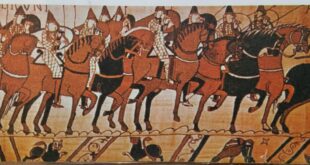
IN THE DIM LIGHT of early morning, the Frenchmen were preparing for battle. Squires helped the knights put on their armour, grooms brought up the horses‚ archers tested their bows, foot soldiers began to assemble, while mounted messengers hurried busily here and there. The date was October 14, 1066 and before the sun set that day a kingdom would change hands and a new era in English history would begin. The battle, one of the most decisive ever fought, would be known as the Battle of Hastings. The cause of the battle was ambition — the driving ambition of Duke …
Read More »
West in the Middle Ages 481 A.D. - 1485 A.D.
1,107
AFTER THE BREAKUP OF CHARLEMAGNE’S Empire, France, the western half of the empire, was ruled by a series of weak kings. They were so weak that they were known as the “do-nothing kings,” and indeed, they could do nothing to stop their powerful and greedy nobles from fighting among themselves. Finally the Carolingian line came to an end and the Franks, as the French were then called, elected a new king. He was Hugh Capet, a relative of the famous Count Odo who had directed the defense of Paris against the Vikings. With Hugh began the line of Capetian kings …
Read More »
West in the Middle Ages 481 A.D. - 1485 A.D.
961
THE WINTER of 1077 was one of the coldest on record in Italy. Ice and snow choked the mountain passages in the north and snowdrifts were piled high well into the south — as far south as the castle of Canossa, which was southeast of Parma. The fortified castle belonged to the countess of Tuscany and here Pope Gregory VII had taken refuge, fearing an attack by his enemies. On January 25, a man stood outside the Castle gate, barefoot in spite of the snow and cold. He was no ordinary penitent come to ask forgiveness of the pope. He …
Read More »
West in the Middle Ages 481 A.D. - 1485 A.D.
1,335
COUNT LEON, lord of the vast domain of Grandpré, stirred and waved away his servants. As he opened his eyes, the first rays of the sun were slanting through the narrow windows of his bedchamber. He stared sleepily at the tapestry hanging on the thick stone wall. It depicted a stag hunt and he enjoyed looking at it, for there were few things in the world he loved more than hunting. For a few minutes he lay there, listening to the sounds drifting up from the courtyard –the clop of horses’ hoofs‚ the creak of leather, the clatter of boots …
Read More »
West in the Middle Ages 481 A.D. - 1485 A.D.
360
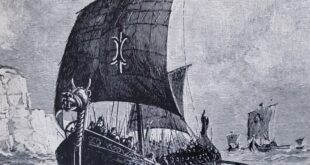
“. . FROM THE FURY OF THE NORTHMEN, Good Lord, deliver us.” Until recent times, this line was included in the prayer book used by the Church of England. The raids of the Norse Vikings on Britain were so terrible that the victims never forgot them. For generations the memory of the savage Norsemen was kept alive and Englishmen repeated this prayer for more than a thousand years. It was not only Britain that felt the fury of the Norsemen; they raided the European continent as well. The Norsemen’s ships themselves seemed to threaten terror. The hull of a Viking …
Read More »
West in the Middle Ages 481 A.D. - 1485 A.D.
765
IT WAS COLD INSIDE the great cathedral of St. Peter in Rome on Christmas day, in the year 800. The breath of the closely packed worshipers rose like steam. Although their heads were bowed in prayer, many of the worshipers stole a quick glance at the man kneeling near the high altar. He was tall and heavy, with fair hair and a flowing mustache; he was dressed in a simple tunic and a fur-trimmed cloak. When the devotions came to an end, the tall man started to rise. At that moment, Pope Leo III, Splendid in his gold-encrusted vestments, stepped …
Read More »
West in the Middle Ages 481 A.D. - 1485 A.D.
323
THE FIRST SIGN of the approaching Roman army was a thin column of dust. It rose like smoke from behind the jagged Thracian hills of Northern Greece, which sheltered the Visigoths’ encampment. Moments later, the Visigoths, or German barbarians, as the Romans called them, could feel the ground tremble with the tread of the imperial legions. The Romans were advancing, forty thousand strong, under the personal command of the Emperor Valens. Within the Visigoths’ barricade of wagons, all was confusion. Chieftains bellowed, calling their clans together. Sturdy Visigothic warriors dragged the wagons closer together in a protective circle. Horses neighed …
Read More »
East in the Middle Ages 214 B.C. - 1644 A.D.
559
Go-Daigo had found refuge in a place in the mountains called Yoshino. Japan now had two emperors, one in Kyoto and the other in Yoshino. Takauji set out to simplify matters. As a first step, he had his puppet, the Kyoto emperor, appoint him shogun. In this way, Takauji became the founder of a new line of shoguns who were called, after their family name, the Ashikaga shoguns. Their shogunate lasted from 1336 to 1573, nearly twice as long as the Kamakura shogunate. Takauji and his successors did not rule anywhere near as firmly as Yorimoto and the Hojo family. …
Read More »
East in the Middle Ages 214 B.C. - 1644 A.D.
416
BY THE middle of the twelfth century, Kyoto was no longer the real center of power in Japan. The old forms of government were kept unchanged. The emperor was still, supposedly, the source of all authority. The aristocrats wanted to enjoy the excitement of the Fujiwara court and they left their poorer relatives at home to manage their estates. The young men who were given this responsibility did not mind. Indeed, they welcomed it, for it was their only chance to get rich. So the Japanese aristocracy was divided between great nobles at the court and lesser nobles in the …
Read More »
East in the Middle Ages 214 B.C. - 1644 A.D.
365
BETWEEN THE ninth and twelfth centuries, Japan developed at a slower pace. It was as if the people knew that they needed time to digest what they had learned. After 838, the government sent no more official missions to China. The Japanese continued to value Chinese civilization as highly as ever, but they went about things in their own way. Slowly, Japan became thoroughly Japanese. Prince Shotoku’s dream of a strong central government had come true. In time, however, the same evils that plagued Chinese dynasties in their later stages began to plague Japan. Thanks to their high positions at …
Read More »
East in the Middle Ages 214 B.C. - 1644 A.D.
334
PRINCE SHOTOKU was pleased to see his fellow aristocrats take to his chosen faith so enthusiastically. He wanted them to adopt other ways of living from China, too. Having seen how the Sui emperors had reunified China after three and a half centuries of disorder, he was particularly eager for Japan to copy their strong central government. In 603 and 604, Shotoku adopted the Chinese calendar, issued a constitution and set up a new civil service system. In the constitution, he left no room for doubt as to the emperor’s supreme position. “A country does not have two lords,” he …
Read More »