
Ancient Far East, included the early Chinese people, the early Japanese people and the ancient civilization of India.
The early peoples of Egypt and the Fertile Crescent achieved a high degree of civilization in ancient times. At about the same time, in another part of the world, other peoples were also developing civilizations – the achievements of the ancient peoples in the Far East and the factors which influenced their civilizations.
As in Egypt and the Fertile Crescent, geography was a major influence upon the early peoples of the Far East. River valleys cradled the early civilizations of China and India, while natural barriers protected them from invaders. In the case of Japan, which was isolated by the sea, many civilized ways and elements of culture were brought from the mainland by immigrants and adapted to local use.
Consider the advantages and disadvantages to China, India and Japan due to their geographical isolation from the early civilizations of the Western world. Compare the early advances of these Far Eastern peoples in farming, government, art and literature with those of Western peoples. Identify some of the discoveries and inventions of early Eastern peoples which were later brought to Europe and from there to the Americas.

THE EARLY CHINESE PEOPLE
Geographical factors helped to shape Chinese civilization.
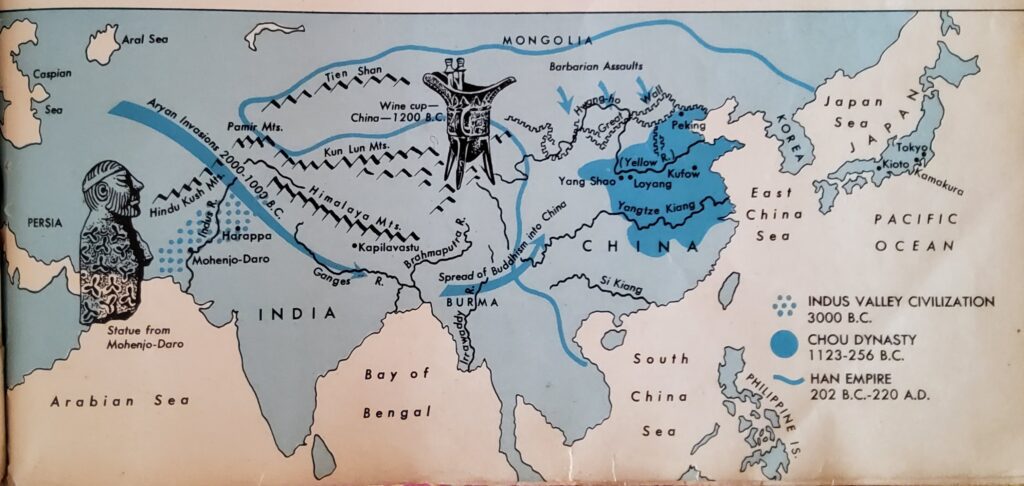
The earliest civilization of China began in the Hwang-ho River valley almost as early as civilization began in the Nile and Tigris-Euphrates valleys. The present Chinese people believe that their ancestors were the original people of the valley, but some scholars believe that they came from the highlands and conquered the valley.
China has several large rivers, while Egypt has only one, the Nile. China’s rivers flow in the general direction of west to east. The Hwang-ho (Yellow River) drains the north, the Yangtze Kiang drains mid-China and the Si Kiang, crosses the south. Of these three, the Hwang-ho, or Yellow River, is the least reliable. It overflows its banks and causes devastating floods, it is called “China’s Sorrow.”
The Yangtze and Si Kiang are the more peaceful rivers of China. They have well-defined valleys and are generally safe from floods. They have become highways of commerce since they are navigable and have developed great ports at their mouths. The Yangtze’s port is Shanghai and the port near the mouth of the Si Kiang is Canton.
These three river valleys greatly influenced the development of China’s early civilization. They served as a cheap and practical transportation system, especially for heavy goods. They provided water for irrigating the adjacent farm lands and in some areas, spread a layer of silt over the land in the rainy season. Due to these factors, fertile soil and a moderate climate, the density of population became greatest in the valleys and near the mouths of the rivers.
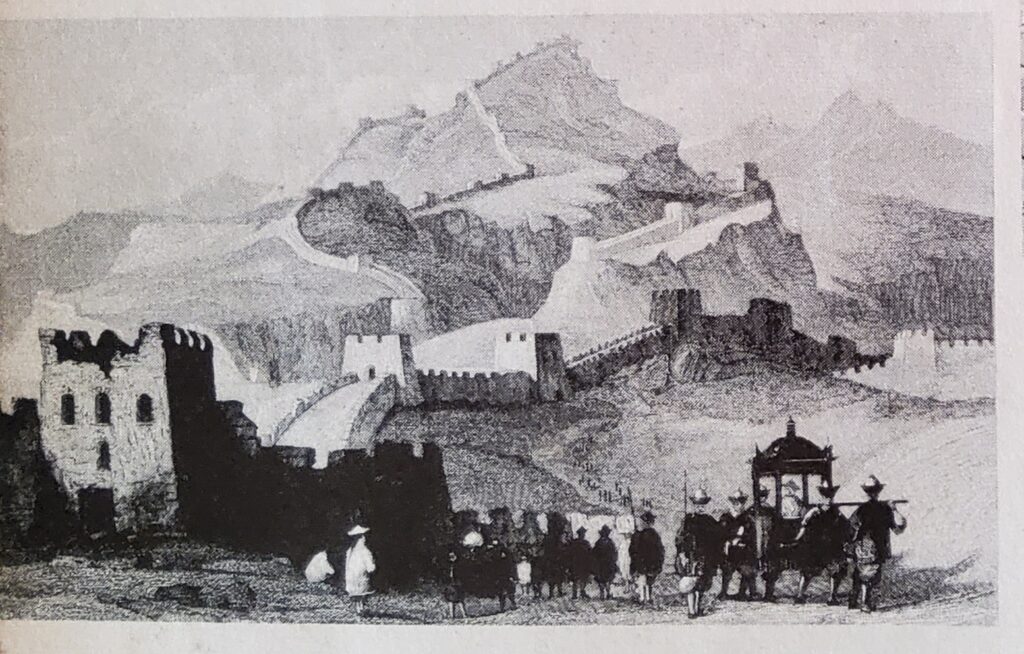
Like Egypt, China has natural defenses which helped it to develop a conservative way of life. To be sure, there was always the danger of invaders by land. That is why, at one period in their history, the Chinese built their Great Wall. Nonetheless, the mountains on the west, the deserts on the north and the open sea on the east, were geographic defenses. These barriers helped China to develop and to maintain for centuries its almost unchanged way of life, by isolating her from close contact with other seats of culture, such as India, Mesopotamia and Persia.
Legends account for the earliest achievements of the Chinese.
A legendary emperor, Fu Hsi, is credited with introducing marriage in B. C. 2852. He is said to have taught his people to hunt, fish and care for flocks. Fu Hsi is also credited with arranging a calendar, inventing musical instruments, and introducing hieroglyphs as a system of writing. Other emperors are supposed to have taught the Chinese people how to till the fields, to build houses in villages, to record time and to use certain plants for medicines. The legends tell how the Chinese people learned to cultivate mulberry trees and silkworms and to make silk.
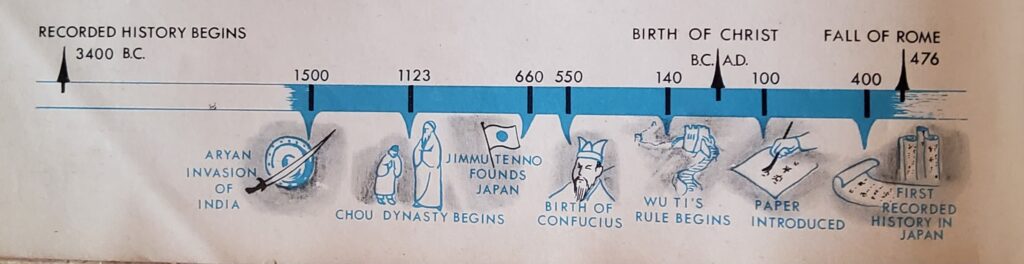
Chinese history is recorded by dynasties. One of the earliest of these long periods of rulers was the Chou Dynasty. It lasted from about B. C. 1123 to 256 A. D.

LINKING THE PAST AND THE PRESENT
The United States government employs more than two million persons under a system called civil service. The positions filled in this manner range from delivering mail to designing money. A person who applies for a civil service appointment must take a competitive examination for the post he wants. If he needs special preparation for the examination, he may take an intensive course in the proper field, or be tutored for it. After the test is taken, if the score qualifies him, the applicant must wait until he receives notice of his appointment.
It may surprise you to learn that neither the civil service nor the procedures mentioned above are new. They existed in ancient China in the first century B.C. A man could train for government service or pay a scholar to prepare him for a civil service examination. The tests were based on the literary classics and so tended to bring China a highly educated group of men for public service. Japan set up a civil service about 650 A. D., but only nobles of a certain rank could take the examinations.
Chinese society was developed around the family.
What is sometimes called “ancestor worship” was established under the Chou Dynasty. This system of cementing family unity remained one of the most powerful factors in the Chinese way of life even into the twentieth century. From earliest childhood the Chinese children were taught to respect, to almost worship, the wisdom and achievements of their ancestors.
In ancient China the oldest male member of the family, the patriarch, had much authority. His position in the family was not unlike that of the emperor in the nation. As the emperor, called the Son of Heaven, was looked upon as the father of the nation, so the patriarch functioned as father of the family, which included the sons, grandsons, greatgrandsons and all the wives and unmarried daughters of these family members. Sometimes, a family constituted an entire village. The fact that the patriarchal system developed early helps explain the tremendous population of China today. A family’s importance was in part determined by its size.

Confucius was ancient China’s greatest teacher.
Of all the philosophers of the Chou Dynasty, his influence has lasted the longest. Confucius was born about B. C. 550. About that time, Cyrus the Great was building up the Persian Empire in the Middle East and the Greek city-states were developing. Confucius began his career by working for a clan chief, but in his early twenties he became a teacher of government and ethics, or right conduct. He stressed the importance of good manners and respect for parents, or as we would say, for one’s elders. He taught his students to respect and honour their ancestors.
Confucius believed that men and women are born with both the desire and the capacity to be decent and friendly in their relations with one another. To live on a high level, he said, each one must recognize rules of conduct proper for his station in life and observe these rules in his daily contacts with others. Many of his sayings were presented by his followers in several books called the Analects.
Among his sayings are the following: Love one another. Return good for good; for evil, justice. Let loyalty and truth be paramount with you. He who has offended against Heaven has none to whom he ean pray.

CONFUCIUS (c. B. C. 550 – 479)
Through the ages, men with definite ideas often have dominated the civilization of a whole people. One of these men was Confucius, whose teachings still dominate the thinking of some 300 million people, most of them in China.
Born into a well-educated family, Confucius gained a mastery of Chinese literature and yearned to impart his learning to others. He became a teacher of ethics, politics and in time, was appointed as minister of crime in his native province. When the ruler lost interest in Confucius’ ideas, the wise old man resigned. With a few students, he wandered over China, teaching others his ideas of good conduct. In his last years he collected old Chinese songs, history, poetry and lectured on them.

The Ch’in and Han rulers also advanced China’s ancient civilization
During the last years of the Chou Dynasty, China was split apart into independent states whose feudal lords made war upon each other. In B. C. 256, the Chou ruler was defeated by the ruler of the state of Ch’in. The Chou Dynasty was ended. Between B. C. 256 and 221, the Ch’in rulers conquered and united the various feudal states and brought peace to China. The Ch’in king, Ch’in Shih Huang Ti, called himself the First Emperor. The country’s name, China, probably was taken from him.
Shih Huang Ti constructed part of the Great Wall on the northern and western borders to keep out invaders. It was 1,500 miles long and 25 feet high. Much of this great structure, the largest ever built by man, may be seen today. Forced labour was used to build this wall and many Chinese labourers died as a result of Shih’s ruthless drive to complete it.
Shih Huang Ti’s death was followed by civil war and a new dynasty of rulers, known as the Han Dynasty. The greatest Han ruler was Wu Ti, who ruled from B. C. 140 to 87. Wu Ti brought Korea, Manchuria, Turkestan and Indo-China into his empire. He also sent troops against barbarians who were pounding at the Great Wall and defeated them. Their defeat made safe the caravan routes to the West and eventually opened up trade with central Asia and the eastern sections of the Roman Empire.

Wu Ti set up a system of state socialism with government control of iron and salt production, the sale of alcoholic drinks; and commerce and exchange. Under this system, there was price control and a five per cent income tax. Wu Ti also sponsored a public works program for building bridges, canals and irrigation projects.
Other achievements under the Hans were the invention of paper (about 100 A.D.), water clocks and sundials. Trade with the eastern sections of the Roman Empire was encouraged. During this period, Buddhism, a religion started in India, penetrated China. This was a highlight in Chinese history, for the influence of Buddhism upon Chinese thought and culture has endured. Under later emperors, slavery was abolished and land reforms resulted in a wider distribution of lands for the peasants. The Han Dynasty concluded what we call the ancient period of Chinese civilization, but it left China welded together as a state.
THE EARLY JAPANESE PEOPLE
Geographical factors have played a major role in Japan’s long history.
The basic factor influencing Japan’s history and development in ancient times was her isolation from the mainland of Asia. Japan is a country of islands. This factor helped to keep Japan from being annexed to China’s empire, but the two empires were so close geographically that Chinese culture was able to span the East China Sea and the Japan Sea to influence the civilization of Japan.
The Japanese are a mixed race. The available evidence supports the belief that in prehistoric times, immigrants came from the mainland and from Borneo, Java and the Philippines. During China’s Chou Dynasty (c. B. C. 1123-256) many groups of Chinese migrated to Japan. During the Han Dynasty (B. C. 202 – 220 A. D.), Korea came under Chinese rule. After that, Chinese and Korean weavers, potters and farmers, brought their skills and culture to the islands. Thus began the raising of silkworms. Chinese medicine and the Chinese calendar were introduced.
Chinese scribes brought to Japan the language, the writing and the literature of China. The Japanese adapted the Chinese language to their own way of conveying images and ideas, retaining much of Chinese literature. Much later, they developed a system of phonetic writing which simplified the Chinese characters and made it easier to use them in writing Japanese. This step stimulated the growth of a native Japanese literature.
Scholars classify the Japanese people as Mongoloid, but some scholars believe that the earliest people to inhabit the Japanese islands were Caucasoid. After a long migration across the continent of Asia, these people called the Ainu, made their homes in Japan. They were a prehistoric people, barbaric and primitive, they lived in caves. Their skin was light in colour and their eyes were not almond-shaped. As mentioned above, later invaders from the mainland were Mongolian and gave to the population the distinctive Japanese characteristics that we know today.

Religion has been a vital part of Japan’s culture.
The early Japanese religion began with worship of the forces of nature and with veneration of the spirits of the dead. Its divine personages were the gods and goddesses of the sky, the earth, the storm, water, of growth and so forth. According to legend, an ancient sky father and his wife, the earth mother, had a daughter, the sun-goddess. She became the supreme Deity of Heaven and founder of an eternal dynasty. Hence, her descendants, the emperors, were believed to be divine.
Out of this primitive faith grew the system known as Shintoism, a word derived from two words meaning god and law. Unlike Confucianism, Shintoism did not provide rules for human conduct. It emphasized veneration of the gods and obedience to authority.
Jimmy Tenno founded the Japanese nation about B. C. 660
As in the case of China, the earliest history of Japan is told in legend and myth, but it is believed that Jimmu Tenno brought the Japanese peoples together into one nation. He and his successors were said to be the descendants of the sun-goddess.
In ancient times, the clan rulers and nobles controlled the land. Farming was the main occupation. Below the nobles were guilds of farmers and artisans. Serfs and slaves completed the social scale. A thousand years passed after Jimmu Tenno’s reign before the Japanese had a written language and began to record their history about 400 A. D.
THE ANCIENT CIVILIZATION OF INDIA
Two great rivers influenced the early civilizations of India.
Fed by glaciers in the Himalayas, the Indus and the Ganges rivers find their way from the highlands out across the fertile plains of northern India. The Indus in the western section and the Ganges in the eastern section, have influenced Indian life since earliest times.
Whereas we have written records of the early civilizations in Egypt and the Fertile Crescent, we have little more than legends and the evidence revealed by archaeologists and their excavations, to shed light on the origin of civilization in these two river valleys. Archaeologists have unearthed ruins at Harappa and Mohenjo-Daro, in the Indus Valley. These ruins indicate that the early inhabitants, called Dravidians, had advanced to a Bronze Age civilization before they abandoned these two walled cities, to drifting sands about B. C. 2000.
Here were brick houses, plumbing, wide streets, water supply and drainage systems. The inhabitants included craftsmen who made jewelry, pottery and metalwork. It is very likely that trade routes connected these people with the peoples of the Nile and Tigris-Euphrates valleys. Many objects discovered in the ruins at Harappa and Mohenjo-Daro suggest an exchange of goods, among the three regions.
As prosperous civilizations developed in the river valleys in ancient times, the danger of invaders was ever-present. About B. C. 1500, the river valleys of India were conquered by tribes out of the northwest called Aryans. The Aryans came into the Indus Valley from the plains of Persia. They called their new home Hindustan, a word meaning “land of the Hindus”. These people were fair skinned in contrast to the darker Dravidians, who by that time, occupied the southern peninsula. The newcomers seem to have been responsible for two unique features of Indian life that have persisted to our day — the Hindu religion and the caste system.

The Hindu religion became allied to the caste system.
Hinduism began as nature worship, but its simple ceremonies developed into a system which combines religion, a social system (caste), a geographic region (India) and a race. The Hindu faith is very complicated and difficult to understand. Many of the religious beliefs are contained in the Vedas, which are to the Hindus what the Scriptures are to Christians.
The supreme spirit, the eternal, immortal being, is Brahman, but Hinduism allows the worship of other gods as steps toward understanding Brahman. Among these are Brahma, the creator; Shiva, the destroyer; Vishnu, the preserver or renewer. A Hindu’s greatest hope is to have union with Brahman, but the route to this spiritual state is a complicated one. Immortality may be achieved through reincarnation; that is, when the body dies, a man’s soul migrates into another body. If one has lived an evil life, this new body may be that of an animal, even a snake. If one has led a good life, his soul may migrate into the body of an even better person or a person of higher caste. Thus, through many migrations, a man’s soul could come nearer and nearer to the perfection of Brahman.
The origins of India’s caste system are unknown to us. When the Aryans came into India, they overcame the Dravidians they found living there and enslaved those who did not flee southward. Since the newcomers did not wish to intermarry with the Dravidians, they outlawed such marriages. This may have started the caste system, which separated the people into fixed social classes or ranks, for it separated conquerors and conquered.
In those early days, the warriors were the most honoured caste or class. Next to them were the Brahmans or priests. When peace began to supplant war, the Brahmans became increasingly important, until they occupied the most privileged position in Indian society.
In the later system, the second caste included the warrior protectors and the third caste, the merchants and farmers. The fourth caste included the labourers, who had few rights. At the bottom of the social system and outside every caste, were pariahs or outcasts. This class was originally a small group of war prisoners who were sold as slaves. They were the ancestors of 40 million people in India who today are still called “untouchables.” They presented a serious social problem because other Indians will have no contact with them. After India became independent in 1947, the government legally abolished caste distinctions, but old beliefs remain.

India was the home of Buddhism, one of the world’s great religions.
This faith stems from humble beginnings in the sixth century B.C. by Gautama Sakyamuni, a Hindu prince who was later named the Buddha.
Gautama was born, as we say, “with a silver spoon in his mouth.” Brought up in the midst of wealth and luxury, he married a beautiful princess when nineteen. As he neared thirty years of age, Gautama changed his way of life. He became troubled over the sorrow, suffering and poverty of his people. According to legend, he gave up his royal home, donned an old robe and went out, to seek a way of life in which human misery might be replaced by happiness and peace of mind.
Gautama’s search for a better way of life was a difficult one. He finally spent days of meditation beneath a certain giant tree and there, according to legend, “enlightenment,” or a revelation of truth, came to him. He felt that at last, he knew why men suffer and what he should do to help his fellowmen. When he told his revelation to his friends, they saw him as the Buddha, the Enlightened One.
The Buddha taught that the best way of life was to be completely unselfish — to expel from one’s thought all desire for worldly pleasures and comforts since they do not truly satisfy. This might be done by right living, by following the Eightfold Path and having “right views, right intentions, right speech, right action, right living, right effort, right mindfulness, right concentration.”
The Buddha hoped to reform Hinduism, not to start a new religion. He strove to free his religion from priestly control and through it, offer hope to those burdened by the caste system. Any man could escape misery in his lifetime, he said, by ethical living and unselfish activity. By such teaching, the Buddha offered “untouchables” and people of the lower castes, a way to salvation that bypassed the Brahmans.
The Buddha lived apart from the world in monasteries. He made no provision for a priesthood or places of worship, but his followers wrote down his sayings and created a Buddhist literature. After his death in B. C. 483, they built Buddhist temples and monasteries, began to worship the Buddha as a god and developed a priesthood. In India, the religion was absorbed into Hinduism and for a while disappeared.
Buddhism appealed to the poor and hungry people of eastern Asia. The Buddha’s followers carried his ideas to many lands. Buddhism became one of the leading religions in China and an important one in Burma, Siam, Japan, Tibet and Ceylon. It is said that in Ceylon, Buddhism today most faithfully reflects the teachings of its founder.

China, Japan and India were slow to change from their ancestral way of life.
The Hindus and Chinese especially, were slow to desire change, but the Second World War forced many changes upon them. When we read of their present-day efforts to achieve social gains and higher standards of living, we should keep in mind the power their ancient civilizations have had over them.
The Orient is important to us, but note how mankind independently developed advanced civilizations in the East that were quite different from those developed in the West. This situation created a problem that has appeared again and again: the need for the peoples of the East and the West to understand and appreciate each other’s cultures.


