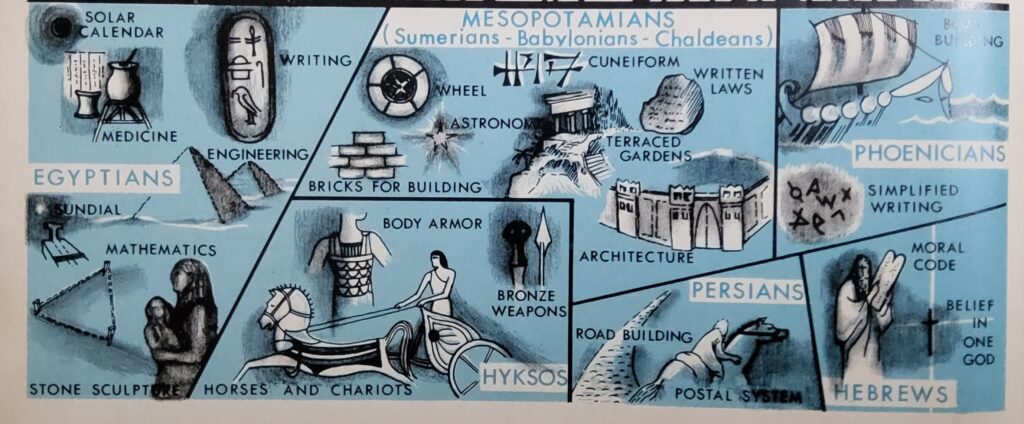
Kingdoms of the ancient Middle East included the Egyptians, Hebrews and Phoenicians. The culture of a people is not regarded as a civilization, until the people have devised a system of writing and developed communities large and complex enough to be called cities. Here in we may trace the many steps by which, ancient peoples of the Middle East met these requirements and achieved the status of civilization in the valleys of the Nile, Tigris and Euphrates rivers.
The Egyptians took thousands of years to achieve the requirements of civilization, but farther east, the Sumerians came more quickly to writing and to having enough skilled people to handle the religious, economic and political needs of large groups of people. Invaders finally conquered the Sumerians, then adopted Sumerian culture and adapted it to their peculiar needs.
Peoples in Egypt and the ancient Middle East contributed many inventions to world civilization. The potter’s wheel, the sailboat, the wheeled vehicle and the use of metals were developed. Noteworthy are the achievements of these peoples in law, art, medicine, writing, religion and other fields, which have come down to us as cherished features of our civilization. Note, too, that individuals made some of the most significant contributions, as they do today.
Gift of the Nile
The development of Egypt’s ancient civilization was protected by natural defenses.
The climate, the physical features, the location and above all, the Nile River – shaped the lives of early Egyptians. The climate is hot and dry with almost no rainfall. Dominant physical features include the river, the narrow valley with fertile soil, the limestone cliffs and the desert plateaus. For many centuries Egypt was never invaded because of its natural defenses. It was protected on the north by the Mediterranean Sea, on the west by the vast Sahara Desert, on the south by the Nubian Deserts and on the east by the Arabian Desert and the Red Sea.
Ancient Egypt was small in area – most of its people lived in the fertile valley of the Nile and avoided the arid deserts. The river rose in the mountains and plateaus south of Egypt and serpentined across the land into the Mediterranean Sea. The Nile was remarkable for the regularity with which it annually flooded and overflowed its banks, leaving a blanket of enriching silt spread over the land.
Early Egyptian life was dependent upon the Nile.
The Egyptians rejoiced and sang hymns of praise to Osiris, the god of the Nile, when the river began to rise during the early summer. Slowly it spilled over the hot, flat lands. In the fall, the waters receded and the river returned to its regular channel. For centuries, this rich valley made Egypt the chief “bread basket” of the ancient world.
The melting snow and heavy rains in Ethiopia swell the Blue Nile. At Khartoum in the Sudan (ancient Nubia) the Blue Nile drops its heavy load of water and soil as it joins the White Nile. The Greek historian Herodotus was curious about the annual overflow. He visited Egypt about B. C. 500 and wrote that Egypt was the “gift of the Nile”, but the people he met credited the god Osiris with fertilizing their soil. It is said that they did not know the real cause of the flooding.
Many of the ancient Egyptians depended upon farming for a living. Those who lived near the river gradually learned to plant their crops after the yearly flood. They had to find a way to time their planting and other activities. The Nile inspired them to make the first known calendar. It called for 365 days in a year of 12 months, with each month to contain 30 days. The extra five days, were set aside for a festival. Later, more accurate observations proved that a year’s length was 365 days plus a fraction, a fraction that we now pick up with an extra day in each leap year.
After the annual overflow, the Egyptians needed some means of measurement in order to re-establish boundaries and landmarks. Thus the Nile challenged them to work out a means of measuring area, even as it had forced them to make a calendar for measuring time. They were inspired to develop engineering skills too. Since it seldom rains in Egypt, it became essential to dig ditches and canals with which to use the river’s overflow for irrigation purposes.
The Nile was Egypt’s only dependable highway in ancient times. There were no permanent roads along the banks of the Nile, both goods and people were moved via the river. Boatbuilding was one of the major occupations. The building of pyramids and tombs would have been impossible without the river. The huge blocks of stone were moved down the Nile from the quarries on barges.
Major Achievements of the Egyptians
Ancient Egyptian history may be divided into three main periods.
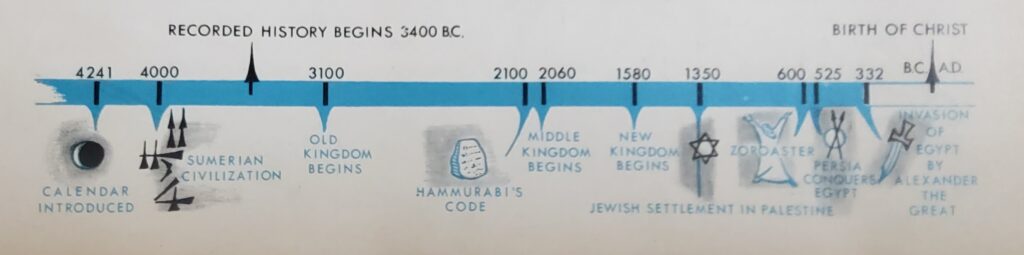
Scholars do not agree as to whether the first organized government began in the Nile Valley or in the Tigris-Euphrates Valley. The first known date in man’s history is often taken as B. C. 4241, when the calendar was introduced into Egypt. Archaeologists have found in Egypt, records carved in stone that date from B. C. 3400. Inasmuch as these facts and others would seem to indicate that man’s first important civilization was founded in the Nile Valley, it may be that prehistoric man established the first organized government there.
This much is definite: the government was headed by a king called a Pharaoh. By about B. C. 3100, two kingdoms had been established. About B. C. 3100, a Pharaoh by the name of Menes united the two kingdoms under his rule and Egyptian civilization was born, politically.
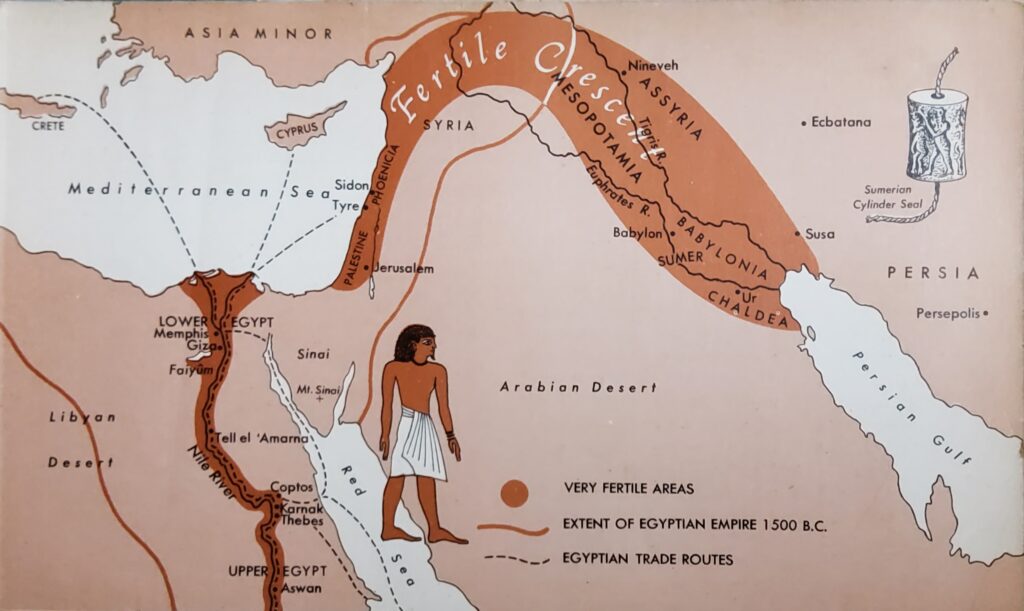
The following period is spoken of as the Old Kingdom (c. B. C. 3100 – 2270). During this age, the Egyptians began to develop a system of writing. Inasmuch as the Pharaoh was thought of as both god and king, he was given the surplus crops of the Nile Valley. The men who handled the Pharaoh’s share became specialists in their jobs, thus meeting a second requirement in the process of becoming a civilization. Trade was encouraged, men were sent to the Sinai Peninsula for copper and to Lebanon for timber.
The Old Kingdom gave way to a series of civil wars. These were followed by the second age of Egyptian history, the Middle Kingdom (c. B. C. 2060 – 1785). It was during this period that the building of cliff tombs began and public works were undertaken.
The third and greatest period, the New Kingdom (c. B. C. 1580-1085), followed a period of civil war and invasion. The Pharaohs of this age expelled the invaders and made many conquests, until Egypt had an empire that spread into Asia.
While the Egyptian empire was still making conquests, a decline began, which in the end, resulted in Egypt being conquered by outsiders. This overthrow of her power completed a cycle which has reappeared many times in history: an empire rises, achieves some fame, then ultimately declines. This cycle of events seems to characterize imperialism — a term one often reads in current events. An imperialistic nation uses its power to conquer, to enslave, to exploit for tribute, or to use the resources of weaker neighbouring peoples.
Imperialism involves a conqueror and the conquered, which makes for class distinctions. In Egypt, the conquered peoples became slaves, who did the heavy labour of building pyramids, tombs and temples. Above the slaves was the second largest group, the peasants who were farmers, but not allowed to own land. The third class of society consisted of merchants and craftsmen. They were similar to a middle-class. The scribes, who could read and write, were above this group. They kept records for the Pharaohs, the nobles and priests; and wrote letters for the people who could not write. Above the scribes were the nobles and priests. They were the chief landowners. At the summit of the social system were the Pharaoh, the ruler, and his family.
The Rosetta Stone unlocked Egyptian writing.
For centuries, scholars tried to read the hieroglyphics (picture writing) of the ancient Egyptians. Each word such as man, cow, sun, moon, etc. was written as a picture. Archaeologists found this kind of writing everywhere in Egypt, but they could not translate it. In 1799, some of Napoleon’s soldiers were digging trenches in the delta of the Nile River. They unearthed a stone slab which is now one of the ancient treasures in the British Museum in London, England.
The Rosetta Stone as it is called, is an inscription in three kinds of writing. The bottom section is in Greek, which was well known to the scholars of the time. The top section is in hieroglyphics and the middle in demotic, or simplified hieroglyphics, which up to that time had not been deciphered. A French scholar named Jean Champollion, reasoned that the Greek was a translation of the other two sections. By comparing the Greek with the unknown hieroglyphic and demotic, he and others found the key to ancient Egyptian writing.
The influence of the Nile in ancient Egypt extended to the development of a written language. All kinds of records had to be kept in connection with the temples, for business transactions, for tax purposes and in handling the Pharaoh’s share of the valley’s crops. The valley afforded the needed materials for keeping records: ink made from a vegetable gum and papyrus (or paper) made from the inner bark of reeds.

Education, the arts, medicine and science flourished in Egypt.
Men were trained for the priesthood and for government positions in schools which were conducted in the temples and in the royal court. Education was highly regarded, but only a few people could read or write. The poorer people apprenticed their boys to craftsmen or farmers. Girls of wealthy families were taught at home, but their brothers were sent to school to study reading, writing and arithmetic, when only three or four years old.
The best careers open to educated men were the priesthood, court offices and the profession of scribe. Scribes were skilled in writing letters, contracts and official documents. Highly trained scribes were often appointed as governors or ambassadors. Among the other important professions were engineering and architecture. The study of arithmetic and geometry was essential for these fields because great skill was required in the building of temples, pyramids, tombs, canals, palaces and other monuments.
The Egyptians did not produce a great literature like that of the later Greeks and Romans. They wrote hymns, stories, chronicles, maxims and poetry. The most important literary work was the Book of the Dead.
The Egyptians developed considerable skill in sculpture and painting. Some of their best work is seen on the walls of temples and tombs, which often were richly decorated. The painters were limited by fixed rules, called conventions, which regulated the choice of subjects and the position and size of the figures.
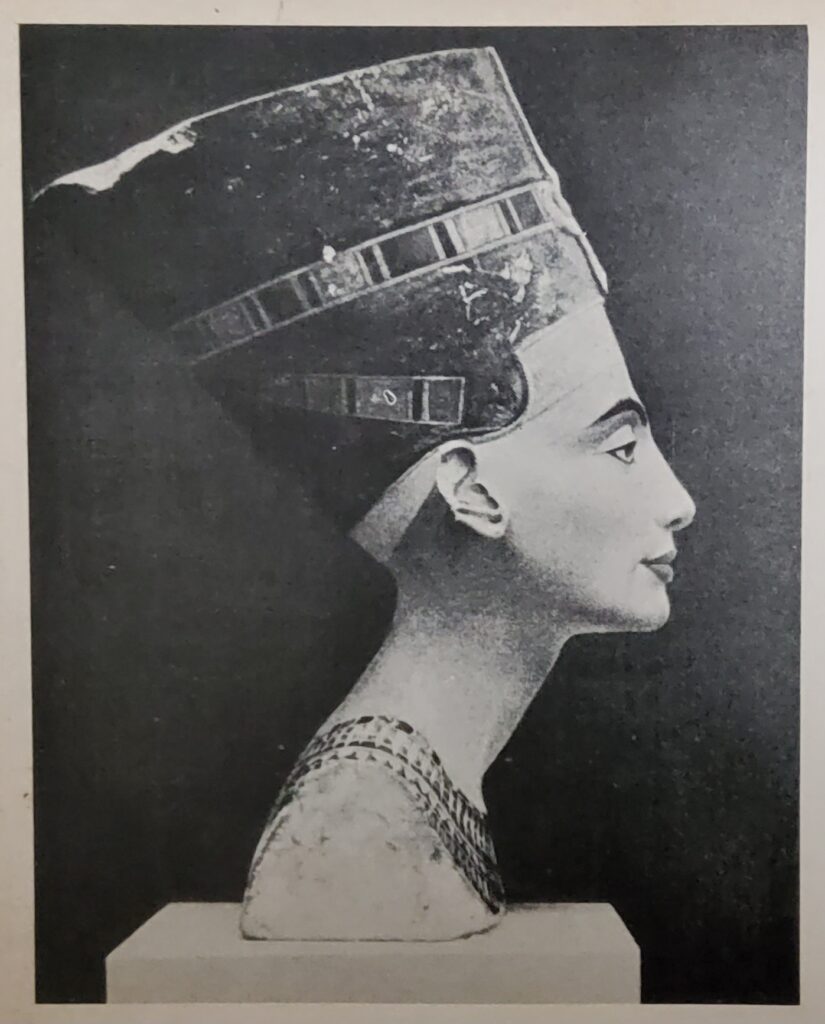
The portrait sculptors carved in wood and stone. The Great Sphinx at Giza and the Pharaoh, were among the largest and most extraordinary statues carved. Statues painted in natural colours, with the eyes inlaid in rock crystal, were often very lifelike. The bust of Queen Nefertiti, the beautiful wife of a Pharaoh, is a masterpiece. It is made of limestone and is beautifully painted. The queen’s delicate features and her use of makeup have long been of interest.
Egyptian architects were very skillful in building with stone. They were the first to use stone columns and to let daylight into large buildings. Their skill is shown in the pyramids and tombs that remain to be admired today. Another symbol of their skill is the obelisk. An obelisk, is a four-sided shaft whose top is shaped like a pyramid.

Medical schools were developed at the temples. Papyrus rolls, well-preserved by Egypt’s dry climate inform us that some doctors used charms and magical rites to overcome the evil spirits which they believed caused disease. Other doctors seem to have been specialists in certain diseases and in eye operations. The gold fillings found in the mouths of the dead testify to unusual dental skill. Old records also indicate that Egyptian surgeons had skill in handling broken bones and other injuries.
Astronomy was a profession in ancient Egypt. The astronomers have left records of the changes of position by the heavenly bodies. It was the astronomers, aided by mathematicians, who developed the calendar and the sundial for measuring time.
The Egyptians came to believe that man is immortal.
Like most early people, the Egyptians worshiped the sun. The people believed that the Pharaohs were descendants of Amen-Ra, the chief sun god. They believed that since the Nile god Osiris was the giver of the soil, he was the symbol of life and man’s judge after death. If one lived a good life, he would go to the “land of the blessed”.
It was believed that the spirit of a person lived on in the body after death. This led to the practice of preserving the body forever and placing it in a safe place, such as a pyramid or cliff tomb. Although only the rich could afford a pyramid or a cliff tomb, all Egyptians tried to preserve the bodies of the dead. The preserved body, placed in a casket, was called a mummy. Many museums in the United States and other countries have exhibits of ancient mummies.
A copy of the Book of the Dead was placed in each tomb so that the spirit of a departed person could consult it. It contained prayer and advice to help the spirit when it came before its judge, Osiris. The Book of the Dead throws light on the beliefs of the peoples of ancient Egypt. Besides this book, favourite foods, pictures, furniture and other objects were placed in the tomb to help comfort the spirit in the hereafter.
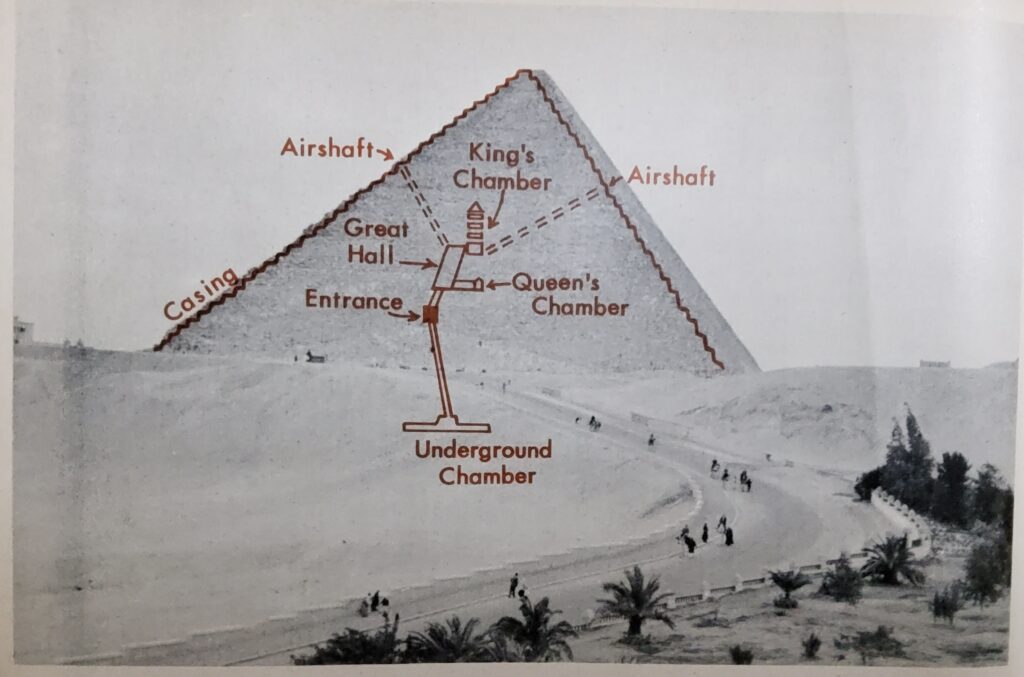
Egyptians who believed that a man’s spirit lived forever, wanted a burial place that would exist forever, too. That is why the Pharaohs’ tombs were built of stone. The largest pyramid was built for Pharaoh Khufu near the Nile at Giza, where the valley is wide and open. Called the Great Pyramid, it stands on the desert floor like a monument to the skill of the engineers and the hard labour of the 100,000 or so slaves who built it. At the base it measures about 760 feet on each of the four sides.
More than two million huge blocks of limestone, each weighing about two and a half tons, were quarried, loaded on Nile barges and transported to Giza. It is believed that crowbars, crude ropes, many rollers and hordes of men, moved these heavy blocks of stone up sloping ramps of earth to construct the pyramid.
Some centuries after the age of pyramid building, the centre of Egyptian civilization moved southward to what is now Tell el ‘Amarna, where the valley is narrow. There was little room for pyramids, but in the steep stone cliffs, tombs were cut deep into the rock during the days of the Middle Kingdom. As in the case of pyramids, the entrances were hidden to prevent looting. Down through the ages, in spite of secret entrances, most of the pyramids and cliff tombs were robbed of their mummies and rich treasures by bandits.
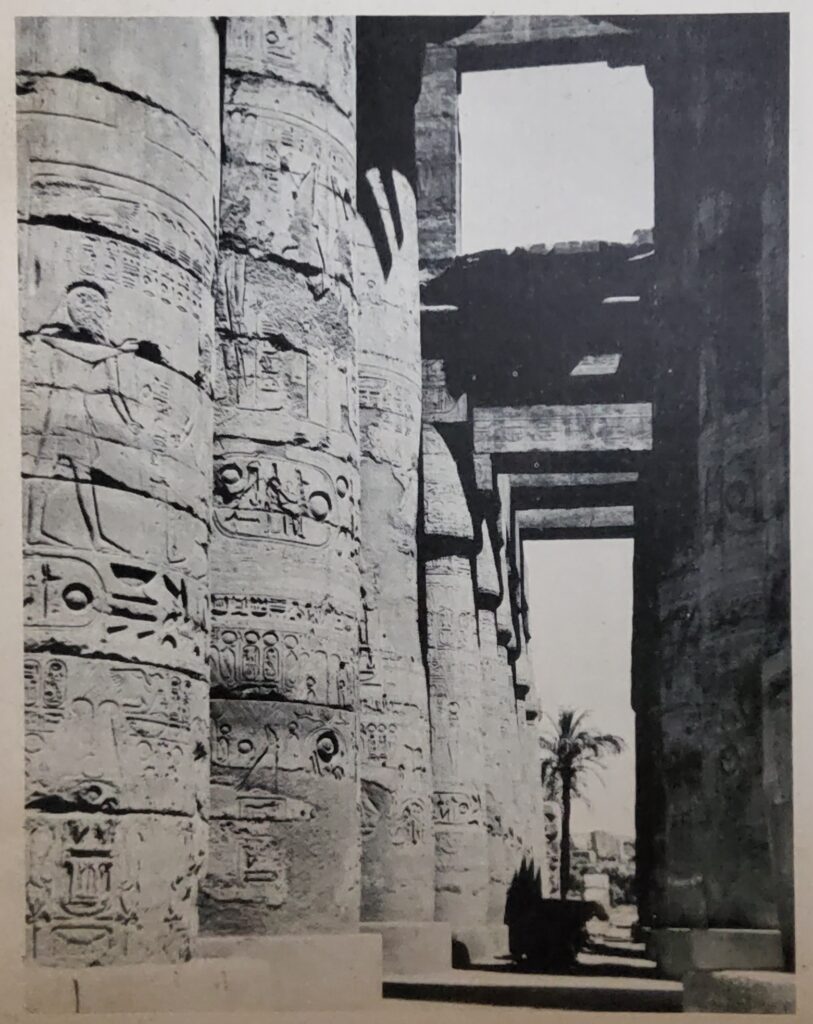
The Egyptians came to believe that if a man’s spirit lived forever, so must the gods and the temples in which the gods resided, should stand forever. This conviction meant, the Egyptians used the vast supply of stone in the cliffs along the Nile for temple building. In time, each town had at least one temple wherein to worship its gods, but the largest and most magnificent temples were built at Thebes, the capital during the Empire Period. There the most famous temple built to honour Amen-Ra is known as the Temple of Karnak.
Achievements of the Great Pharaohs
Amenemhet Ill, a “builder” Pharaoh, brought prosperity to Egypt.
The outstanding leader during the Middle Kingdom, Amenemhet IlI, became Pharaoh about B. C. 1850 and brought prosperity to Egypt. Wars among the provincial governors had greatly weakened the nation’s economy. It seemed to Amenemhet III, that Egypt needed internal improvements which would create jobs for the people and produce more crops and goods. To increase trade, he had a canal dug from the Nile to the Red Sea. The increased exchange of goods resulted in prosperity for the craftsmen, the shipbuilders and the traders.
The first cataract on the Nile River hampered trade with Nubia, since goods had to be shipped by boats. Amenemhet III had a canal built around the first cataract so the Egyptian traders could move farther up the valley to exchange goods.
One of the earliest reclamation projects we know about was carried out by this same Pharaoh. The Faiyum, a large marshland depression to the west of the Nile, was reclaimed for farming. An old lake became a reservoir in which flood waters could be stored until they were needed for irrigating in the dry season.
Strong leaders drove out the barbarians and made Egypt an empire.
During the period of civil wars which followed the Middle Kingdom, the Hyksos came out of Arabia and Syria and invaded Egypt. The Hyksos used horses and chariots, thus introducing horses to Egypt. They were the first people able to conquer Egypt. They gradually absorbed Egyptian culture and governed part of Upper Egypt. Several generations later Ahmose, an able military leader from Thebes, drove out the Hyksos by using their horse-and-chariot method of warfare.
Thutmose III, trained the army to use the horse and chariot as a cover for his soldiers. He conquered Syria, Phoenicia and Palestine. He accepted gifts from rulers in the Tigris-Euphrates Valley. After achieving an empire, he proved to be a good administrator. It was he who had the children of conquered princes in Asia and elsewhere taken as hostages to Egypt. There they were educated and taught to respect the power of Egypt and the Pharaohs, then returned to their homelanda to succeed their fathers as rulers. This was an early use of indoctrination.
Amenhotep IV decreed that all Egypt must worship one god.
This was indeed a revolution in a land where many gods were worshiped. Apparently young Amenhotep IV, was opposed to the vast power and influence which the priests of Amen-Ra had over the people and he may have thought that a new state religion, would curb this power. In any event, Amenhotep had come to believe that since there was one sun, universal in its blessings, there must be only one sun god in the form called Aton. He commanded that all Egyptians should worship Aton, changed his own name to Ikhnaton and built a new capital, which he called Akhetaton.
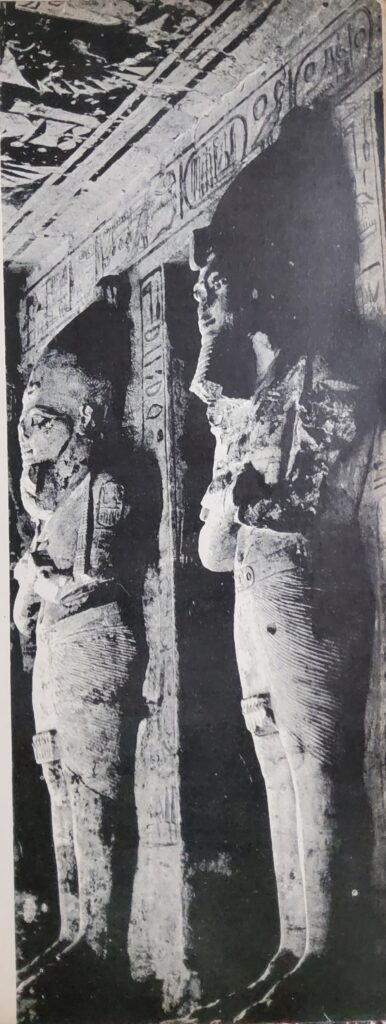
Ikhnaton’s new religion never took deep root among the people. Their worship of Osiris, the god of future life, for example, was deep-seated. The priests resented the turning away from Amen, although they were kept quiet during Ikhnaton’s lifetime.
We know many details of this period in Egyptian history because archaeologists uncovered the ruins of Akhetaton in the nineteenth century. Some three hundred clay tablets were found in one ruin. These included letters sent to Amenhotep IV and his father, by Asian kings such as those of Assyria, Babylon and by Egyptian governors in Palestine, Assyria and nearby provinces. The ruins and nearby tombs are now called Tell el ‘Amarna and the tablets are referred to as the Amarna letters.
The Amarna letters indicate that Ikhnaton neglected his empire. The Asian provinces gradually went to pieces inspite of the calls (unanswered) for help against their enemies that were made by the Pharaoh’s loyal Asian officials.
Under Tutankhamen the old religion was restored in Egypt.
Ikhnaton died c. B. C. 1354, leaving six daughters, but no son. Two teenage sons-in-law reigned after him. The second one, Tutenkhaton, was perhaps twelve years old when he became Pharaoh. He was persuaded by the priests to return to the worship of the old gods and to change his name to Tutankhamen. Tutankhamen probably reigned about six years and was buried at Thebes. His name is familiar to many people, because his tomb was discovered in 1922 and the world was given reports and pictures of the treasures found in it. His body was found untouched and still rests in the tomb, but many of the treasures were put in museums.
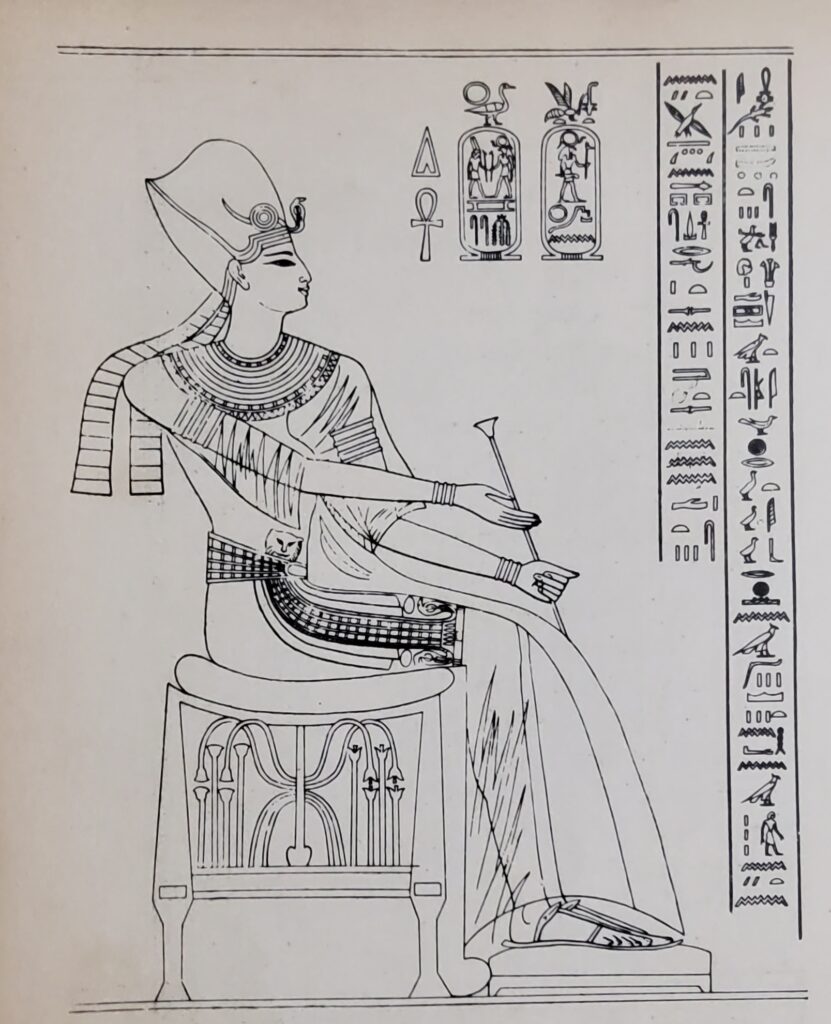
Ramses II was one of Egypt’s most famous Pharaohs.
He and Ramses I, were among the well-known successors to the two teenage Pharaohs. Ramses I planned and began the great hall of the temple at Karnak; Ramses II completed it.
Ramses II (c. B. C. 1304 – 1237) inherited the conditions in the Middle East described in the Amarna letters and spent much time reconquering Egypt’s lost territory. Early in his reign he made a campaign against the Hittites, fierce fighters from Asia Minor who introduced the use of iron into the ancient world. The Hittites were a source of trouble until Ramses II made a treaty with one of their kings and a few years later married this king’s daughter. The Pharaoh also gave much time to building temples, monuments and statues, some of which remain as his memorials. He took credit for many monuments of his ancestors by having his name carved on them.
The decline of Egypt which began under Amenhotep IV continued under some of the rulers who followed Ramses II. Many Egyptians were too lazy and soft, to fight for their country, hence the Pharaohs had to hire outside soldiers. By B. C. 1150, the Iron Age was under way, but Egypt had no iron and had difficulty importing it. Unable to compete with armies that had iron weapons, she gave up some of her possessions. The treasury was drained by building projects and the heavy cost of warding off invaders. Persia conquered Egypt in B. C. 525 and ruled her until Alexander the Great invaded the country in B. C. 332. After Alexander’s conquest, Egypt was ruled by foreign powers for more than two thousand years.
Fertile Crescent Kingdoms
The Tigris-Euphrates Valley was once a great battleground.
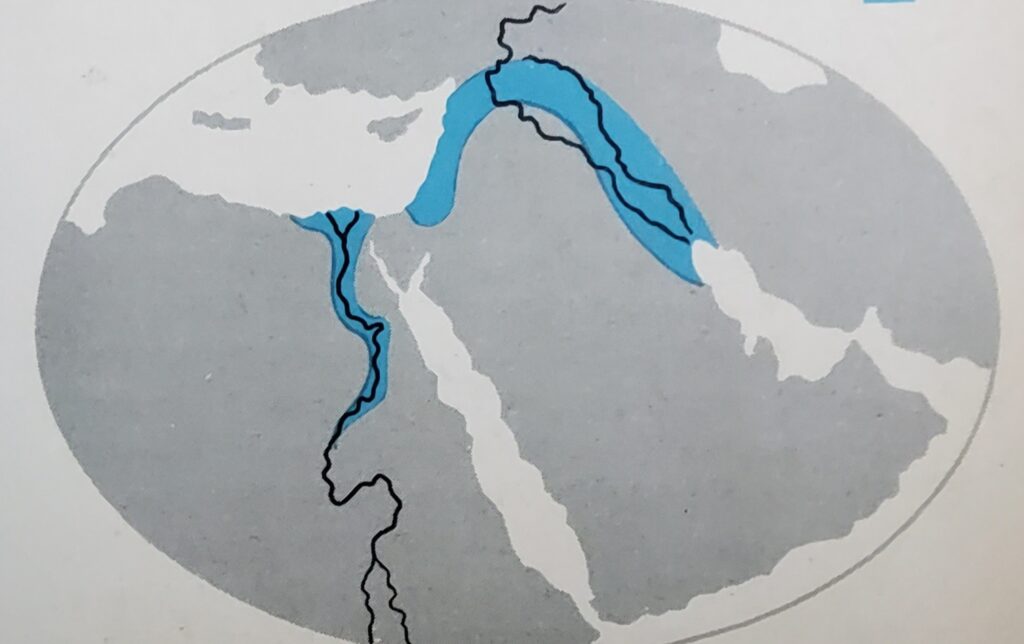
Note on the map an area labeled the Fertile Crescent. This term is used to describe a wide belt of fertile soil that stretches up the Tigris-Euphrates Valley and then curves in a narrower path to the Mediterranean Sea. The urge to control this food-producing area led to a succession of ancient kingdoms.
Geographical factors greatly influenced the civilizations which successively developed in the Fertile Crescent, but unlike Egypt, this region lacked natural defenses such as wide and barren deserts and the Red Sea. East of the Mediterranean lay the Syrian Desert, where shepherd bands wandered with their herds. When there was little rainfall and the grasses dried up, these shepherds often drove their flocks into the nearby green valley. Sometimes they stayed. The Arabian Desert harboured tribes who would invade the valley after crops were harvested.
The Tigris-Euphrates Valley had a hot and dry climate. The rivers were the chief highways for transporting goods and people. The rivers overflowed their banks, but the overflow was less reliable than in Egypt. Frequent floods caused great damage.
The lack of natural defenses impelled the valley peoples to wall their cities. Inspite of the walls, the Tigris-Euphrates Valley was a common battleground for centuries – as empires rose and fell.
Many different peoples occupied the Fertile Crescent.
The land between the Tigris and Euphrates rivers, now Iraq, was once called Mesopotamia. Ancient civilizations developed there and in Egypt, at about the same time. Some scholars think civilized ways came first to one, some to the other. Our knowledge of these valley civilizations derives largely from archaeological discoveries and from accounts in the Old Testament of the Bible.
As in Egypt, internal decay and the use of superior weapons by the invaders led to the downfall of one kingdom and the establishment of another. The Sumerians, who came first, were succeeded by Babylonians, Assyrians, Chaldeans, Persians and others.
The tribes which fought for ownership of the Crescent represented two of the major language families of mankind. Those speaking what are now the chief European languages and some Asian tongues (Indo-European languages) were Aryans. Those speaking such ancient languages as Aramaic, Arabic, Hebrew, Ethiopic and Phoenician (Semitic languages) were called Semites. The tongues of Egypt and other peoples of northeastern Africa were Hamitic and the peoples were called Hamites.
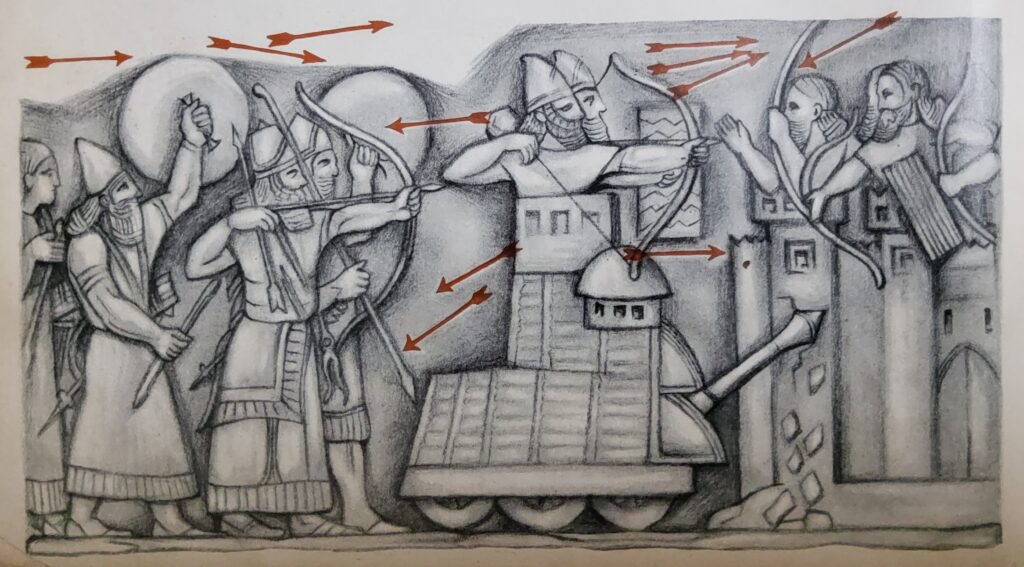
Archaeologists have shown us that weapons and the techniques of warfare improved century by century. Bows and arrows, metal daggers and sharp knives were used. Warriors learned to cut down the enemy with chariots. Officers learned to form their troops in closed ranks and organize them into companies. The valley peoples also developed battering rams with which to knock down city walls and built movable towers to climb over them. Another advance in making weapons was the use of iron, for iron weapons were superior to those of bronze.
The earliest records indicate that the Sumerians, who invaded the valley about B. C. 4000, lived in small, walled-towns, raised crops and engaged in trade. They domesticated horses, oxen and mules and used them as beasts of burden. They also developed the wheel. Metals, such as bronze, gold, silver, lead and iron were in use, Since stone was not available in the lower valley, bricks of clay, often glazed in coloured enamel, were used for building.
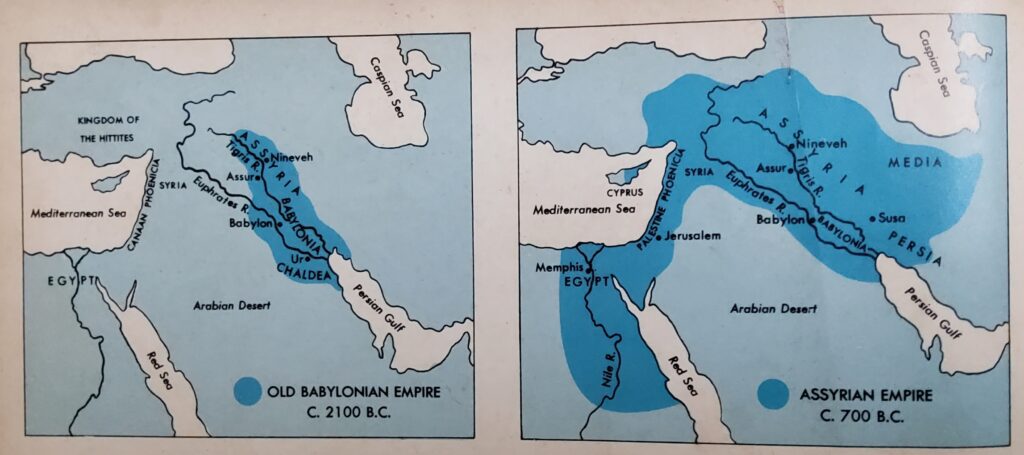
As their cities grew larger and more powerful, the Sumerians went to war against each other. Internal conflict greatly weakened their ability to ward-off new waves of invaders. Before B. C. 2000, powerful tribes from the north conquered the Sumerians. The most important invaders made their capital at Babylon and were called Babylonians. The region then became known as Babylonia.
The Babylonians did not destroy the Sumerian cities or wipe out their way of life. Instead they adopted the customs of their victims and improved the civilization which they found. Their greatest king was Hammurabi, who became famous for his code of laws. Like the Sumerians, the Babylonians believed in many gods, but Marduk, the sun god, was the chief one.
The next invaders from the hills in the upper Tigris Valley were Assyrians. They easily conquered Babylonia, extended their conquests around the Fertile Crescent into Palestine and then added Egypt to their empire. The Assyrians were fierce and brutal fighters. They were highly skilled with new iron weapons. Above all, they used follow-up terroristic methods, to crush any remnants of opposition. They wiped out cities, tortured the people and left a trail of blood. They were the most hated people of the ancient world, yet they were won over by the civilization they tried to destroy. The Assyrians finally adopted the customs and artistic skills of the Babylonians and built a new capital at Nineveh, on the Tigris.
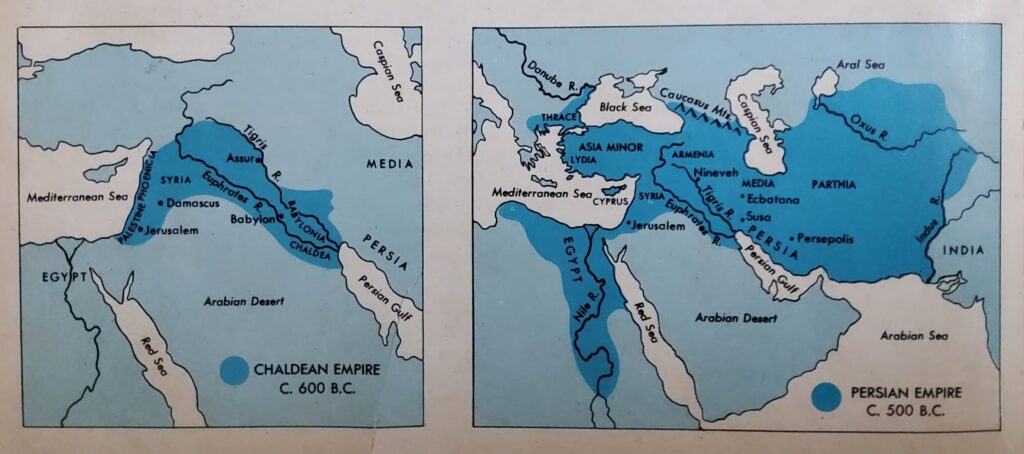
The Assyrians were conquered by the Chaldeans when the Assyrians became luxury-lovers and neglected their defenses. In B. C. 612, the invaders destroyed Nineveh and never rebuilt it. Instead, they chose Babylon as their capital and made it one of the most beautiful cities in the ancient world.
The Persians were the next conquerors of the Fertile Crescent. Cyrus, a Persian king, united the tribes under his control, then rebelled against the Medes who ruled them. He crushed the Medes and set up his own empire. Turning westward, he overthrew the small kingdom of Lydia in Asia Minor. Turning eastward, he defeated the forces of Belshazzar, crown prince of Chaldea. In B. C. 538, proud Babylon fell and Cyrus freed the “children of Israel” from their bondage in Babylon. After Cyrus’ death, his son continued the war and in B, C. 525, brought Egypt under Persian control. The new empire then included the civilized East from the Nile and the Aegean coast, almost to India.
Linking the past and the present.
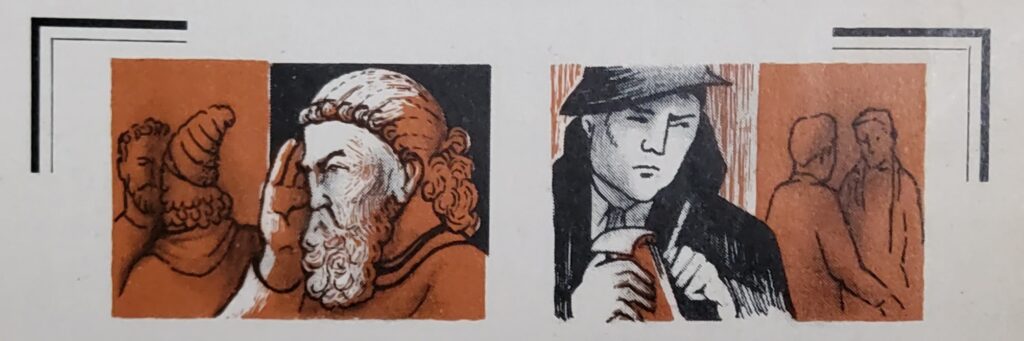
The Persian government set up the most powerful network of internal espionage in the ancient world. Darius the Great (B. C. 591- 485), made the secret police a part of his imperial organization when he organized the Persian Empire. Twenty-one provinces were put under governors. Since most of the provinces were conquered territory, the emperor had to have some means of checking on the loyalty of the governors and other officials.
His secret police were called the emperor’s “eyes and ears”. The eyes looked for disloyalty and the ears listened for it. The “eyes and ears” of Darius and other Persian kings, were similar to the secret police used by dictatorship nations today. We often refer to such nations as “police states”. Since dictatorship governments do not exist by the free choice of the people, they must be maintained by force. The secret police are used to root out disloyalty to the existing system of government.
Contributions of the Valley Kingdoms
The Sumerians developed an unusual form of witng.
The codes of law developed by these people stated that business agreements must be written and signed. This requirement made writing an important necessary skill and the kind of writing the Sumerians invented, is possibly older than Egvptian hieroglyphics.
All records and business agreements were written on clay tablets that are still found in large numbers. Short, wedge-shaped marks were made on the clay with a stylus or three-cornered stick. This wedge-shaped writing was called cuneiform, from the Latin word cuneus, or wedge.
Hammurabi had the laws of Babylonia collected and classified about B. C. 2100.
They were carved on stone and set up where the people could read them. Some of the code was so severe that we call these laws “eye-for-an-eye-and-tooth-for-a-tooth” laws.
The laws Hammurabi accepted and codified were based on the needs of an agricultural people, who also engaged in commerce. The code safeguarded both personal rights and property rights, provided for the punishment of crime, regulated marriage, inheritance and for the first time in any civilization, defined womans position and rights.
As in the case of most ancient peoples, the Hammurabi Code recognized social classes. Another important aspect of the code was that the state or government protected the people’s rights. Some punishments were severe, for example, the death penalty for robbery and kidnapping. If a son struck his father, his hands could be cut off.
Perhaps the most valuable contribution to civilization made by this code was the principle of protecting the rights of the individual, but the existence of a body of written law in itself was a great step toward equality before the law.
The Chaldeans made contributions in astronomy and architecture.
About B. C. 747, Chaldean astronomers began recording regular observations of the heavens and continued this work for more than 360 years. The data thus assembled enabled the astronomers to figure the time required for the moon to revolve around the earth.
The Chaldeans divided the day into twelve “double” hours; the year into twelve months, of thirty days each. The week was divided into seven days — one sacred to the sun, one to the moon and the other five to planets. Of these, we still have Sunday, Monday (Moonday) and Saturday (Saturn day).
The greatest Chaldean ruler was Nebuchadnezzar (c. B. C. 605 ‐ 561). He made Babylon the most beautiful city in the valley. It was also the most cosmopolitan, because people from many lands and with different languages, lived and worked there.
The thick walls of the rebuilt city enclosed some farm land on which food could be raised if the city were besieged. Most fabulous and striking of the many large buildings was the king’s palace, built of glazed or enamelled brick. Legend says that the queen was homesick for the mountain environment in which she had been brought up. Babylon stood on a flat plain and had a hot climate. To please his wife, Nebuchadnezzar had terraced gardens built into his huge palace. These “Hanging Gardens” brought visitors – we would call them tourists—from many lands. The Greeks listed the gardens as one of the Seven Wonders of the (ancient) World.
The Persians made lasting contributions in government, religion and art.
The successful organization of the Persian Empire was begun by Cyrus and continued by his successor, Darius (c. B. C. 558 – 486). Darius ruled Babylonia and Egypt personally as king and divided the remainder of the empire into twenty-one provinces known as satrapies. Each province was ruled by a governor, or satrap. Darius allowed much self-government within each satrapy and did not interfere with local customs so long as the people were loyal to the emperor, paid their taxes and furnished soldiers for the army. He built roads to connect the provinces and the main cities, Susa and Persepolis, which made possible an excellent postal system using horses and riders.
The Persians made an original contribution in the field of religion. The people still believed in many gods when about B. C. 600, a religious reformer named Zoroaster, began to preach that there is one god. He said that human life is a struggle between good and evil forces. Ahura-Mazda, the god of light, the creator or the universe, leads the forces of good and judges each man’s life when he dies. Opposed to Ahura-Mazda is Ahriman, the spirit of darkness.
Zoroaster taught that each person on earth is being trained for a future life. If he aligns himself with the good and comes to the accountant’s bridge after death with a balance of good works in his favour, he passes into paradise. If his evil works outweigh the good, he will have misery forever.
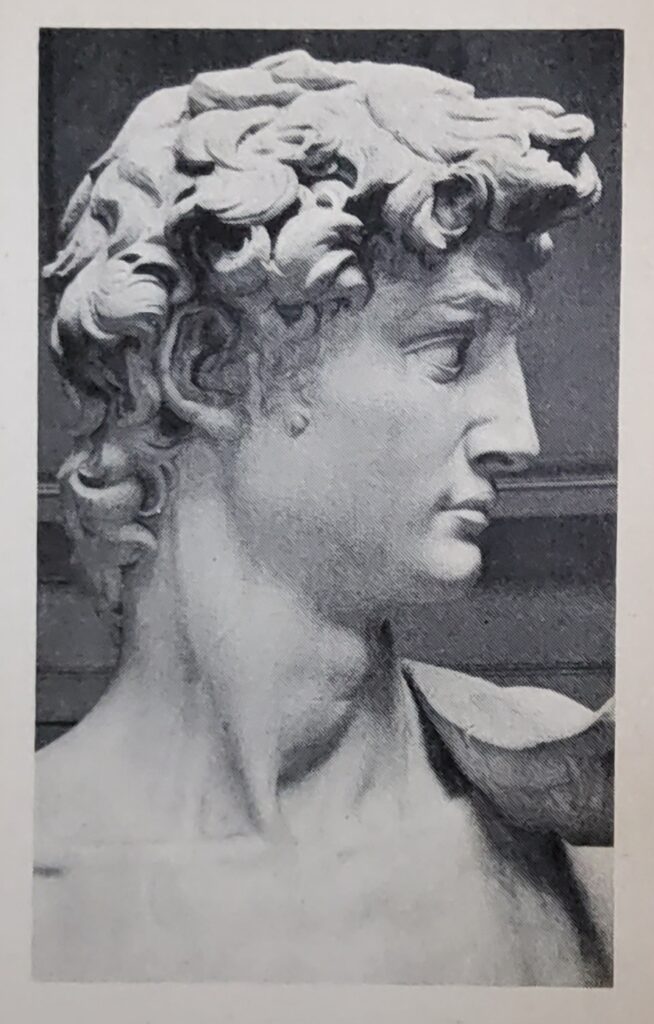
KING DAVID—(c. B. C. 1013 – 973)
David, the second king of the Hebrews, may be considered the most popular and beloved personage in early Jewish history. The Old Testament of the Bible is the chief source of information about David, but the accounts do not agree on the details of his career. He was the son of Jesse and tended his father’s sheep in Bethlehem south of Jerusalem. He was handsome, brave and talented. According to the Hebrew story, he won fame when he slew the giant warrior, Goliath. As a poet, he wrote some of the Psalms. He sang well and played the harp. King Saul invited him to become a member of his household, where he became too popular for his own safety. He aroused Saul’s jealousy and enmity.
When Saul died, David was chosen king. He captured Jerusalem and made it the political and religious centre of the Hebrew kingdom. He was an able and wise ruler. The book of Samuel in the Bible says he “executed judgment and justice unto his people.”
Contributions of the Hebrews and Phoenicians
The Hebrews’ contribution to world cultures was spiritual.
Their religious teachings have outlived the material riches acquired by ancient empires and remain as a powerful influence on mankind.
The early Hebrews were Semitic nomads who tended their flocks on the grasslands of Arabia. They lived in groups of families headed by patriarchs. In time, some of them drifted northwestward and settled in Palestine about B. C. 1350. Another group moved into Egypt, where they became slaves. Among them there arose a leader named Moses, who led them out of bondage and back to the borders of their “Promised Land” — Palestine. After his death, the Hebrews entered Palestine and made it their homeland.
Moses was a great leader and he remains one of the remarkable figures of history. We are told in the Bible how on Mount Sinai the Lord “called unto him out of the mountain”. There, amid “the thunderings and the lightnings and the noise of the trumpet and the mountain smoking,” the author of Exodus tells us, Moses was given the Ten Commandments. These have remained the basic law of the Hebrew people and have become part of the teachings of Christianity.
Among the other peoples in Palestine were the Canaanites. These people had established cities and had adopted civilized ways of living. After much severe warfare, the Hebrews settled among the Canaanites and slowly mingled with them until the identity of the separate groups became less marked.
Abandoning the nomadic life, the Hebrews gave up their primitive tribal organization and about B. C. 1025, chose their first king. His name was Saul. He was succeeded by David, a leader who conquered Jerusalem and made it his capital. David was known as a soldier, but he is better remembered for the beautiful Psalms which we find in the Old Testament.
After David, Solomon became the king. He was said to be a man of exceptional wisdom. Wishing to give distinction to his reign, as well as to do honour to God, Solomon built a great temple in Jerusalem.
After Solomon’s death, the Hebrew kingdom was divided. The northern area was inhabited by well-to-do city dwellers; the south by a poorer agricultural population. The northern kingdom of Israel was attacked and conquered by the Assyrians. The southern kingdom of Judah was later attacked and conquered by the Chaldeans. Some of the Hebrews were made slaves in Babylon. They remained in Babylon until they were freed by the Persians.
The Hebrews lived among peoples who believed in many gods, but they worshiped a God called Jehovah, or Yahweh. They came to believe that Jehovah was the one true God, not only of the Hebrews but of the universe; that He was not limited by time or space. The Hebrews clung to this idea and expressed it in the Old Testament. The Old Testament and the moral code based upon the Ten Commandments remain as great contributions to civilization.
The Phoenicians gave us the basis of an alphabet.
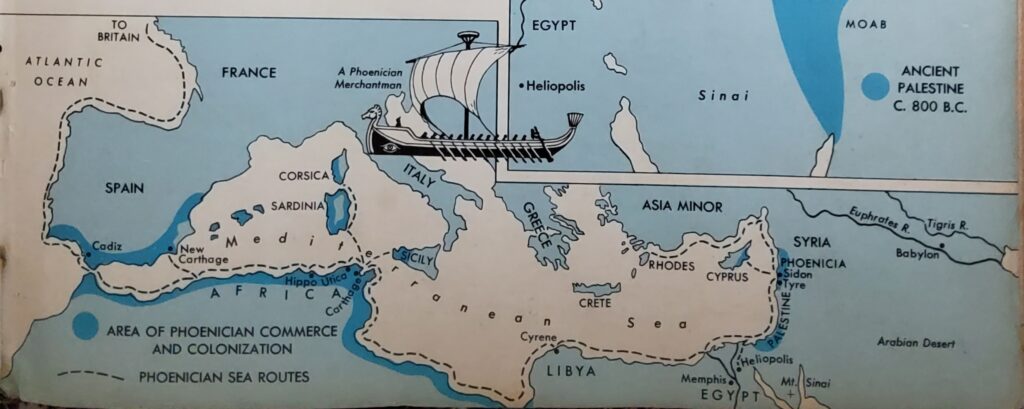
Phoenicia was a narrow country sandwiched in between the Mediterranean Sea and the cedar-forested mountains of Lebanon. (Modern Lebanon is located there.) The two chief cities were Tyre and Sidon. The geographic location of Phoenicia influenced its development. The mountains cut off the lands to the east. The lack of fertile soils and good grasslands turned its people to the sea to make a living. Phoenicia, at the crossroads of sea and land routes, became a market place.
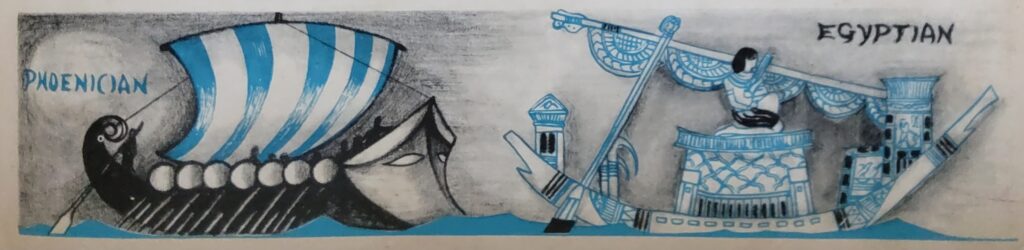
Among the skills developed by the Phoenicians were shipbuilding (they invented ships with two rows of oars on cach side), woodworking and the making of — glass, pottery and cloth. Their purple dyes were especially famous; so was their cloth dyed in this Tyrian purple. It was natural that Phoenicia should become the centre of shipbuilding and furniture manufacture, because of the cedar and fir available in the Lebanon Mountains.
Besides being good craftsmen and traders, the Phoenicians became expert seamen and colonizers. They sailed across the Mediterranean and into the Atlantic to secure cargoes of tin, gold, silver and copper. Along the coasts they started settlements which, in some cases, developed into colonies.
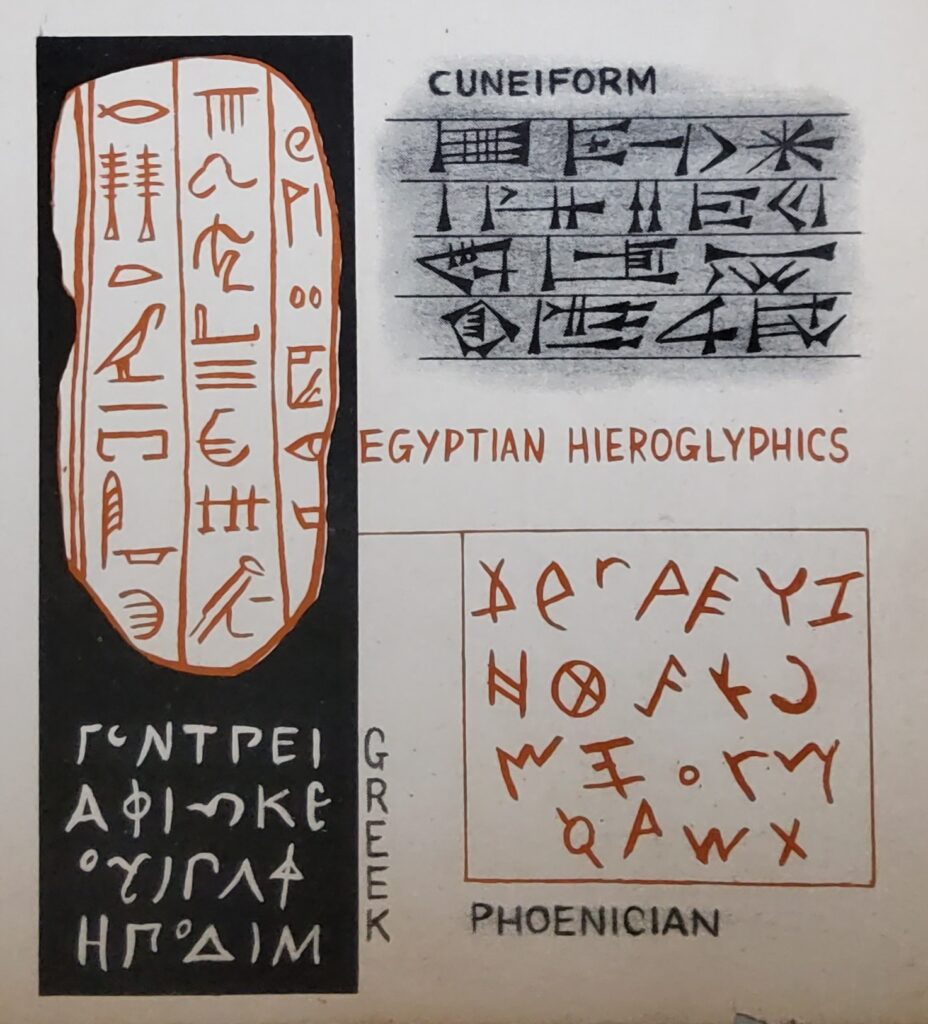
In their trading, these bold seamen picked up the ideas for an alphabet based on hieroglyphics. Some sources say they adapted their letters from the Egyptians and others say from the Cretans. We know that as sea traders and land merchants, they needed an easier means of keeping business records. The chief value of their alphabet was the small number of letters — twenty-two.
The Greeks made some changes in this alphabet, added vowels and passed it on to the Romans. From the Greeks and Romans, it was carried throughout Europe and in time, was brought to the New World. Our alphabet is most nearly like the Roman, but the word alphabet comes from the Greek A and B, Alpha and Beta.
The Phoenician alphabet and the spiritual contributions of the Hebrews, point to the fact that the value of ancient civilizations to modern nations, is the value of their ideas. Some of the ideas of ancient man about science, mathematics, and law were, of course, crude and not in themselves of lasting importance, but those men led the way. They asked the questions and found the kinds of answers that caused man to go forward.