Prehistoric ages of man include – the dawn of life on our planet, the tools and weapons of prehistoric man, the deep roots of civilization and the achievements of prehistoric man.
Scientists estimate that man may have lived on the earth a million years or more. During these many centuries man has learned very slowly, mostly by trial and error. For example, many hundreds of thousands of years — perhaps millions — passed before man was able to develop a spoken language. Then he slowly — very, very slowly — discovered methods of making symbols which would represent the spoken word on sheets of papyrus or tablets of clay. The result is that the written record of man’s accomplishments covers only the last six thousand years.
The basic insight being that all men may learn from a study of history. Each of man’s outstanding steps forward toward civilization, such as learning to use fire and cook food, usually has come only after a long period of groping or of experimentation. What is more, man has not progressed from savagery to civilized ways at the same rate everywhere. Men laid the foundations of our civilization long ago in such fields as communication, transportation, education, religion, trade and manufacture. Note too, that here and there, groups of men conquered a civilized group, absorbed their culture and increased the tempo of their own accomplishments.

The Dawn of Life on our Planet
The earth and its solar system are part of a vast and orderly universe.
Many scientists believe that there may be intelligent life on planets which belong to other solar systems, but at present they have no proof. The facts collected through their research indicate that the earth and the life upon it are very old, but some planets in other solar systems may be even older.
The historian collects and studies the evidence of man’s actions in the past, draws conclusions, which seem valid, about man’s adventures and then composes an account. This written record of man’s past actions upon the earth is the history of our world, or world history.
In order to keep the record straight, historians speak of the long period before man’s invention of writing as prehistoric time. The relatively brief period in which man has kept written records of his adventures is called historic time. In length, historic time totals perhaps 5,000 years.
Geologists estimate the earth’s age as perhaps three billion years. These scientists say that living creatures have existed upon the earth for perhaps one billion years, or one third of this period.
Estimates of this kind are arrived at in various ways, but one of the more useful methods of dating is based on carbon 14. Scientists know how long carbon will last. A living organism absorbs radiocarbon from the atmosphere around it. When the organism dies, the carbon in its body disintegrates at a known rate. When a scientist finds the remains of an organism, such as a piece of bone or wood, he can burn a sample, reduce it to carbon, measure the carbon that remains and determines when the plant or animal died.
The Ice Age made many changes in the surface of Europe and North America.
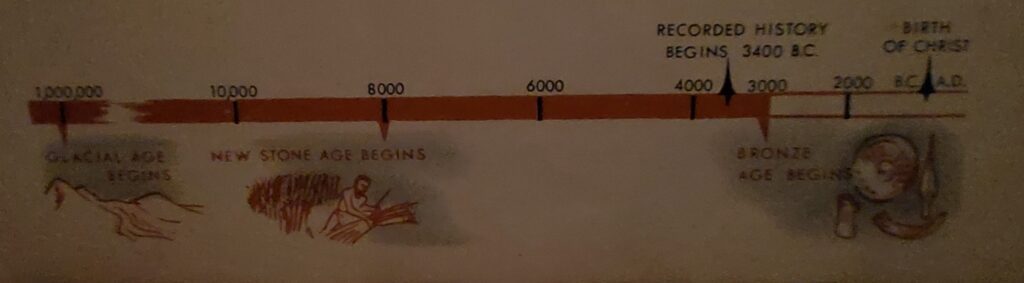
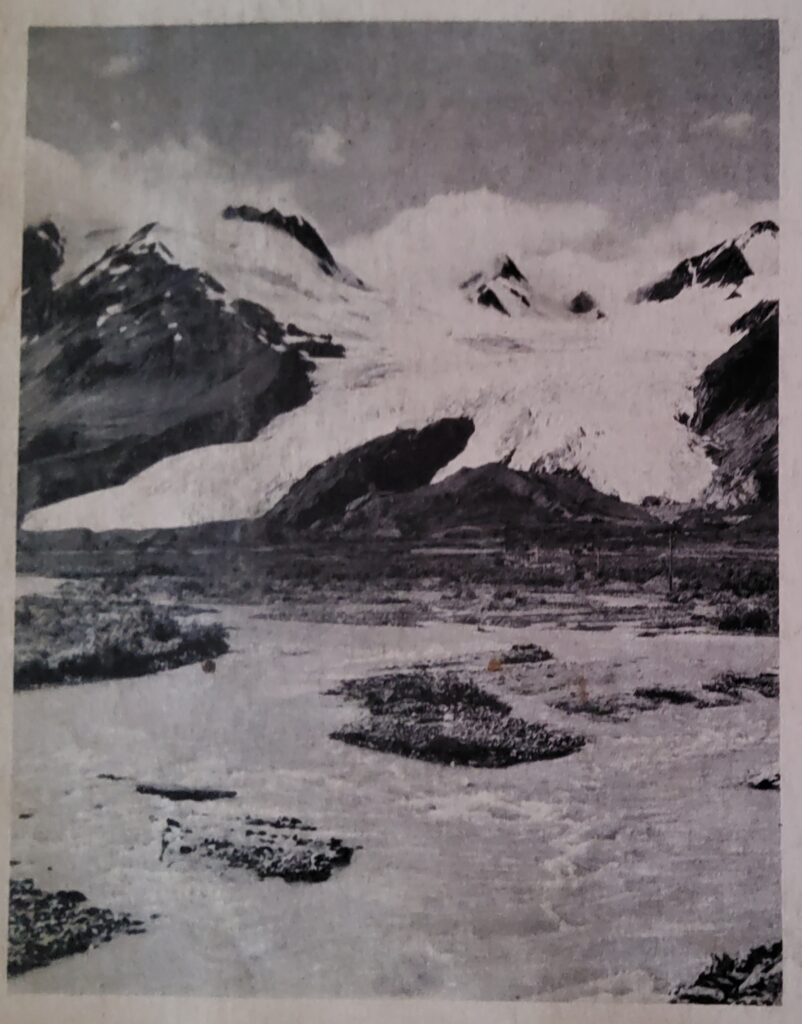
About 1,000,000 B. C. great glaciers formed near the North Pole. At four separate periods, these glaciers crept southward over North America and central Europe, some two or three inches a day. Each ice invasion was followed by thousands of years of warmer weather, called an interglacial period. During each interglacial period, the ice melted as it retreated northward.
The glaciers scooped up great boulders, smaller stones and gravel, as they pushed southward. When the ice melted, its load of glacial rubbish was dropped, forming long glacial ridges and mounds called moraines. Moraines found in the northern United States today are deposits of glacial thaws thousands of years ago. Such gravel beds are used to advantage in providing stone, sand and gravel, for construction.
The four periods of glaciation, advancing and receding, occupied the past million years. Together they make up the Ice Age or Pleistocene Epoch. During the interglacial periods of this epoch, forms of plant and animal life developed. It is believed that man appeared during the third interglacial stage, which lasted some 60,000 years. He gradually spread throughout western Asia and Europe.
Three groups of scientists concern themselves with the study of our earth and prehistoric man.
The geologists are chiefly concerned with the origin of the earth, its layers of soil, rock and mineral deposits. Geologists are able to decide the age when primitive organisms lived by examining the fossilized animals and plants, discovered within layers of rock.
A second group of scientists is chiefly interested in the remains of early man found in caves or buried in the earth. They are archaeologists. Many millions of dollars have been spent to aid archaeologists dig up the remains of ancient civilizations. Much of our knowledge of ancient Egypt, Babylonia, Greece and Rome has resulted from their work. They have unearthed many artifacts (products of human workmanship) such as tools, pottery, household goods, weapons and clay tablets, as well as the remains of persons who lived in the early periods of man’s history. Archaeologists have also learned much about life in prehistoric times, by studying primitive peoples.
Anthropologists are interested in the classification of men, their customs and their racial traits. They take the findings of other scientists – from biologists to archaeologists and try to fit them together. Their interests range from finding and analyzing the remains left by ancient man, to investigating the customs of living peoples.
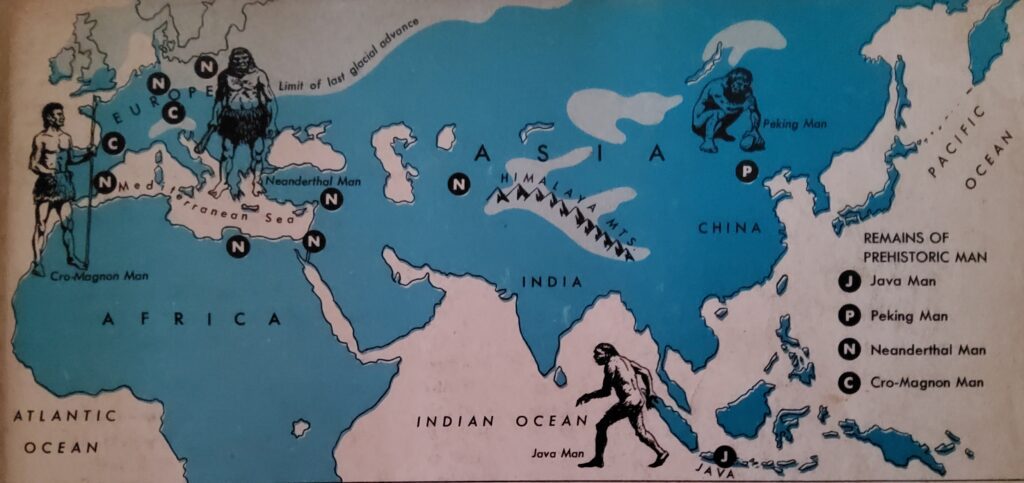
Several types of prehistoric man have been discovered in various regions.
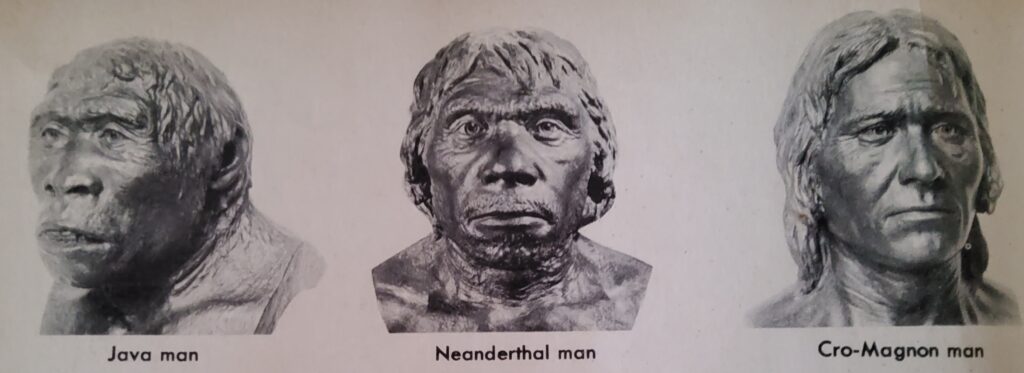
It is possible that the oldest remains of man may someday be found deep under the sand of the Sahara Desert. Thus far, the oldest man discovered is Java man, whose bones were unearthed in Java, Indonesia, in 1892. Java man’s skull indicates that he had a small brain and may not have had much intelligence. Other bones suggest he was a very short man and walked in a stooped position.
Peking man’s bones were found near Peking, China, in 1927. He had a larger brain and had advanced in intelligence. He had become a hunter and learned how to use fire.
A later and more civilized type of man was the Neanderthal, man whose remains were unearthed in the Neander Valley in Germany. (Thal, is the German word for valley). He lived in the Fourth Glacial Age some 50,000 years ago. Neanderthal man was short, had a much larger brain, probably lived in a cave and constantly hunted animals.
Cro-Magnon man was very similar to present-day man. His bones were discovered in the Cro-Magnon region of southern France, where he lived some 25,000 to 10,000 years ago. He was tall and stood straight. His skull indicates a large brain. He lived in a cave and was mostly occupied as a hunter. It is believed that he had a much larger command of spoken language than his predecessors had.
The Cro-Magnons included some artists who painted on the walls of caves-in France and Spain by the smoky light of animal-fat lamps. Some of their pictures of bison, mammoths, reindeer and wild horses are sharp, clear outlines; others, in colour, show a thorough knowledge of anatomy.
The Tools and Weapons of Prehistoric Man
Early man learned slowly, hence the prehistoric period was a long one.
It took man thousands of years to learn that he could use a stone as a weapon to kill an animal or defend himself against another man. It took him nearly a half million years more, to learn how to make and use stone tools.
Man passed through several periods of development during the prehistoric period. Scientists identify these periods by the kind of tools man used. Thus, we speak of the Stone Age and the Age of Metals. Each of these ages is divided into shorter periods, such as the Old Stone Age and the New Stone Age, the Copper Age, Bronze Ag, and Iron Age.
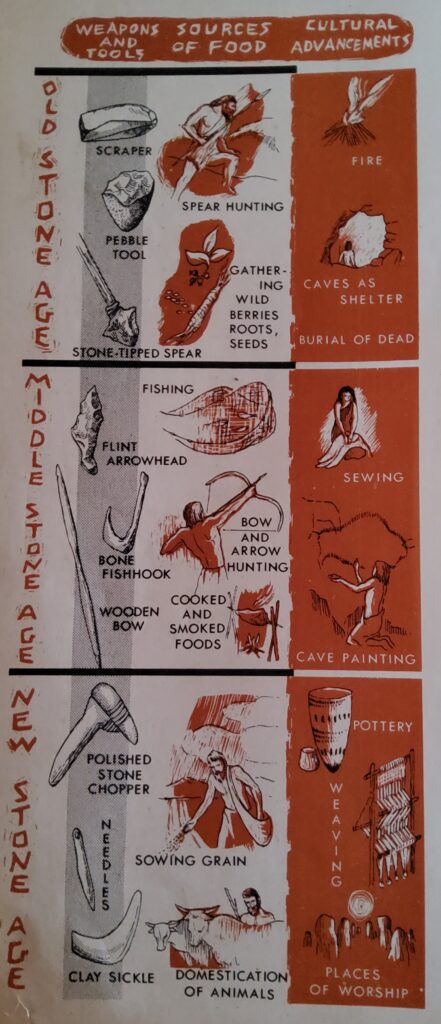
During the earliest period of man’s existence, his tools were the sharpest sticks and stones he could find. He was a savage, a hunter, a fisherman and a wanderer. He lived largely on meats, grasses, berries, nuts and roots.
It is important to remember that man’s development did not then and does not now, proceed evenly throughout the world. In some parts of the world today, people still live and prefer, primitive ways.
Old Stone Age man progressed when he improved his tools.
Gradually, as thousands of years went by, the typical “Old Stoneager” learned how to make sharper tools. He heated stones and flaked or chipped them to make sharp edges. With these sharper tools, he was able to improve his skills in hunting, fishing and self-defense. The main stone tool was a fist hatchet, used as a hammer, a dagger, a knife, or an axe.
Many more thousands of years passed before Old Stone Age, or paleolithic man learned to use fire, cook food, wear clothes and live in a fixed place, usually a cave.
Man’s achievements multiplied during the New Stone Age (or Neolithic Age).
All scholars however, do not agree on any exact date when the New Stone Age began. Man had not yet learned to write and without a written record, we can only guess at a date. That is one reason that you will find the word circa (about), or its abbreviation c., before questionable dates.
About 8000 B.C., a new method of making stone tools and weapons was discovered or invented that sped up man’s advancement. The man of this New Stone Age found that he could make use of sand or sandstone to grind and polish stone tools. We might call this method “precision toolmaking”, to use a present-day term. The “New Stoneager” also learned how to bore holes in stone, bone tools and attach handles.
In some paleolithic cave drawings, one can see some kind of domesticated dog or wolf accompanying a hunter. Cubs were likely captured and raised by man as hunting companions and, possibly, as guardians and pets.
Neolithic man took other steps toward becoming modern man. He learned to use sleds, skis and canoes. He discovered that he could save the seeds of wild grasses and produce crops of barley, millet and wheat. This way of acquiring food, was less dangerous than hunting and assured him a more stable supply. Then, as wild cattle came to the rivers for water, man captured and domesticated some of them. His diet improved as he learned to use milk and to cook grain. The new ways of life as a farmer and shepherd, lured man from cave life to simple houses heated by a fireplace and lighted by oil lamps.
In time the “New Stoneager” added other grains, fruits and vegetables to his food crops and looked to his tamed animals for milk, skins and meat. He stored his surplus grain to use when crops were poor. He learned to make linen threads from flax and woolen yarn from sheep’s wool. With these, he wove linen and woolen cloth for clothing. He increased his knowledge of animal skins, until he learned to make leather.
The “Old Stoneager” had made and used baskets as containers, but the “New Stoneager” discovered, perhaps by accident, that he could bake clay and have containers that were both waterproof and lasting. He may have first smeared clay on the outside of a basket for waterproofing. In time, this new skill led him to make a variety of containers in different shapes and forms.
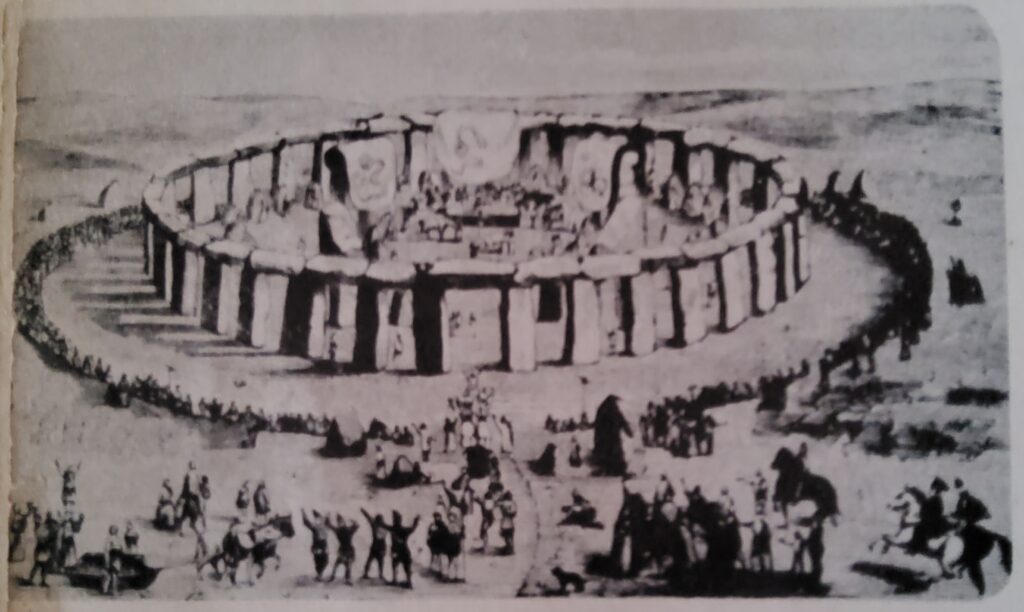
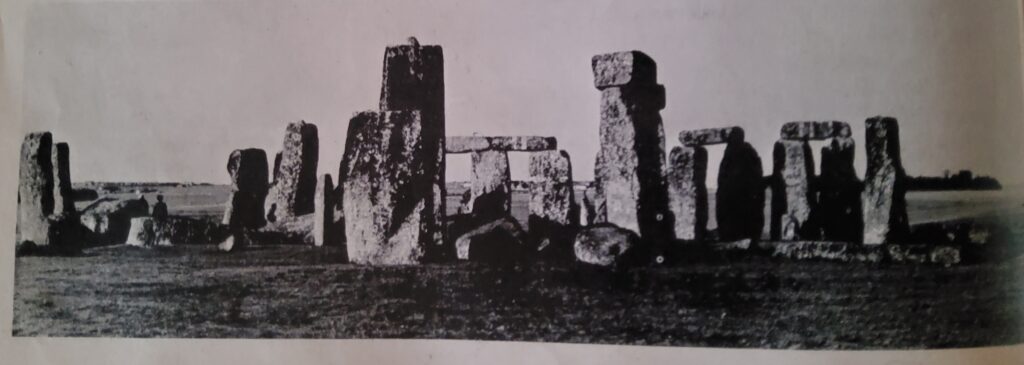
Besides practical containers, this early craftsman made figurines of women and statues of animals. Using shells and bone, he made rings, necklaces and bracelets. He also made monuments of stone, some of which are of great size. One of the best-known monuments is Stonehenge in southern England. It is believed that this monument was an outdoor temple for worship of a sun god. New Stone Age man added mining and trade to his occupations. He sank shafts into the earth in search of flint. He exchanged goods by barter with bis neighbours. Among the items of trade were flint, shells, furs, amber and salt; There is reason to believe that even trade in cattle existed.
Women did all the farming and manual labour. Aside from the craftsmen, the men were engaged in hunting for food and in protecting their families. Defense against enemy neighbours was an ever-present duty.
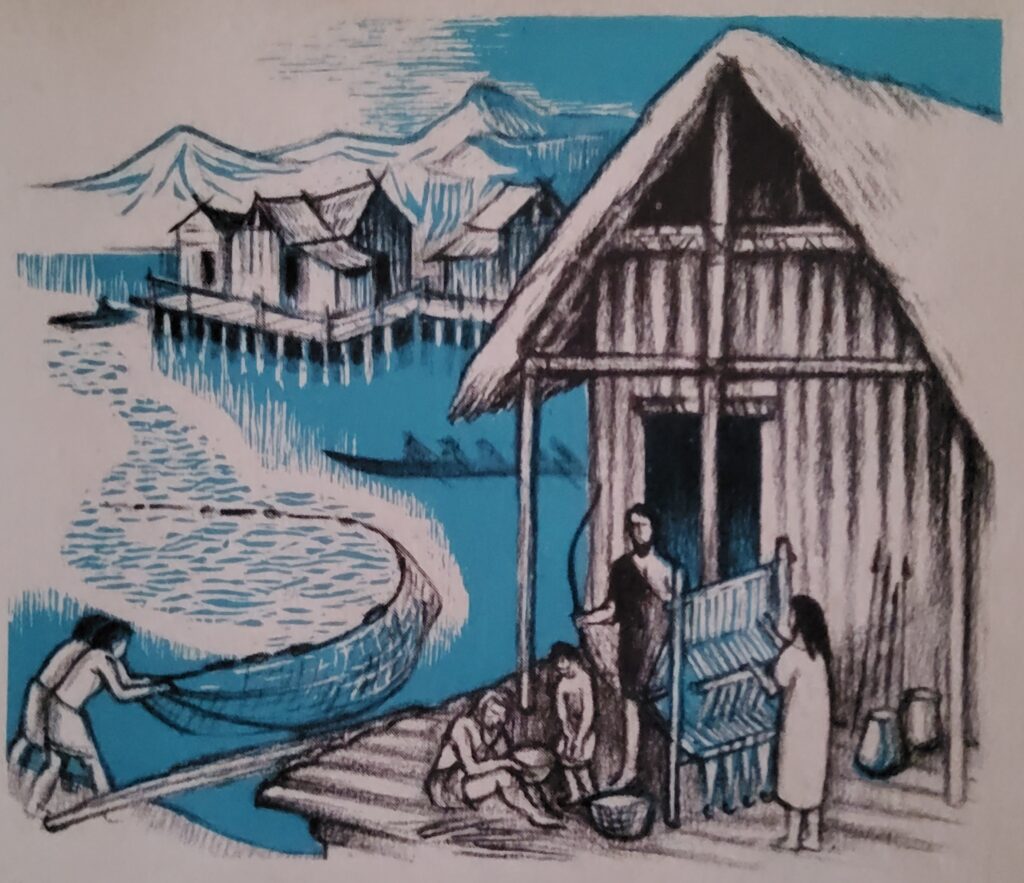
Stone Age Man’s achievements in improving his way of life made him less of a wanderer. He developed some forms of community life. Remains of his settlements in Europe have been found in widely scattered places. Among the most interesting of these were lake dwellings. In order to escape from unfriendly neighbours and savage animals, man built his houses over lakes, sometimes in village-like clusters. The houses were set on posts (piles) driven deep into the lake mud.
THE DEEP ROOTS OF CIVILIZATION
Primitive man learned how to communicate orally.
No doubt the development of language and the use of fire were prehistoric man’s two greatest achievements. He learned to talk many thousands of years before he learmed to write. We are not sure how language originated. One theory is that man first formed words by imitating the sounds made by animals. This is called the “bow-wow” theory.
A second guess, called the “pooh-pooh” theory, is that man’s first words were exclamations caused by pain or emotional outbursts. For example, when man suffered pain from hitting his toe on a stone he would let out an exclamation. This came to be a word.
A third theory is that man’s work caused him to standardize sounds into words. For example, in lifting heavy stones the sound uttered might have been heave, which became a word used when lifting heavy objects.
Governments developed from primitive social organizations.
Among all peoples, the basic social unit is the family — parents and their children. Among some peoples is a larger family group, made up of one individual family and some related persons. A third group, the clan, are people within a community who claim a common ancestor and are of one blood. A fourth primitive grouping is the tribe. This may be a whole community that has a common speech or dialect, a common heritage of customs and perhaps inherited land.
Historians are not agreed upon the type of government which was developed by primitive man. We are sure that leadership was most important and necessary because of the constant danger of enemy attack. Those laws which have been discovered relate to property rights and to the leaders’ opposition to witchcraft, cowardice and treason.
The belief in divine spirits led to religious customs.
Primitive man believed in many gods or spirits. All around him strange and unexplained things happened. The sun did not always shine. There were lightning and thunder, strange lights and strange sounds. Where did the water of rivers begin, why were rocks moved in a storm and what caused the leaves to appear and later fall? Life was full of uncertainty. Why did people get sick and die? All these things were mysteries. Certainly, man reasoned, there were good and evil spirits which affected his life.
The making of animal or human sacrifice to a god is one of man’s oldest customs. It is still practiced in some parts of the world. The purpose of such sacrifice was to appease an angry or jealous god or to express gratitude and loyalty to him. Certain objects were considered omens of good luck. Primitive man treasured objects such as a lucky charm or a rabbits foot. He believed there was magic in them: they would bring good luck or ward off harm. Certain animals were sacred and others were “taboo” or evil.
It was a common practice for a clan to identify itself with a totem, or symbol, that could be revered and worn as an amulet, or charm. The totem was often a bird, a beast or a fish. Some American Indians carved their totems on poles. Today totemism is seen in the animal mascots of football teams and the insignia worn by military units.
Since early man believed in good and evil spirits, he developed ideas about right and wrong, one of the basic concepts associated with the religious way of life today: Some of primitive man’s beliefs, still linger as superstitions.
LINKING THE PAST AND THE PRESENT
For countless ages, man has wondered about the heavenly bodies in far-off space. Back in 150 A.D. a scholar named Ptolemy, taught that the earth was the centre of the universe. He assured the stargazers of Alexandria, Egypt, that the sun, the stars and the planets, revolved around the earth, which had no motion.
Ptolemy’s theory was believed until the Polish scholar, Copernicus, wrote a book in 1543 favouring the theory that the earth is a moving planet that revolves around the sun at high speed. This theory was confirmed when Galileo made his own telescope and used it to study the heavens.
Men still dream of exploring the endless heavens called space and outer space. In the 1940’s scientists sent rockets hurtling into space. In the 1950’s they launched artificial satellites and a rocket that functioned as an artificial planet circling the sun. So many discoveries are being made now, that ours is called the Space Age. Undoubtedly man’s discoveries in space ultimately will result in changing his way of life.
Prehistoric Man’s Achievements
The need to move and the urge to travel helped to spread civilization.
Fortunately, primitive man did not “stay put”. The glacial invasions caused man in northern latitudes to seek a warmer climate. The land bridges helped him to travel. No doubt the Isthmus of Panama was such a bridge during the Glacial Ages. There was another bridge in the Middle East where Europe, Asia and Africa meet. It is near this Middle Eastern bridge that we find the most valuable remains of early civilization in the Nile and the Tigris-Euphrates valleys. Thus, the spread of civilization was one of man’s achievements.
We are indebted to prehistoric man for many of our basic ideas.
We have made great progress in extending the achievements of early man, but he originated religion, law, government, agriculture, weaving, pottery, the use of fire and the use of language. To be sure, primitive man was slow to learn basic ideas, sometimes taking thousands of years. His learning process was in great contrast to the speeded-up tempo of modern man’s learning process.
Prehistoric man also discovered the use of metals. He mined copper, but found it was too soft for tools. He mined tin and learned that mixing copper and tin made bronze from which he could make good tools. The Bronze Age may have begun about 3000 B.C.
Environments influence the development of cultures and civilization.
After reading about man’s early steps out of a primitive state into civilization, it is time to consider the meaning of two terms: culture and civilization. The anthropologist defines the culture of a people as “a way of life”, or the way in which a human group lives at a given time in a certain region of the earth. A way of life consists not only of securing food, clothes and shelter, but also of fostering religion, music, art, government, science, manners and living together in harmony.
Civilization is not so easily defined, for anthropologists are not agreed as to when a culture becomes a civilization. Let us take the arbitrary view that a civilization is a culture in which the people have achieved a written language and cities large enough to support a variety of specialized occupations. There must be enough specialists, such as priests, doctors, teachers, manufacturers and tradesmen to meet the needs of a cultivated people in politics, religion and economics.
A second important aspect of a civilization is that it is relative. This means that some people have reached a higher type of civilization than other people. After a people have a written language and cities with specialized occupations, the extent to which they develop the many facets of their way of life, will indicate their degree of civilization. In the course of man’s development, numerous civilizations have come and gone. Among the greatest have been the Egyptian, Greek and Roman. These have contributed most to Western civilization. Other great civilizations of the past, such as the Chinese and Indian, have contributed less to the western way of life, but they are highly respected civilizations in the Orient and have increasing influence.