Age of Revolution 1765 – 1815
AGE OF REVOLUTION, IMPORTANT DATES AND EVENTS IN THE AGE OF REVOLUTION, 1765 – 1791
The American Revolution
1765 The British try to raise money by requiring tax stamps on documents; the colonies protest.
1766 The Stamp Act repealed.
1767 The Townshend Acts impose taxes on imported goods; unrest continues in the colonies.
1770 British troops open fire on a crowd in the Boston Massacre; The Townshend Acts repealed.
1772 A mob burns the British coast guard ship Gaspee; Sam Adams starts the first committee of correspondence in Boston.
1773 Boston patriots dressed as Indians destroy three shiploads of tea in the Boston Tea Party.
1774 In reprisal for the Tea Party the British blockade Boston; the first Continental Congress meets in Philadelphia to consider ways of protesting.
1775 The revolution begins as minutemen fire on British troops at Lexington and Concord; Washington becomes commander-in-chief; British win the battle of Bunker Hill but suffer heavy losses.
1776 British troops evacuate Boston; Congress adopts the Declaration of Independence; Washington crosses the Delaware and defeats the Hessians at Trenton.
1777 The British are defeated in battles at Princeton, Bennington and Saratoga.
1778 France enters the war on the colonists’ side; Lafayette joins Washington’s army.
1781 Washington and a French fleet trap Cornwallis at Yorktown; his surrender ends the war.
1783 Britain recognizes American independence by the Treaty of Paris.
The French Revolution
1787 The Assembly of Notables meets; Lafayette demands that the king call the Estates General.
1789 The Estates General meets but the Third Estate declares itself a National Assembly and begins to write a constitution; Parisians storm the Bastille, arm themselves and force the king to return from Versailles to Paris.
1791 The king is captured while trying to flee Paris and begin a counterrevolution and is returned to his palace in Paris.
IMPORTANT DATES AND EVENTS IN THE AGE OF REVOLUTION, 1792 – 1815
1792 Austria and Prussia form an alliance against France; the king is arrested and France declared a republic; the Assembly calls a National Convention.
1793 The king is tried and executed for treason; England, Spain and Holland join the alliance against France; Robespierre gains power; the reign of terror begins.
1794 The Terror continues until a coup by moderates brings about the fall of Robespierre and suppression of the political rights of the Jacobins.
1795 The White Terror against radicals begins; Prussia withdraws from the war against France.
1796-1797 Napoleon Bonaparte leads a French army into Italy and defeats the Austrians.
1798-1799 Hoping to cut England off from India, Napoleon lands in Egypt.
1798 England and Russia form a new alliance against France and are later joined by Austria.
1799 Napoleon returns from Egypt and overthrows the Directory, becoming the first consul and dictator.
1802 Peace with England; Napoleon becomes consul for life.
1803 England again declares war on France.
1804 Napoleon is crowned emperor of the French.
1805 Austria, Russia, Sweden declare war on France; Nelson destroys the French fleet at Trafalgar; Napoleon defeats the Austrian and Russian armies at Austerlitz; Austria makes peace with France.
1808 Napoleon invades Spain and makes his brother king; the Spanish, aided by England, revolt.
1809 Austria declares war on France; Napoleon defeats them and captures Vienna.
1812 Napoleon’s invasion of Russia ends in a retreat in which most of the army is lost.
1813 Prussia and Austria declare war on France.
1814 The allies invade France and capture Paris, exiling Napoleon to the island of Elba.
1815 Napoleon lands in France and raises an army; he is defeated at Waterloo and exiled to St. Helena, where he later dies.
Age of Revolution 1765 - 1815
330
EVEN AFTER IT HAPPENED, few people in colonial Boston knew the boy’s name. He was just a barber’s helper, but everyone heard about him on the night of the trouble. On that night he set off an angry mob by pointing his finger at a British guard and the violence that followed became a famous incident in American history. The date was March 5, 1770. Boston was then occupied by British troops. The troops had been brought in to keep order and to force the people to pay taxes they did not want to pay. The people of Boston hated …
Read More »
Age of Revolution 1765 - 1815
317
There had been few serious misunderstandings between the colonies and the mother country before the French and Indian War, but that was mainly because England had allowed the colonies to do pretty much as they pleased. They had been free to set up their own governments, make their own laws, have their own armed forces, print their own paper money and manage most of their local affairs as they saw fit. England’s American colonies had enjoyed far more freedom and independence than had any of the colonies of France or Spain. Not that England planned it that way. She had …
Read More »
Age of Revolution 1765 - 1815
726
Another unpopular step England took after the war was to reorganize her defense system in the colonies. The French and Indian War had proved to the British that the colonies could not be depended upon to defend themselves. Some new system had to be worked out in North America, to defend not only the colonies, but also Canada, Florida and the wilderness east of the Mississippi. England decided to leave this task to a standing army of ten thousand British redcoats. Such an army would cost a great deal of money. Taxpayers in England were already paying very high taxes …
Read More »
Age of Revolution 1765 - 1815
235
Due to the taxes on tea, many of the colonists began drinking coffee or cocoa, or bought tea smuggled in from Holland. Within a few years, the British tea trade with the colonists dropped from 900,000 pounds to 237,000 pounds and in England the warehouses of the East India Company were filled to overflowing. The East India Company was Britain’s largest and most important trading company and to save it, Parliament passed the Tea Act. The East India Company was given a monopoly on tea trade with the colonies — that is, it was the only company allowed to sell …
Read More »
Age of Revolution 1765 - 1815
152
When Samuel Adams, his cousin John Adams and the rest of the delegates from Massachusetts arrived in Philadelphia, they found themselves very unpopular. Cousin John complained that he was avoided as if he had some sort of contagious disease. The delegates from other colonies looked upon the men from Massachusetts as radicals and did not like their wild ideas about protecting American rights with force, if necessary. Patrick Henry of Virginia made a speech pointing out that it was no longer possible for any of the colonies to stand alone. They had to unite, to work together with other colonies …
Read More »
Age of Revolution 1765 - 1815
351
On the evening of April 18, 1775, Paul Revere quietly made his way through the dark streets of Boston to the Charles River. At the river’s edge he hid in the shadows, watching and waiting. He kept a sharp lookout for British patrols. Spies had brought the patriots word that the British were to launch a surprise attack; Revere, William Dawes and other members of the Sons of Liberty had made careful plans to warn the countryside. There could be no doubt that something was about to happen. Several days earlier, eight hundred of the best troops stationed in Boston …
Read More »
Age of Revolution 1765 - 1815
238
The British in Boston had no reason for suspecting anything unusual on the night of June 16, 1775 but across the Charles River, a column of colonial soldiers was moving quietly toward the twin hills overlooking the town. Behind the soldiers came wagons loaded with picks and shovels. The grass-covered hills they were approaching served as pastures‚ one owned by a Mr. Bunker and the other by a Mr. Breed. Washington had already been elected commander by the Congress in Philadelphia, but the news had not yet reached Boston and the colonial forces knew nothing about it. Their colonial high …
Read More »
Age of Revolution 1765 - 1815
228
Samuel Adams was an unhappy man. He moved among the other delegates to Congress like a lonely, silent shadow, keeping his thoughts to himself. He dared not open his mouth for fear of saying too much. Months had passed since the Battle of Bunker Hill. Colonial troops had made an unsuccessful attempt to drive the British from Canada. Congress had organized the Committee of Secret Correspondence to find out what help to expect from European countries in their war with England. In December of 1775, Congress had ordered the building of an American navy. Yet, in spite of all these …
Read More »
Age of Revolution 1765 - 1815
206
One chilly morning in April, General Howe stepped out of his Boston headquarters and stared in amazement at a hill called Dorchester Heights, to the south of the city. It had been fortified during the night by George Washington’s rebel army. Strong breastworks of ice blocks and brown earth ran along the crest of the bill. Above the steepest slopes, barrels filled with rocks stood balanced, ready to be sent tumbling down the hill in the path of attacking troops. Studying the hill through his glass, Howe could make out several companies of riflemen and some units with muskets. What …
Read More »
Age of Revolution 1765 - 1815
376
The fog was lifting over New York early on the morning of June 29, 1776, when a man named Daniel McCurtin happened to glance out over the bay. At first he saw nothing but mist hanging low over the water then suddenly he blinked and stared in amazement. Later he tried to describe the scene. He wrote that he had “spied as I peeped out the Bay something resembling a wood of pine trees trimmed. I declare, at my noticing this, that I could not believe my eyes, but keeping my eyes fixed at the very spot, judge you of …
Read More »
Age of Revolution 1765 - 1815
193
The cold winter winds howled through the streets of New York, but the houses were filled with warmth, good cheer and the merry crackle of hearth fires. It was late in December of 1776. Six months earlier the city had been the headquarters of General Washington’s ragged army of patriots. Now it was in the hands of the British and they were in a mood to celebrate. Some redcoats were making ready for Christmas. Others were writing long letters home to England, saying that the war was almost over. They told how Washington had been driven out of New York, …
Read More »
Age of Revolution 1765 - 1815
297
The big English setter did not look like a stray dag. When it came wandering into Washington’s camp one day in the fall of 1777, a soldier brought it to his officer. The officer took it directly to Washington’s headquarters and pointed out the name on the dog’s collar–“General Howe.” Washington had the dog fed while he wrote a polite note to General Howe. Half an hour later, the dog and the note were sent to the British camp under a flag of truce. The incident was not important, but it gave the Americans something to laugh and joke about …
Read More »
Age of Revolution 1765 - 1815
346
WHEN THE MARQUIS DE LAFAYETTE returned to France in 1782, after taking part in the American Revolution, he was hailed as a popular hero. It was pleasant to be welcomed as a champion of liberty, but he had been in America so long that he was beginning to see his own country as an American might see it and he was troubled. France was one of the largest and richest countries in Europe and yet the wealth of the nation was in the hands of a few, while the great majority of the people had almost nothing. He found a …
Read More »
Age of Revolution 1765 - 1815
321
The sun had broken through the clouds after a night of spring showers. Dripping leaves sparkled in the golden light, which flooded the gaily decorated streets of Versailles and the broad terraces of the king’s royal palace. It was May 4, 1789, the day of the opening ceremony of the recently elected Estates General. The streets were crowded with visitors, most of them from Paris, only a few miles away. They had come to see the grand procession of the Estates General and were in a holiday mood. The shops were closed. Local citizens watched from windows, crowded balconies and …
Read More »
Age of Revolution 1765 - 1815
249
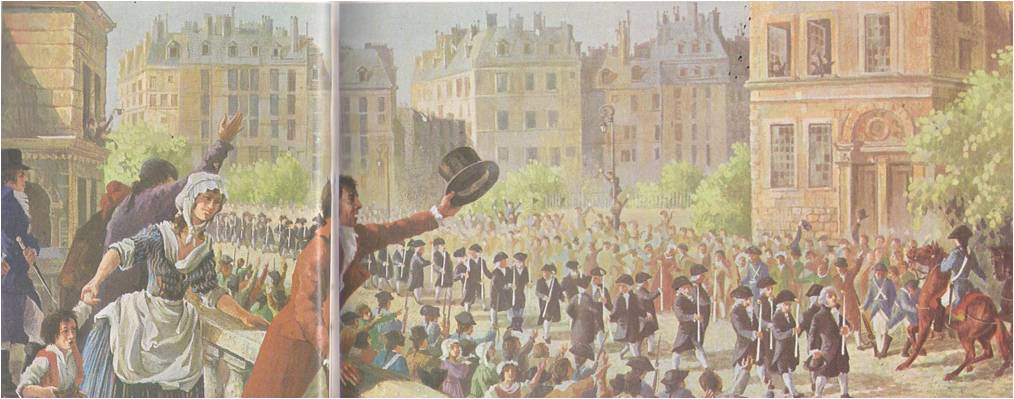
On Sunday, July 12, 1789, the people of Paris learned that Necker, the popular minister, had suddenly been dismissed by the king. They could only guess at the king’s reasons for wanting Necker out of the way. It seemed clear enough that Necker’s dismissal had something to do with the recent arrival of Swiss and German troops in the Paris area. It was said that more troops were arriving every day. Why? People were almost afraid to guess at the answer. The news of Necker spread quickly and angry crowds gathered in the streets. A young man named Desmoulins leaped …
Read More »
Age of Revolution 1765 - 1815
332
In the towns and cities of the provinces, the news of the fall of the Bastille led to wild celebrations and a series of revolts against local governments. These governments had long been unpopular, since most of them were controlled by nobles and others who had bought their government positions from the king. The town people set up new governments, similar to the one in Paris and organized local units of the National Guard. The revolution spread to the countryside as well. There the peasant uprising had started even before the fall of the Bastille. The peasants made up at …
Read More »
Age of Revolution 1765 - 1815
436
“Down with the King!” That cry was heard again and again on the night of August 9, 1792, as restless mobs gathered in the streets of Paris. They had only one purpose in mind and that was to make certain the king was toppled from his throne. The Assembly had been warned to dispose of the king before midnight and that deadline was only hours away. If the Assembly failed to act, the mobs would join forces, march on the royal Palace and seize the king themselves. As the midnight deadline approached, the frightened members of the Assembly were still …
Read More »
Age of Revolution 1765 - 1815
354
The execution of the king stunned the rulers of Europe. They were stunned as well by the French military victories in Belgium and along the Rhine River. Furthermore, the French government was offering to come to the aid of any people willing to fight for their liberty. The revolution threatened to spill over into other countries, becoming a crusade of peoples against kings and nobility. If successful, it could destroy every kingdom in Europe. England and most of the European powers, therefore, joined together in 1793 to crash the revolution and to place another king on the throne of France. …
Read More »
Age of Revolution 1765 - 1815
645
In March of 1796, a new commander named Napoleon Bonaparte was placed in charge of the French army on the Italian front. The soldiers and officers were amazed when they first saw him. He was short, thin, pale, only twenty-seven years old and spoke French with an Italian accent. Napoleon was not an unknown. He had first come to public attention as the young artillery officer who drove the British fleet from the harbour at Toulon. Later, as a brigadier general, he had successfully defended the Convention from an uprising in Paris. What most people did not know was that …
Read More »
Age of Revolution 1765 - 1815
589
On December 2, 1804, in a ceremony of great pomp and splendour at the cathedral of Notre Dame in Paris, Napoleon Bonaparte was crowned Napoleon I, Emperor of the French. Pope Pius VII was there. He had come from Rome to offer his blessing and to place the crown on the head of the new emperor but Napoleon did not do what was expected of him. Instead of kneeling, he took the crown from the Pope’s hands and put it on himself. He also placed a crown on the head of his wife, Josephine. Only twelve years had passed since …
Read More »