Europe in Transition (1400 – 1650 A. D.)
This brief category deals with two of the most famous movements in human history, the Renaissance and the Reformation. Together, they bring the Middle Ages to a close and constitute a transition to the Modern Period.
The Renaissance was a time of intellectual and cultural achievement in the West, when many men produced outstanding works of art, literature and philosophical reasoning. It began in the 1300’s and ended during the late 1500’s and early 1600’s, when Europe was experiencing the Reformation and a series of religious wars. Its home base was Italy, but it reached France, Germany, the Low Countries and England. It was relatively unimportant in Scandinavia, Portugal and Spain.
We can understand the Renaissance period because we can compare it to the Space Age. In spite of the fact that we live in a world of marvelous machines and scientific inventions, the Space Age burst upon the average person with great suddenness when Sputnik was skyrocketed into space. As other sputniks, rockets and a variety of satellites were launched abroad and in our country, their names and the names of the space scientists who had produced them became known to us. So did the personalities of the astronauts who were launched into space. These men and the inventors of the machines which will carry men to the moon and planets, will be known to future generations, much as the leaders of the Renaissance became known to the peoples of their day, who followed their reasoning as thinkers and benefited one way or another from their varied achievements.
The Renaissance electrified the minds of medieval men by opening up avenues of thought and expression that revolutionized their world. The shock was felt first in Italy, when her merchants and scholars brought back manuscripts and records they had discovered in Constantinople —at that time, it was the storehouse of many items from the Greek and Roman civilizations. As Renaissance men pondered the ideas of ancient Greeks and Romans, studied the remains of their architecture and sculpture and read their drama, they were fired with enthusiasm and a desire to excel the ancients. The wave of their achievements in literature, painting, sculpture, architecture and the physical sciences, spread outward and inspired other men, to advance the Renaissance front. This migration of culture occupied several centuries, but as a result of the Renaissance, European society underwent various changes and the new ideas touched almost every area of life.
Accompanying the Renaissance, but not necessarily connected with it, was the movement called the Reformation. As old concepts about the earth, the sun and the universe were challenged and investigated, so were the practices and doctrines of the Christian Church, examined and disputed. Churchmen demanded that reforms be instituted. As is often the case with social movements, the Reformation resulted in something no reformer had in mind at the beginning: a division among the adherents of Christianity that has remained permanent. The Roman Catholic Church remained firm in its beliefs and religious unity, whereas the body of dissenters — the Protestants — was split into many separate church groups. The Reformation so stirred the peoples of Europe, that for almost 200 years thereafter, groups of men and even whole nations, were involved in wars which they fought in the name of religion.
1415 – Council of Constance denounces John Wycliffe as a heretic—England.
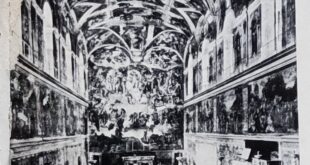
1508 – 1512 – Michelangelo paints frescoes on the Sistine Chapel ceiling— Italy.
1517 – Martin Luther posts his ninety-five theses; starts a Protestant revolt in Germany.
1521 – Emperor Charles V outlaws Martin Luther at the Diet of Worms—Germany.
1543 – Copernicus reveals his theory of a sun-centered universe — Poland
1545-1563 – The Council of Trent meets; clarifies Roman Catholic doctrine — Italy
1555 – Peace of Augsburg ends a Catholic-Protestant war in Germany
1643 – Torricelli invents the barometer — Italy
Europe in Transition (1400 - 1650 A. D.)
77
Reformation, revolt and division in the church – conflicts over Christian Doctrine, the religious revolt in Germany, the Catholic reformation and the Protestant revolt outside Germany. The fourteenth and fifteenth centuries saw in many categories of manifestation the full medieval effort. Material progress, the rise of the new nobility and the merchantmen of the cities — saw upheaval on every level of society. This was true also on the level of religion, where many churchmen had not kept abreast of the changes in society. Very often, the Church was thought of as associated with the old order of things. The …
Read More »
Europe in Transition (1400 - 1650 A. D.)
51
Renaissance – the beginnings, political institutions, the arts, literature, education and advances in Science – most fascinating those periods of history, in which men manifest a great spurt of mental energy and rack up a surprising score of achievements. We have reviewed several such periods: that of the Hebrew prophets, Buddha, Confucius and the Greek thinkers, who contributed richly to religion and philosophy; the Periclean Age, when a remarkable cluster of men brought lasting fame to the small city of Athens; the days of the T’ang Dynasty when the Chinese attained higher standards of living than they had ever known; …
Read More »