Renaissance – the beginnings, political institutions, the arts, literature, education and advances in Science – most fascinating those periods of history, in which men manifest a great spurt of mental energy and rack up a surprising score of achievements. We have reviewed several such periods: that of the Hebrew prophets, Buddha, Confucius and the Greek thinkers, who contributed richly to religion and philosophy; the Periclean Age, when a remarkable cluster of men brought lasting fame to the small city of Athens; the days of the T’ang Dynasty when the Chinese attained higher standards of living than they had ever known; the years when the Moslem scholars at Bagdad and Cordova were synthesizing the best in other cultures. Scholars never cease studying such periods of human accomplishment in the hope of summing up those factors, which make for human progress.
The Renaissance, an age of intellectual energy in western Europe during which medieval men, having rediscovered the learning of the ancients, made significant advances in all the branches of human knowledge. These advances, enthusiastically observed by the men of the Renaissance, pushed to broaden their economic, political and religious horizons, by extending the limits of human knowledge. Rejoice with them as they come to realize that their ideal — the well-rounded man — is a free agent, capable of doing almost anything he sets his mind to do.
BEGINNINGS OF THE RENAISSANCE
The Renaissance was the culmination of medieval progress.
After 1200, a quickening spirit roused western Europe to greatly increased activity. Comparatively strong monarchs brought greater political stability and security to England, France and Spain. In other parts of Europe, strong dukes or counts, maintained law and order and protected their subjects from aggressors. Improvements in navigation and shipbuilding led venturesome seamen to dare the Atlantic. Prosperous merchants and craftsmen in the growing towns and cities, sought a more coinfortable way of life. An increased interest in learning, resulted in the development of universities and a new interest in ideas. An inclination to question authority appeared.
There seems to be a tendency for momentous historic trends to begin slowly and then accelerate, whether the movement is upward in progress or downward in decline. It was thus with the trends reviewed above and as they increased in tempo, a new element was introduced that led to the great blaze of achievement we call the Renaissance, or rebirth of culture. The new element was a revival of interest in the learning of Greece and Rome that influenced the literature, art, religion and science of western Europe for some 200 years or more.
This interest in ancient culture did not burst out all over Europe at one time, nor was it a general movement that appreciably changed the lives of all men. The masses stuck to their accustomed ways and some medieval habits and institutions, remained for a long while. Looked back upon now however, the Renaissance is recognized by historians as a crossroads in Western civilization. Men became willing to push back geographical boundaries and to acquire a wealth of human knowledge. Out of it came an awareness, of an individual man’s worth in human experience and a desire to develop well-rounded individuals.
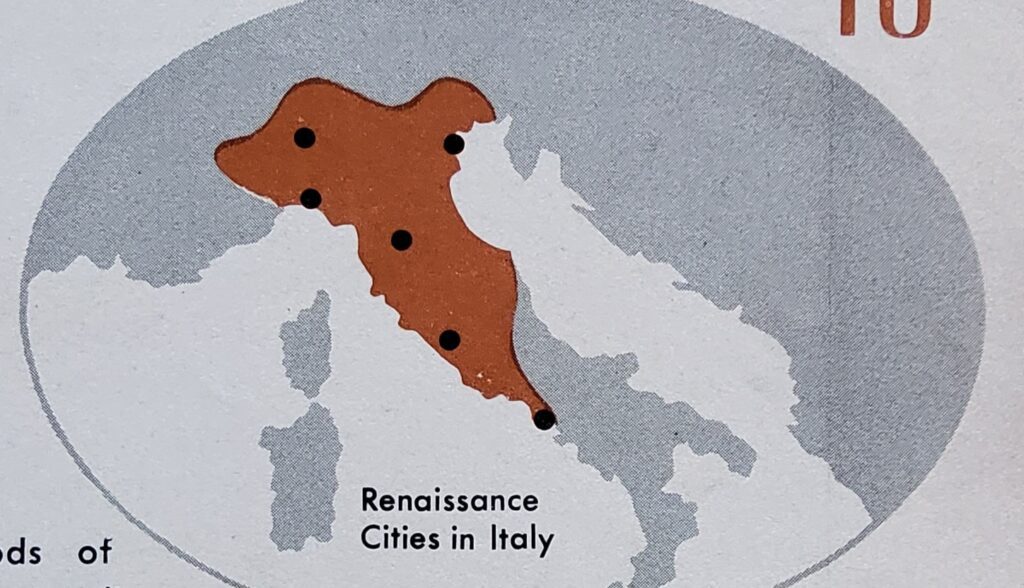
The Renaissance began in the city-states of Italy.
There was some knowledge of the ancient world throughout western Europe. Educated persons spoke, read and wrote, Latin. Those who had commercial or diplomatic relations with the Byzantines, knew Greek. Aristotle was studied in the universities, but even in Italy – where more of the artifacts of the classical civilization survived than in other countries – there was general neglect of old buildings and old books. In the fourteenth century, a number of Italian writers discovered the beautiful writing and the ideas in some old Greek and Roman manuscripts. Generated by their enthusiasm, this interest spread through the city-state of Florence, like a new fad.
Over a period of three centuries, Florence was a centre of intellectual and artistic activity, that suggests a parallel with Athens. Both were turbulent city-states, engaged in fighting other states and in civil strife among factions. Both had a freedom of thought and an interest in a beautiful way of living, that encouraged the development of culture. Florence was not a seaport, but it was located on one of the main land routes to Rome. The city came to rival Venice and Genoa in wealth, for its people wove silk and wool; and were among Europe’s first bankers.
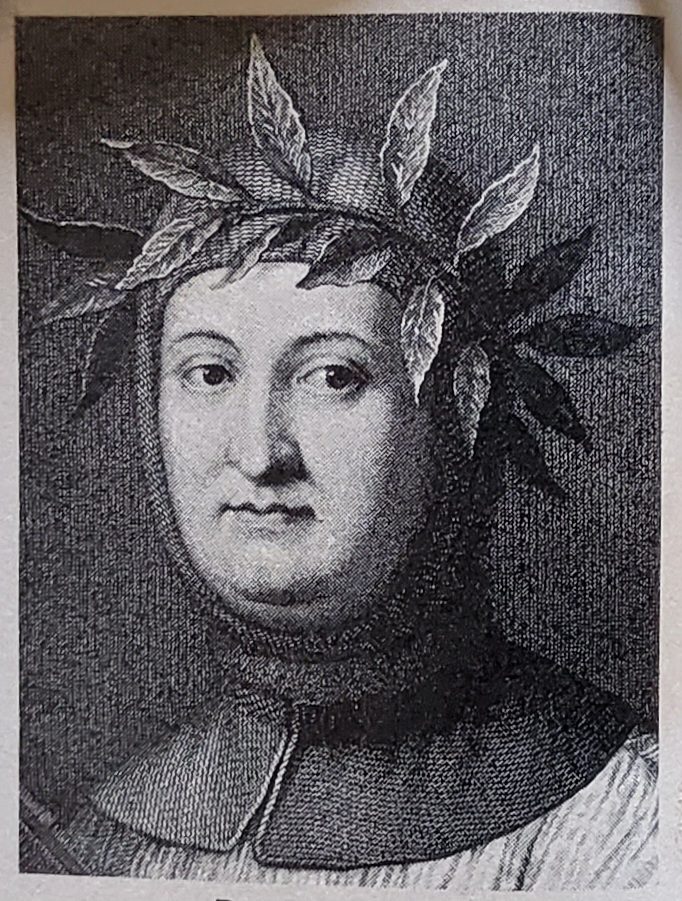
Florence claimed the great Dante, whose use of the Tuscan dialect in the Divine Comedy, made it the model for literary Italian. Florence was likewise, the home of Petrarch (1304 – 1374 A. D.), who may be called the founder of the Renaissance. His poetry in the Tuscan dialect is still famous, but historically he is more important as one who assembled a private library of old manuscripts and enthusiastically urged his friends, to collect and copy ancient manuscripts.
Petrarch’s friend and pupil, Giovanni Boccaccio, aided his teacher in seeking ancient manuscripts and learned his Greek well enough, to teach at the University of Florence. Boccaccio was a serious scholar, but he is best-known now for The Decameron, a collection of stories in the Italian vernacular of that day, which makes fun of human frailty.
Petrarch and his friends stirred many men to unearth old manuscripts and to preserve, catalogue and study them. An intensive search was begun in the libraries of old churches and monasteries. Important Latin works by Cicero, Ovid, Pliny, Cato and many others which were unknown or had been forgotten for centuries, were turned up. Libraries were built to house them and copyists were hired to reproduce them.
As the Moslems closed in on the Eastern Empire and the fall of Constantinople seemed but a matter of time, many Greek scholars made their way to Italy. Some were employed as teachers of Greek in Italian universities. The study of Greek never became as popular as the study of Latin and many scholars found it easier to study Latin translations, than the Greek originals.

It is important to know and remember, that Renaissance writers who had studied the spirit and the form of ancient books, often made translations and wrote in the vernacular, the everyday speech of Italy. In this way, Italian was established as a literary language. The extension of the ability to read and the invention of printing, coincided to widen even more the range of persons influenced by the revival of ancient culture.
Giotto (1266 – 1336 A. D.), a Florentine, deserves credit for a great breakthrough in painting. Italian art had followed the traditional Byzantine style. Something new appeared in Giotto’s religious murals — highly emotional facial expression and a dramatic grouping of figures, that contributed to the Biblical story being portrayed. Masaccio, in the following century, exhibited the development of the newer style with more realistic figure painting. Progress was rapid and in Ghirlandajo and Botticelli, we see painting which differed from the traditional style.
There is a famous painting by Ghirlandajo of an old man — one of the ugliest faces ever painted with a swollen, disfigured nose — and his grandson. These are real people, character studies from life that we recognize as individuals. In Botticelli we find interest in pagan art and figures, such as Venus modelled after ancient statuary.
The artistic achievements of the Florentines were made possible by wealthy patrons.
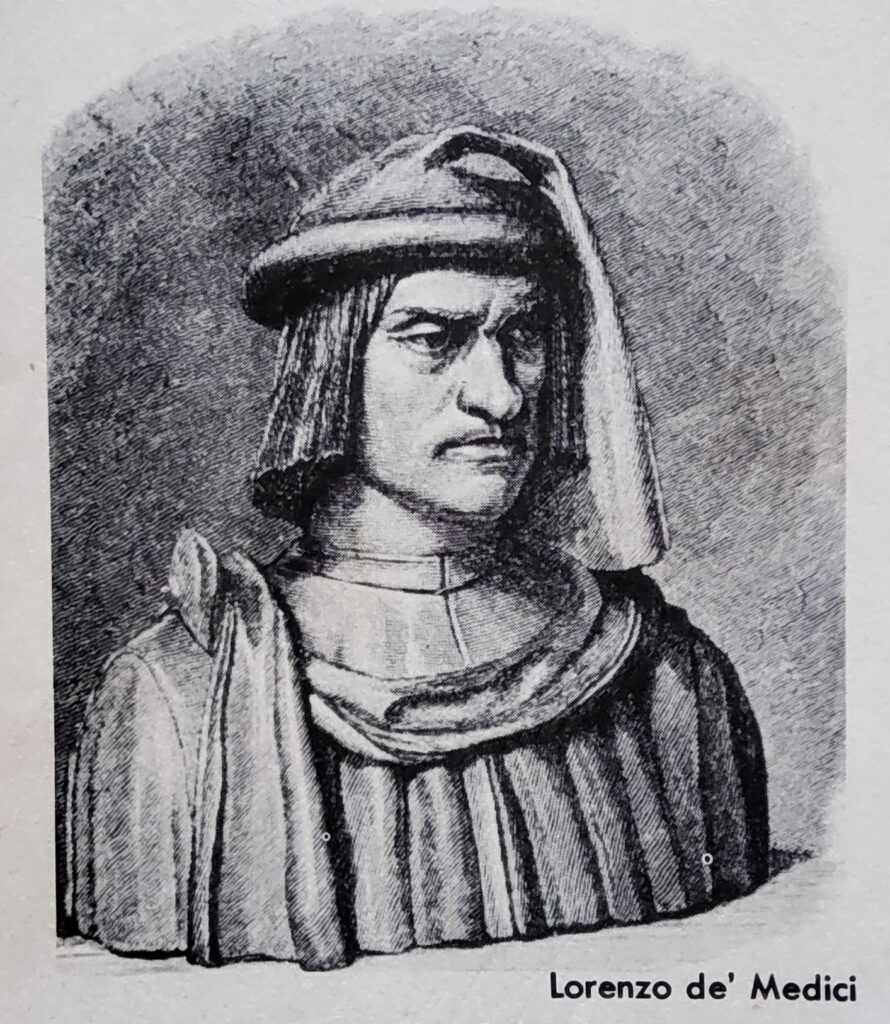
Best known of these were members of the Medici family, who had become wealthy through banking and mercantile enterprise. In the incessant strife of Florence, the Medici were shrewd enough to stay on the popular side of issues. Over the years, they gained in power until they controlled the city. This family became renowned as patrons of art not only through the lavish financial support which they gave, but also for the excellence of their taste. Lorenzo the Magnificent (1449 – 1492 A. D.), virtually brought the Italian Renaissance to its peak, with Florence as its capital. Although he was ambitious and greedy for power, he is remembered as one of the greatest patrons of the arts – of all time. His taste was superb and he spared no expense in bringing to his court artists, poets and philosophers. It was he and other wealthy patrons who paid for the collections of manuscripts and libraries described earlier.
The interest of the Florentines in Greek culture led to the founding in Florence of the Platonic Academy. Aristotle had long been a dominant influence in medieval thought, spreading from Moorish Spain into such intellectual centres, as the University of Paris. The rediscovery of Plato helped to create interest in the individual and development of his powers, through education and culture.

Venice and Rome became centres of the arts.
The prosperous city of Venice, became known for its painters. The Venetian school had to solve the problems of painting space and depth, as the Florentines did, but in addition, they gained a greater master of colour. This development began with Giovanni Bellini, who gave his Madonnas a soft tenderness and his landscapes warm colours.
Giorgione and Titian, two of Bellini’s pupils, brought the Venetian school even more fame. Giorgione used classical themes and landscapes, but instead of painting muses and Venuses out of his imagination, he used Venetian women as his models. Titian was a great draftsman, a master of composition, but mainly renowned for his colour and for showing his model’s character. Painters who followed him in Venice sought the same objective of rich colour suffused with light. Titian painted both religious and secular subjects and was a master portraitist. Amusingly, Venetian women had an artificial process for making their hair red and “titian” is still a synonym for this shade.
During the fourteenth century, there was little significant cultural activity in Rome. The residence of the popes had been removed to the city of Avignon and Rome lacked the patronage essential to art. Avignon served, during this period, as a sort of bridge for Italian art to pass to northern Europe. When the popes returned to Rome from Avignon, they set about adorning the city. They had the wealth and power to bring the finest artists there. The papal favourite was Raphael. The soft colour and charm of his Madonnas are still of outstanding fame, upto a century or two ago, when he was regarded as the world’s greatest painter.
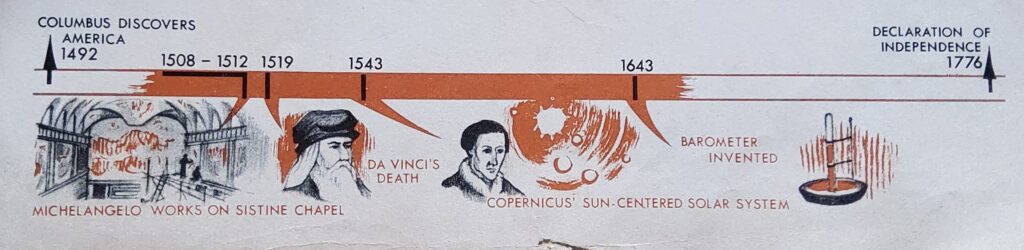
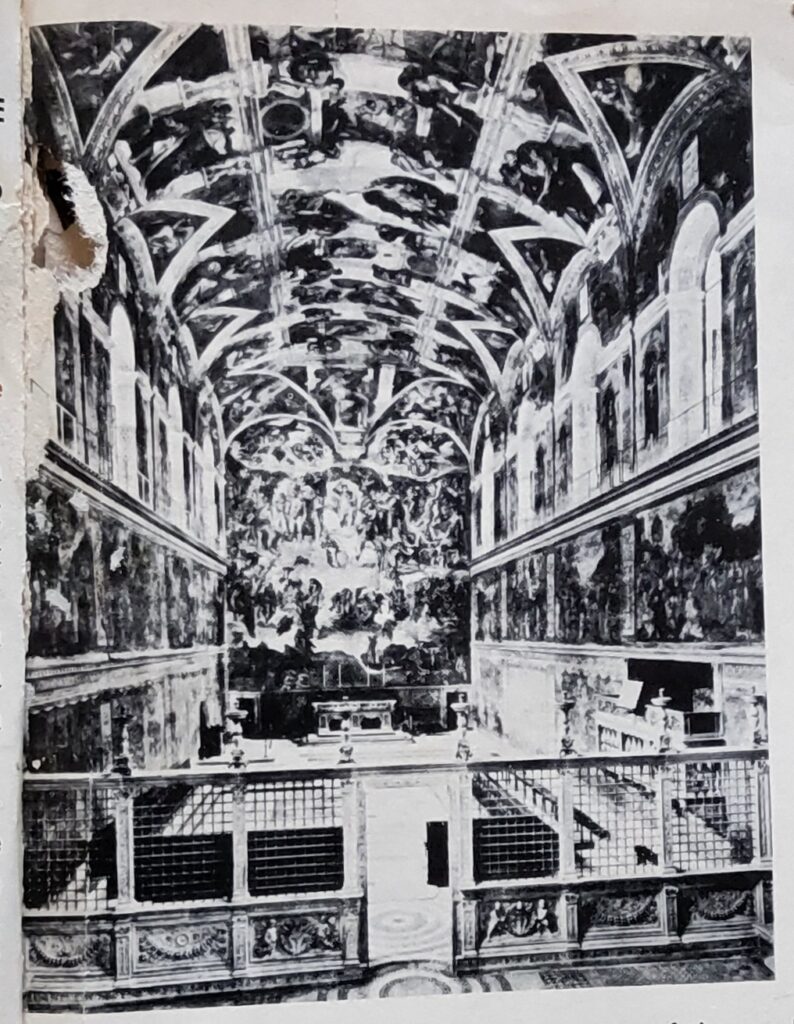
The greatest artist employed by the popes was Michelangelo. He thought of himself as a sculptor, but the Vatican persuaded him to paint the curved ceiling of the Sistine Chapel. For four years, from 1508 to 1512 A. D., hoisted up on a high scaffold, the painter lay on his back while he covered several thousand square yards of ceiling, with 145 large figures.
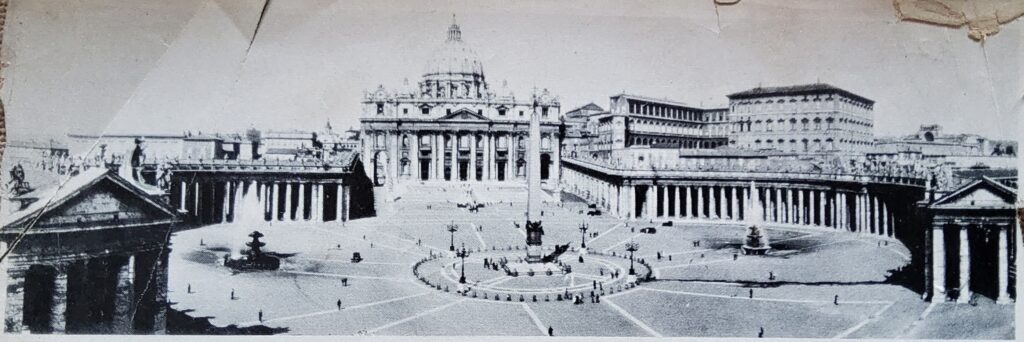
The popes decided to erect a magnificent new church to replace the basilica of St. Peter’s. The style selected was a clear indication, of the revival of taste for ancient things. It was to have a Roman dome, superimposed upon a Greek-type building with columns.
A number of architects served during the long years of planning and construction. In 1547, Michelangelo was made the chief architect. He visualized the vast dome as having a diametre of 138 feet and a height of 437 feet. By the time the church was consecrated in 1626, later architects had added facades and colonnades which take away the dominance of the dome, but the church has the symmetry which Renaissance builders tried to achieve, in all their buildings.
Since the Capitol at Washington was built in this style and the example was followed in most of American state capitols, we tend to associate it with political rather than church architecture. We think of the spire, rather than the dome, as appropriate to a church.
THE RENAISSANCE AND POLITICAL INSTITUTIONS
The new wealth from trade brought new patterns of living to western Europe.
Before 1492 A. D., European commerce centered in the Mediterranean and Italians were the first to increase their wealth. They could afford luxuries and the leisure to enjoy them. They spent increasingly more money on architecture, painting and collections of manuscripts and books.
The discovery of the Americas and the sea route to Asia led the mariners of several countries to sail the Atlantic. The trade with Africa in ivory, gold and slaves, led to new sources of wealth. Before the Renaissance was over, Cortes, Pizarro and other Spanish conquerors had claimed for Spain all of Mexico, much of South America, and part of what is now, the western United States.
Vast quantities of gold were shipped to Spain. Dutch, English and French colonies likewise, had been founded in the Americas and Europeans were establishing themselve to some extent, in Africa and Asia. Each country tended to monopolize the trade of its colonies for itself, thus enriching the monarchs, those who invested in shipping and the merchants. As in Italy, with more wealth available, more individuals gained the wherewithal, to buy luxuries and patronize the arts.
Even before the Renaissance, kings were increasing their power in France and other countries. More money enabled them to employ more soldiers, judges, customs collectors and other officials. Many nobles gathered at the kings courts, seeking favours and appointments. Elaborate public buildings and palaces were built.
By 1500, the kingship in England, France and Spain reached powers undreamed of in early medieval times. Government favoured one-man rule and tended towards absolutism. Kings were less dependent on the Church of Rome than they had been for centurie and some of them began to claim that they held their powers through divine right. The development of national churches occurred at the same time and may be regarded a part of the same historic trend.
Capital cities became more important in European life.
As the kings enlarged the machinery of government, it became more evident in everyday life. The capital cities became fashion centres where the king and his court set the fashion in dress, in taste, in manners and in speech. We still use the expression “the king’s English.” The way of life that provided leisure for hunting, for elaborate parties and for collecting books and paintings, remained popular long after the Renaissance.
The taste for power and for beautiful surroundings led princes to alter the arrangements of some cities. Wide straight avenues were needed for marching armies and for holding festive parades. Many cities still had their medieval walls, providing little space for growth. Houses were made taller and suburbs were built outside the city walls, to help take care of an increasing population.
Machiavelli wrote a book of rules for princes and diplomats.
As Italians observed the consolidation of nations in other parts of western Europe and their growth in prosperity and power, it was natural for them to long for a similar development in their own land. It seemed logical that one of the petty princes could establish a unified Italy as the Capetians had done in France. These Italians found their spokesman in Niccolo Machiavelli. He had read the classics, but his interest was in government rather than in philosophy, art or poetry. The story of ancient empires and their creation fascinated him.
Machiavelli served as a public official and was sent on embassies to other governments. He observed the actions of Cesare Borgia, who built considerable power for a time by very unscrupulous methods. Machiavelli came to believe that the ends of politics were so important, that any means might be used to attain them — that princes were not bound by the morals of private life, in their conduct of public affairs.
When a political change occurred, he turned to writing. His famed book, The Prince, summarized his viewpoints on government and gave detailed procedures to be followed. Unfortunately, his writing helped to perpetuate in diplomacy tactics such as resort to treachery, falsehood and the attitude that a “treaty is a scrap of paper.”

Machiavellianism was matched by Utopianism.
Some writers protested against absolute monarchy and the miseries and cruelties of their age. They read Plato’s Republic, in which he had combined what he considered to be the best features of the Greek city-states in an imaginary, ideal state. Some Renaissance writers thought that America would be an ideal place in which to start a new kind of society. There, far from all that was old, men might start anew with a different viewpoint and a fresher, greater love for life.

An Englishman, Sir Thomas More, wrote a book that added a word to our language, Utopia. This name, itself is evidence of the interest and knowledge of ancient ideas possessed by the people of the period, formed from Greek words meaning “No where.”
Thomas More imagined a land where all property is equally owned by all the people. Men and women are equals and work only six hours a day. Much work is done by machines. Education is enjoyed by everyone. People have freedom of conscience and religion. Everyone chooses his own vocation. Men live as brothers; they fight only to defend themselves, their friendly neighbours, or oppressed peoples.
Thomas More believed in Christian brotherhood of nations. In brief, the world he described in Utopia, was very different from England of the sixteenth century. The book was widely read and had a liberal and hopeful influence.
The lives of More and Machiavelli offer a parallel. Both were educated in the ancient classics. Both were gifted writers and public officials. One was inspired to idealism, the other to a cynical realism. More’s life ended in tragedy when, after disagreement on religious matters with his friend and king Henry VIII, he was executed in 1535.
THE RENAISSANCE AND THE ARTS
Renaissance princes patronized the fine arts, especially in italy.
A contagious enthusiasm for beautiful objects spread among the Italian cities. Painters and sculptors were in big demand to decorate palaces, churches and public buildings. Those artists who knew Greek and Latin motifs, were especially sought after.
As the Renaissance advanced, art came close to the people. Even the poor shared its beauty in the churches and city halls. They gathered around the splendid statues which decorated public squares. Art was used in the making of such commonplace things as clothing and soldiers’ uniforms. Michelangelo designed the uniforms still worn by the guards in the Vatican palace.
The walls of many churches were covered with paintings. The altarpiece for a church was considered especially important and some of our greatest Renaissance art consists of paintings used over altars.
The label “Renaissance” became a hallmark of quality in the field of painting.
The Renaissance painters, like the writers and scientists, turned to nature for their inspiration. They studied light and shadows, perspective, colour values and the anatomy of the human body. They were amazed at the naturalness and life-like qualities of the statues of ancient Greece. Basing their new technique largely on Greek naturalism, artists began to paint what they saw, exactly as they saw it. Just as surgeons of the Renaissance dissected the body to find its secrets by observation, knowledge of the New World came from men who went there, so too, did the artist approach his work. The result frequently was an almost photographic picturing of every fine detail.
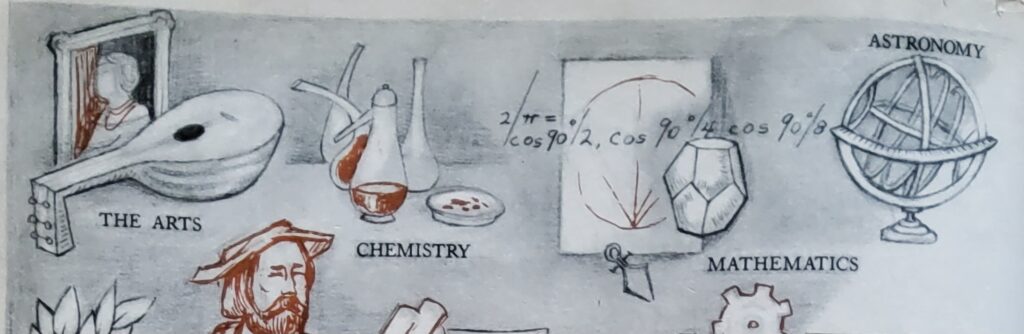
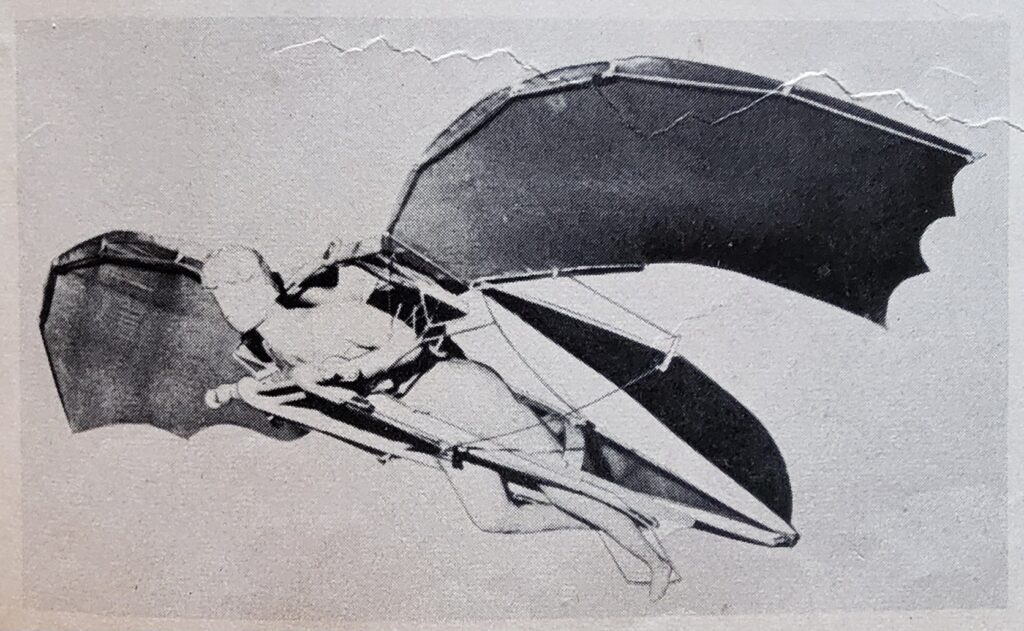
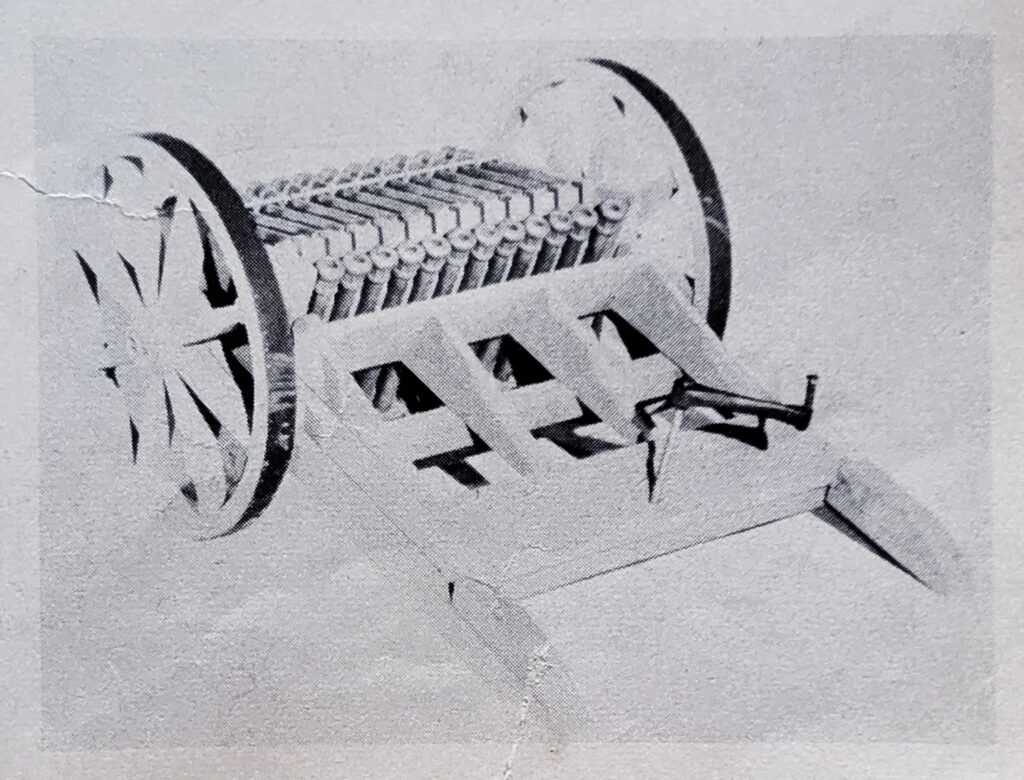
Among the great Italian painters were Michelangelo, Leonardo da Vinci, Raphael, Andrea del Sarto, Correggio and Titian. There were many others. There are scholars who find in one of these, Leonardo da Vinci (1452-1519 A. D), an outstanding example of the Renaissance man. As a painter, he did not produce many works, but his Last Supper and Mona Lisa are universally known. Leonardo may have been the most versatile man who has ever lived because he was also sculptor, military inventor and engineer, scientist, anatomist, mathematician, poet, musician and athlete. He experimented with many things and left sketches and descriptions of ideas from flying machines to submarines, from the explanation of fossils to irrigation systems.
The second great painter of the high Renaissance period is known to us as Raphael (1483 – 1520 A. D.). Helping to decorate the Vatican, Raphael absorbed ideas from Leonardo, Michelangelo and painted some memorable frescoes in that building.
Michelangelo, was the third great painter of this time.
The interest in ancient manuscripts was matched by an interest in ancient statues.
Some of the statues that most influenced Renaissance artists were Roman copies of Hellenistic work produced later than the Periclean period. The earlier Greek ideal of calm and serenity had passed to one of vigour, action and movement. For one example, we have the group representing the Trojan priest, Laocoön and his sons, struggling with serpents.
Like many painters, sculptors still turned to religion for inspiration and carved many – prophets, saints, Biblical heroes and martyrs. Among the best was Lorenzo Ghiberti of Florence, whose training as a goldsmith enabled him to carve delicate figures. Most of his working life was spent making Old Testament scenes for the bronze doors of the baptistry in Florence. Michelangelo said the doors were worthy to be the gates of paradise.
Ghiberti’s younger contemporary, Donatello, created a free-standing statue, showing that the human body was a mechanism that maintained itself against the pull of gravity. He also created an equestrian statue that could have been inspired by the equestrian statue of Marcus Aurelius in Rome. The treatment is classical and the material is bronze, instead of the stone used previously by European sculptors. More exciting than these statues is one by Andrea del Verocchio in which one of the horse’s legs is unsupported. This was considered a remarkable achievement in sculpture.
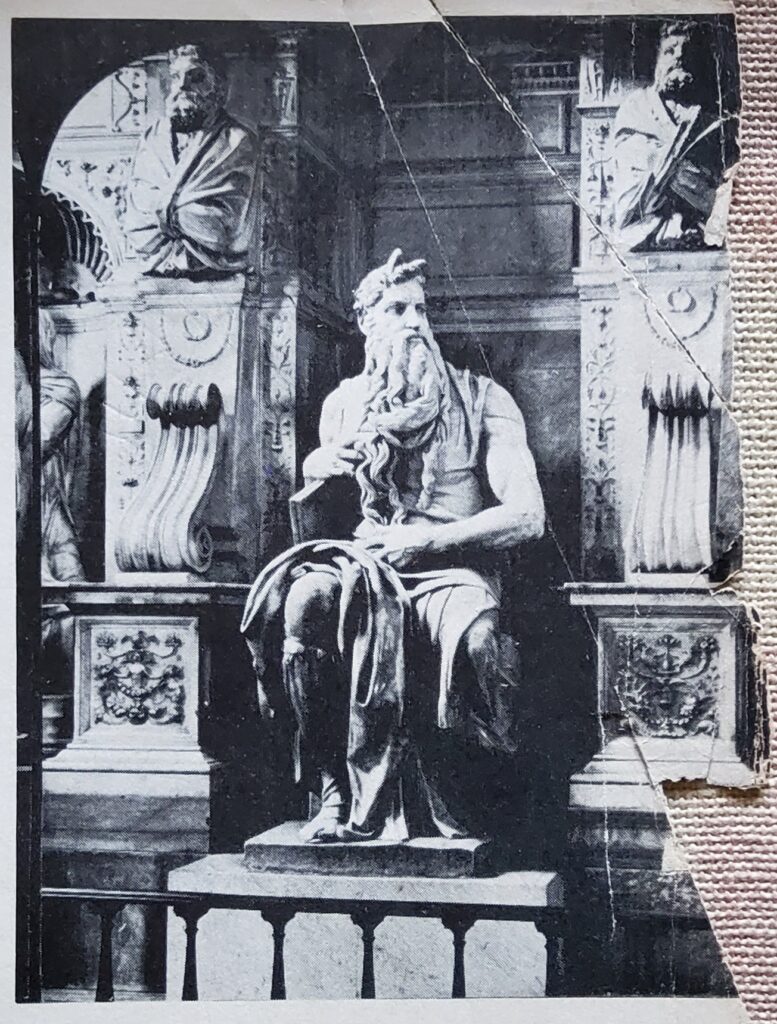
Michelangelo has left us some memorable sculptures. Once seen, no one can forget the magnificent David he carved from a piece of discarded marble or his Moses, brooding over the children of Israel. His Bound Slave, Day and Night – are also celebrated statues. We must not forget Benvenuto Cellini (1500 – 1571 A. D.), perhaps the greatest goldsmith of all time, who combined the natural ability and abounding vitality regarded as necessary in the universal man— the Renaissance ideal of greatness. Cellini left us striking statues and beautiful ornaments of gold and silver.
Renaissance architecture was based on ancient forms.
Using the Corinthian, Ionic and Doric columns of Greece and the arch of Rome, Renaissance architects achieved new effects. St. Peter’s Basilica in Rome was one of the greatest undertakings of the period. In its entirety, it covers almost fourteen acres. It is the most awe-inspiring church in Christendom.
Famous palaces were built, among them the Pitti Palace in Florence. These were far more comfortable and luxurious than medieval castles. Iron grillwork became popular beeause it afforded protection, while admitting light and air.
The opera and orchestra came out of the Renaissance.
This is one field in which little evidence was left to historians on dates and people. Someone invented our present system of musical notation, with notes arranged on and between five lines of a staff. Musical instruments were improved and made more uniform in their tone. These steps were necessary before we could have an orchestra in which a leader depends upon a group of skilled musicians, to play the exact notes with the time and emphasis, the composer intended.
The Church continued to be interested in music and in the dramatization of Biblical stories. These were combined in the oratorio. We find people performing playlets set to music and called “masks” because the performers wore masks. When the masks were made longer and more formal, the productions became operas. In France, the ballet appeared when plays set to music were interpreted by dancing, instead of by the Voice.
Two names may be mentioned among the pioneers of modern music. Palestrina, a choirmaster of the Vatican, composed music which is still enjoyed. An opera, Eurydice, appeared in 1600; and in 1607 Monteverdi produced Orfeo. Both were based upon the Greek legend of Orpheus and Eurydice. Opera rapidly gained popularity. By 1637, Venice had an opera house; London had one by 1656; and Paris by 1669.
RENAISSANCE LITERATURE AND EDUCATION
People of Renaissance times were stirred by action.
They were interested in their kings and their countries. Historical drama was especially popular, for there were few histories. Consequently, the plays of William Shakespeare, were more than plays to his audiences. They were history in the sense that some of our modern films are history. Shakespeare knew how to make his audiences laugh, how to make them weep and how to keep their interest, because he understood the minds and hearts of people. He wrote:
All the world’s a stage, And all the men and women merely players. They have their exits and their entrances, And one man in his time plays many parts.
To us, Shakespeare typifies the Renaissance writer. Like other typical geniuses of the period he expressed himself in a variety of forms of writing. He wrote famous sonnets. He could create a tragic figure like Hamlet and a “slapstick” comic figure like Falstaff. He used themes from the classical period in Julius Caesar, Troilus and Cressida, and Timon of Athens. He wrote several plays based upon the histories of English kings. In Romeo and Juliet and The Merchant of Venice we get a picture of life in the Italian cities.

A movement called humanism influenced writing as well as other arts.
It appeared in Italy with Petrarch’s interest in the civilizations of classical Greece and Rome. Those who promoted it took the name humanists from studia humanitatis or humanities — a term used by Roman writers for a liberal education.
A study of the classics was begun in an effort to discover what an educated Roman was like. The study led to an intense interest in man himself — his feelings, his sympathies, his failures, his triumphs and his loves and hates.
Humanist writers developed in every field. Erasmus of Rotterdam, who taught Greek at Cambridge University, found a wry humour in the foolishness of man. Germans enjoyed Tyll Eulenspiegel, a vivid tale of a rogue. Cervantes wrote Don Quixote, a burlesque on the romantic medieval stories about knighthood. Rabelais, too, mocked medieval notions.
The essay became a popular literary form for other humanists. The essayist finds his subjects in people and their many interests. He tries to bring a fresh viewpoint upon his subject and to write in a polished, incisive manner. Montaigne in France and Francis Bacon in England, serve as examples of writers who saw the life of their period clearly and wrote well.
Renaissance education was influenced by the needs of the time and the tastes of monarchs and their courts. Artists, writers and scholars, were on intimate terms with kings and nobles and often sat in government councils. A ruler like Queen Elizabeth, to the credit of her tutor, Roger Ascham, had mastered Greek, Latin, Spanish, Italian and French. She would naturally want at her court people of broad education and superior culture.
The gentleman of the period aspired to be a “universal man.” He developed many interests, practiced fencing, was skilled at games and strove to be a witty and entertaining dinner guest. Women’s position in the world improved and a lady of wealth was expected to be an intelligent individual, in an intelligent society.
New ideas of education were introduced by important educators.
Since schools usually try to meet the needs of the time in most periods, writers and philosophers turn their attention to the schools and offer some plan of instruction. The humanists did this, stating the purposes and ideals of Renaissance education. A humanist writer, da Feltre of Venice, thought that education should be directed toward discipline, good character and sound judgment. These qualities could be obtained, he thought, through a study of religion and of Greek and Latin. He called his schoolhouse “The Joyful House,” for he believed that children should be happy while learning.
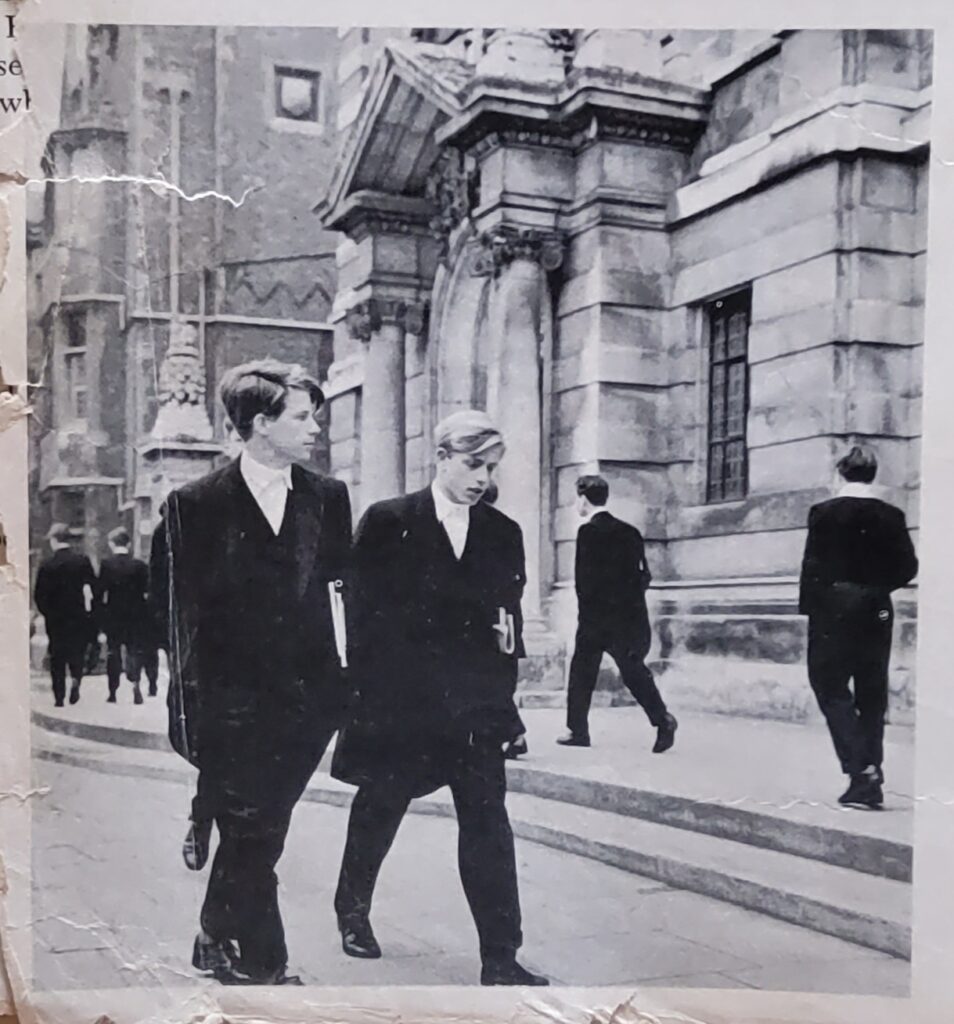
In 1570, Roger Ascham, Queen Elizabeth’s tutor, published his ideas on education in The School Master. Ascham believed in outdoor exercise and encouraged dancing, wrestling, swimming, running, hunting and tennis. Much of this stress upon athletics continues in English schools. The remark attributed to the Duke of Wellington that the Battle of Waterloo was won on the playing fields of Eton is often quoted.
Schools that the English call “public,” although they are private and charge tuition, were founded in the fifteenth and sixteenth centuries. Among these were Eton, Harrow, St. Paul’s, Westminster and Rugby. The latter is said to be the birthplace of modern football. Some provision was made for poor boys who were bright and considered worthy but, in general, in western European countries educational opportunities for the poor, were very limited.
Scotland was a leader in making education more widespread and democratic. Actually, at a later date, it was in New England that the first free and compulsory primary schools were established.
ADVANCES IN SCIENCE
Scientists began to look beyond the earth in their search for truth.
Examined now in the light of modern science, the ideas of medieval man about plants and animals, about the sun, moon and stars, about the nature of matter and energy, seem to be childlike and naive.
Although his writings passed unnoticed at the time, in the thirteenth century Roger Bacon saw the relationship between mathematics and science and urged scholars to experiment. He wrote:
Experimental science has one great prerogative in respect to all other sciences, that it investigates their conclusions by experience . .. It is true that mathematics possesses useful experience with regard to its own problems of figure and number, which applies to all the sciences and experience itself, for no science can be known without mathematics. But if we wish to have complete . . . knowledge, we must proceed by the methods of experimental science.
As the medieval period moved toward the Renaissance, man’s horizons were widened. For instance, the discovery of the Americas confronted man with new geographical facts and the need to re-adjust his thinking. There was suddenly a new world with new people, different types of government, new plants and new animals for study.
Great issues were raised by investigators who sought to understand the solar system. These investigators put great emphasis upon minute observation and reasoning. Yet, if you notice the dates given for the scientists involved, you can see that the real advances in science came after the Renaissance had reached its zenith.
After years of study, Copernicus (1473 – 1543 A. D), a Polish priest, advanced a new theory of the universe. He was a mathematician who, had read many Greek and Roman authors. In 1543 he wrote:
I made every effort to read anew all the books of philosophers I could obtain,… So I found first in Cicero that Hiketas of Syracuse believed the earth moved … The order and the magnitude of the stars and all their orbs and the heaven itself are so connected that in no part can anything be transposed without confusion to the rest and to the whole universe.
Then, after this preface to his book, Concerning the Revolutions of Celestial Spheres, he stated that the sun, not the earth, is the centre of the universe and that the earth revolves about the sun.
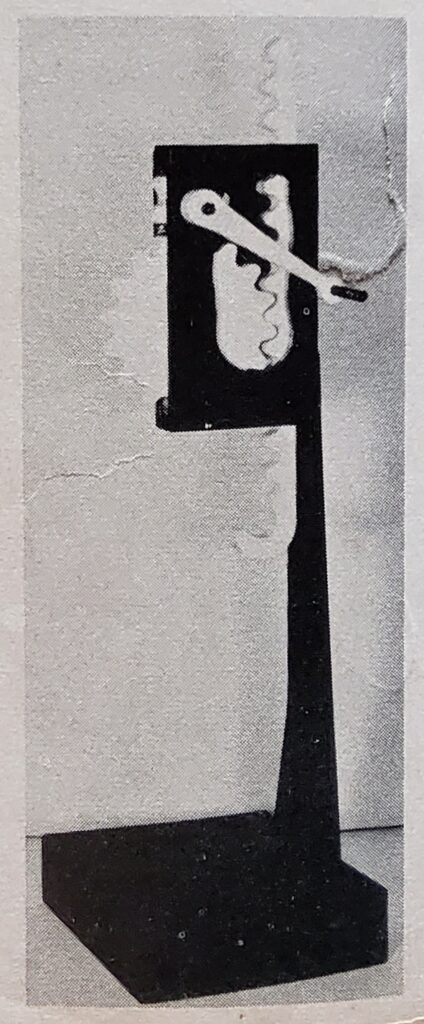
Imagine the hornet’s nest of disagreement, that theory stirred-up. For more than a thousand years, western Europe including the Church, had accepted the belief of the Greek scholar Ptolemy that the earth was stationary and the centre of the universe. The Inquisition condemned Copernicus’ views and his book was put in the Index of Prohibited Books. Copernicus had no telescope, but reached his conclusions by reasoning. In doing so, he gave us a good example of the hypothesis, the educated guess or “hunch,” which always opens a new field of scientific thought.
The Danish astronomer Tycho Brahe (1546 – 1601 A. D.), did not fully accept Copernicus’ theory and decided to chart a large number of observations of the heavens. A painstaking observer and recorder over the years, he accumulated a mass of data concerning the exact time and position of planets, as he studied them through his telescope. Brahe exemplifies another principle of the scientific method, that hasty conclusions should not be drawn; that much evidence should be collected over a period of time, before theories are accepted as fact.
Johann Kepler (1571 – 1630 A. D.), a German mathematician, was baffled for a time by a problem which interested him. The records of observations such as Brahe’s, did not support the theory that the planets moved in orbits which were perfect circles. If the orbit was an ellipse however, the facts would fit. We can find no better example of the modification of an hypothesis, in the light of evidence.
It remained for Sir Isaac Newton and Leibniz, to explain why the orbit of a planet was elliptical and to invent a higher form of mathematics, the calculus, that was needed to predict the position of planets at future times.
Newton discovered the laws of gravity and their effect on the earth and the planets. No modern machine could have been invented, without a knowledge of the principles he discovered. His book, the Principia, brought into being the new world of science.
The Italian, Galileo Galilei (1564 – 1642 A. D.), made important contributions to physics. He stated the law of falling bodies. He is said to have proved this law by dropping a one-pound weight and a ten-pound weight, from the leaning tower of Pisa. This may be fiction, but he disproved the belief that the weight of a falling object determines its velocity. He also gave the world the thermometer and discovered the principle of the pendulum. Using a crude telescope, he observed the mountains of the moon and the satellites of Jupiter.
Men became more and more interested in space, in motion, in direct observation and in careful recording of data. Francis Bacon founded the Royal Society in England, dedicated to the advancement of science.

The progress of modern science has been a “chain reaction”, in which one invention or discovery has led to another. We are constantly reminded, that knowledge is incomplete. In recent times, Albert Einstein added to the contributions of these men we have been briefly noting.
Man began to reinterpret his religious beliefs so as to bring them into harmony with the new scientific thought. He began to think of an infinite God of boundless mercy, who operated the universe by divine laws — laws which the scientists were discovering.
Through inventions newly discovered, scientific laws and principles were made to serve man.
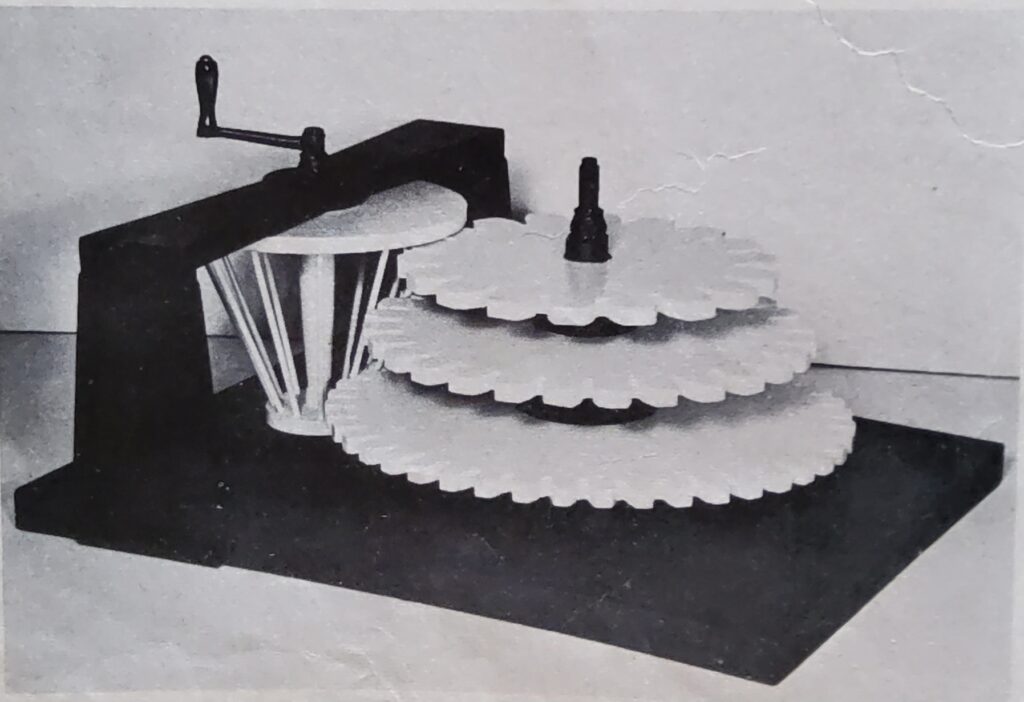
We find in the notebooks and sketchbooks of the incredible Leonardo – what amounts to a catalogue of modern machines. It seems tragic to us that there was no systematic follow-up to his wealth of ideas, since technological progress could have been hastened by centuries.
The invention of the telescope opened the macrocosm (from the Greek words meaning “large world”) to man to study; the microscope opened the microcosm (“small world”) for the same purpose. These two inventions alone, one making possible modern astronomy, the other modern bacteriology, were quite as significant as the work of a Columbus, or a Magellan. Anton Van Leeuwenhoek discovered protozoa, bacteria and red corpuscles, by means of the microscope.
Two men, the Scottish John Napier and the Englishman, Henry Briggs, appear to have invented logarithms, at approximately the same time.
Numerous inventions of everyday practical value appeared: improved clocks, the foot spinning wheel, lead pencils. Torricelli’s invention of the barometer in 1643, was an aid to the forecasting of weather, a matter very important to farmers and seamen.
Many of the inventions mentioned, depended upon the use of metal. The professional standing army had come into being in some areas. The widespread use of fire-arms, led to new demands for iron.
The achievements in science of the late Renaissance, fore-shadowed the machine age. Already men were giving new honour and new glory to the makers of machines. There were those who dreamed of mechanical robots, that would do the work of man.

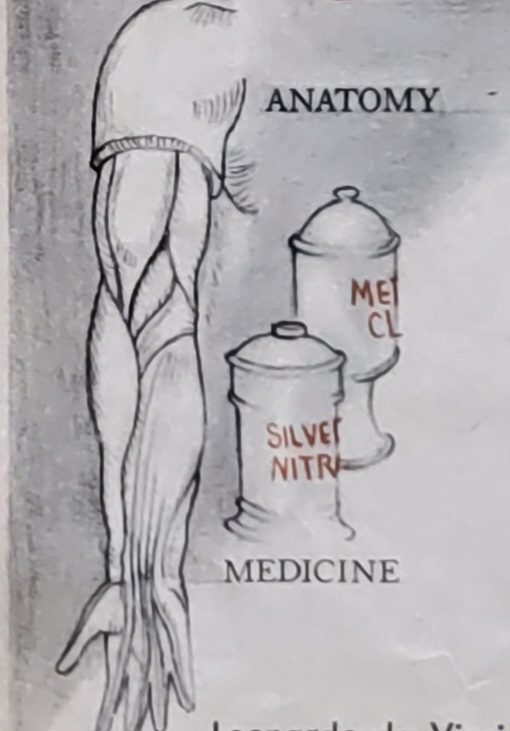
Scientific medicine began to develop from a better understanding of anatomy.
During the early Middle Ages, the medical ideas of Galen, Hippocrates and other ancient physicians were almost forgotten, but by the thirteenth century, Moslem commentaries on these men and on Aristotle’s biology, could be read in western Europe. Greek and Arab medical theories dominated the scene, until the high Renaissance. During the sixteenth century, several men did much to build a scientific foundation for medicine. Andreas Vesalius (1514 – 1564 A. D.), a native of Brussels who was called the father of modern anatomy, actually dissected the human body in the classroom, although dissection was practiced as early as the thirteenth century. His book on human anatomy did for anatomy, what Copernicus’ book did for astronomy. In France, Ambroise Paré (1510 – 1590 A. D.), the father of modern surgery, invented the use of ligatures, to arrest bleeding and discovered the value of salves, for healing.
The Renaissance bridged the gap between the medieval awakening and modern times.
Its spirit is one we understand because it is much like our own. The term Renaissance thrills us because man made progress on so many fronts. Some men, like Leonardo, conceived ideas so brilliant that it is only in our time, that they have been put to practical use. Their vision was extended to distant stars and planets, into minute organic and inorganic matter.
American students and tourists go to Europe to see Renaissance architecture, painting and sculpture. An education is incomplete without some knowledge of Renaissance literature. Renaissance man taught us to find an austere beauty in mathematical theorems and in the orbits of planets.
Finally, the scientific method, the tradition of unceasing experiment and research, has continued unbroken through 400 years of progress. Development of the whole man, remains an ideal for the individual to attain.
MICHELANGELO BUONARROTI (1475 -1564 A. D.)
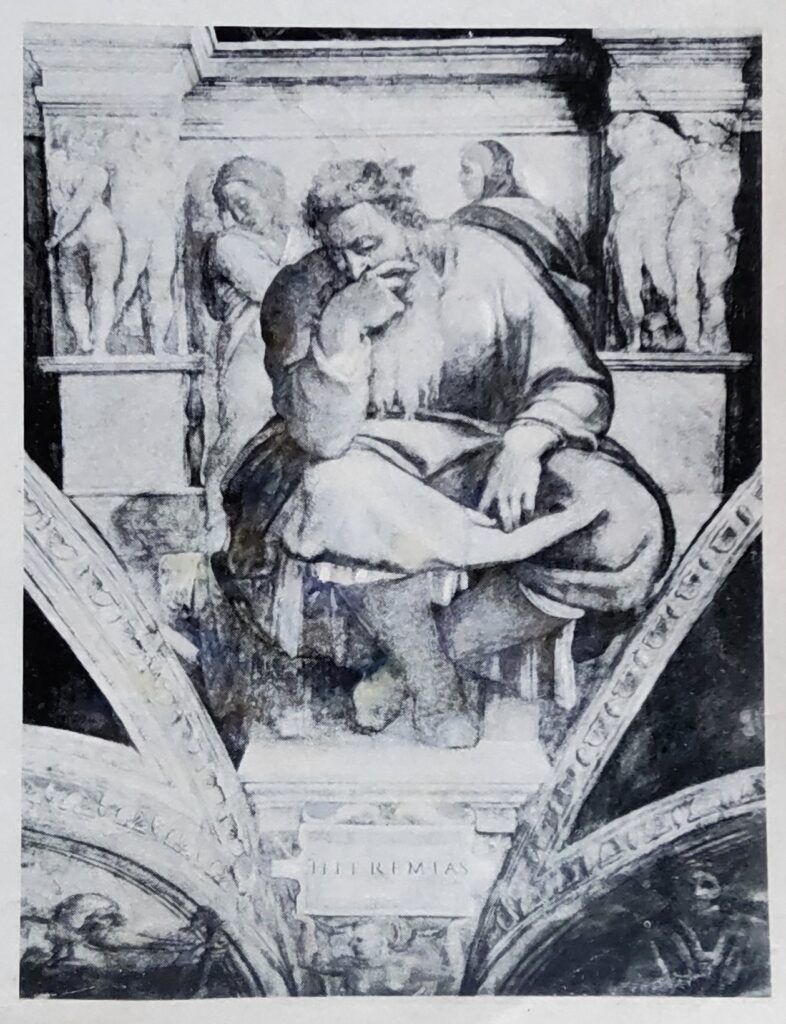
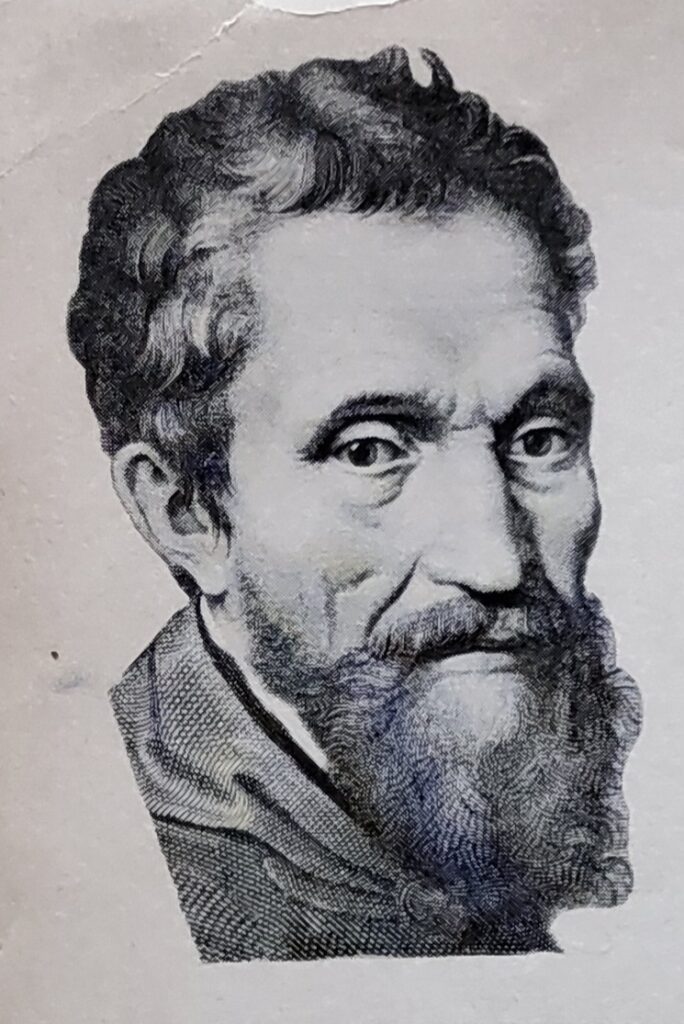
Those who believe that genius thrives upon sorrow and personal problems, can find a classic example in Michelangelo. He was a lonely bachelor, imposed upon by his relatives, jealous of the achievements and rewards of other artists. His bitterness grew until he became plain cantankerous. In his own portrait, we find the same brooding sternness that we find in his pictures of Hebrew prophets.
Michelangelo was not as versatile as his contemporary, Leonardo, whom he surpassed in the arts. Still, he was architect, engineer, poet, painter and sculptor. In sculpture, his masterpieces are his David, a figure which might be an Apollo, by one of the greatest Greeks; and his Moses, brooding in solitude. He did his best painting in Rome for the popes. His ceiling frescoes and the Last Judgment in the Sistine Chapel, draw from critics the same term, incomparable.

LINKING THE PAST AND THE PRESENT
The discoveries and inventions of the Renaissance period created a problem for education. Suddenly there was so much more to be learned, that a stretching of men’s minds was necessary. In geography, for example, one needed to know something of the entire globe and not just a segment of a continent. The dimensions of other subjects of study, were equally expanded. The human mind proved equal to the task and we read about men and women who became more learned and versatile, than their ancestors.
Today the student is faced with the need to become familiar with a much larger body of knowledge, than Renaissance men could have known. It takes more time to master any one subject and still no student can afford to overspecialize. A knowledge of both the physical sciences and the studies of man, is essential if we are to meet the present threats to our way of life.