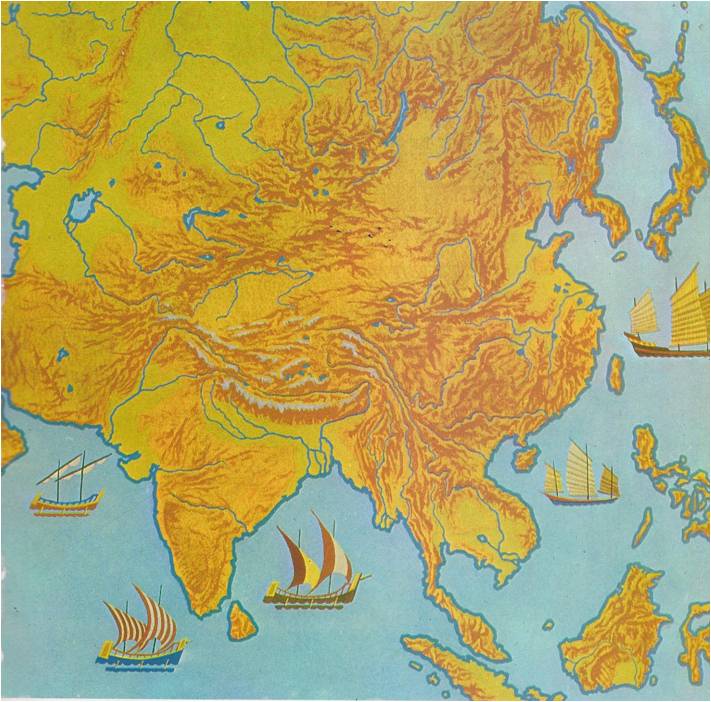
East in the Middle Ages 214 B.C. – 1644 A.D.
Medieval Asia, important Events of the East in the Middle Ages 214 B. C. – A. D. 1071
214 B.C. The Ch’in emperors build the Great Wall of China.
206 B.C.-A.D. 220 Trade and the arts flourish in China under the Han dynasty, in the east.
A.D. 220-589 China is torn by invasions and civil war in the period of the Six Dynasties
552 Buddhism is officially introduced into Japan and China.
571 The birth of Mohammed happened in the east.
604 Prince Shotoku gives Japan a constitution.
607 Shotoku sends missions to study Chinese culture.
618-907 The T’ang dynasty, one of the “golden ages” of China.
622 Mohammed and his followers are forced to flee from Mecca to Medina in the Hegira.
630 Mohammed’s followers capture Mecca.
632 Death of Mohammed.
642 With the defeat of the Persian Empire, the world of Islam extends from Africa to the Indus.
710-784 The Nara Period in Japan is marked by semi-Chinese culture.
711 Moslem Arabs and Berbers invade Spain and defeat the Goths.
712-756 Hsuan Tsung reigns over China; art, literature and philosophy flourish.
720 The Nihon Shoki, legends of the history of Japan, is written.
750 Rise of the Abbasid caliphs.
751 China loses Turkestan to the Arabs after the battle of Talas.
756 Rise of the Omayyad dynasty in Spain.
762 Al-Mansur founds a new capital for the caliphs at Baghdad.
778 Charlemagne and the Frankish army invade Spain but are defeated by the Moslems at Roncesvalles.
786-809 Harun al-Raschid encourages learning and makes war on the Byzantine Empire.
794 Kammu moves the Japanese capital to the new city of Heian, the present-day Kyoto.
813-833 Reign of al-Mamun, under whom Baghdad becomes a center of knowledge and the arts.
960-1279 Painting and printing flourish in China under the Sung dynasty.
1071 Alp Arslan defeats the Byzantine army and destroys the empire in Asia Minor.
Important Events in the East in the Middle Ages, 1099 – 1644
1099 Crusaders invade Palestine and capture Jerusalem.
1185-1333 Japan becomes feudal during the Kamakura period, with effective rule by the warlords.
1187 Moslems led by Saladin recapture Jerusalem.
1189-1192 The “Crusade of Kings” reaches Palestine but fails to conquer Jerusalem.
1206 Temujin is proclaimed Genghis Khan and leads his armies to conquests in Asia and Eastern Europe; a Moslem is made Sultan of Delhi and begins to unite India.
1227 Death of Genghis Khan.
1258 Mongols under Hulagu capture Baghdad and execute the last of the Abbasid caliphs.
1260 Mamelukes under Baybars defeat the Mongols at Ain Jalut, saving Egypt as a refuge of Moslem culture.
1267 Kublai Khan builds Peking.
1274 Kublai tries to invade Japan but is defeated.
1275 Marco Polo arrives in China.
1281 A second invasion of Japan is completely wiped out.
1294 Death of Kublai Khan.
1336-1573 Japan under the Ashikaga shoguns is torn by civil wars.
1368-1644 The Ming dynasty gives China three centuries of order.
1398 Timur captures and sacks Delhi, killing many thousands.
1421 Yung-lo moves the Chinese capital to Peking.
1453 Mohammed II and the Ottoman Turks capture Constantinople, ending the Byzantine Empire.
1498 Vasco da Gama reaches India.
1520-1566 Suleiman, greatest of the Ottoman rulers, expands the empire and organizes its legal system.
1526 Babur defeats the Delhi sultan at Panipat and founds the Mogul Empire.
1543 Portuguese traders and missionaries arrive in Japan.
1556 Akbar becomes Mogul emperor and consolidates India.
1557 Portuguese build a settlement at Macao on the coast of China.
1632 Shah Jahan begins construction of the Taj Mahal.
1641 European merchants are expelled from Japan.
1644 Beginning of the Manchu dynasty in China.
East in the Middle Ages 214 B.C. - 1644 A.D.
676
ARABIA, the big, boot-shaped peninsula off the northeast corner of Africa, is one of the hottest and driest regions on earth. It is also extremely rugged. Almost all of it is made up of mountains‚ deserts and immense plains of sand broken by hills. Not a single river crosses it, only dry riverbeds called wadis which quickly carry away the little rain that falls. Water is so scarce that trees and plants can grow only along some of the coasts and in small “islands” of green called oases, mostly found in the wadis, which dot the vast interior. Yet this …
Read More »
East in the Middle Ages 214 B.C. - 1644 A.D.
917
IN THE year 571, in Mecca, a boy was born in a humble household of the Quraysh. No one knows what name he was given. His father died before his birth and his mother when he was six. The orphan, boy now called Mohammed, was brought up by his grandfather. When his grandfather also died, he came into the care of his uncle, Abu Talib. Nothing definite is known about his early life. As a boy, he may have tended sheep at the edge of the desert outside the city. When he was old enough to ride a camel, he …
Read More »
East in the Middle Ages 214 B.C. - 1644 A.D.
360
Mohammed sometimes dictated his thoughts to his secretary, Zayd, but when he spoke in public no one wrote down what he said. Instead, his listeners learned his speeches by heart and mistakes crept in, as they usually do. Only a short time after Mohammed’s death people were repeating his sayings in quite different ways. If Mohammed had been anyone else, this would not really have mattered. It would have been enough to remember what he had said without bothering too much about how he had said it. But the Moslems believed that God himself had addressed them through Mohammed. Every …
Read More »
East in the Middle Ages 214 B.C. - 1644 A.D.
732
THE FIRST three caliphs — Abu Bakr, Omar and Othman — had all known — Mohammed well. In 656, Othman, an old man in his eighties, was stabbed to death by a band of rebels. They believed that the right to be caliph belonged to Mohammed’s son-in-law, Ali. Sometime later, Ali defeated his rivals for power in battle and proclaimed himself caliph. Instead of Medina, he chose as his capital the new Arab city of al-Kufah, in Iraq. All but one of the leaders of Islam swore loyalty to Ali. The exception was Muawiyah, the governor of Syria, who set …
Read More »
East in the Middle Ages 214 B.C. - 1644 A.D.
1,425
UNDER THE Omayyads, who ruled from 661 to 750, Islam had grown into a mighty empire. Arabic had become its language, while the Arabs, in turn, had picked up useful skills from the peoples they had conquered. The state had grown rich from the tribute paid by non-Moslems and the land tax paid by landowners. Though the caliphs were mainly concerned with pleasure and power, they had not neglected religion completely. They had built the Dome of the Rock in Jerusalem and the Omayyad Mosque in Damascus — two magnificent sanctuaries which were the holiest places in Islam after the …
Read More »
East in the Middle Ages 214 B.C. - 1644 A.D.
230
IN 750, when the first Abbasid caliph ordered a wholesale massacre of the family that had ruled before him, hardly any of the Omayyads came out alive. One who did was a twenty-year-old youth named Abd-al-Rahman, a grandson of the tenth Omayyad caliph. Fleeing from a Bedouin camp on the Euphrates, he wandered in disguise through Palestine, Egypt and North Africa. Again and again he barely escaped being discovered and seized by Abbasid spies. His desperate flight lasted, altogether, five years. Finally he came to the town of Ceuta, on the northwest coast of Africa, where some Berber chieftains, who …
Read More »
East in the Middle Ages 214 B.C. - 1644 A.D.
671
THROUGHOUT THE eleventh century, the divided Arab Empire became weaker in all its parts. Meanwhile, the Christian lands to the north became stronger. Adventures from northern France snatched Sicily and Southern Italy from the Arabs. The pope called on the rulers of Europe for a united Christian attack on the Moslems. By the end of the century, European knights in chain-mail armour were streaming into Syria by land and sea, determined to recapture the holy places of their religion. This campaign was the first of many. The Crusades dragged on for two centuries, with long periods of peace coming between …
Read More »
East in the Middle Ages 214 B.C. - 1644 A.D.
750
LIKE THEIR relatives the Mongols, the Turks began as wandering herdsmen in Central Asia. Their first contact with Islam was as victims rather than victors. When Arab armies overran the southern part of their homeland in the eighth century, many Turks were captured and enslaved. Recognizing their talent for fighting, their new masters enrolled them in their armies. In time, many of them reached high positions in the lands of their adopted religion. About the middle of the tenth century, tribesmen from Turkistan, led by a chief named Seljuk, settled near the city of Bokhara. There they became converted to …
Read More »
East in the Middle Ages 214 B.C. - 1644 A.D.
574
ACCORDING to their tradition, the Ottoman Turks once belonged to the same Central Asian tribe as the Seljuk Turks. Their ancestors came to Asia Minor with the Seljuks. In time, they began to challenge the authority of their fellow Turks. The Ottomans took their name from a chieftain called Othman, who in 1299 became the emir of Seljuk lands bordering on the Byzantine Empire. Othman declared holy war on his Christian neighbours. His son Orkhan captured the city of Brusa and in 1362 Orkhan’s son Murad took Adrianople, beyond the strait and sea that separated Asia Minor from Europe. Thereafter, …
Read More »
East in the Middle Ages 214 B.C. - 1644 A.D.
555
IF Islam had never existed, the Christian countries of the world would probably be less advanced and certainly less varied, than they are. For it was Moslems who gave the West many of its basic skills and ideas. From the eighth to the thirteenth centuries, the Arabs and the other Islamic peoples were the main carriers of western civilization. While Europe was torn by almost constant fighting, Moslem scholars preserved the learning of the ancient world. Other Moslems added discoveries and original works of their own. In time, translators in the parts of Europe that were in closest contact with …
Read More »
East in the Middle Ages 214 B.C. - 1644 A.D.
1,580
UNTIL 1947, when the Moslem state of Pakistan was carved out of its western and eastern corners, the entire triangle of land that points south from the Himalaya Mountains into the Indian Ocean was known as India. Geographers call this huge land mass a subcontinent, because it is almost completely cut off from the rest of the continent of Asia. The Himalayas on its northern frontier form a continuous barrier of rock, the highest in the world. “MOTHER GANGES” From the southern slopes of the Himalayas, two great rivers run down to the ocean. The valley of the Indus River, …
Read More »
East in the Middle Ages 214 B.C. - 1644 A.D.
719
IN 711‚ when other Moslem forces were invading distant Spain, Arab soldiers fought their way to the mouth of the Indus River and captured the area called Sind. There they stopped. Nearly three centuries passed before Moslems again menaced India. In 998, a Turk named Mahmud, the amir of Ghazni in Afghanistan, burst through the Khyber Pass with an army of Turkish horsemen to sweep across the Punjab in the first of seventeen raids. Not even the savage, pagan Huns had been as bloodthirsty as these civilized sons of Islam. They hated the Hindus with a special hate. Believing in …
Read More »
East in the Middle Ages 214 B.C. - 1644 A.D.
423
THE name “Mogul” comes from the Arabic word for “Mongol.” Babur, the founder of the Mogul dynasty, was probably descended from both Timur and the mightiest of all Mongol conquerors, Genghis Khan. His early story was much like that of Genghis. Born a minor prince in what is now Soviet Turkistan, he was driven from his throne while still a child. He spent years wandering about with a few hundred ragged, half-starved followers. In 1504, he captured Kabul and began to dream of conquering the richer lands south of the Khyber Pass. In 1519, he made a start by seizing …
Read More »
East in the Middle Ages 214 B.C. - 1644 A.D.
245
Akbar died and the hope of a peaceful, prosperous India died with him. None of his successors was nearly so wise, open-minded, and farsighted. Even so, the Mogul Empire kept growing. The seventeenth century was, indeed, the height of Mogul power. Akbar’s son Jahangir reigned from 1605 to 1627. His name, which meant “grasper of the world,” did not fit him at all well, for he added only a little territory to the empire. Although he was clever and well-educated, Jahangir was also lazy and pleasure-loving. He was content to leave affairs of state to his Persian wife and her …
Read More »
East in the Middle Ages 214 B.C. - 1644 A.D.
491
MORE than two centuries before Aurungzeb‘s death and even before the coming of Babur, a new kind of invader had appeared in India. Instead of thundering down on horseback from the Himalayan passes, he arrived on the coast by ship. Instead of plunder, he sought trade. Instead of wanting to conquer the subcontinent, he wanted to conquer the seas around it. This invader’s name was Vasco da Gama. He had sailed his small fleet all the way around Africa from his homeland of Portugal in southwest Europe. In 1498, just six years after Columbus discovered America, he landed at the …
Read More »
East in the Middle Ages 214 B.C. - 1644 A.D.
264
THE vast East Asian land of China is named after its first family of emperors, the Ch’in. The Ch’in brought the country together under one government and built the Great Wall to keep out northern barbarians. They were in such a hurry to get things done, however, that they drove their subjects too hard and lost their support. In 206 B.C., after only a few years in power, they were overthrown. The Ch’in were replaced by an imperial family named Han. The Han dynasty ruled for two centuries before the time of Christ and then, after a break, for another …
Read More »
East in the Middle Ages 214 B.C. - 1644 A.D.
472
THE three states into which China had split were soon split up themselves into even smaller divisions. For three and a half centuries, war raged almost continuously among rival kings. Doubt and confusion were everywhere. The period between 220 and 589 is called the Six Dynasties era, after six ruling families in a row which used Nanking as their capital. In all those years‚ the memory of the Han Empire never died. Looking back longingly at the peace and order of that time, the people came to think of the Han government as the great model which all rulers should …
Read More »
East in the Middle Ages 214 B.C. - 1644 A.D.
665
IN 589, a warlord named Sui Wen Ti conquered the last dynasty in the south and so became emperor of all China. He put his subjects to work repairing the Great Wall, building palaces and digging long canals to carry water out to the fields and grain back to the cities. He sent his armies south into Vietnam and west into central Asia. In 604, he died. No one knew how he died, but many people suspected that he had been murdered by his son Yang Ti. As emperor, Yang Ti drove the people even harder than his father had. …
Read More »
East in the Middle Ages 214 B.C. - 1644 A.D.
583
DURING THE turbulent Five Dynasties and Ten Kingdoms era, the main outside threat to China came, as usual, from the north. A tough Mongol people from Manchuria helped one of the Chinese Warlords conquer North China. In return, he let them settle around Peking. Some of them became farmers, but their nomadic habits of roving and fighting remained strong. From time to time they raided the North China Plain, striking terror into the hearts of the peasants. These troublesome people were called the Khitan. Another form of their name, Khitai, sounded like “Cathay” to European travelers who later came to …
Read More »
East in the Middle Ages 214 B.C. - 1644 A.D.
540
IN 1135, Hangchow became the capital of the Southern Sung. Thereafter, the Sung kept an uneasy peace with their unwelcome northern neighbours, the Chin. Then, out of Mongolia came the mighty Genghis Khan, whose warriors and their descendants were to spread terror across Asia into Christian Europe and the lands of Islam. Before he died in 1227, Genghis had crushed the Hsi Hsia and all but crushed the Chin. His son, Ogodai, made a treaty with the Sung emperor, and the Sung and Mongol armies together put an end to the Chin. This alliance with a barbarian power turned out …
Read More »
East in the Middle Ages 214 B.C. - 1644 A.D.
883
THE MEN who took over from the Mongols came to be known as Hung-wu, or “Vast Military Power.” Hung-wu named his dynasty ming, or “brilliant.” As things turned out, however, the Ming dynasty was not particularly brilliant. It was, in fact, humdrum compared to the Han, the T’ang, or even the Sung. Nevertheless, it gave China nearly three centuries of order, from 1368 to 1644. Hung-wu was born in a hut near Nanking in 1328. His parents soon died and the boy entered a Buddhist monastery, where he learned to read and write. His studies completed, he went out into …
Read More »
East in the Middle Ages 214 B.C. - 1644 A.D.
720
THE Japanese islands — four large ones and many smaller ones — rise out of the Pacific Ocean to the east of China and Korea. They form a bow that bends from southwest to north for eleven hundred miles. The northern tip is at the same latitude as Montreal and the southern tip at that of Florida. Long ago, the people of the islands noticed that the sun always seemed to rise out of the ocean. They named their land Nihon or Nippon, “the source of the sun.” To the Chinese, on the mainland of Asia, the sun often appeared …
Read More »
East in the Middle Ages 214 B.C. - 1644 A.D.
349
DRAWING ON nature for inspiration, the Japanese invented a number of gods and goddesses. They took it for granted that their islands and their ancestors had been created by gods. Many different stories were told about how these things had happened. The official account of how Japan got started was finally laid down in 720, in a book called Nikon Shoki, or The History of Japan. This book, written on the orders of the emperor, was a hodge-podge of myths and family trees, with a little recent history thrown in. Its authors were trying to please their imperial master. T …
Read More »
East in the Middle Ages 214 B.C. - 1644 A.D.
334
PRINCE SHOTOKU was pleased to see his fellow aristocrats take to his chosen faith so enthusiastically. He wanted them to adopt other ways of living from China, too. Having seen how the Sui emperors had reunified China after three and a half centuries of disorder, he was particularly eager for Japan to copy their strong central government. In 603 and 604, Shotoku adopted the Chinese calendar, issued a constitution and set up a new civil service system. In the constitution, he left no room for doubt as to the emperor’s supreme position. “A country does not have two lords,” he …
Read More »
East in the Middle Ages 214 B.C. - 1644 A.D.
365
BETWEEN THE ninth and twelfth centuries, Japan developed at a slower pace. It was as if the people knew that they needed time to digest what they had learned. After 838, the government sent no more official missions to China. The Japanese continued to value Chinese civilization as highly as ever, but they went about things in their own way. Slowly, Japan became thoroughly Japanese. Prince Shotoku’s dream of a strong central government had come true. In time, however, the same evils that plagued Chinese dynasties in their later stages began to plague Japan. Thanks to their high positions at …
Read More »