Modern World 1815 – 1945 A.D.
Industrial Revolution, nationalism, imperialism, WWI, Great Depression, totalitarianism & WWII. How science and industry changed the world.
World War 2 and its Aftermath 1934 – 1944
261
Czechoslovakia was a country of many peoples. The largest groups were the Czechs and the Slovaks, but in the region called Sudetenland lived 3,000‚000 Germans. Although Sudetenland had never belonged to Germany — it had once been under the rule of Austria — Hitler was determined to “bring the Sudeten Germans home.” The Nazis had been active in Sudetenland for some time and after Hitler took over Austria they became busier than ever. Throughout the spring and summer of 1938, the Sudeten Germans made demands on the Czech government. In Germany, there were threatening troop movements. Hitler also began the …
Read More »
World War 2 and its Aftermath 1934 – 1944
204
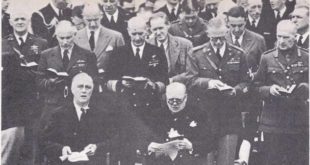
Even before Pearl Harbour, there had been cooperation between the United States and Britain. In August of 1941, President Roosevelt and Prime Minister Churchill met secretly, on a cruiser at sea off the coast of Newfoundland. There they drew up the Atlantic Charter, a document stating the principles on which they based their hopes for a better future for the world. They pledged that neither country would seek more territory. They hoped that, “after the final destruction of Nazi tyranny,” all men in all lands could “live out their lives in freedom from want and fear,” and they called on …
Read More »
World War 2 and its Aftermath 1934 – 1944
364
Adolf Hitler, stood above the German town of Berchtesgaden, in a large, imposing house in the mountains and stared out a window. It was a fine February day in the winter of 1938 and the snow-covered peaks of the Alps glistened in the clear air. The man at the window seemed not to see the peaceful mountains. Berchtesgaden was close to the border of Austria and he seemed to see beyond the mountains into the heart of Austria itself — an Austria filled with marching troops‚ cheering crowds and the swastika banners of the Nazis. Staring at this vision, he …
Read More »
Totalitarianism and the Great Depression 1861 - 1938
396
AS THE 1930’s drew to a close, only eight countries in Europe, besides Great Britain and France, were still democracies. They were Belgium, Holland, Switzerland, Czechoslovakia, Norway, Sweden, Denmark and Finland. Three of Europe’s most important nations were dictatorships. The Soviet Union was communist; Germany and Italy were fascist. There had been dictatorships before, but these went further; they were totalitarian. The word “totalitarian” comes from the word “total,” and total control is what these dictatorships were after — total control of their people, total control of their actions and thought. There were differences between the totalitarian countries. While Stalin …
Read More »
Totalitarianism and the Great Depression 1861 - 1938
254
UNLIKE Britain, France was not a highly industrialized country; its economy was fairly evenly divided between industry and farming. For this reason, the depression came to France later than it did to any of the democracies and its effect was less severe, but in no other democracy did communists and fascists play so large a part. For a time there was real danger that the French republic would be overthrown by the fascists and there were riots in the streets. One reason the fascists were so dangerous was that the French people were sharply divided in their political opinions. There …
Read More »
Totalitarianism and the Great Depression 1861 - 1938
641
IN Europe as in America, the leading democratic nations — Great Britain and France — faced the problems of the great depression. In those nations, too, the question arose: Could democracy survive, or would it give way to totalitarianism? Would the people turn instead to fascism or communism? Although Britain had a brief period of prosperity immediately after World War I, of all the world’s democracies, it was struck hardest and soonest by the depression. For Britain had a special problem. A highly industrialized country, it lived by its exports. It sold manufactured goods and coal to other countries and …
Read More »
Totalitarianism and the Great Depression 1861 - 1938
228
BEGINNING his second term, Roosevelt made it plain that the New Deal would go on. He would continue to work for reforms. He said in his second inaugural address: “In this nation I see tens of millions of its citizens — a substantial part of its whole population — who at this very moment are denied the greater part of what the very lowest standards of today call the necessities of life. “I see millions of families trying to live on incomes so meagre that the pall of family disaster hangs over them. “I see millions whose daily lives in …
Read More »
Totalitarianism and the Great Depression 1861 - 1938
214
As Roosevelt’s first term in office neared its end, many people in the United States — and in other countries — wondered if the New Deal could really solve America’s problems. More than that, they wondered if Americans would continue to follow the path of democracy. A wave of totalitarianism was sweeping the world; would it reach as far as America? There was no doubt that there were some Americans who supported Hitler and the Nazis. Members of the German-American Bund paraded in brown shirts and held a mass meeting in New York’s Madison Square Garden, but there were comparatively …
Read More »
Totalitarianism and the Great Depression 1861 - 1938
171
IN THE spring of 1933, as the New Deal roared into action, business began to get better, but it dropped again and as 1933 ended and a new year began, even the most optimistic New Dealer had to admit that the depression was still on. During 1934, the government took further steps to regulate banking and finance‚ but some Americans were dissatisfied. Businessman complained that the government was making it harder to do business. In spite of all the excitement, the NRA was not working out well. The farmers were complaining that prices of farm products were still too low. …
Read More »
Totalitarianism and the Great Depression 1861 - 1938
252
WHEN Franklin Delano Roosevelt was nominated in 1932, he was fifty years old. A fifth cousin of former President Theodore Roosevelt, he came of a wealthy family. He grew up on a large estate at Hyde Park, New York, overlooking the Hudson River. At the age of twenty-four he married Eleanor Roosevelt, a distant cousin and a niece of Theodore Roosevelt. Several years after graduating from Harvard and studying law at Columbia University, he entered politics and was elected to the state senate. In the presidential campaign of 1912 he supported Woodrow Wilson, who named him assistant secretary of the …
Read More »
Totalitarianism and the Great Depression 1861 - 1938
325
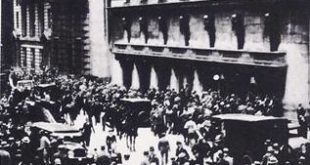
AS MILLIONS of Americans hurried to work on the morning of October 24, 1929, it seemed like the start of an ordinary day. It seemed just as ordinary to the brokers and bankers who were entering their offices on New York’s Wall Street. True, the prices of stocks had been falling for several days, but that was nothing to worry about. There were bound to be ups and downs in the stock market and prices would surely rise again. For never before had the United States known such prosperity as it did in the 1920’s. Herbert Hoover, who had become …
Read More »
Totalitarianism and the Great Depression 1861 - 1938
132
So it happened that in many parts of the world people were living under a system of government that came to be called totalitarianism. There were differences in the governments of the totalitarian countries, but they were alike in certain important ways. In each of them, the government was controlled by one political party, usually under a dictator and no other political parties were allowed. The ruling party was not satisfied to control the government; its aim was total control of the life of its people. It controlled the courts and the armed forces, labour and industry, science and the …
Read More »
Totalitarianism and the Great Depression 1861 - 1938
162
THE END OF World War I brought many changes of government in Europe, but in a number of countries the old aristocrats and landowners still had power and the new governments could not solve the problems that faced them. Among these countries was Poland. A democratic form of government had been established, but conflicts between various parties and their leaders kept it from being very effective. General Joseph Pilsudski had helped to set up the new government of Poland. He retired from public office in 1922, when Poland adopted a democratic constitution. Pilsudski wanted a bigger and stronger Poland and …
Read More »
Totalitarianism and the Great Depression 1861 - 1938
164
IT WAS almost midnight in Berlin — a strange hour for a parade in any city, but down the street called Unter den Linden paraded thousands of students, carrying torches that flickered in the darkness. In the big square near the University of Berlin, they gathered around a great pile of books. They cheered as the books were set on fire and flames rose toward the sky. For this was the night of May 10, 1933 — less than five months since Hitler had become head of the government — the night when books were being burned in a number …
Read More »
Totalitarianism and the Great Depression 1861 - 1938
266
DURING THE years that followed Hitler’s adventure in the Munich beer hall, ministers came and went in the German government. Among them were some able men, particularly Gustave Stresemann. He was foreign minister from 1923 until his death in 1929. His policy was to work out a way of getting along with Germany’s former enemies; so that Germany’s mighty industrial machine could operate again as it had in the past. This policy brought results. Inflation was stopped and foreign bankers made large loans to German industry. Smoke poured from the smokestacks of Germany’s efficiently run factories and the republic began …
Read More »
Totalitarianism and the Great Depression 1861 - 1938
387
When Hitler was discharged by the army in 1918, he found an altogether different Germany from the one he had known before the war. It was no longer ruled by a kaiser. The Socialists had taken over the government, but the Communists were active and calling for a revolution like that of Russia’s. After some fighting, the government succeeded in putting down the Communists. Their leaders, Karl Liebknecht and Rosa Luxemburg, were killed and the communist threat died down, at least for a time. In 1919, after elections, a coalition — a combination of various parties — led by the …
Read More »
Totalitarianism and the Great Depression 1861 - 1938
315
ON NOVEMBER 8, 1923, about three thousand men were sitting at the tables of a large beer hall on the outskirts of Munich. They had come this evening not just to drink beer; they were to hear a speech by Gustave von Kahr. He was the head of the government of Bavaria, one of the states of Germany. Conditions had been bad in Germany since the end of World War I and Kahr’s audience was anxious to learn what the government intended to do. Kahr was still speaking when there was a commotion at the back of the ball. Several …
Read More »
Totalitarianism and the Great Depression 1861 - 1938
481
AFTER THE PEACE with Germany, Lenin had hoped for a breathing spell which would give him the chance to build up his backward country. Instead, there had been civil war and it left Russia worse off than ever. Although the government had taken over all the industries, they were producing very little. A way had to be found to give the people the necessities of life, especially food. To do this, Lenin proposed to put into effect something he called the New Economic Policy, soon known as NEP. While large industries would remain in the hands of the state, small …
Read More »
Totalitarianism and the Great Depression 1861 - 1938
379
SPEAKING BEFORE the Congress of Soviets on November 8, the second day of the November revolution, Lenin had said, “We shall now proceed to construct the Socialist order.” Constructing any kind of order in a vast country like Russia would not be easy. The Bolsheviks had won the support of the soviets, but could they win the support of all Russia? As a matter of fact, not all the people in the country known as Russia were Russians. The tsars had gathered in under their rule many territories. On these territories lived people of many different nationalities, each speaking a …
Read More »
Totalitarianism and the Great Depression 1861 - 1938
360
LENIN’S REAL name was Vladimir Ilyich Ulianov. Like most Russian revolutionaries, he had taken another name to protect himself from the Police. He looked like anything but a leader of men; someone once said he looked more like a small-town grocer. He was short, stocky, bald and wore a small heard. His clothes were shabby and his pants were usually too long. He was not a great orator but he had a gift for simplifying and explaining complicated questions, which made him an effective speaker before crowds. Lenin was born in 1870, the son of a schoolteacher who became an …
Read More »
Totalitarianism and the Great Depression 1861 - 1938
498
IT BEGAN in the Russian capital, in the city which had been called St. Petersburg and was now called Petrograd. Bread had been rationed and on March 8, 1917, crowds of women and boys formed into long lines at the bakeries to get their share. Russians were used to waiting in line and usually they were patient, but on this day they were hungry. Besides, they were tired of the war, tired of the tsar, tired of living without hope. When they learned that there was no bread to be had, they lost their patience. They suspected that the bread …
Read More »
Totalitarianism and the Great Depression 1861 - 1938
433
THE TSARINA Alexandra was a religious woman. That was why she was immediately interested in Rasputin, when he was introduced to her in 1905. Rasputin was neither a priest nor a monk. He was a starets, or Holy Man. There were a number of such Holy Men in Russia at that time. They left their homes and families to wander about the country, living on charity and devoting themselves to religion. Often people came to them, hoping to hear words of wisdom and advice on how to conduct their lives. The tsarina, too, felt the need of someone to give …
Read More »
Totalitarianism and the Great Depression 1861 - 1938
339
SOME DAY there would be no tsars, but there was little sign of that during the last years of the nineteenth century. Alexander III still held Russia in a firm grip. When he died in 1894, his son Nicholas II came to the throne. Nicholas was twenty-six years old. He was a handsome young man and a few months after his father’s death he was married to a German princess. They were in love and it looked as though Nicholas would be a popular ruler. His reign began badly. In 1896, a great crowd gathered on a field in Moscow …
Read More »
Totalitarianism and the Great Depression 1861 - 1938
444
The ideas that attracted these Russians came mostly from a man named Karl Marx. Marx was born in Germany in 1818, the son of Jewish parents who had become converted to Christianity. He began the study of law, but soon dropped it to study philosophy. After receiving his degree of Doctor of Philosophy from the University of Jena, he became the editor of a newspaper. When the German government ordered the paper to stop publication, Marx moved to Brussels. He returned to Germany to take part in the unsuccessful revolution of 1848, but by 1850 he had settled in London, …
Read More »
Totalitarianism and the Great Depression 1861 - 1938
464
IT WAS a Sunday in January of 1905 and snow lay on the ground and rooftops of St. Petersburg, the capital of Russia. Although winters were cold in this northern city and it seemed like a day to sit indoors before a warm fire, many people were hurrying through the streets. About 200,000 men, women and children gathered in huge crowds, their breath making puffs of vapour in the frosty air. Soon they formed processions and began marching across the hard-packed snow. As they tramped along in ragged lines, they sang the national anthem, “God Save the Tsar.” Many of …
Read More »