Feudalism – centuries of groping and experimentation to restore law and order in Europe and to develop forms of centralized government – after the security provided by Roman law and administration had been ruptured by the Germanic invasions.
Barbarian chieftains had little training in political administration. The Romans lacked the money to finance the machinery of large-scale government and to train government workers. Craftsmen did not even have the skill to rebuild roads, bridges and aqueducts.
This tells us how culture declined to a subsistence level during the period from 500 to 1000 A. D. Many people lived and were governed within very small areas and had little contact with those only a few miles away. One group of strong kings emerged for a while and developed an empire in western Europe, but it soon declined. A stop-gap military, social and political system named feudalism developed side by side with the economic life of the manor.
The whole was tied together with the golden threads of chivalry. Those golden-threads are tangible evidence that during the darkness of this low spot in western civilization, the Christian Church maintained a positive influence over the manners and morals of the blending Roman and Germanic cultures.

RESETTLEMENT OF GERMANIC TRIBES
Germanic tribes entered the Western Roman Empire by peaceful infiltration and forcible invasion.
Groups often drifted across the borders to become farmers or soldiers in the Roman army. Sometimes large bands fought battles with the Roman legions for possession of territory. Large masses of people were not generally involved. There was no census, but the estimates of some of the stronger groups vary from 40,000 to 100,000. These incursions had gone on for several centuries, so a considerable Germanic element, had been assimilated into the population by the end of the Empire.
The tribesmen varied in their cultural level. Some had contact with Roman merchants or priests or with the frontier garrisons. Many were pagan, but some like the Goths had become Christians, at about the time they entered the Empire. In general they led primitive lives, between herding and farming.
Led by their chieftains, the primitive German tribesmen entered a civilized empire. The barbarians had ruled themselves with a few unwritten rules, customs and taboos. Over the centuries, the Romans had developed many laws, statutes, ordinances and edicts — enough to fill many volumes when collected. The Roman government had performed many services for its citizens, as civilized governments do today. Such an administration required many trained civil servants — what is sometimes called a bureaucracy.
Here was a social and political situation full of inherent danger and possibility. Would the two cultures merge or exist side by side? Who would rule?
Some of the German chieftains came to hold high civil and military positions in the Roman Empire. They understood the system, but too few Germans did. If the system were to continue, Rome must provide continuing education in order to fill vacancies. This did not happen and good administration, trade, commerce, income from taxes and education, gradually dwindled.
The date 476 is one to be remembered. It has been used for centuries as an historical landmark and appears on the timelines, as a high point in world history. That date is associated with the last Roman emperor to rule in the West. He was a boy, Romulus Augustulus, a mere puppet who was put on the throne and soon banished by the powerful chieftain, Odoacer. Instead of replacing the emperor, Odoacer took over, calling himself king. With this event, a great era came to an end without “a bang or a whimper.”
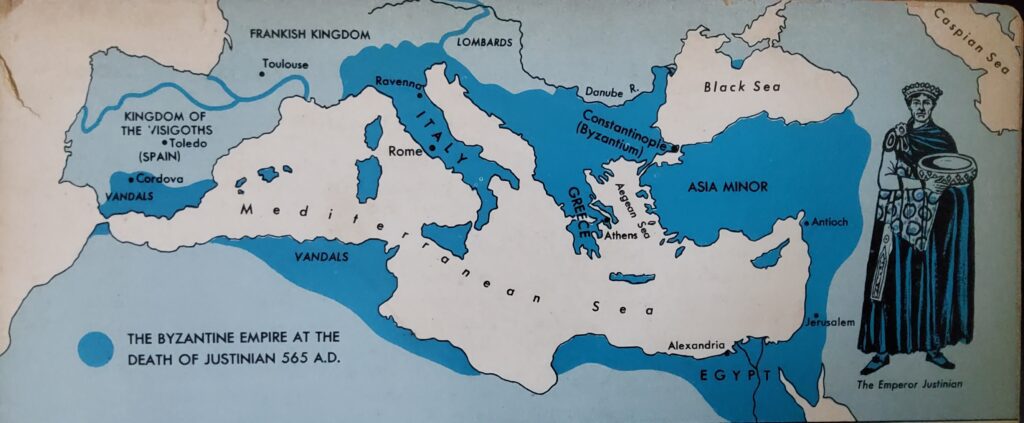
The Roman Empire in the East soon displayed remarkable vitality.
A great emperor, Justinian, came to the throne in Constantinople in 527. His armies, led by capable generals, attacked the Persians to the east and the barbarians to the west. They defeated the Ostrogoths, who had dominated Italy for a century. As a result, parts of Italy were ruled by the Eastern Empire for about 500 years.
Justinian regained North Africa and parts of Spain from the Vandals and Visigoths. Although his armies did not penetrate into northwestern Europe, the Roman Empire in 550 A. D., had some semblance of its old self even though the emperor ruled from Constantinople.
In 568 A. D., another German tribe, the Lombards, came into the Italian Peninsula. They were a thorn in the side of the popes for generations, because they refused to accept papal authority.
An able lawyer named Tribonian directed a staff, in simplifying and putting into a consistent system or code, the Roman laws which had accumulated through the years. A code, known as Justinian’s, was hastily assembled and contained some errors, but preserved Rome’s legal heritage for posterity. The formal study of Roman law was required at Bologna in the twelfth century, after the code influenced the improvemient of medieval justice.
Justinian’s influence was so great that for many years, Constantinople was an important centre of intellectual, religious and political life. In its libraries, old manuscripts were copied and Greek and Roman cultures were preserved, at a time when most of Europe knew little of either culture.
The Christian Church revived the arts of architecture, agriculture and taught the barbarian invaders, more civilized ways of living. This was a slow and tedious process, but one of great signincance, for between 500 and 1000 A. D., western Europe was generally in an unsettled, unhappy condition, with a relatively dark outlook.
THE FRANKISH EMPIRE
Like Odoacer, other invading tribal chieftans assumed the title of kings.
We must remember that the German or Teutonic invasions were mass migrations of whole tribes, including women and children. They extended over several centuries. With no strong central government to oppose them, a medley of kingdoms arose. There was much murdering and killing in some places and Romans were disarmed, but in many places, the barbarians settled down beside the culture in the provinces. At first, each group of barbarians continued to obey its own laws and to observe its own customs. Their Roman neighbours continued to obey Roman laws and observe Roman customs. Gradually the Germanic chieftains assumed the rights of Romans and accepted many Roman ideas.
The Franks, who had settled in what is now France, Holland, Belgium and western Germany, united with some other peoples in a loose, sprawling kingdom. Clovis, a strong king who ruled from 481 to 511, accepted Christianity and was baptized at Reims on Christmas Day of 496, along with 3,000 Franks. This baptism began a union between the Church and the Frankish (French) kings that lasted for more than a thousand years.
After Clovis’ death in 511, his sons and grandsons extended the Frankish kingdom to include all of modern France, Belgium and much of Germany. In 714, Charles (the Hammer) Martel became Mayor of the Palace and seized control of the kingdom. His reputation was established when he checked a Moslem invasion with a great Victory at Tours in 732. When the pope was menaced by the Lombards, he called upon Charles for help. The pope’s recognition of his power, added to Charles’ prestige.
Charles was succeeded by his sons, Carloman and Pepin. Carloman became a monk and Pepin received from the pope a ruling, that he who had the legal power should be the legal ruler. Pepin then got himself chosen as king and had himself crowned by the pope. This ceremony increased the king’s prestige, as it had his father’s.
Pepin bestowed on the pope, some territory near Rome he had taken from the Lombards. Called the “Donation of Pepin,” this gift made the pope a temporal (civil, political) ruler over the Papal States, a strip of territory across the Italian Penninsula.
The teaming up of the Franks and the papacy, started by Clovis’ conversion and cemented by Pepin, affected the course of religion and politics in Europe for centuries. In the alliance lay the seeds of the bitter give-and-take struggle for power that resulted in the separation of church and state, when the United States was formed, a thousand years later.
Charles Martel’s grandson was ultimately honoured as emperor
Pepin’s son was so outstanding that greatness was “built into” his name, Charlemagne, or Charles the Great. Under his guidance, the Franks reached the zenith of their power.
Charlemagne spent most of his long rule of nearly fifty years, leading military campaigns. He fought the Moslems in the Pyrenees, conquered the Saxon tribes between the Rhine and Elbe rivers and made himself king of the Lombards. He also extended his territory eastward by a series of campaigns. Finally, as related in the biographical sketch, the pope crowned the great king as emperor.
Charlemagne encouraged a revival of learning. When he had time for peaceful pursuits, he showed much interest in education. One royal order said:
Let every monastery and every abbey have its school, where boys may be taught the psalms . . . singing, arithmetic, and grammar; and let the books that are given them be free from faults, and let care be taken that the boys do not spoil them either when reading or writing.
Charlemagne maintained a school in his palace for the training of his sons and those of some great nobles. Among the teachers hired for the palace school was Alcuin, an Englishman and a noted scholar of the day. Alcuin was able to read and write Latin and had a smattering of classical knowledge. Charlemagne sat in the classes to receive instruction in reading and writing, Latin, theology and other subjects, as a man past his forties.
Charlemagne corresponded and exchanged gifts with the Byzantine emperor and with the caliphs at Cordova and Baghdad. As a result, some new ideas and some knowledge of a wider world, came into northern Europe. The emperor had a staff of Irish and Anglo-Saxon copyists, who come to France to correct and rewrite old texts and prepare new ones.
In this way, many classics were saved for us. These men were skilled in handwriting and helped the Franks develop a more legible style of writing, than they had previously used. This style became the basis for the roman type face (still in use), when movable type was introduced toward the end of the Middle Ages.

The later Carolingians failed to maintain their empire.
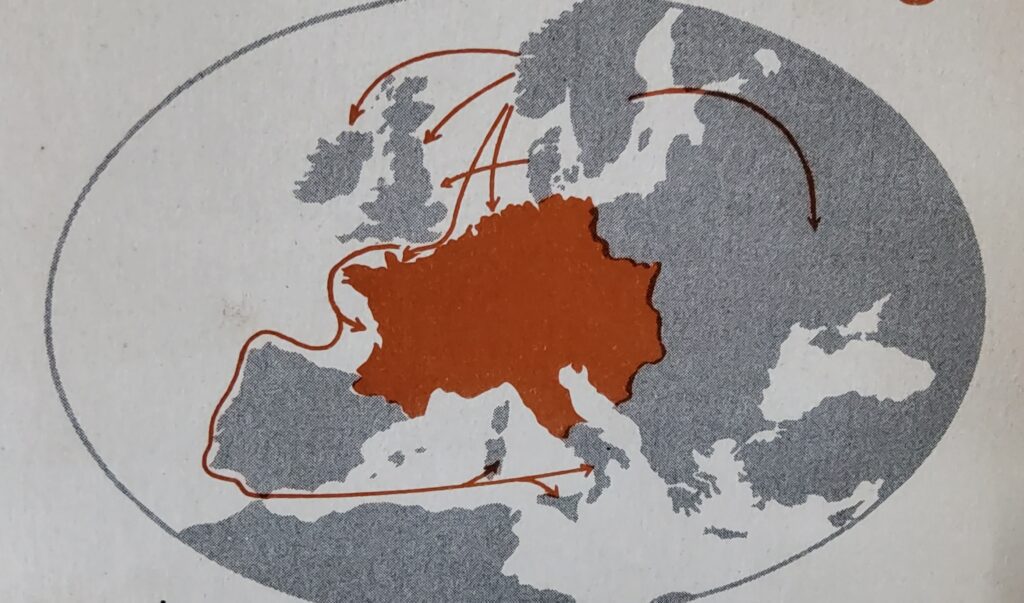
The family of Charlemagne is called the Carolingian Dynasty. When the emperor died in 814, he was succeeded by his son Louis the Pious. Louis was troubled by fighting among his three ambitious sons, but after his death they halted their fighting and agreed at Verdun in 843, to split the empire three ways. The map indicates that this division was a step towards a France and a Germany. Lothair’s middle area north of the Alps, called Lotharingia or Lorraine, included Latin and German cultures and was a centre of dispute for centuries, even though it was divided between Charles and Louis in 870.
Students of languages like to point out that the agreement at Verdun was written in early French and early German, indicating that Charlemagne’s empire was splitting into two areas of language — East Frankland (later Germany) and West Frankland (later France).
For a century and a half, the Carolingian rulers were incompetent. The Franklish lands were ravaged by civil wars and the invasions of Northmen. That was a time of hardship for the people of western and central Europe.

INVASIONS OF THE NORTHMEN
In the ninth and tenth centuries, raiders from Scandinavia ravaged the coasts of Europe.
Variously called Vikings, Norsemen, Northmen and Danes, they sought land in England, Ireland, Scotland, France and Germany. They entered the Mediterranean and attacked parts of Italy and North Africa. Some settled in Russia and their chieftain, Rurik, established a family of rulers. They made westward voyages. Some went to Greenland and it is believed, to the shores of North America. They founded a “primitive parliament” in Iceland in 930, the Althing; it still survives as the oldest representative assembly in the world.
The Northmen were mobile. No land force could properly combat their hit-and-run technique of raiding. For over a hundred years, people were in danger from the Northmen wherever there was a harbour or beach and wherever a river enabled them to penetrate the interior. They killed or scattered the inhabitants of whole villages, or sold them as slaves. In the ravaged countries people found some safety by seeking the protection of local warlords.
Law and the Church
The regular practice was called trial by combat. Two persons who had disagreed would put on their armour and fight it out. Again, it was assumed that God would protect the innocent. Another method of determining guilt or innocence was known as compurgation. This method gradually replaced trial by ordeal and by combat. A man accused of crime would swear that he was innocent. He would bring friends with him to act as “character witnesses” and swear that they believed him innocent. The word of a noble outweighed the word of a serf. Medieval jurors were what we would call witnesses; they did not determine guilt or innocence.
At the Lateran Council, held in 1215, the Church finally succeeded in eliminating trial by ordeal and trial by combat. Thereafter, the use of juries became popular, particularly in England, where our jury system developed. Gradually, the condition of medieval courts improved, particularly in England, but while court practices themselves grew fairer, laws tended to become harsher.

A lord’s residence was often a seat Of government.
If massive and easily defended, it was usually called a castle. Castles that remain today as tourist attractions were fortresses built of stone, in the late medieval period. They were usually placed on hills or islands, since such locations were more easily defended.
Villages grew near the castles, where refuge would be found in time of danger. Merchants and craftsmen set up shops and stores. Mills were built for grinding grain. In some cases, there were inns for travellers.
The lord held court in the castle to try cases and settle disputes. He conferred with his stewards and checked the agricultural accounts and the collection of fees.
The lady of the castle supervised the domestic work. Much time was spent in weaving cloth of linen and wool. Clothing was made and sometimes embroidered robes and beautiful tapestries. The lady took much interest in her herb garden. Herbs were an important part of medieval medicine.
Castle life is usually presented as romantic and glamorous.
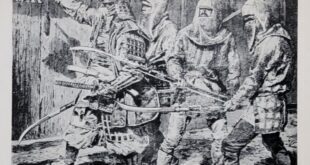
Fiction writers and film-makers have tended to idealize the period, but actually it was a hard life with few comforts. The knights lived by a complicated svstem of rules, customs and manners, which we refer to as chivalry. These rules reflected the civilizing influence of the Church. The knights were sworn to protect women, the weak and even in battle, to observe a kind of sportsmanship.
When the future knight was a boy, his parents could send him to another castle as a page. He learned to wait upon and show a mannerly attitude toward women. He was taught horsemanship and the use of the shield, lance and sword. He would practice these skills throughout his life, because in time of peace, there were frequent tournaments at which jousting, a form of mock battle, took place.
As the boy approached manhood, he was called a squire, which meant a candidate for knighthood. The squire become a knight in an elaborate ceremony, not unlike the initiation of a warrior into a tribe. He had proved his eligibility and worthiness for the honour. Often he spent an all-night vigil in church. The following day, dressed in white, he recited his pledges. The conferring knight tapped his shoulder or touched him on the neck with a sword and “dubbed” him knight.
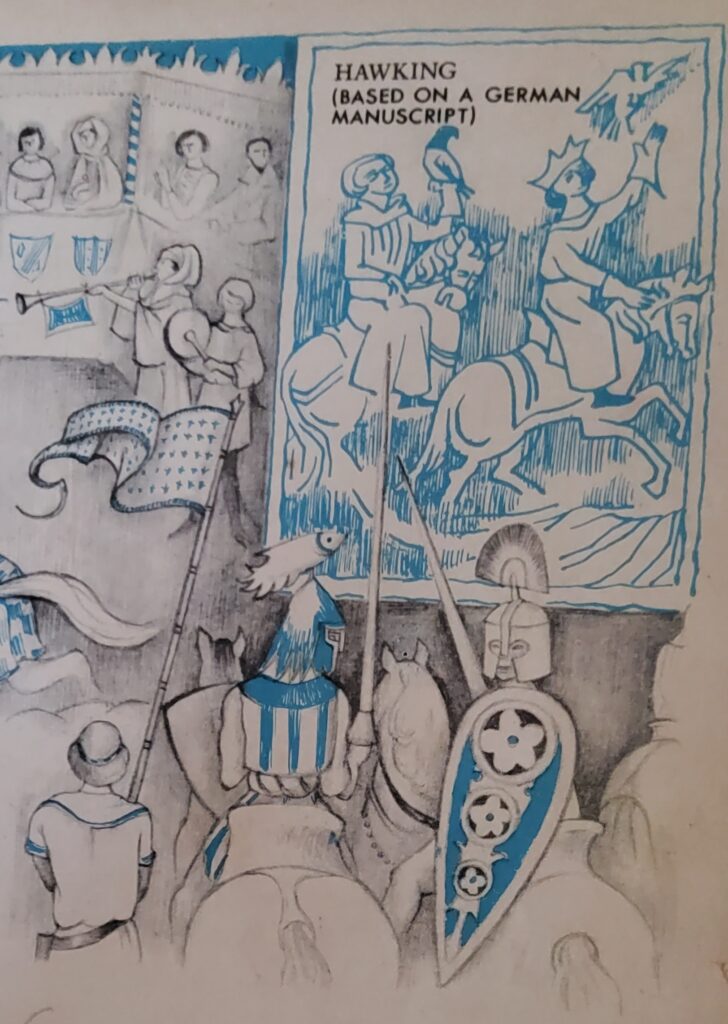
A principal recreation of knights and their ladies was hunting. They would ride out with their retinue, their dogs and falcons, to engage in sport that also had its ceremonies and etiquette. The nobles had servants to watch and preserve the game and reserved the privilege of hunting for themselves and their guests.
Indoor recreation consisted of chess, checkers, backgammon, dice and playing cards. After dinner, troubadours and minstrels would play instruments and sing. The jester, or fool, would furnish comedy. Occasionally, a group of strolling entertainers would appear to perform acrobatic stunts, juggle balls, show trained bears and in other ways, entertain the court.
Feudalism and serfdom gradually diminished in western Europe. For three or four centuries it served a purpose, by maintaining a bare minimum of culture and security in times of great difficulty. It went out of existence when conditions improved.

CHARLEMAGNE — (742 – 814 A. D.)
The Frankish chieftain Charlemagne maintained more order and security in his sprawling territories, than had seemed possible to outsiders. With restless energy and courage, he travelled up and down his empire until he was known, respected and feared, throughout western Europe.
The most important event in Charlemagne’s life come in the year 800 A. D. He had proved himself an aggressive leader and a loyal friend of the Church. The pope could not count upon the emperor at Constantinople to protect him against his enemies in Italy. The time seemed ripe to create a political power in western Europe that would work in close relationship with the Church — even to revive the Empire at Rome.
Thus it was that when Charlemagne knelt before the altor of St Peter’s Church on Christmas Day, the pope placed a crown upon his head and the congregation saluted him with the words previously used to welcome a patrician: “To Charles Augustus crowned of God, great and pacific Emperor of the Romans, long life and victory”.
Through this ceremony the Frankish king become the chosen civil protector of the Church. He had long exercised this role, now it was formally acknowledged through the granting of the imperial tile. The title of “emperor” in the West, never granted rulers greater lands or money, but it made them the first rulers in the West, because of their association with the Christian Church.