European nations preserved to keep the continent from chaos. In the troubled days of invasion and disorder that followed the collapse of the Roman Empire, the feudal system had served a purpose in western Europe. Enough order and security had been preserved, to keep the continent from chaos.
After a time, a new type of political organization, unlike any previously known, began to develop around some of the kings of western Europe. Ultimately this would be the nation-state, but during this period, kings were busy developing a strong central government, defining the boundaries of their holdings and giving their people some security.

We see that political units in Europe took form slowly and not without a struggle. The governments of England and France were among the first to shape-up and they took the form of monarchies. They developed more power and offered their peoples more security than some of their neighbours. As a result, other rulers aspired to create stronger central governments. Each emerging group individually shaped a representative assembly, advising its ruler, limiting his power and protecting individual rights through institutions, such as courts and bodies of written law. Important elements of government, which medieval Europe developed and later transmitted to the Americas.
EVOLUTION OF ENGLAND
Modern England evolved from the union of Anglo Saxon and Norman elements.
Much of the history of this evolution is also the history of America. The people of the British Isles extended their influence into every continent of the world. This influence was so great that their language, literature, culture and history, are studied by educated people everywhere.
In English history we learn about the invasions of the Romans and barbarians. The flat country of southeastern England made landings easy for invaders from the European mainland. Defense was difficult. Before history was written, a slight dark-haired people, known as Iberians, came to the island. A wave of tribes, grouped together as Celtic, moved into western Europe at about the beginning of the historic period. Some of them, called Britons, gave a permanent name to part of the islands. Other Celtic tribes were named Picts, Scots and Gauls.

The Romans subdued the Celts and held Britannia as one of their provinces for about 400 years. About 400 A. D., Rome withdrew its legions from Britain and before long, Germanic tribesmen (the Angles, Saxons and Jutes) poured in. After many years of fighting, the Britons were pushed into Cornwall and into the highlands of Wales and Scotland. Some fled into Brittany, in Gaul.
The Angles and Saxons were pagan barbarians. Introducing their own language and customs, they very nearly wiped out Christianity and Roman culture in the areas they conquered. For several hundred years, there was no central government. A number of small states or kingdoms developed, each with its own ruler. In the ninth century, these were united under King Egbert of Wessex, who is considered to have been the first king of England. The name England comes from Angleland, or land of the Angles.
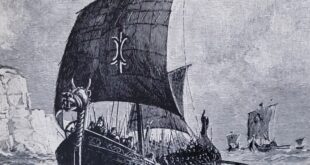
The only Saxon ruler of importance was Alfred the Great (849 – 899 A. D.). Like Charlemagne, he tried to promote education and raise the cultural level of his people. Unfortunately, the Northmen (Danes) invaded England during his reign and most of Alfred’s life, was spent resisting their attacks. A large area in central and north England, the Danelaw, became their territory. A Danish king, Canute the Great, became ruler of England in 1017 and his family held control for twenty-five years.
The Saxon kings were restored in 1042 with Edward the Confessor, who had spent years of exile in his mother’s land, Normandy. Childless, Edward promised the throne to his kinsman, Duke William of Normandy. Most of the English lords preferred a native ruler and a powerful noble, Harold of Wessex, became king.
William was a fierce fighter. He had spent years defending his dukedom and in keeping his turbulent people under control. He and his knights were much like their ancestors, the Viking marauders, although they had taken on a few rudiments of Christianity, chivalry and French culture.
To enforce his claim, William recruited an army of knights, adventurers and assembled a fleet of ships. With diplomatic skill, he secured the support of the pope and of the French king for his enterprise.

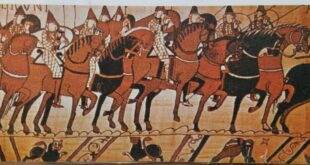
Meanwhile, Harold had his troubles. The king of Norway, who also claimed the English throne, invaded northern England. Harold marched to meet and defeat him at Stamfordbridge. When he learned that William had landed near Hastings, he hurried southward to resist that invasion. A bloody battle took place at Hastings on October 14, 1066 — one of the famous dates in the history of Western civilization. The English fought on foot with stone hammers, battleaxes, bows and arrows. They were defeated by the heavily-armed Norman knights on horseback. Harold of Wessex was killed in the battle.
William then went to London, where he presented himself to the Anglo-Saxon nobles and clergy at Westminster Abbey. He was recognized by them and crowned as king. He had conquered a small, compact kingdom and he meant to rule it.
William knew the weaknesses of the feudal system in France and took steps to avoid them in England. He made himself direct ruler of the entire land. He held about one sixth of it and the rest went to Normans and English, who were faithful to him. William made every landowner pledge loyalty and service to him. No matter whose vassal any man became after that, his first duty was to his king. No castle could be built without a license from William. No vassal could be called by his overlord to fight against the king, or to war upon another noble without the king’s permission. In this way England became a strong monarchy.
William allowed his Anglo-Saxon subjects to continue many of their customs and laws. He was advised by the nobles and clergymen who gathered at his court (the curia regis, or king’s court). He personally appointed a sheriff in each county to see that his will was carried out. This was not the medieval sheriff as a man with a star on his vest — he was a strong noble with a castle and armed retainers.
William wanted to raise more taxes and to know the value of his new assets, so the Domesday Book was compiled. It recorded a survey of all the landed property in England, made under William’s direction. The names of all property owners were recorded, with a full list of their resources and property.
Our language was an important result of the Norman Conquest. For a time the Normans and Anglo-Saxons held apart as people with different languages and customs. Gradually, the two elements began to intermingle and a combined language appeared. Most of our basic, everyday English and its structure is the Germanic Anglo-Saxon. Added to it we have in our vocabularies thousands of French words derived from Latin. This gives us a language very rich in synonyms, a “two-in-one” language, with which we can express many shades of meaning. We can say twelve or a dozen, kingly or royal, tongue or language.

The English legal system was strengthened by Henry II.
The sons of William the Conqueror, William II and Henry I, maintained their father’s strong rule, but twenty years of lawlessness followed their reigns, while the weak Stephen of Blois held the throne.
Stephen was succeeded by Henry II (1133 – 1189), the first of a royal family known as the Plantagenets. Through inheritance and marriage, Henry controlled an immense territory. He inherited England and Normandy from his grandfather, Henry I. His father, the Count of Anjou, left him a great domain in central France. His wife, Eleanor of Aquitaine, was heir to most of southern France. He thus controlled more of France, than the French king!
Henry II was a practical, forceful man, the kind needed to hold together a kingdom of that great size in the feudal period. He is today generally recognized as England’s greatest medieval king and as a genius in administration and law. When he became king, England had many courts. The king settled disputes among the lords. Each noble had his own feudal court to try cases from his estates. The church had courts. Each county or shire had its own court.
Henry set up royal courts, presided over by well-educated judges. Judges travelled from shire to shire, operating a “circuit court” system. When a judge reached a shire, the sheriff brought in men who reported under oath, all the crimes that had occurred since the last judge’s visit. “Who did these things? What persons do you accuse?”, the visiting judge inquired. Then, along with a jury, he proceeded to try the cases.
Here we see the ancestor of grand jury, which presents to courts the names of suspected lawbreakers, with a list of offences charged against them. The travelling judges based their decisions on certain legal customs and traditions, that had been generally accepted throughout England. These decisions became the basis of the “common law”, because they were common to the whole country and upheld by the royal courts. The common law, recorded and developed over the centuries, became the foundation of much American, as well as English, legal practice.
Henry II tried to limit the customary authority of the church courts. This resulted in a serious dispute with his former close friend and adviser, Thomas à Becket, the Archbishop of Canterbury. Then some knights murdered the archbishop in his cathedral, perhaps to curry Henry’s favour. Whatever the reason, this brutal deed shocked western Europe and Henry hurried to make his peace with the pope.
Henry II suffered an even greater defeat at the hands of his sons. They brawled and fought each other and rebelled against their father. At the time he died, they had allied themselves with the king of France and were attacking Henry’s possessions on the Continent. Henry is said to have turned his face to the wall and muttered as he died, “Shame, shame on a conquered king!”
The nickname of England’s next king, Richard I (the Lionhearted) (1157 – 1199 A. D.), is evidence of his personal daring. He was out of the country during all but six months of his ten-year reign, but Henry’s work was so well done, that the machinery of government functioned without a king.
King John was forced to sign a list of concessions called Magna Carta.
Richard’s brother, John (c. 1167 – 1216), has come down to us as one of history’s “villains,” for he was unreliable and treacherous. The revolts and wars in France culminated in a great defeat for him. Although he was allied with strong German forces, the French King Philip defeated him at Bouvines in 1214 and his French possessions were lost.
In 1215, some English nobles revolted. They met John at Runnymede, near London and forced him to sign the Magna Carta, or Great Charter. Magna Carta stands as one of the great documents in the history, of human liberty. In 1215, it was regarded merely as a statement of the rights of feudal lords, that previous kings had recognized. In it the king promised to reform some of his practices and made concessions to the nobles, tradesmen and churchmen.
The importance of Magna Carta has grown through the years, because of the interpretation later peoples placed on certain provisions. For instance, it denied the king the right to impose taxes, other than the feudal dues, without the consent of the Great Council (of barons and bishops). This was later interpreted as “all taxation must be by consent of the taxed,” or “taxation without representation is tyranny.”

England witnessed the gradual growth of representative institutions.
In Anglo-Saxon days the Witenagemot or Witan, was established as a council to elect and advise the kings. William the Conqueror, changed its name to the Great Council and used it both as a court and as an advisory body. He also set up a small permanent council of royal advisors, the curia regis. Under Henry II the curia regis became an important advisory group. Several times a year, the Great Council met with it.
After John there came the long, troubled reign of his son, Henry III. Like his father, Henry violated some provisions of the Great Charter. The nobles resented his tendency to one-man rule and revolted. They put the king in prison for a while. In 1265 their leader, the king’s French brother-in-law, Simon de Montfort, called an assembly to discuss the situation.
Nobles and churchmen of the Great Council attended this assembly. So did representatives of the shires and towns, for Simon had invited each county to send two knights and each town two citizens (burgesses). This famed assembly became known as a parliament, from the French word parler, which means to speak or to discuss.
After Henry III regained power, he continued to depend upon his small council, but he also called meetings of the enlarged Great Council, or Parliament. Edward I (1239 -1307) who became king in 1272, called a meeting of Parliament in 1295, that established the pattern of membership, followed thereafter. According to the summons, the king sent to the sheriffs – two knights from each county, two citizens from each city in the county and two burgesses from each borough, to be elected to meet with the king.
In the next century, the nobles and clergy began to meet separately from the knights and burgesses. In this way two groups were formed, the House of Commons and the House of Lords. This bicameral principle — a two-house legislative body — is widely followed today in the Iegislatures of the world.
Next, Edward III (1312 – 1377) became involved in a long and expensive struggle with France, the Hundred Years’ War. When English kings needed money for war, Parliament forced new concessions from them, before granting new taxes. The custom of regular meetings developed and the regular meeting place became Westminster. Parliament was becoming a true legislative body rather than an advisory council and the concept that “government derives its power from the consent of the governed” was beginning to emerge.
The English kings attempted to extend their control over Ireland, Scotland and Wales.
Soon after the Conquest, Norman knights began to seek estates in other parts of the British Isles. They found a market for their fighting services in regions where disorder and confusion had continued, from the time of the Viking invasions.
Henry II sent expeditions to Ireland which succeeded in subduing the eastern half of the country. Norman knights received large feudal estates. Unfortunately for Ireland, fighting continued for hundreds of years between the part controlled by the English and the western part of the island. The feudal lords fought among themselves. The development of a culture was greatly retarded, by so much warfare.
Until the reign of Edward I, Wales was ruled by native princes who became vassals of the English kings. Edward conquered Wales and made it part of his kingdom. However, the Welsh language and some of the Celtic customs and traditions, have continued to the present day.
Attempts were also made to add Scotland to the kingdom. Edward I made a serious attempt to conquer Scotland and for a time, nearly succeeded. The Scots, however, found capable leaders in William Wallace and Robert Bruce, whose memories are still preserved in their traditions. Although it was united in the monarchy after 1603, Scotland was governed as a distinct unit until 1707, when it united with England through mutual agreement.
Scotland had a troubled history, with much internal dissension and fighting. The Lowlands and the capital, Edinburgh, were English-speaking and relatively progressive; in the Highlands, Celtic tribes remained primitive as late as the 1700’s. Scotland was often allied with England’s enemy, France; and several wars were fought with England.
THE RISE OF THE FRENCH NATION
France became a feudal state under the Capetions.
In the centuries of disorder that followed the breakup of Charlemagne’s empire, the lands of the western Franks became divided into a number of small territories ruled by feudal nobles. The French still retain the names of some of these regions, such as Normandy and Anjou. In 987 A. D., the nobles elected Hugh Capet to the rather empty honour of king and his descendants, held the title as long as there were French kings — for nearly 900 years.
At first, the Capets were weak counts who controlled a small territory from Paris to Orléans. Other lords had more lands and power, but the Capets had two important advantages. First, the title of king carried more prestige than such titles as duke or count, because he was the central political figure, he was annointed by the Church and he was answerable to no overlord. Second, the Capets lands occupied a strategic position and included Paris. From their domain, rivers and routes radiated like the spokes of a wheel. Their cities controlled the routes of the Seine and the Loire.
The Norman Conquest of 1066 opened a long period of close relationship between England and France. The English derived great benefits from the introduction of the French language and culture. Trade and commerce developed, with the English exporting wool, grain and importing a few simple manufactured products.
The accession of Henry II to the English throne in 1154, created a crisis for the French king. The fact that over half of France was controlled by a foreign king, who was only nominally a vassal, threatened the existence of the French monarchy.
A great French king and crusader, Philip Augustus, solved this problem for about a century. He took advantage of the hatred that John had aroused among his subjects and brought both war and rebellion upon him. The great victory at Bouvines in 1214, in which Philip reduced John’s power, is a high point of French history.

The first round of the Hundred Years’ War ended in a stalemate.
In the following century, the descendants of John returned to their ambitions in France. The English king, Edward III, laid claim to the French throne, but the French lawyers said his claim was nonsense. The French crowned a Capet, a cousin of the late king.
Edward’s claim to the throne of France and the French king’s wish to control Aquitaine, led to a series of bloody wars that greatly weakened France and lasted for over a century. Important victories were won by the English at Crécy in 1346 and at Poitiers, in 1356. The port of Calais, nearest to England, was captured and held for 200 years. Still, the first part of the war was a stalemate and came to a halt with land possessions, about the same as they were at the beginning.
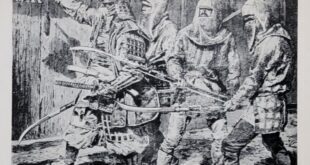
New weapons made the fighting different from that in earlier feudal wars. Archers aimed at the openings and joints of the knights’ armour. Both longbows and crossbows became dreaded weapons. Gunpowder and cannon made their appearance. By the seventeenth century, cannon were improved to the point where they could batter down castle walls. The bullets of the arquebusses, fired by individual soldiers, could penetrate armour. Before 1700, the armoured knight was meeting his match in the common foot soldier.
The long, drawn-out wars discouraged the knights and their followers. They were absent too long from their homes and their lands. More and more they became willing to pay money for exemption from military service. The kings agreed, for with the money they could hire mercenaries who were more dependable and could be better trained and organized. Mercenaries would fight as readily against a king’s feudal lords, as against his foreign enemies.
There was great misery in France during the wars with Edward III, all fought on French soil. During intervals of inactivity, the mercenaries were disbanded and wandered around the country plundering and pillaging. An epidemic (perhaps bubonic plague), called the Black Death, moved from Asia across Europe. In many places, one third or more of the population died. Partly because of the epidemic, the serfs revolted against their hardships and were subdued with great cruelty.

Round two of the Hundred Years’ War ended in a French victory.
After a truce of about forty years, the fighting began again in what was, for France, both a foreign and a civil war. A young and energetic man, Henry V, had become king of England. He became possessed of the old idea of controlling France. The French king, Charles VI, was insane and his relatives were intriguing among themselves, for power.
In the midst of this shameful situation, Henry V invaded France and won a victory at Agincourt, in 1415 that was a repetition of the victories at Crécy and Poitiers. It was another smashing defeat of a large French feudal army, by a small English force with the traditional bowmen. Henry then captured Paris and forced an agreement, that he and not the king’s son, would be the next king of France. Henry died prematurely, but the English continued their successes and it seemed that if they could capture Orléans, their victory would be complete.
France was rescued in an unexpected and dramatic way. In a little village in eastern France, the girl we call Joan of Arc, had been brooding over the fate of her country. Visions and voices came to her, urging her to aid the king. She gained an audience with Charles VII, a weak man who had virtually given up and was given command of some troops, to relieve the siege of Orléans.
The sight of this girl, whom they believed to be divinely inspired, riding into battle in armour, renewed the courage of the dispirited French troops. Orléans was saved. For his coronation, Joan led Charles to Reims, where French kings had been crowned since the time of Clovis.
Joan wanted to return home, but the king insisted that she continue to lead his men. Her fate was tragic and shameful. Captured in battle, the English had her tried before a court of French prelates. Charles VII did not interfere. She was burned at the stake as a witch — a horrible example of medieval superstition. According to legend, an English soldier present at the burning said, “We are lost — we have burned a saint.” This haunting legendary remark was prophetic. During the following twenty years, the English lost all of France except Calais and the Hundred Years’ War at last, was over.
The French kings continued to increase their power.
The French monarchy was stronger after the Hundred Years’ War. The English menace was removed. For a time, parliament — the Estates-General — seemed to be developing much as the English parliament had. Then it “committed suicide” by voting an annual direct tax for maintaining an army. The tax was to be levied on individuals and to be collected by royal agents. This act, enabled the king to govern without calling the Estates-General together and that body, sank into unimportance.
Louis XI (1423 – 1483), the son of Charles VII, was such a crafty ruler that he has been called the “universal spider” and the “spider king.” Louis XI recognized the growing power of the French middle-class and secured its support. These thrifty and energetic people called the “bourgeoisie”, saw advantages in Louis’ policies. They saw that he controlled the army, the coinage of money and the judges in the courts. Such control assured law, order and some uniformity of procedures, throughout the provinces — elements essential to good business, but not obtainable in a country divided among feudal lords.
Louis XI was still faced with some powerful vassals who were jealous of his authority. The greatest single feudal threat was from Charles the Bold, Duke of Burgundy, who was building an independent kingdom between France and Germany. He was strong and frequently had Louis at a disadvantage, even as a prisoner. Louis stalled and temporized; he made promises and concessions that he meant to repudiate.
Then on January 5, 1477, Charles was killed in a battle with the Swiss, whose confederation he was threatening. His lands were partitioned. Never again was there a French noble with forces capable of resisting the power of the king. The nobles passed from a position of power to one of privilege. They enjoyed lands, wealth, certain exemptions from taxation, ceremonial honours, but all through the king’s favour.
France, like England, had become a united people without the effective beginnings of modern day concept, of representative government. The trend was toward a monarchy that ruled without the Estates-General.
FERDINAND (1452 – 1516) AND ISABELLA (1451 – 1504)
There are countless husband-wife teams in which the husband alone receives credit for their mutual achievements. In other cases, the way in which the two personalities complement each other is understood and appreciated. lt was thus with Isabella of Castile and Ferdinand of Aragon, who were married in 1469. Ferdinand was equipped to be a ruler in his period. A capable military leader, he put down resistance to his rule, ended Moorish power in Spain and conquered ports of southern Italy. He was a wily diplomat, but there was not much in his nature to win the affection of his people.

Isabella supplied this lack. She was warm and friendly, a person of principles and integrity. She proved, too, that a woman can express the qualities of a statesman, for she took an active part in making governmental policies. The achievements of Ferdinand’s reign were all made during his joint rule with Isabella. He survived her by about twelve years and his lack of accomplishment during that time, showed what he had lost with her death.

THE RISE OF SPAIN AND PORTUGAL
The history of the Iberian Peninsula has been influenced by Europe and Africa.
The land’s original inhabitants were Iberians, a dark-haired, brown-skinned people similar to those generally found around the Mediterranean basin. In time, it was invaded or influenced by Phoenicians, Greeks, Celts, Carthaginians, Romans, the Germanic Vandals and Visigoths. The Visigoth kingdom flourished from 475 to 675. Then came the Moslems; Arabs and Berbers crossed tne Strait of Gibraltar early in the 700’s and easily conquered the Visigoths. For more than 700 years, southern and central Spain was a centre of Islam and of Moorish culture.
In the very north of Spain, at the foot of the Pyrenees Mountains and along the edge of the Bay of Biscay, a resistance movement began to develop against the Moslems to the south. A few tiny states began to appear. They were ruled by Christian princes who claimed descent from Visigoth chieftains. These so-called Christian kingdoms included Aragon, Asturias, Castile, Leon, Navarre and Portugal. Their rulers were not then ready to unify as one country, but they were united in their hatred of Islam.
The feudal nobles of the Christian states fought among themselves and conducted a crusade at home —they fought incessantly with their Moslem neighbours. This developed in them an almost fanatical, aggressive loyalty to their religion.
Castile, which included in time the areas of Austurias and Leon, was particularly active against the Moslems. The great Caliphate of Cordova collapsed in 1031, opening the way for a full-scale drive by the Christians. Castile’s boundaries were pushed to the southern coast and included the cities of Toledo, Cordova, Seville and Cadiz.
In 1469 Isabella of Castile and Leon was married to Ferdinand of Aragon. Within ten years each was ruling his kingdom and looking toward the unification of Spain. In 1492 their force “*otured Granada and ended Moorish power in Spain. The Moslems were compelled to give up their religion or leave the country, and at about the same time the Jews were expelled from Spain.

With this consolidation and the discovery of America, Spain became a strong European power in the sixteenth century.
Its achievements were mostly due to the militant zeal of the people and to the wealth that poured in from the New World and the Low Countries.
Along the Atlantic Coast lay Christian Portugal. Once a province of Castile, Portugal had won her independence in the twelfth century and had succeeded in staying independent. Her people learned to trade with other countries and established trading posts along the African coasts. Her nationalism was greatly extended after her explorers opened sea lanes, around Africa to Asia.
GERMANY AND ITALY REMAINED DISUNITED
German emperors became involved with the dea of a universal empire.
After Charlemagne’s death, Germany fell into feudal disorder. Then Otto of Saxony, a strong noble, made himself king. Like Charlemagne, he crossed into northern Italy to intervene in a dispute and was recognized as king of Italy. The pope crowned him emperor in 962 A. D. From then until 1806, there was a loose union of German and Italian states known as the Holy Roman Empire. Actually, it had little connection with the Church, it was mainly German and it had almost no political power.
Emperors would go to Italy to be crowned by the pope, return to Germany to suppress a revolt, then go back to Italy to try to gain control. Under these chaotic conditions, neither Germany nor Italy achieved the unity of a nation, at the time where England, France and Spain were successful.
For centuries, the position of emperor was elective and no dynasty was established. By the fourteenth century, the electors were three archbishops and the rulers of the Palatinate, Saxony, Brandenburg and Bohemia. In 1273, they chose Rudolph of Hapsburg, who soon seized the duchies of Austria and Styria. From that time on, the majority of emperors were Hapsburgs. They ruled Austria until 1918.

The emperors fell into disputes with the popes.
The original meaning of “emperor” in medieval civil and canon law, had been that he who possessed the title, was the chosen protector of the Church. In the twelfth century, the study of Roman law was revived and with it a tendency to exalt the emperor. In accord with the old pagan imperial tradition, certain German emperors began to assert that they were going to rule in the West as the old Roman emperors had done. They sought to depart from the concept of a Christian empire.
By the middle of the fourteenth century, because of disputes between the emperors and the popes, the idea of an emperor as the civil protector of the Church disappeared. There was then introduced the idea of the emperor as a kind of world ruler, in the old Roman sense. However, times had changed and even in Germany, for all his high titles, the emperor was a mere figurehead.
Other nations also developed during the medieval period.
The king of Denmark became an important ruler, holding Denmark, Norway and lands settled by the Northmen. His control of the strait between the North Sea and the Baltic at Copenhagen, enabled him to collect toll on commerce.
Sweden too, was ruled by Denmark for a time and it seemed that a strong Scandinavian power might develop, that had been the dream of rulers as early as Canute the Great. Sweden became independent again in the 1500’s and began to build up its power in Finland and the Baltic area.
East of the Holy Roman Empire the predominant peoples were descended from Slavic tribes. Mingled with them were other ethnic groups, including peoples from central Asia. Some of these tribes were converted to Christianity by Roman Catholic missionaries; others by Greek Orthodox missionaries from the Byzantine Empire. This resulted in important political and cultural divisions in eastern Europe.
Within the Holy Roman Empire there were important provinces such as Bohemia and Moravia, where the Slavic Czech and Slovak people were controlled by German nobles. The Empire also came to include the Slavic Croats and Slovenes.
The large state of Hungary was just east of the Empire. It had been established about 1000 A. D. by the Magyars, a fierce tribe from Asia, who had ravaged the region after Charlemagne’s death. They possessed a very fertile area of farming land and an important location on the Danube. In the 1500’s, they were forced to defend central Europe from attacks out of Asia.
The Slavic, Poles and Lithuanians occupied a very large territory, extending from the Baltic to the Black Sea. This area was the boundary of the eastward expansion of the Roman Catholic religion.
During the medieval period, the Russians were controlled by Mongols and Tatars, as a result of invasions and conquests. This period was a great setback to the development of Russian culture. Finally, the Russians gained freedom from this control. Muscovy appeared as the leading principality. In imitation of the Byzantine Empire, the prince assumed the title of Caesar or czar. With the rule of Ivan III (the Great) who ruled from 1462 to 1505, Muscovy was ready for a period of growth and expansion.
Western Europe had thus passed out of the period of chaos and confusion that one found in 900 A. D., by taking power through many stages, from the feudal lords. For the most part, the power passed to the kings and rulers of larger regions. The change-over brought more law and order, raising the general standard of living, but government was still too personal, too dependent upon the ability of one man.

LINKING THE PAST AND THE PRESENT
Present day, takes the formation of new nations as a natural step in the civilizing process. The boundaries of new nations appear on new maps of Asia and Africa; we follow the first events in their national histories, in our daily newspapers.
Life is not so simple as that, for the newest of the world’s nations. They are confronted with very serious problems, often because they lack long-established customs and traditions. They make us aware that for them, democracy is a recent development; though practiced long before it became known in most of Europe, Asia and Africa. To organize a stable government and to learn democratic procedures, are difficult steps to take, but help is at hand for new nations who wish it. By studying the history of the older nations, they can read how others faced problems similar to theirs and appraise the success or failure of the solutions, of those nations.