Medieval East includes the spread of Islam, medieval India, medieval China, medieval Japan, the Mongols and Eastern Europe – the developments that took place in India, China, Japan and other parts of the East during the medieval period. When we turn our attention from Europe to Asia, we are obviously moving into a much larger and more complicated theatre of events. We encounter large masses of people of dissimilar language, race and culture, separated from one another to a great extent by more impassable geographical barriers, than exist in Europe.
In comparing or contrasting the progress of civilization in Asia with that in Europe, we find the greatest similarity in the fact that ideas and customs were carried from one area to another, by missionaries and traders. We are reminded that all of the great world religions of today, had their origin in Asia.
We read that the infamous Genghis Khan, united the nomadic mounted warriors of Mongolia and terrorized the East. He and his successors conquered eastern and central Asia, then rode into Persia and lraq. Later, the Ottoman Turks attacked Constantinople and brought an end to the Eastern Roman Empire — the last eastern bulwark of Christian civilization and to determine the effect of Islam on those Asiatic lands overrun by the Mongols and by the Turks.
THE SPREAD OF ISLAM
The Moslems carried their religion to many peoples by force.
More than a century after Mohammed died in 632 ,his followers were an almost invincible force. They spread across western Asia, northern Africa and took Spain. They conquered the greater part of the Byzantine Empire, reducing it to a small part of Asia Minor. By conquering Persia, they extended their power to the boundaries of India, to their invasions of India and China. It is important to realize that except for Spain, the Moslems held their conquests and usually extended them. The crusades, for example, failed to dislodge them permanentlv from western Asia.
As a result of their cultural contacts, the religious outlook of the Moslems was changed.
Mohammed had taught a very austere, puritanical way of life. This simplicity tended to continue at the heart of Islam in Arabia, but away from Arabia and in more fertile and productive regions, a softer, more luxurious life came was enveloped. This was true in Spain, which developed a religious centre at Cordova.
In Persia, a way of life developed that is described in the famous poetry of Omar Khayyam. A departure from the strict teachings of Mohammed was highly important to art. The representation of human beings in sculpture and painting, had been prohibited by Mohammed as idolatry. In Persia, however, manuscripts appeared illustrated with beautiful miniature paintings. These are greatly admired by contemporary artists, whose works frequently shows their influence.
Although the Moslem way of life changed, its essential ideas and practices continued. Islam remained monotheistic, the pilgrimage to Mecca continued as an obligation and it sought new members, by both peaceful and forcible conversion. By 1500, it had penetrated into western China and was active in the islands of the East Indies.
MEDIEVAL INDIA
Civilization flowered in northern india under Buddhist rulers.
Due to its large area of approximately 1,500,000 square miles and the fact that the world’s highest mountains, the Himalayas, blocks it off from the bulk of Asia, India is often called a subcontinent. Like a continent, it has many varieties of climate, race, language and culture, making it difficult to maintain political unity.
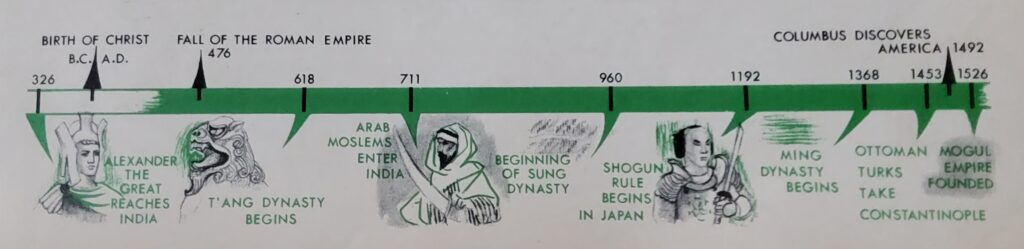
In its isolation, India developed a distinctive culture. Hellenistic influences that came in after the conquest of Alexander the Great in B. C. 326 – 325, were blended with the native art. Asoka (c. B. C. 269 – 237) created the first large Indian state, thereby taking the first steps towards the unification of India. Buddhism was proclaimed the state religion. Asoka sent Buddhist missionaries to many lands: as far east as Ceylon and Burma, as far west as Egypt.
In the days of the Gupta rulers, from about 300 to 500 A. D., India enjoyed an epoch of greatness. What may have been the world’s first university, was founded. Outstanding inventions were made in mathematics, including “Arabic” numerals, the decimal system and possibly, the zero. There was much good writing of fables, folklore, plays and poetry in Sanskrit, the classical language of India. In chemistry, the processes of making soap and cement were discovered. Dyes, drugs, silks and spices, were sold abroad. Paintings done then are still visible in the Ajanta caves. Gupta sculpture became a model for later Indian art.
This period of growth was interrupted by a new series of invasions.
The high mountains and the deserts of northern India have never brought the security from invasion, that one might expect. Perhaps that was due to the fabulous wealth of India, which attracted many would-be conquerors. The events of this period, would seem to point up a theme that reappears over and over in history — aggressive nomadic peoples, have played an important role in the rise and fall of civilizations, for a good many centuries. A second theme or corollary, is that an invader, once he has succeeded, often settles down, becomes respectable and absorbs the culture, of his conquered neighbours.
About 455 A. D., hordes of White Huns, attacked an area of India and at the same time, their relatives under Attila, were attacking the Roman Empire. This was the beginning of a series of raids that brought a decline in civilization to northern India.
Invasions by Moslems resulted in the conquest of India.
In 711 A. D., a horde of Arab Moslems entered India and made the southern valley of the Indus, part of the Moslem Empire. By the tenth century, the Afghans and Turks of central Asia had accepted Islam and were waging wars against “infidels.” Both Turks and Afghans invaded India and set up a sultanate at Delhi. In 1397, the dreaded Mongolian, Timur the Lame (Tamerlane), looted Delhi and killed perhaps 100,000 prisoners. In 1526, the invader Baber seized Delhi and established a new Moslem sultanate, the Mogul Empire.
The destructive and bloody Moslem conquests, permanently divided India. From the Moslem viewpoint, Hinduism was intolerable because of its many gods, rituals and use of images. Moslems opposed the caste system and attracted converts among the low-caste Hindus, who wished to escape from their castes.
Persecution strengthened the beliefs of those who remained Hindu. Buddhism practically disappeared. A modified Hinduism emerged that offered lofty ideals to the educated. The ignorant could continue to be superstitious and worship many gods. The caste system, by which one inherited his social position and his occupation, “froze” society and helped prevent the inter-marriage of Hindus and Moslems. The two lived side by side in hostility, frequently breaking into violence and riot.
The native Hindi language continued to be spoken by the Hindus, but the Moslems developed Urdu as an aid to administration. Urdu used the grammatical constructions of the Hindu languages, but combined Arabic, Persian and Turkish words. The conquerors also introduced new architectural forms to India, such as the arch, minaret, dome and the decoration that did not use any animal or human forms. The Taj Mahal, an exquisite tomb constructed in the 1600’s at Agra, in India, is often pointed out as an example of Moslem influence on Indian architecture.
The history of the Indian sub-continent was greatly affected by the Moslem invasions and Moslem culture. Up until then, the foreign peoples who had found their way through “the mountain passes of the north”, had inter-married and been assimilated by the people and Hinduism. The Moslems would have none of Hinduism or the Hindu way of life. From 1206 onward, therefore, the Hindu and the Moslem ways of life never fused. In modern times, this division resulted in India’s splitting into two separate nations, Hindu India and Moslem Pakistan.
MEDIEVAL CHINA
Under the T’ang Dynasty, Chinese culture was far in advance of the European cultures of the same period.
The Chinese achieved several forward steps under the Ch’in and Han Dynasties, which coincided with the Roman period of achievement from B. C. 221 to 220 A. D. During that period, the Great Wall was completed and trade with the Roman Empire was carried on over the “silk route.” Thought was influenced by the teachings of Confucius and by the new teachings of the Buddha. Chinese power was extended far south into what we call Indo-China and west to the Tarim Basin.
Chinese political power achieved new heights under the T’ang Dynasty (618 – 907 A. D.). For a time, China was the world’s largest empire and extended westward nearly to the Aral Sea.
T’ai Tsung (597 – 649 A. D.) was the greatest of the T’angs. He was a Confucianist, but he tolerated all faiths and creeds. Buddhists, Moslems and Christians, were permitted to enter China and teach their beliefs. Japanese visitors took home ideas, which aided a social revolution in their country.
T’ai Tsung’s administrative reforms sound very modern. He ruled through men selected by competitive civil service examinations. His tax system was based upon ability to pay, as ours is supposed to be. Laws were passed to stop the combining of large estates.
The T’ang Dynasty completed a system of canals begun under a previous dynasty. This improved transportation system, plus the reforms made by T’ai Tsung, contributed to increased prosperity. Trade with India and Persia flourished by sea. Caravans passed over the long land routes towards the Mediterranean carrying luxury goods, such as silks, porcelain and pottery. The Chinese people learned to enjoy new foods, including almonds, dates and pepper.
Scholarship thrived under the T’angs. The Chinese language was simple and spare. Declensions, conjugations and endings, had been dropped long ago and words were reduced to their most basic element. Intonation was relied upon to carry shades of meaning. Using these monosyllables, the poet tried to get the maximum of meaning and emotion into each line. Translators tell us that it is almost impossible to do justice to Chinese and Japanese works, in the European languages.
Over 48,000 poems of the T’ang Dynasty still survive. Among the great poets of the period were Li Po and Tu Fu. The following poems by Tu Fu show that people of other times and places, felt much as we do about some things:
Last night a government order came To enlist boys who had reached eighteen. They must help to defend the capital. O mother! O children, do not weep so! Shedding such tears will injure you.
Birds make love in their dreams while they drift on the tide, For the dusk’s paths the fireflies must make their own light. Why should man kill man just in order to live? In vain I sigh in the passing night.
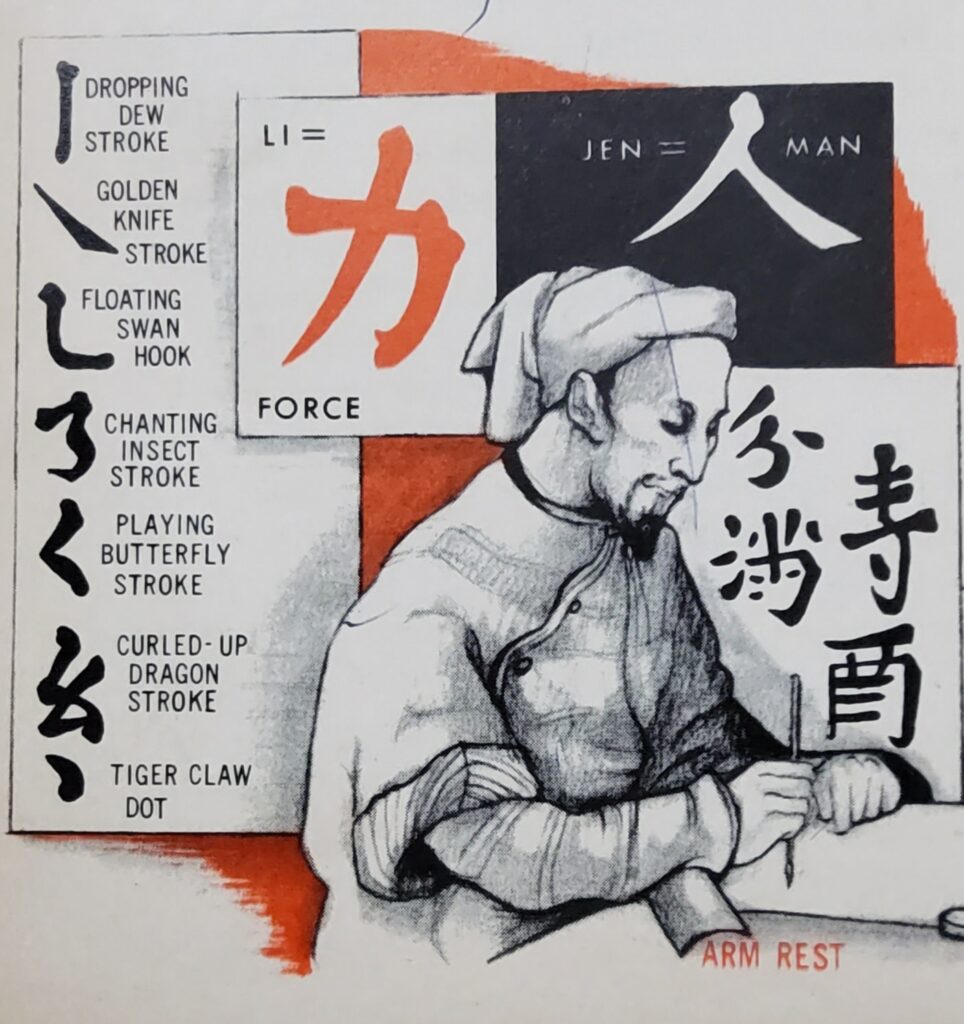
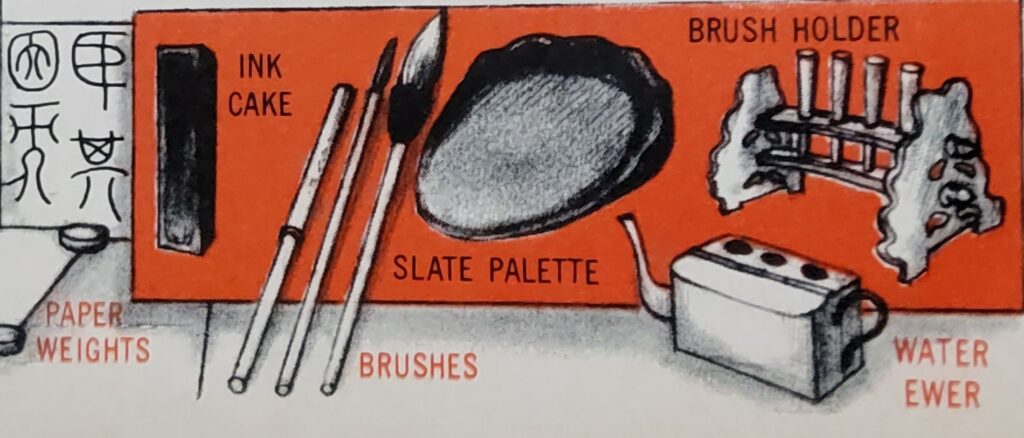
Chinese painting and the Japanese painting derived from it, were related to chirography (handwriting). Much painting was produced with rice paper, brushes and stick ink, used in ordinary writing. Prepared silk was used for other work. This expensive material, which did not permit correction, was an incentive to develop skill and certainty of hand. Scroll paintings were popular, often picturing a story to be read from side to side. Any small section, as it was unrolled, was expected to be a perfect composition. The painter did not try to make his picture resemble a photograph, but he sought to express the essence of his subject with the fewest possible lines.
Original work was done by Chinese sculptors. T’ang craftsmen improved the techniques of making porcelain. Their green celadon ware became museum pieces. Their charming terracotta figurines depicted court ladies, musicians and polo players.
A clash of values occurred in China between Confucianism and Buddhism.
Between the third and eighth centuries, China was torn between Confucianism and Buddhism. Confucianism, as practiced by the upper classes, was a code of manners and morals rather than a religion of faith, or of preparation for another world. Confucius taught that men should pursue a lofty, ethical code of conduct — be faithful to themselves and others, be righteous, wise and sincere. The turmoil following the breakdown of the Han empire brought a loss of faith in this ethical system.
Buddhist missionaries introduced a religion with faith as its core and with the promise of salvation to all classes, rich and poor. Buddhism taught the unimportance, of the things of this world.
During the T’ang Dynasty, renewed emphasis was put on studying the Confucian classics in preparing for civil service examinations. Confucianism was restudied and revised and some elements in Buddhism and Taoism were joined with it. As a result, the new Confucianism held its place among the ruling groups until the twentieth century, although other faiths had followers among the people.
The Sung Dynasty saw its people progress in the arts and sciences.
This dynasty came into power in 960 A. D. and continued until 1279 A. D. The work of its artists was skillful and painstaking. Its thin porcelain has been famous for hundreds of years and the industry gave us the name “china” for the fine earthenware dishes.
One Sung emperor, faced with a budget deficit and inflation, turned for help to his prime minister, Wang An-shih, the latter wanted to take drastic steps. He is quoted as saying:
The state should take the entire management of commerce, industry and agriculture into its own hands, with a view to succoring the working classes and preventing them from being ground into the dust by the rich.
Believing that a ruler should provide the necessities of life for his people, Wang An-shih experimented with political control of the economic system 900 years ago, in ways that remind us of events of the last one hundred years in Western civilization. He established compulsory military service. He had all property taxed, including incomes. He provided for public works at government expense, including canals and irrigation projects. He made government loans to farmers at reasonable rates of interest. He wanted commerce placed under government control. A system of fixed prices for commodities was initiated. Boards were set up to regulate wages and to plan pensions for the unemployed and aged.
Both the T’ang and Sung Dynasties get credit for developing the art of printing. In the first century A.D. the Chinese had learned to make paper. In the fifth century, they made seals of metal and stone with which to ink-stamp documents. These discoveries were at hand, when a big demand for written materials made necessary some better method than writing by hand. The Diamond Sutra, a book printed from wooden blocks in 868 A. D., has been found in a Chinese cave. By the tenth century, the Chinese were printing paper money and by the eleventh century, they had invented baked-clay movable type.
Chinese scholars liked encyclopedias. One was compiled during the eighth century. By 1103, a Chinese architect had published an eight-volume treatise on architecture. Buddhist temples and pagodas were being built throughout the land.
The people of China were mostly farmers. Many raised mulberry trees, on the leaves of which the silkworm feeds. Rice, millet, soybeans, tea and many fruits and berries were grown. The Chinese made few uses of animals in farming, nor did they understand the use of crop rotation and fertilizers. As a result, some parts of China are still today, unproductive.
Many other medieval accomplishments were made by the Chinese. Progress was made in astronomy, geography and cartography. No one else knew more about algebra. In medicine, inoculation against smallpox was begun. The magnetic compass was invented and put to use in navigation. The Chinese invented gunpowder and were making fire crackers before the year 1000 A. D.
China was Included in Genghis Khan’s farflung Mongol Empire.
In the earlier periods of history, the vast steppes of central Asia had only a sparse population of nomadic horsemen and herders. In times of stress, such as growth of population or drought, groups moved into more settled areas. The Huns, the Magyars and the Bulgars, invaded Europe and were absorbed in larger populations. In the third century B. C., the Chinese began to erect the Great Wall to keep the Huns out of China.
These tribesmen became superb horsemen. They spent much time in practicing military skills and were subject to rigorous discipline. They lived frugally and in their campaigns, took little in the way of supplies to encumber them. As time went on, they employed a form of “psychological warfare,” depending upon the terror of their name, to paralyze their opponents before they arrived.
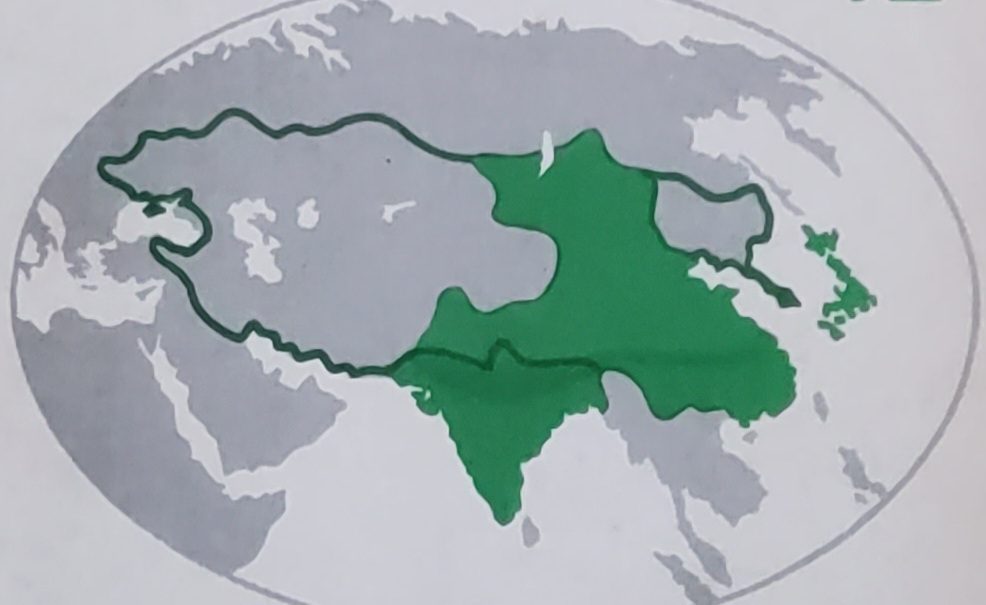
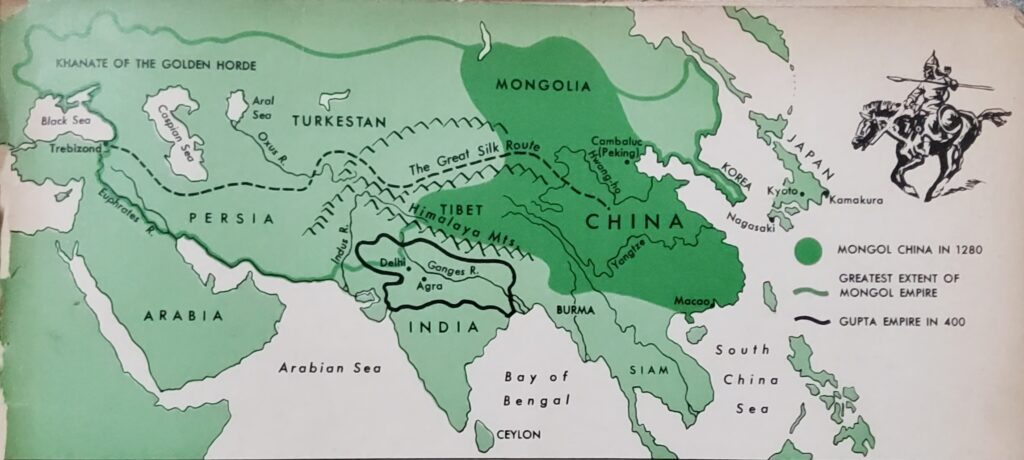
Shortly after 1200 A. D., Genghis Khan, one of the greatest rulers and warriors the world has ever known, became leader of the Mongol tribes. The twenty-year period of conquests that followed, established his authority over north China and Turkestan and attacks were made upon Persia and southern Russia. His sons and grandsons used the power they inherited, to build the largest empire ever known. (Map)
Genghis Khan’s grandson, Kublai Khan (1216 – 1294 A. D.), completed the conquest of China and became emperor in 1279. From his court at Cambaluc (Peking), he ruled China and most of the Mongol Empire, which extended to Mesopotamia and Europe. The Mongol-controlled trade routes across Asia were safe for a while and many foreigners traveled to China. Among them, for the first time, were persons from western Europe like Marco Polo and his relatives. The emperor liked to attend the theatre, hence the drama, which had arisen centuries before in China, became established as a form of art, during the Mongol period.
Within a century, after Kublai Khan’s death the Chinese rebelled and regained their empire. The Ming Dynasty took over in 1368 A. D.
The Ming Dynasty remained In power Into modern times — until 1644.
Europeans again came to China, including Christian missionaries. Portuguese merchants appeared, but were soon driven out or killed. They finally formed a settlement at Macao and traded from there. The Chinese took to trading outside for a few years, but their voyages were then outlawed and the people were forbidden to leave the country. Academies and libraries were built, artistic and intellectual life flourished, the novel became important in literature, but foreign influences were ruled out. Porcelains and paintings were produced, but they are not so highly regarded, in general, as the objects of the T’ang and Sung periods.
KNIGHTHOOD DOMINATED JAPAN
A feudal system and a military aristocracy developed in Japan.
The ancient Japanese culture was built upon the foundation of ancient Chinese culture and the early religion, known as Shinto or the “Way of the Gods.” Shinto included the worship of ancestral spirits and the forces of nature and developed the idea that the emperors were descendants of the sun-goddess.
In the sixth century, a powerful Japanese prince was converted to Buddhism. For the next two centuries, Buddhism made broad gains in Japan. Chinese monks introduced many Chinese customs to the Japanese, who adopted them. Buddhism and Shinto, seemed to contribute to each other’s growth.
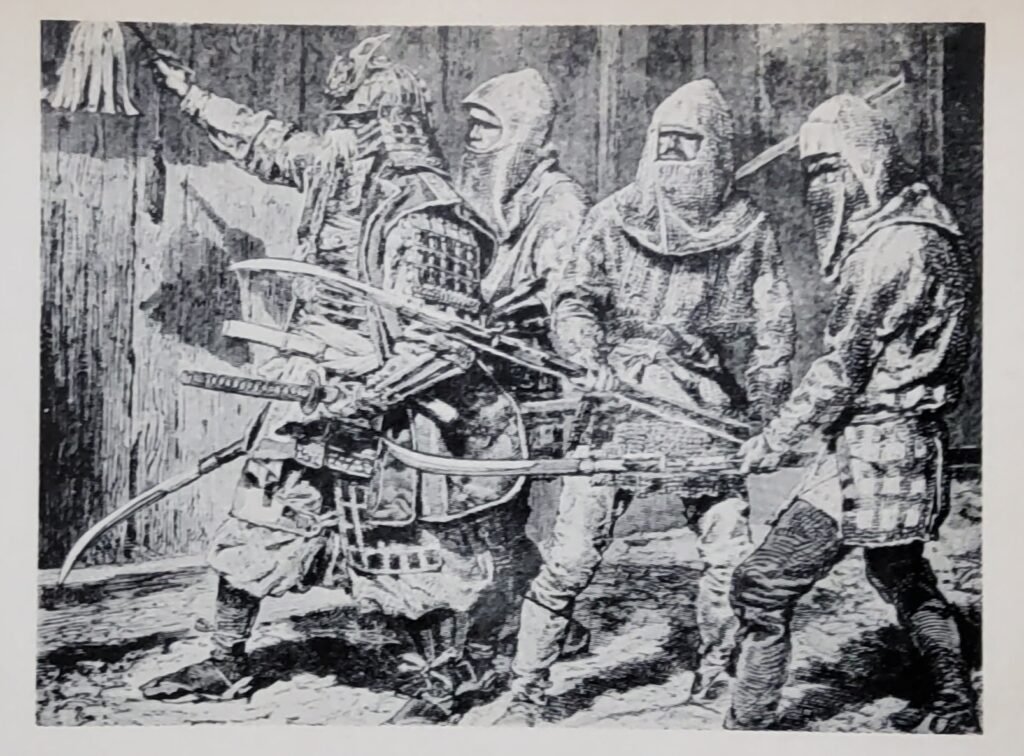
The Japanese developed a strong belief that the nobles were superior. Only nobles could take the training for civil service examinations; therefore the aristocracy won all the best posts in government. In time, some of the nobles gained control of vast estates and a form of feudalism developed. The most powerful nobles were called daimio (great names). They lived in fortified houses. Each daimio gained a group of knights, called samurai, who were pledged to aid the lord in wartime. The samurai came to live by a code known as Bushido, or the “Warrior’s Way.”
Bushido insisted on each warrior following a strict routine, beginning his military exercises at 6:00 a.m. He should practice archery, gunnery, equestrianism, read military books – “live and die sword in hand.” Dancing was unlawful; military amusements alone were suitable. The penalty for violating this provision was death by suicide — hara-kiri. Bushido is an excellent example of the power of an uncontested tradition over the minds of men. Its traditions continued into the present century, even after Japan had become a modern, industrialized nation.
The daimio and the descendants of the royal family who went into military service developed into a military aristocracy. After a struggle among the military leaders, one gained control — Yoritomo (1147 – 1199 A. D.). In 1192, Yoritomo forced the emperor to appoint him for life as generalissimo, or shogun. As shogun, he had the right to name his successor. In this way, japan gained a hereditary military dictatorship.
Yoritomo set up his headquarters at Kamakura, while the emperor and capital remained in Kyoto. The royal family and the civil bureaucracy were allowed to remain, but the shogun’s organization ran the country. The shogun maintained law and order, levied taxes, appointed constables and land stewards, to prevent rebellion.
The shoguns paid respect to the emperors, but the emperors became puppets in their hands. The emperors lived apart in a palace with their courtiers. They were considered too “sacred” to be involved in the confusion and discord of politics.
Japan under the shoguns sealed herself off, from the rest of the world.
Japan’s geographical separation from the mainland brought it relative safety from foreign invasion and conquest. Twice, in 1274 and in 1281 A. D., Kublai Khan tried to conquer the island. Both times a severe storm brought disaster to the Mongol fleet, convincing the Japanese that their islands enjoyed divine protection.
The shoguns ultimately closed the doors of Japan to Europeans. About 1542 A. D., three Portuguese ships from Macao visited the islands. Not long afterwards, came the traders. St. Francis Xavier and other Roman Catholic missionaries, arrived and made converts. The bigotry of some Christians and the exploitation of the natives by the Portuguese merchants, stirred up ill feeling. The rulers became fearful that Christian conquerors would follow the missionaries. In 1587, the shogun ordered Christians to leave. Some priests were killed, others continued to work secretly. Other edicts followed and Christians were killed. A final edict, in 1639, forbade any Christian to come to Japan, thus closing the door to European trade and contact. One small trading post at Nagasaki could be visited by the Dutch, but they could not leave their ships. Thanks to this policy, Japan remained relatively isolated until 1853, developing a distinctive outlook and culture.
The art of the Japanese influenced their home life.
The home was the main unit of Japanese society, but its pattern was quite different from that of European homes. The father, in medieval times, had the power of life and death over his wife and children, whom if he chose, he could sell as slaves. On the other hand, if a young man committed a crime, his father and brothers were punished. The family was responsible for the action of all of its members. Today, Oriental parents feel responsible for the acts of their children and children are trained in perfect obedience to and respect for, their parents. It has been noted that among Japanese and Chinese Americans, delinquency is rare.
Due to the frequency of earthquakes, Japanese houses were lightly constructed. Movable paper screens partitioned the rooms. During most of the year, outdoor living was possible. The Japanese cultivated flower gardens, dwarf trees and used pools of water, to beautify their surroundings. Simplicity, was the keynote of their interior decoration and usually, only a single painting or spray of flowers was displayed in a room. Highly skilled painters, sculptors, potters, metal and textile workers, contributed their products to the beautification of home life.
Japanese culture was ordered and ceremonious. It changed little from generation to generation. Along with high levels of culture, we find as we did in China, a low standard of general living. Japan’s mountainous terrain left little land for cultivation. Even when the Japanese population was much smaller than it has become in modern times, the people had to depend greatly upon fishing to supplement their diet.
THE MONGOLS AND EASTERN EUROPE
The Mongols influenced the status and future of Russia
During Genghis Khan’s campaign of world conquest, one of his generals penetrated Europe to the Danube in 1223 A. D; and a raid was made on southern Russia. The Mongols returned to their home base in eastern Asia, but not before they had seen that the Russians were helpless. They came again in 1237 and this time, conquered parts of Russia and went on almost to Vienna. Then, when it seemed that the Mongols would conquer all of Europe, the khan died. The armies went home to elect a new khan.
The Mongols were called Tatars by Europeans, but the group which remained to govern Russia was referred to as the Golden Horde, because their leader’s tent was reputed to be of cloth of gold. The Golden Horde ruled the vast plains of Russia from a capital at Sarai on the Volga, near modern Stalingrad. They allowed the Russians to govern themselves, provided they paid tribute. The princes of Moscow were prominent among the tribute collectors and Muscovy began to emerge as the leading Russian state.
The Russians were completely cut-off from the rest of Europe and from western civilization. The tribute exacted by the Tatars and the penalties imposed for opposition, were cruel and inhuman. These and other factors, served to make the Russians despotic and backward in culture.
The rulers of Moscow kept on cooperating with their Tatar overlords and gaining morepower. During the reign of Ivan III, the Great (1462 – 1505 A. D.), they were strong enough to renounce their obligations to the Tatars as vassals. By using ruthless Tatar methods, they finally overcame their overlords and assimilated them into the Russian state.
Ivan married the niece of the last Byzantine emperor and copied the customs of the Byzantine court. The head of the Russian Orthodox Church made Moscow the headquarters of the Church. By the end of the fifteenth century, Muscovy had become the most important state of the Orthodox faith. Its rulers had acclaimed themselves the heirs of Constantinople and Moscow — the “New Rome.”
Among the long line of invaders from the East were the Turks.
Constantinople was sacked in 1204 A. D., during the Fourth Crusade and a Latin empire was set up. A combination of armed forces retook the city in 1261 and re-established the Byzantine or Eastern Roman Empire.
During the fourteenth century, the fierce Ottoman Turks broke away from their rulers, the Seljuk Turks and became independent. The Byzantines asked the Ottomans to help them against the Slavs, who had developed powerful kingdoms in the Balkans. The Moslem Ottomans, sensing the weakness of the Christian Byzantines, took Gallipoli, bypassed Constantinople, attacked the Balkans, then returned to lay siege to the great city beside the Bosporus. In 1453, they battered a breach in the ancient walls with artillery and took the city by storm.
Why did the West stand by and let the forces of Islam destroy the Byzantine Empire? As far back as 1395, the West had seen this coming and a force of combined nationalities had gone to the rescue, only to be defeated by the Turks at Nicopolis, in 1396. Sentimentally, the popes and rulers in western europe, dreaded to see the end of an ancient Christian power, the “New Rome.” Unsuccessful efforts were made to reunite the Roman Catholic and Orthodox faiths, but the mutual dislikes and doctrinal differences, proved too great.
By the close of the fifteenth century, the Turks had conquered the Balkan region and were menacing Hungary, the Venetian Republic and the Holy Roman Empire.
Man at the crossroads of civilizations, has presented certain concepts worth remembering. First, out of the misery which followed the decay of the Roman Empire, man salvaged some of the civilization which had gone before. Second, without the quieting influence of the Christian Church and the transitional system of feudalism, the coming of the Renaissance could have been delayed centuries longer. Third, Mohammed’s new religion of Islam, which spread over the Middle East and across North Africa, still dominates that part of the modern world. Fourth, new nations emerged out of feudalism which are still important political units in Europe.
The Far East reached a higher standard of living, generations ahead of Europe and ultimately contributed many ideas to Western progress. We of the modern period appreciate the gifts handed down to us by medieval man. Some of our chemistry was touched by the work of medieval alchemists. Architects often imitate medieval churches and houses; more than one printer has carved type faces to resemble the letters in illuminated manuscripts. Many of our democratic procedures and institutions, were developed in the free cities and the parliaments of that day. Daily customs which most of us follow, such as tipping our hats and serving on juries, were practiced in medieval Europe.
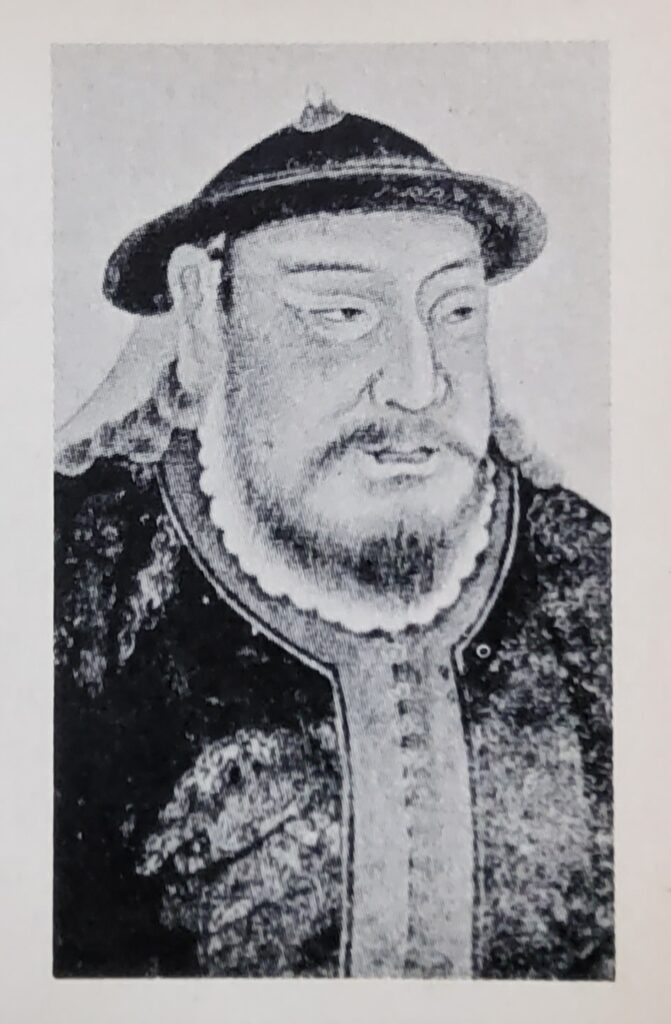
KUBLAI KHAN — (1216 – 1294 A. D.)
Kublai Khan was one of those leaders whose ideas and accomplishments caught the imagination of peoples in their own time and of peoples in the centuries that followed them. Kublai was the grandson of the dreaded Mongol chieftain, Genghis Khan, who began the conquest of China. It took Kublai half a century, to finish the conquest. Then he founded the Mongol Dynasty.
The Venetian traveller, Marco Polo, wrote a fascinating account of Kublai and his magnificent royal court. Like his barbarian ancestors, the khan was cruel and ruthless to his enemies. In spite of this characteristic, he was a benevolent ruler and often showed magnanimity after he adapted himself to his subject people and gathered at his court their scholars and their artists. He made Buddhism the state religion and created the office of Lama in Tibet. Before his death, he had extended his empire westward to Europe, northward to the Arctic Circle and southward to the East Indies.
LINKING THE PAST AND THE PRESENT
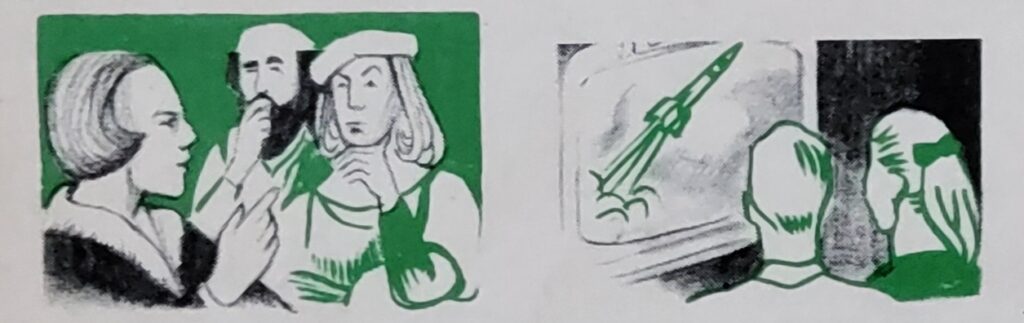
When a medieval explorer returned home, he often had difficulty in telling others what he had seen. He had no words with which to describe the strange plants and animals. Sketches he had made, were not always clear and accurate. Too often he wound up facing disbelief and the reputation of being a teller of tall tales. Marco Polo was nicknamed “Marco Millions” for his supposedly exaggerated accounts, of the wealth in Asia.
In our day, human veracity is less involved, in the exploration of space. Satellites automatically broadcast to radio, TV and record scientific data, invisible to the eye. Our age does not want to repeat the loss of data, that followed the early exploration of our planet.