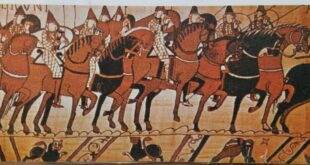
Medieval Culture – in surveying man’s achievements during the Middle Ages – is another example of man’s ability to rebuild his culture after disaster and destruction. The new culture that ultimately emerged was made up of the remnants of the old, contributions from other peoples, new inventions and discoveries.

In reviewing the reasons why trade and commerce dwindled in the period between 476 and 1000 A. D., then describes some of the favourable changes that took place in western Europe, as towns and cities were re-established in the twelfth and thirteenth centuries. We see the contributions of this latter period in the arts and sciences, review the introduction and rise of medieval universities as “guilds of learners” and glimpse the awakening that came to Europe, before that great spurt of mental energy and creative strength that men call the Renaissance.
We find that the medieval period had been preparing western Europeans for the thrilling adventures of invention and discovery that the modern period was to bring. Among other things, it had developed in the middle-class a powerful and self-confident group of men, who tended to focus their creative abilities on the improvement of social and economic conditions, rather than waste them on the warfare that had characterized earlier periods.
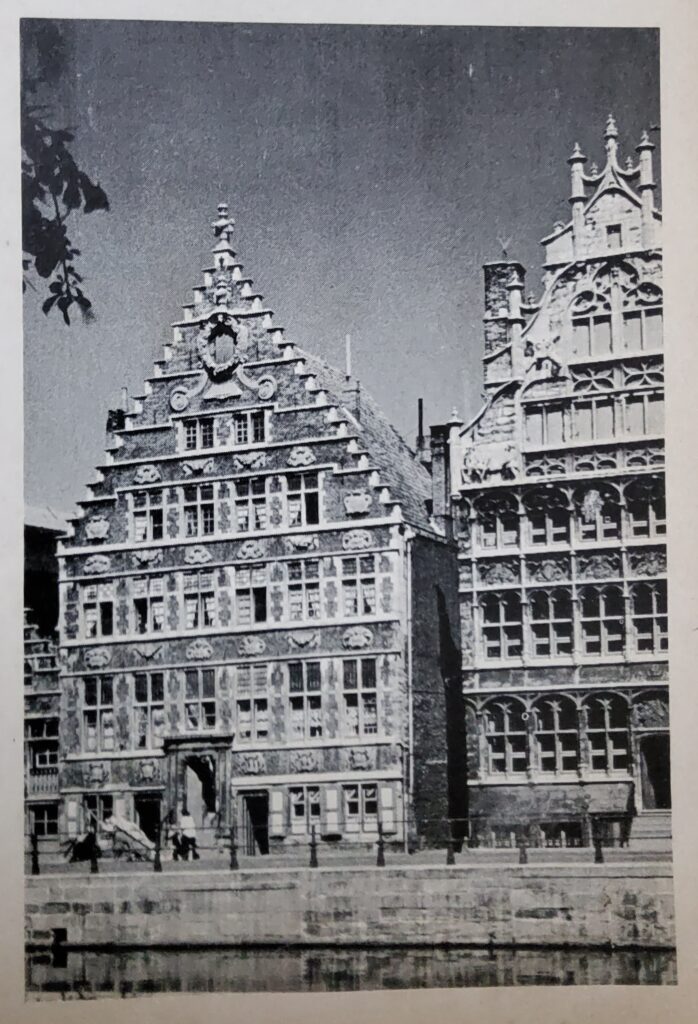
TOWNS REAPPEARED WITH THE REVIVAL OF TRADE
Trade and towns dwindled in western Europe between 500 and 1000 A. D.
Past history makes us aware that cities large and small were scattered over the various empires, but especially Alexander’s and the Roman. These cities were the centres of culture, for where people live closely each day, they can exchange ideas and join together in promoting the general welfare.
We know from the study of geography, that the people who work directly with natural resources, the farmers and stockraisers, the fishermen, miners and foresters, must produce a surplus above what they need for their own living, before they can sell to townsmen or buy the goods and services, that towns exist to supply. By the same token, traders and merchants need goods to exchange and means of transporting them.
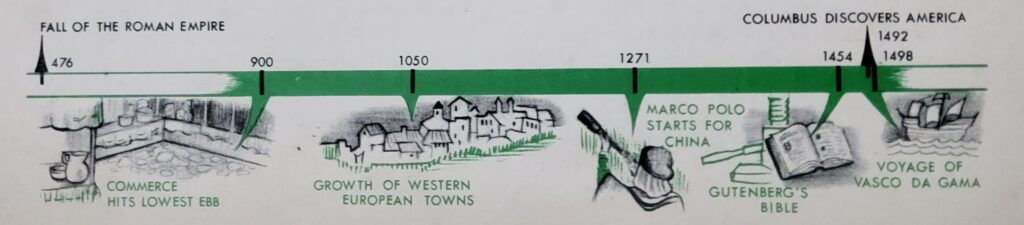
As the Roman Empire declined, the invading barbarians sacked the cities and destroyed many towns. There was so much fighting and disorder in western Europe, that farmers and craftsmen on the manors had little surplus, during the period from 476 to the ninth and tenth centuries. Mediterranean commerce continued for awhile, but by the ninth century, Moslem expansion in the Mediterranean world had closed that sea to European ships. When Oriental products, such as spices and silks, were no longer available to European merchants, the inland trade ceased. Such ports as Marseilles dwindled and city life almost disappeared. Western Europe fell back upon the manor and farming.
For a while the Frankish rulers brought a measure of stability to the West, but the empire did not endure because it had no economic base, other than farming. Industry had died. As the kings lost their power, they adopted a form of land tenure. That is, they gave great landowners the right to govern their holdings, without interference from the king’s officers. When the Carolingians could no longer protect their people, they made a law (in 847 A. D.) that every freeman should put himself under some lord’s protection. Each mounted warrior (knight) maintained himself by the income from his fief.
The tendency to land tenure and the protection of overlords, the reduced number of small landowners, the end of foreign trade and the dwindling of towns and cities — these and other factors, brought feudalism and manorialism to full flower in western Europe, by the year 900 A. D. That year may be taken as the low point for the region, both politically and economically. Moslems, Magyars and Northmen were ravaging wide areas. Population was falling off, large sections of land were being deserted and the shortage of food, was growing. Manorialism and feudalism, as stopgaps for a centralized rule and a culture based upon trade, were being sorely tested.
We do not want to imply that trade and towns completely disappeared in western Europe. Although most people lived on manors, the manor was seldom self-sufficient. It usually needed salt, iron for tools, plowshares and mill stones, for grinding grain. As knighthood grew, the knights needed the arms and armour, made by skilled artisans. The demand never ceased for fine cloth, jewelry, hunting dogs, falcons and warhorses. The profit on even a small volume of luxury goods, made a few merchants willing to face the tremendous risks of robbery and piracy.
Beginning about 1050 there was a rapid development of towns in western Europe.
There was also a rapid expansion of trade and an increase in population. Some towns developed where Roman towns had once been. Persons seeking security crowded into the serfs’ villages, beside strong castles. Cathedral towns expanded too. Besides the bishop, other clergy and attendants lived there and boys attended the cathedral school. People gathered there for important religious ceremonies and in time, to exchange goods in the open square near the church.
Towns also developed near sources of raw materials. Those who worked with tin or iron, for instance, would settle near tin or iron mines. Among the famous towns of this era were those in Flanders (later Belgium), where weavers had access to the superior wool produced nearby.
Many of the new towns which grew into trading centres and cities, were built on sites beside navigable rivers, on trade routes, or where two trade routes crossed. These attracted artisans and merchant, some of whom had previously moved from manor to manor, or from fair to fair. Many serfs who had been on crusades, came back to make a living as craftsmen in towns and the demand for Eastern goods, stimulated trade.
Cities learned to solve some problems in municipal government.
Since there was great need for defense, most medieval towns and cities were surrounded by walls several times a man’s height. A few night watchmen served both as policemen and firemen. As space was limited, many cities did not exceed 5,000 people. A city of 25,000 and above, was very large outside Italy.
Most cities were not planned but grew haphazardly about a market place. Streets were narrow and crooked, but there was little vehicular traffic. Shops and homes were close together and mainly built of wood. Danger from fire was an ever-present threat.
There was generally more freedom and security of life and property in a walled city, than existed in the countryside. Courts of justice were maintained. Nevertheless, in matters of health and sanitation, cities were backward compared to Roman times. The water systems were often polluted and there was no provision for the disposal of sewage and garbage, both of which were often thrown into the streets. Disease and epidemics were common and the average life expectancy, was less than half what it is today.
Towns and cities ultimately gained charters which guaranteed their freedom.
Early in the eleventh century – Amalfi, Genoa and Pisa, challenged and broke Moslem sea power on the Mediterranean. During the crusades (1095-1291 A. D.), hundreds of Italian ships transported crusaders and supplies to the eastern end of the sea and brought back Eastern goods.
With the movement of goods once again over the Mediterranean, trade further increased and many towns grew. The craftsmen and merchants began to choose the mayors, aldermen and other officials, from their ranks. They began to throw off, the control of the feudal lords and abbots, on whose lands the towns were built. Sometimes by revolt, but more often by the payment of money, townsmen got charters that granted the town certain rights of self-government. The townsmen’s feudal obligations to the nobles, were usually replaced by a payment of money, from the town.
In some cases, the king granted a charter which gave a town the right to elect its own officials, handle its finances, organize guilds and pay its taxes, in a lump sum to the king. Thus, in various ways, townsmen were freed of feudal obligations. A serf who escaped from a manor and lived a year and a day in a town, was considered free. He could then become a craftsman or merchant. “City air makes people free,” became a common saying.
In northern Europe, some of the first free commercial cities developed in the Rhine Valley and in what are now, Holland and Belgium. Cloth weaving was an important industry there.
Gullds, organized by merchants and craftsmen, regulated industry.
Merchant guilds, first formed in the eleventh century, were associations of the merchants in a given locality. Their purpose, was to control all the import and export trade within the locality, insure protection for their members, enforce trade standards and supervise outside merchants, doing business in the town. The guild set a just price, that would insure a fair profit to the producer and the merchant. Disputes were settled at the guild’s own court.
Craft guilds were developed in the twelfth century. Coppersmiths, tailors, furriers, shoemakers, goldsmiths, potters, toymakers and others, formed separate guilds. Each guild had an elected head, rules and regulations, a patron saint and a meeting place, called a guildhall.
The standard of workmanship among the guilds was high; requirements for membership were exacting. The guilds set prices, wages and the hours of work. A boy began as an apprentice. When he had spent the required time in learning the trade and could prove his skill, he became a journeyman and was elegible to receive wages. Those who trained the apprentices, hired the journeymen and ran the business, were the master craftsmen.
Medieval business was not generally favourable to competition. The guilds carefully guarded uniformity of price and quality, watching to see that one member did not gain advantage over another. In like manner, the cities closed their markets to the goods of other cities that might compete. The growth of business to a larger scale, however, made monopoly less practicable. In the cloth industry, for example, the cities of the Low Countries, came into competition – in the buying of raw material, in marketing the finished product and in obtaining labour.
A group of towns sometimes joined to protect each other and to improve trade.
One of the most famed of these trade associations was called the Hanseatic League. The League began with such German cities as Cologne, Danzig, Hamburg and Lubeck, but eventually had between 60 and 75 member cities. It won such a monopoly and such power, that during the thirteenth and fourteenth centuries, it had a representative council to deal with trading problems in its member cities and a navy to protect its commerce.
Medieval fairs were centres for both wholesale and retail trade.
The idea of merchants gathering at a convenient spot or town to exchange goods, grew out of the weekly markets in the towns when the housewives came to the public square, to buy goods displaved by serfs and craftsmen from the manor and by fellow townsmen. The smaller fairs, often staged by a local lord, were usually held on a Church holy day or festival date.
A large fair where local merchants could buy goods at wholesale, could last several weeks. Among the best known of these, were those staged in the county of Champagne in France and Novgorod in Russia. Just as at modern fairs, the people came to enjoy the free entertainment, to meet people from other places and lands and to see the displays of luxury goods, as well as to lay into supplies of necessities.
Money reappeared in Europe as a medium of exchange.
Nobles going on the crusades, needed funds with which to buy supplies. They sold or mortgaged their lands for cash. Money came to be used at fairs. Hoarded coins came back into circulation. In the thirteenth century, gold coins came into general use, especially the ducat from Venice and the florin from Florence.
As the use of hard money became common in business, simple forms of banking and credit were developed. A man could deposit his money in a bank and take a receipt, which he could later cash in at any office of that bank, in another place. A crusader who deposited his money in Venice, could withdraw it in the Holy Land. In time, banks began to lend money as well. When a loan was not repaid promptly, a service charge was put on it. Interest could be charged, if the loan seemed to be a great risk.
The revival of trade changed the class structure of medieval society.
City businessmen began to surpass many nobles in wealth and power. The income from land, was less than that from trade and commerce. More and more the kings and nobles, went to the towns and townsmen to borrow money, thus giving the wealthy townsmen increased political power. Their representatives, called “burgesses” in England, became members of parliaments. In England, as you have noted, the burgesses decided that the king should be reasonably strong, but be kept in check through the control of taxation. In France, they allied themselves with the king.
By the end of the Middle Ages, this change had resulted in the new middle-class of businessmen, demanding the privileges of the upper class. Below this prosperous group, were the artisans, tradesmen and the working class. The power of the top group was waning. From then on, more was heard of the bourgeoisie, the business class, which took its name from the French bourg or town.
THE GROWTH OF UNIVERSITIES AND KNOWLEDGE
Medieval education was centered in the schools maintained by monasteries and churches.
Teachers tried to follow the curriculum used in the later days of the Roman Empire. It consisted of the “trivium” of grammar, rhetoric and logic; and the “quadrivium” of arithmetic, geometry, astronomy and music. Latin, Church law and some knowledge of the vanished Roman administration, were part of the training too.
After the Moslem conquest of Spain in the eighth century, some students studied in Spain, especially men from France and Italy. Until about 1200 A. D., those who had studied in the Church schools or under Islam, were about the only educated men available to the kings as secretaries, writers and judges.
Universities became the intellectual centres of western Europe.
The revival of trade and the stimulus of the crusades, brought new ideas and wider horizons, to the people of western Europe, in the twelfth and thirteenth centuries. There was a revival of interest in classical learning. Students flocked to available schools. A demand arose for professional studies in law, medicine and theology.
This new interest in learning, led to the development of universities. When word got around, that a good scholar was lecturing and teaching at a specific place, students gathered there, eager to learn. The teacher collected a fee from each student. Instruction was given in Latin, the international language of the educated.
These first teacher-student associations gave way to more permanent groups of scholars and students. In Paris, for example, the teachers banded together in a guild. They drew up a charter of rules and regulations that guaranteed a certain standard of instruction and shut out unqualified teachers. At Bologna, the students organized themselves into guilds and formed the rules. Sometimes a guild was made up of both teachers and students.
Such guilds of scholars were known by the Latin word universitas, meaning an association of persons into one body. From this came the word university, meaning a guild of learners with a common purpose. The new student was an apprentice to the trade of learning. Just as craftsmen were recognized as “journeymen” and “masters”, a student won his bachelor’s, master’s and doctor’s degrees, by studying and passing rigid examinations by his instructors, at each level.
In the Middle Ages, a man (all the students were men) who had passed his apprentice’s exam and received his Bachelor of Arts degree, could teach certain elementary subjects. When he had qualified for the Master of Arts degree, he was admitted to the teachers’ guild and considered a full-fledged teacher of the liberal arts. If he continued to study in one of the professional fields — law, medicine, theology — he might ultimately win a degree as a specialist, such as Master of Theology.
The earliest European universities (outside the Moslem schools in Spain) were at Salerno, Bologna, Paris, Salamanca, Oxford and Cambridge. In time, they were recognized by the kings and the Church and granted charters. Besides giving the schools legal status, the charters guaranteed certain rights, such as freedom from the supervision of town officials.
As the interest in learning became more widespread, universities developed at Heidelberg, Vienna, Prague, Cracow and Upsala. As more colleges developed, large universities became aggregations of colleges, in which thousands of students lived as well as studied. They provided the medieval world with its clergy, doctors, lawyers, scientists and government officials. The universities also stimulated the desire to inquire and to know, to discipline one’s intellect and to advance human knowledge.
Advances in science were made in the late Middle Ages.
A foundation for a better science of mathematics was laid, as scholars assimilated the knowledge of numerals, decimals, algebra and geometry they gained from the translation of Greek and Arab writings. Leonard of Pisa, worked out a method of extracting square roots and of solving quadratic and cubic equations. The belief that the elements were fire, water, earth and air, gave way to new knowledge about metals, acids and chemical compounds. Observation of the artillery coming into use, was leading to the study of dynamics.
Albert the Great (Albertus Magnus) mastered the Greco-Arab learning and made original contributions in botany, zoology and chemistry. He broke new ground in the study of insects and wrote widely on natural science. The studies of a few men led them to criticize the scientific methods of the day. Roger Bacon (1214-1292), a man “with a bold and lively mind,” stated:
There are four principal stumbling blocks to comprehending truth, which hinder well-nigh every scholar: the example of frail and unworthy authority, long-established custom, the sense of the ignorant crowd, and the hiding of one’s ignorance under the show of wisdom.
Looking into the future, Bacon amused the people of his day with predictions such as these:
I will now mention some of the wonderfud works of art and nature in which there is nothing of magic and which magic could not perform. Instruments may be made by which the largest ships, with only one man guiding them, will be carried with greater velocity than if they were full of sailors. Chariots may be constructed that will move with incredible rapidity without the help of animals. Instruments of flying may be formed in which a man, sitting at his ease and meditating on any subject, may beat the air with his artificial wings after the manner of birds . . . as also machines which will enable men to walk at the bottom of seas or rivers without ships.
MEDIEVAL CONTRIBUTIONS TO THE ARTS
Medieval literature originated in the songs of minstrels.
At a time when few persons could read, readers and non-readers alike, derived enjoyment from listening to the songs of bards and scalds. These men, perhaps accompanying themselves on a harp or lute, sang of the deeds of warriors and heroes. Later these stories were put into writing.
Down to the thirteenth century, poetry was the most common tool of literary craftsmen. The epic was the earliest form and the earliest Anglo-Saxon epic, Beowulf, dates from the eighth century. The French epic, The Song of Roland, which relates the heroic deeds of a Frankish general, comes from northern France. At the time it was popular there, the troubadours of southern France were singing poems of chivalry and romantic love. In Germany similar troubadours, the minnesingers, sang love iyrics to amuse the nobility.
The poetry mentioned was written in the vernacular or everyday speech of the people, in one locality or section of a country. Elsewhere, the vernacular developed into the Romance Languages. Any literature written in the vernacular, could be more appreciated and understood by the common people, than the literature written in Latin by scholars.
Dante and Chaucer, two of the greatest writers of that time, wrote in the vernacular. The Italian Dante (1265 – 1321 A. D.), did much to set the form of written Italian. His Commedia, which is now called the Divine Comedy, is one of the world’s great narrative poems. It is an allegory, the story of an imaginary trip through purgatory, hell and paradise. In reading it, one learns much about the religious beliefs of the time.
The vernacular of Chaucer (c. 1340 – 1400 A.D.), is recognized as the basis of today’s English, but his fame rests upon his skill in telling a story. In Canterbury Tales, twenty-nine pilgrims journey to the shrine of Thomas á Becket at Canterbury. On the way, each tells a story to entertain the others. Modern readers see in these tales, a cross section of the customs and thinking of medieval England.
Medieval music included popular songs and church music.
We mentioned the popular songs about war, love and happy living, sung by the troubadours and minnesingers. Ballads and folk-songs were likewise sung and handed down by the people. The harp, the dulcimer, the zither and forms of flutes and bagpipes, were among the instruments used. Old church manuscripts have been preserved which show that musicians had a scale of eight notes and had discovered they could write music, by using certain letters of the alphabet. In the late medieval period, they learned how to sound notes together to get chords. They also learned to combine tones and in such a way that they had a melody or tune.
Music became an important par rt of church services. Bible verses were sung in the form of the Gregorian chant. Hymns written in Latin were sung by the congregation.
Drama was reborn in the Middle Ages in the form of Latin mystery plays. They developed out of the choral singing of sacred stories. When performed in the churches, mystery plays were additions to the service. When performed outside the church, these plays departed from Biblical stories and often used an allegory as a plot. In that form, they were known as morality plays.
Medieval artists were in the service of the Church.
For the most part, the architects, sculptors and painters, were devoted to the building and decoration of Romanesque and Gothic churches and cathedrals. The glassmakers, stone masons and weavers of tapestries ,were often first-rate artists.
The paintings of the period usually portray the Holy Family or saints. They are not realistic and follow the Byzantine style, that persisted in Russian icons until recent times. The figures look rigid, solemn and majestic. The artists used gold, blues, reds, against dark backgrounds.


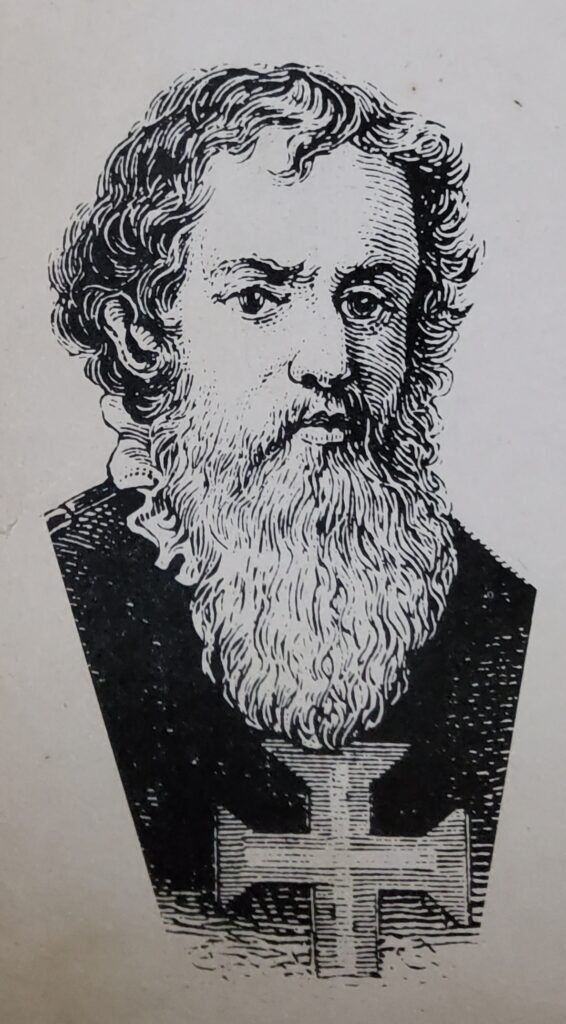
HENRY OF PORTUGAL (1394 – 1460 A. D.)
Prince Henry of Portugal, usually called the Navigator, was the son of that King John, whose armies mode Portugal independent by defeating Castile and the Moors of Morocco. Henry hod a part in that achievement, then began explorations in the Atlaniic Ocean which broadened into a desire to explore the west coost of Africa and some of its interior. He also developed a desire to win lands and converts for the Church in Africa and to share in the lucrative slave trade controlled by the Moors.
Henry gathered at his court – mapmakers, navigators, Arab, Jewish mathematicians and other scholors. They instructed his captains, pilots and other seamen, in the making of charts, maps and in the art of navigation. His men then went out well-taught, in the best geographic knowledge of the day, provided with the best available instruments and familar with geometry and astronomy.
Although Prince Henry did not live to see the outcome of his work, his trained men worked their way down the west coast of Africa and finally sailed all the way to India, the Spice Islands and the East Indies. Portugal gained concessions, that gave her a rich trading empire in the East.
MEDIEVAIL TECHNOLOGICAL ADVANCES
During the Middle Ages man began to free himself by inventing machines to do some of his work.
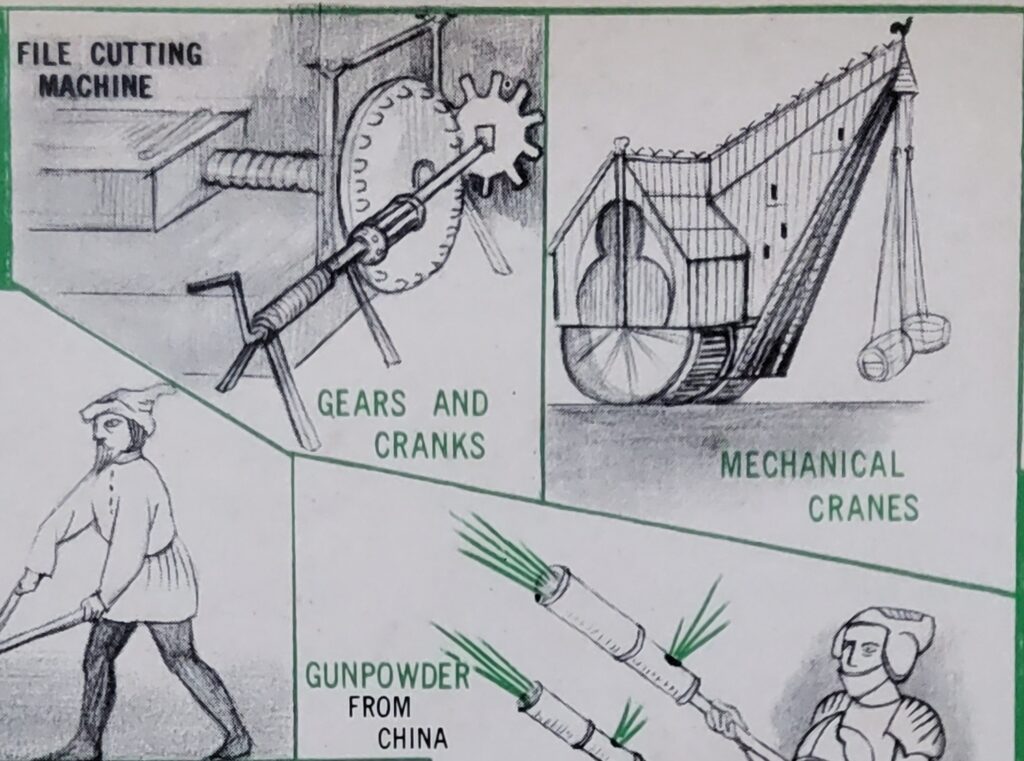
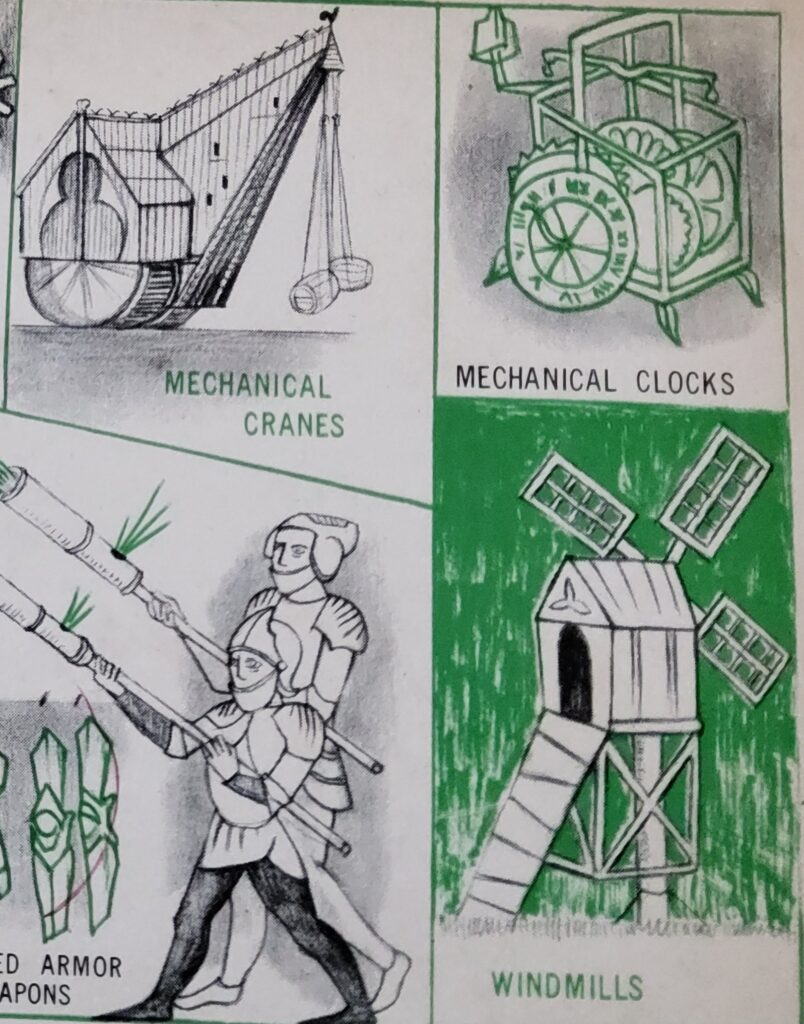
The water-driven mill, which played such an important part in colonial America’s economy, was invented in B.C., but its use became widespread in the tenth and eleventh centuries. The crank and many kinds of gears were invented; the use of drills and lathes became common. The windmill, invented in the twelfth century, rapidly became popular. Mechanical cranes also appeared.
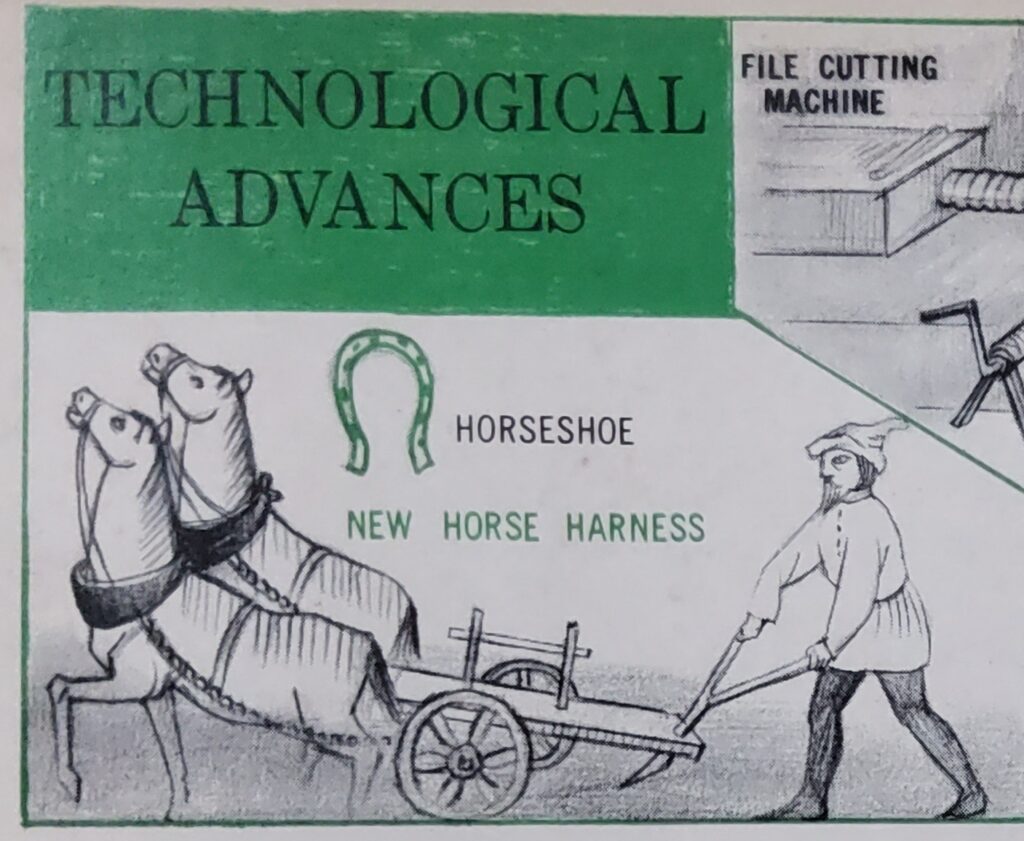
The horse played a part in the winning and overthrow of empires. The wicked sickles on war chariots cut down many a footsoldier. The improvement of harness for the horse did for the eleventh and twelfth centuries, what the steam engine did for the nineteenth century.
That may sound like overstatement, but look at the inventions in question. In ancient times, a horse pulling a load was choked by his harness. In the tenth century, Europeans invented the horse collar, a piece of harness by which the weight of pulling was thrown on a horse’s shoulders instead of his neck. It is said that this arrangement gave the horse four times the pulling power previously achieved. The horseshoe was created, providing protection for a horse’s hoofs and giving him better traction. This invention has been compared in economic importance, to the invention of the rubber tire in the automobile age. A third invention of this period was a tandem harness, which permitted the hitching of horses in tandem.
Metal technology continued in a relatively high stage, since metal was needed for tools, weapons and armour. The Moslems had found skilled ironworkers in the Middle East and the blades made of Damascus and Toledo steel became famous. Some knowledge of Moslem processes became known in western Europe. It took good materials and skilled craftsmen to produce chain-mail and plate-mail armour and both were very expensive.
The Moslems brought the knowledge of three great Chinese inventions to Europe. Gunpowder has been referred to, as coming into use about the time of the Hundred Years’ War. The magnetic compass helped to make modern navigation possible. The introduction of paper was tremendously important. Papyrus had disappeared from use in Europe, early in the Middle Ages and manuscript books were being written on prepared sheepskin, called parchment. Parchment was expensive and restricted, the quantity of books produced.
Among the reasons for the backwardness of medieval mathematics and science, was the inaccuracy of measurement. Modern science and technology are dependent upon the precise measurement of length, area, volume, weight and time. Medieval rulers had difficulty getting their people to agree upon crude weights and measures. The hourglass was a poor instrument. Therefore, the invention of mechanical clocks, which were used widely by the 1300’s, was a great medieval invention, although accurate pendulum clocks were not invented, for another 300 years.

Perhaps the greatest invention between 500 and 1500 A. D. was the printing press.
Like many of mankind’s steps forward, it was part of a revolutionary process. The Chinese had made paper as early as the second century. They had also printed from wooden blocks. In the eighth century the Moslems had made a cotton paper, then one of linen. They brought both to Spain. By the eleventh century, the Chinese had invented movable type.
Perhaps the next step was taken by the European engravers, who made woodcuts or copper plates, by which to produce many copies of the same drawing. Sentences were added to explain the sketches. Finally, during the 1440’s someone produced movable type. Each piece of type was a tiny bit of engraving which could be combined with other pieces to form words, sentences, or a whole page. Historians do not agree who first devised it or whether the idea filtered in from China, but it is relatively certain that in 1448, Johann Gutenberg had built his famous press and was using movable type, to print papal documents in his Mainz, Germany, shop. In 1454 or 1456 he published a version of the Bible.

Medieval man widened his physical world.
The expeditions of the Vikings, the crusaders and the Moslems, led to an increased knowledge of geography. As early as the twelfth century, European ambassadors were being sent into Asia. Merchants were interested in establishing trade connections with the Orient.
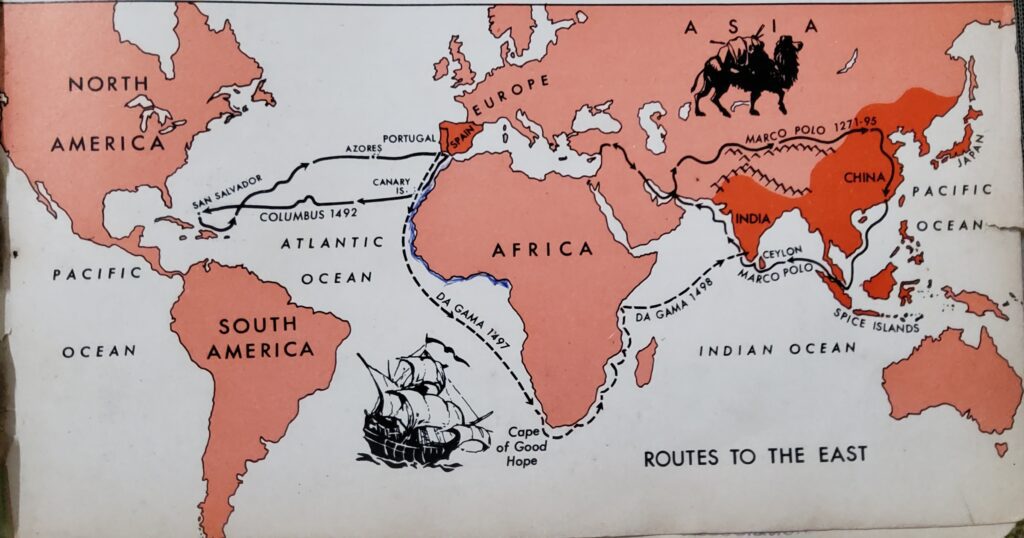
Between 1271 and 1295 A. D., Marco Polo, a member of a family of Venetian merchants, made a celebrated trip to China. The record of this journey is a result of chance. Marco was later captured in a battle with the Genoese and whiled away his time in prison, relating his story to one who put it into writing. The book begins:
Great Princes, Emperors and Kings, Dukes and Marquises, Counts, Knights, and Burgesses and People of all degrees who desire to get knowledge of the various races of mankind and of the diversities of the sundry regions of the World, take this book and cause it to be read to you….
For let me tell you that since . . . our First Father Adam, even until this day, never hath there been Christian or Pagan, or Tatar, or Indian, or any man of any nation, who in his own person hath had so much knowledge and experience of the divers parts of the world and its wonders as hath had this Messer Marco Polo!
To most people, this was a wildly imaginative tale. Nevertheless, some of his readers, like Christopher Columbus, regarded the book as a true account of countries like China, Japan, Tibet, Ceylon, Siam and Java. They, too, wanted to visit “Cathay” and “Cipangu.” Geography written in Spain about 1350 A. D., indicates that the Canary Islands were known and that the Azores had been explored. Once mariners had entered the Atlantic, efforts to find new places and new routes were made. In 1484, the Portuguese explorer Diaz, sailed around the Cape of Good Hope. The most significant discovery of the time was that of Christopher Columbus, who in 1492, reached an island he named San Salvador, in the West Indies. In 1498, Vasco da Gama sailed around the Cape of Good Hope and reached India. Thus by 1500 A. D., the Western Hemisphere had been discovered and a new way to reach the Orient had been found.
The majority of the people of Europe did not immediately realize the significance of finding the New World. Discovery of the new route to the Orient, on the other hand, took on immediate importance, for spices from India, silk and incense from China, were greatly sought after.
We use the date 1500 A. D. to bring to a close the long period of the Middle Ages. This does not mean that a sudden change had occurred overnight and that things had become “modern.” It does mean that the emergence of nations, the geographic discoveries, the establishment of universities with a greater interest in learning, the invention of printing with a greater dissemination of knowledge, combined with other factors to influence men’s minds. With the 1500’s, there appeared an almost explosive physical and mental energy among Europeans, that brought their culture to higher levels and carried their influence to the other continents of the world.

LINKING THE PAST AND THE PRESENT
In the late Middle Ages, after the Mediterranean Sea had again become a highway of commerce, the making of maps was revived. Although navigators had only the crudest instruments and limited mathematical knowledge, they became fairly proficient in sketching coastlines and estimating distances. As new continents were opened to the Europeans, maps soon began to appear that resembled the more accurate ones available today.
Modern governments maintain departments to work continuously on the refinement of maps. The curvature of the earth is known more accurately, an essential to the guiding of rockets. The oceans are better charted. Recent research has told us much about submerged mountain ranges and the great troughs. With the aid of modern invention, man has in the recent-past been able to conquer the highest mountain and to descend to the most profound depths.