East in the Middle Ages 214 B.C. – 1644 A.D.




THE name “Mogul” comes from the Arabic word for “Mongol.” Babur, the founder of the Mogul dynasty, was probably descended from both Timur and the mightiest of all Mongol conquerors, Genghis Khan. His early story was much like that of Genghis. Born a minor prince in what is now Soviet Turkistan, he was driven from his throne while still a child. He spent years wandering about with a few hundred ragged, half-starved followers. In 1504, he captured Kabul and began to dream of conquering the richer lands south of the Khyber Pass. In 1519, he made a start by seizing a border province. In 1524, on the invitation of the Afghan nobles, he invaded the Punjab. His army was ridiculously small for such an ambitious venture, but the weakness of the Delhi Sultanate favoured him. In 1526, he defeated the sultan in battle at the ancient town of Panipat and so became master of North India.
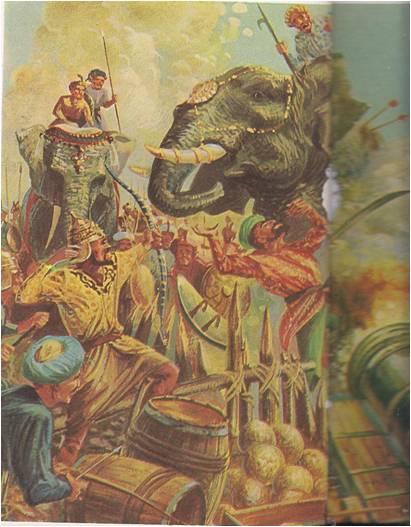
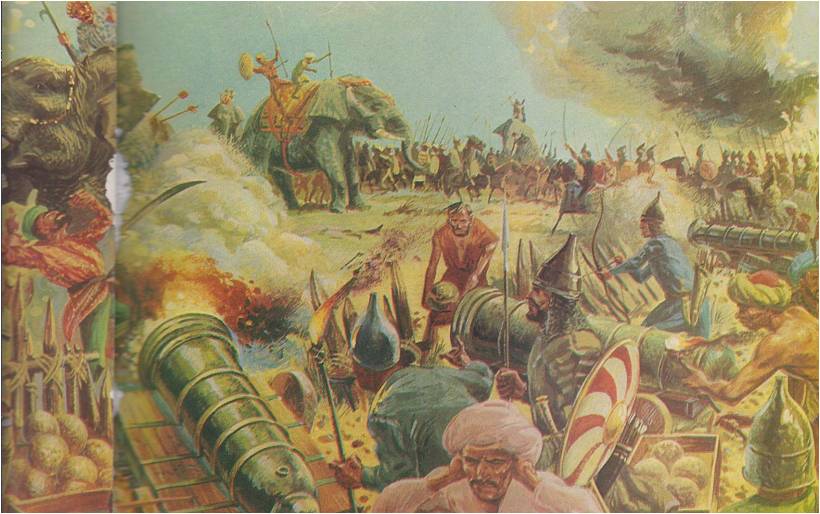
The Battle of Panipat showed how important firearms could be in deciding the outcome of a battle. Babur had only eight thousand troops to Sultan Ibrahim’s fifty thousand men and one thousand elephants. He also had cannon and crude muskets. By clever tactics he forced the sultan’s army into a solid mass and then ordered his men to fire. Twenty thousand of the enemy fell dead, including the sultan. The following year, Babur beat back a combined attack by the Hindu princes of the neighbouring Rajputana. This victory ended the Hindu’s last hope of chasing the Moslems out of North India.
In 1530, Babur died. His intelligent but lazy son Humayun had to flee the country when one of his provincial governors rebelled against him. Humayun’s son Akbar turned out to be the strongest and also the greatest of all the Mogul rulers.
AKBAR, MASTER OF INDIA
Akbar was only thirteen years old when he came to the Mogul throne and his forces were weak. Nevertheless, he promptly defeated a huge Hindu army at the Second Battle of Panipat. This gave him possession of Delhi, Agra and other small states in the central part of North India. When he grew up, he began to expand his kingdom. First he took the Rajputana, by defeating the Rajput princes in battle and by making treaties with them. In 1572 he annexed Gujarat and in the next twenty years conquered, in succession, the large states of Bihar, Bengal, Kabul, Kashmir and Sind. His conquest of Baluchistan in 1595 made him the ruler of all North India.
Like the Guptas and the Turks before him, Akbar dreamed of building an empire that would take in all of India. He also wanted to expel the Portuguese traders from the southern ports which they had occupied. Accordingly, he turned south to attack the Moslem sultanates of the Deccan. Berar fell to him in 1596 and Kandesh in 1600. Before he could push farther south, however, his son Jahangir launched a rebellion against him. In 1605, Akbar died.
One reason why Akbar became one of the most powerful monarchs in history was his shrewdness. From the start, he saw that he would have to win the loyalty of his Hindu subjects if he wanted to keep peace and order in his realm. He therefore did away with the tax on non-Moslems and encouraged Hindus to serve in his government. He went out of his way to make friends with the proud and warlike Rajput princes. His policy of fostering good feeling between Moslems and Hindus was the exact opposite of what the Delhi sultans had done.
MOGULS, GOVERNORS AND RELIGIONS
Akbar showed wisdom, too, in the way he ran his empire. He organized it into twelve provinces and put a well-paid official of unquestioned loyalty in charge of each. He set up a national system for collecting land taxes that was both efficient and fair. He founded a royal mint which turned out the finest coins in the world.
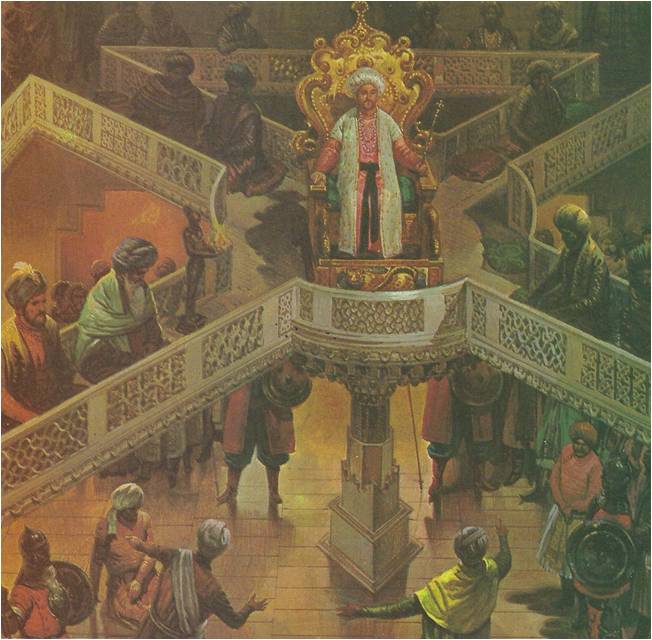
Although he never learned to read and write, Akbar was one of the best-educated men of his time, for he filled his court with scholars and had them read aloud to him by the hour. For many years he studied all the known religions, searching for basic truths which he failed to find in his own religion, Islam. At last he invented a religion of his own. It combined what he considered to be the best features of many faiths, including Christianity. After he died, no more was ever heard of Akbar’s religion.