
Age of Revolution 1765 A.D. – 1815 A.D.

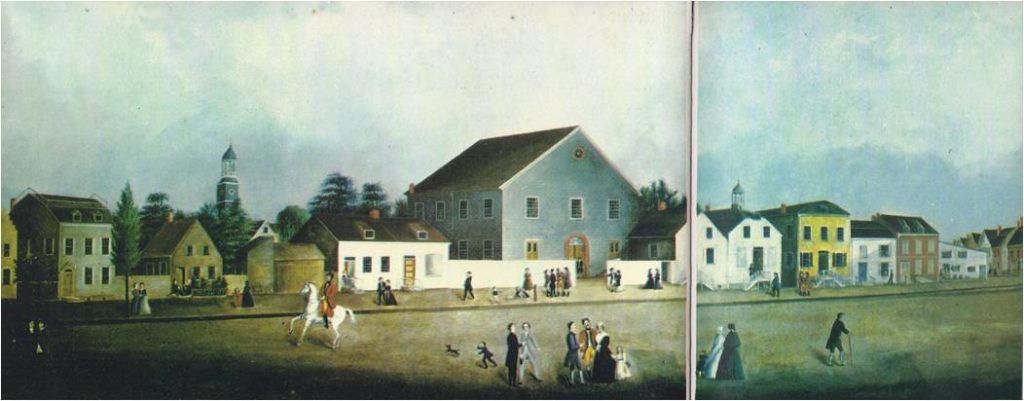








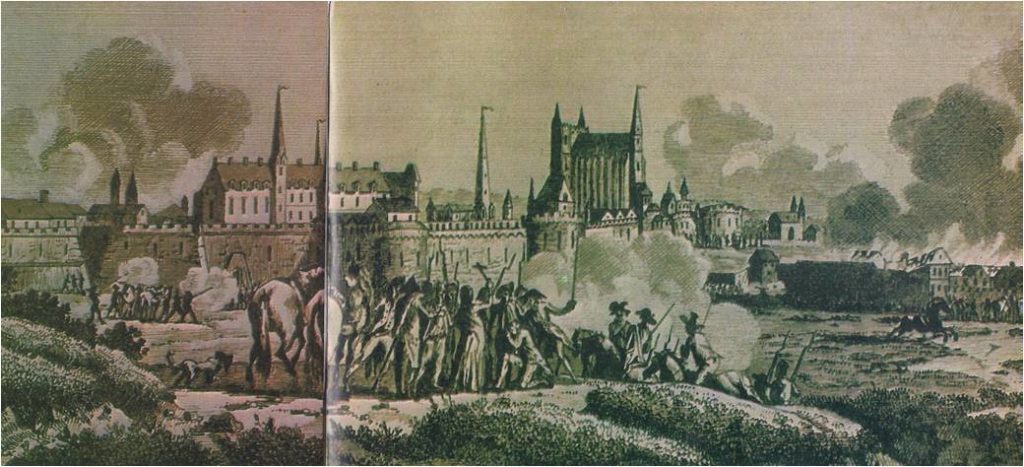


The British in Boston had no reason for suspecting anything unusual on the night of June 16, 1775 but across the Charles River, a column of colonial soldiers was moving quietly toward the twin hills overlooking the town. Behind the soldiers came wagons loaded with picks and shovels. The grass-covered hills they were approaching served as pastures‚ one owned by a Mr. Bunker and the other by a Mr. Breed.
Washington had already been elected commander by the Congress in Philadelphia, but the news had not yet reached Boston and the colonial forces knew nothing about it. Their colonial high command had given the order that Bunker’s hill was to be fortified. By some mistake, the troops were instead led up Breed’s hill, which was closer to the water and just across the river from Boston.
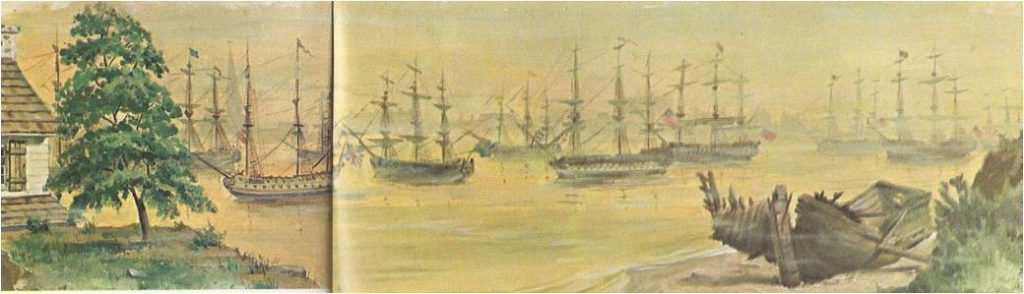
The men began digging. From the top of the hill they could look down on the lighted windows of Boston and could make out the dark hulls of British warships lying at anchor in the harbour. If they could fortify the hill with a few cannon, they would have Boston and the ships in the harbour at their mercy and the British would be forced to leave the city.
Colonel William Prescott and the other officers gave their commands in whispers. There was no moon. No one was allowed to smoke. The troops dug in silence. Some made trenches, some stacked hay behind a rail fence that ran down the slope to the water’s edge and some threw up walls of fresh earth and sod and stone.
At dawn the following morning, British sentries were amazed to discover the activity on Breed’s hill and the long breastwork of freshly turned earth that crowned its top. After General Gage met with Sir William Howe and other generals who had just arrived from England, the British began firing their cannon at Breed’s hill. Most of the round shot thudded harmlessly into the side of the hill, short of the mark. All the while, the colonial troops at the top kept working desperately, making ready for the battle that was sure to come.
“THE WHITES OF THEIR EYES”
It was afternoon before the redcoats crossed the river in barges and whaleboats manned by sailors from the men-of-war. From church spires and rooftops, the people of Boston watched to see the excitement. The British could easily have trapped the Americans by landing on the narrow neck of land which connected the twin hills with the mainland. It would have taken several days to starve out the Americans and General Howe chose to attack from the front of the hill. British pride had been hurt by the ragged retreat from Lexington. Now they had a chance for a quick and glorious victory, a chance to prove what the might of the British army could really do in face-to-face battle with untrained rebels.
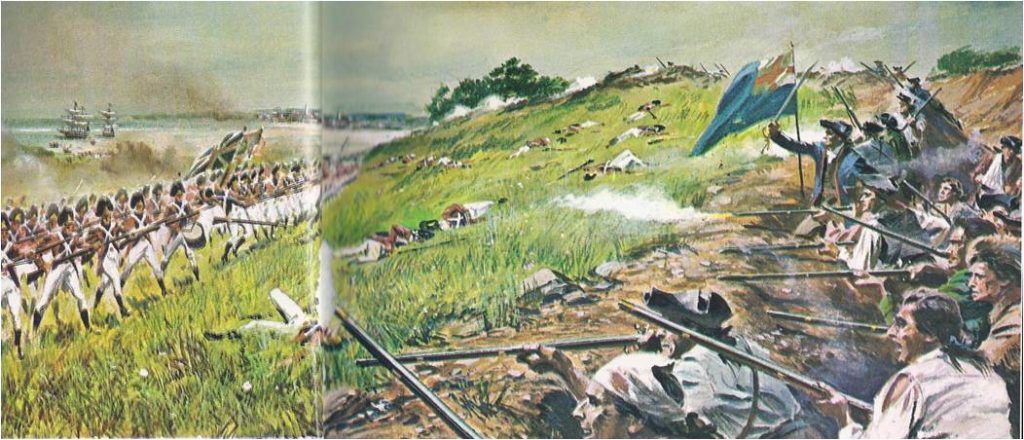
At three o’clock the British formed three long scarlet lines, one behind the other, across the foot of the hill. The hot sun beat down and fluffy white clouds floated lazily overhead as the rolling of drums gave the signal for the attack. There were rail fences on the rolling slope, knee-high grass and clumps of thorny bushes. Even so, the redcoats managed to keep their lines straight. Each was loaded with a knapsack, blankets, three days’ supply of food, ammunition and rifle — about one hundred and twenty pounds of equipment in all.
At the top of the hill, the patriots waited behind their breastwork of earth and stone, with their best marksmen lined up in firing position. Others crouched behind them, ready to hand up loaded muskets as fast as they could be fired. According to legend, the patriots were told to hold their fire until they could see “the whites of their eyes.” Officers kept reminding the colonials that they were low on ammunition and that they could not afford to waste a single shot.
The British came on, their rifles lowered, sun flashing on the steel of their bayonets. They had come within fifteen paces when suddenly a living wall of flame and smoke leaped from the breastwork. Hats flew in the air. Redcoats sank to the ground. Their lines crumbled. Through the dark swirl of gunsmoke the American sharpshooters kept up a constant fire. The British fell back, then turned and fled down the slope in panic.
AN EMPTY VICTORY
General Howe sent for more troops from Boston. When they arrived, he stormed the slope again. Once more they were driven back, leaving dead and wounded scattered over the hill. By now the Americans had used up most of their ammunition. Anxiously they watched as Howe massed his troops near the water for still another try. This time the redcoats staggered slowly up the slope in uneven lines. All they had left to go on was raw courage.
The patriots fired their last shots. The British reeled, but stumbled on through the smoke. They charged over the breastwork. Swords flashed. Bayonets jabbed. The Americans fought back with stones or used their rifles as clubs, trying to delay the redcoats while most of their comrades made their escape down the back side of the hill.
The Battle of Bunker Hill, as it was called, gave England her first victory over the Americans. The victory cost her 1,054 killed and wounded, including every member of General Howe’s staff that took part in the battle. The Americans lost 441 killed or wounded and most of these were lost during the last moments of battle. They were proud of the way they had fought and were sure they would have won if they had not run out of ammunition. “I wish we could sell them another hill at the same price,” said one of them. In England, people were shocked by the heavy British losses. They joked bitterly about it, saying that if they won another such victory, there would be no one left to carry the good news back to England.

