West Dominates the World (1763 – 1899 A. D.)
Nationalism and Union in Germany and Italy include: Metternich and European affairs, Bismarck and European affairs and the struggle to unite Italy. Histories of Germany and of Italy were long intertwined as components of the Holy Roman Empire; when Napoleon broke up the Empire, central Europe was left a patchwork of small states, each with its own government, tarifs and traditions. Austria and France wished to perpetuate this weakness for their own selfish ends and that made central Europe a battleground.
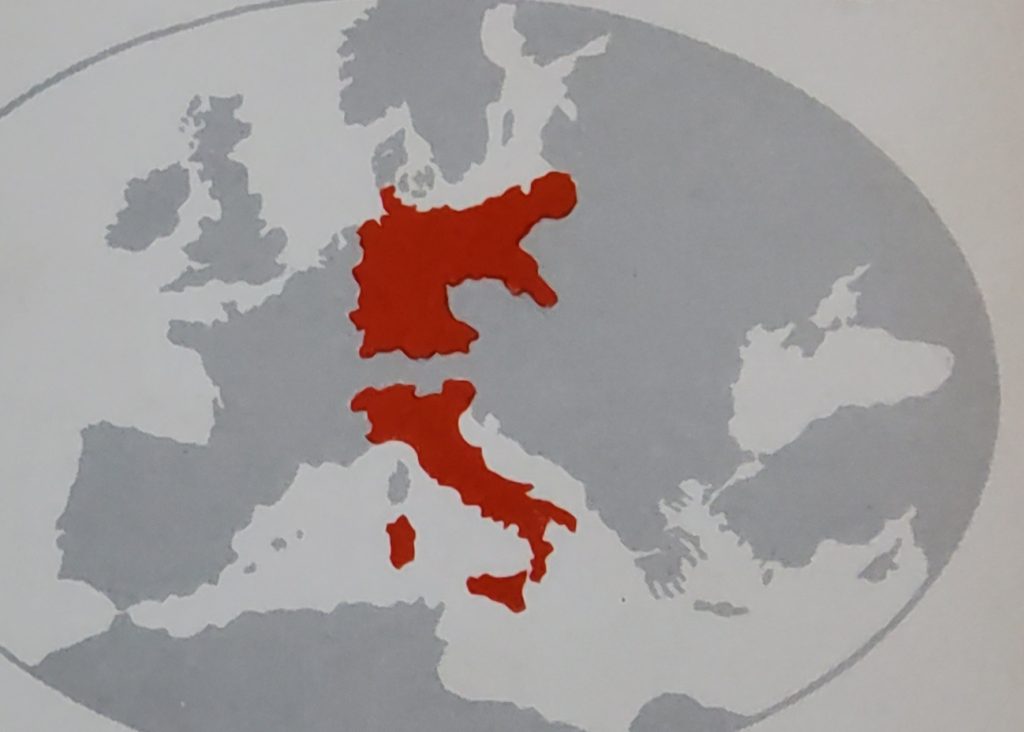
Two remarkable men of the nineteenth century ended this disunity and altered the balance of power in Europe. Their names were Otto von Bismarck and Count Camillo Benso di Cavour. While the events in Germany and Italy were parallel, it will be important for you to note the differences in policies and methods used in the two countries. We find, that a union for free trade brought the Germans together economically, before their leaders achieved political unity.
The hand of Austria’s chancellor, Metiternich, lay heavy upon the Italians, restraining every movement toward independence and unification. Through a series of moves on the part of Italian patriots, a kingdom was formed under the king of Sardinia and all of Italy, was ultimately brought into it. After achieving national unity, Germany and ltaly developed into strong and ambitious states.
METTERNICH AND MODERN AFFAIRS
The Congress of Vienna failed to solve all issues.
When Napoleon was at last defeated and exiled in 1815, the rulers and groups who had suffered from his conquests and from the ideas of the French Revolution, did all they could to erase the picture from their minds. They hoped to turn back to the conditions of 1789.
The northern regions of Lombardy and Venetia – in Italy, were directly ruled by the Austrian emperor and several of the other states were under members of his Hapsburg family, or of Bourbons allied with Austria. The pope continued to rule the Papal States in central Italy as a temporal ruler, while Sardinia was the only state ruled by an Italian king.
To use the vernacular, the repetition of facts about disunity – Austria and Prince Metternich becomes a sort of broken record, but the old policy of “divide and rule” was still being followed by Austria and Metternich. The weakness in the decisions reached, at the Congress of Vienna, lay in the fact that most people had lost rights and privileges that they possessed, even under Napoleon.
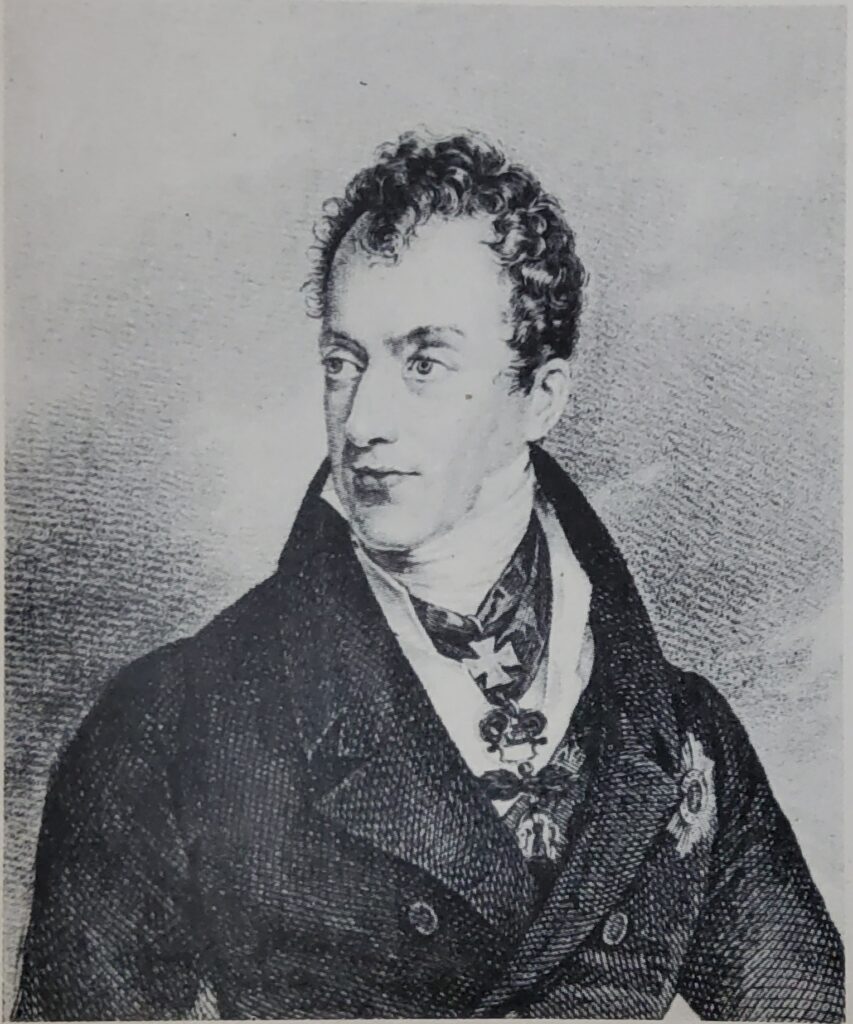
German students and professors longed for better conditions and a unified Germany.
In spite of resistance from the older generation, they organized and pledged themselves to work for a united Germany under the motto, “Honour, Liberty and Fatherland.”
In 1817, students from many of the small kingdoms met at the Wartburg, the famous castle where Martin Luther had translated the New Testament into the German language. They ended their meeting in a joyous mood and built a large bonfire. Into this they pitched the wig and corset of a German officer, a corporals baton and certain books, which upheld the older views of monarchy. The materials burned were symbols of a way of life, to which the students rebelled.
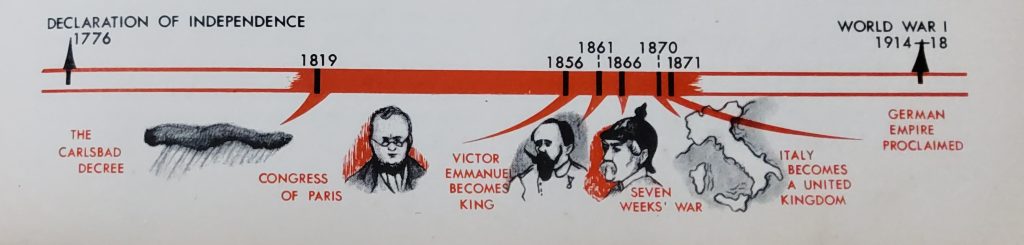
After Metternich learned of the students’ festival at the Wartburg, he called a meeting of the princes at Carlsbad. There, in 1819, these rulers wrote the Carlsbad Decrees, which were later adopted by the German Diet. The decrees forbade free speech, called for censorship of the press, and set up government supervision of education in the universities. They also forbade the German princes to grant liberal constitutions to their subjects.
In Italy a secret society, calling itself the Carbonari (charcoalburners), attempted an underground resistance movement. This movement received a setback in 1820 when an attempted revolt in Naples was suppressed by Austrians.
In spite of censorship under the Carlsbad Decrees, news of national revolutions filtered through to the peoples of Germany and Austria. The French Revolution of 1830 was a signal for outbreaks in central Europe, but most of them were quickly put down by the Austrian and Prussian monarchs. The czar suppressed a Polish uprising or insurrection aimed at regaining independence. The Belgians succeeded in withdrawing from the union with the Dutch [forced upon them by the Congress of Vienna] and formed a new state.
The Revolution of 1848 in France was followed by other revolts. These were more widespread and violent than those of 1830. Metternich was forced to resign and he and his wife fled to England in disguise. Revolutions in Italy, Austria, and Germany sought to establish constitutional governments, parliaments elected by the taxpayers, and ministers of state responsible to their parliaments.
Hungary declared her freedom from Austria. It was only after long and bloody fighting that the Hapsburgs retained Austria and suppressed the uprisings in Italy and Hungary.
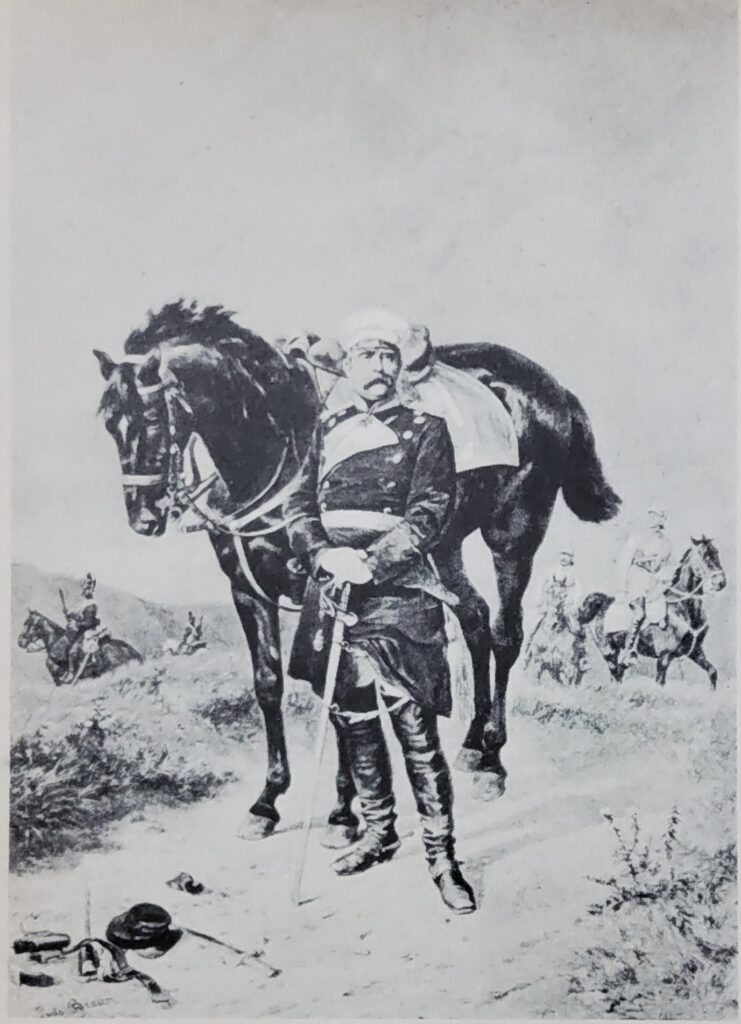
BISMARCK AND EUROPEAN AFFAIRS
Prussia became the leading German state after the Revolution of 1848.
Up to that time, Prussia had been an absolute monarchy. In 1847, when refusing to give his people a constitution, King Frederick William IV had declared:
. . . Neither now or ever will I allow a scribbled sheet of paper to intervene like a second Providence between our God in Heaven and this land of ours . . .
The king soon had to “eat his words,” for in March of 1848, there was rioting in the streets of Berlin and some Prussians were killed. The king finally ordered his soldiers out of the city, but the revolting citizens brought their slain comrades into the king’s courtyard for a funeral. The humiliated king was forced to pay his respects to his dead subjects by taking off his hat! He reluctantly set an example for other German rulers by granting a constitution, a parliament and support, for a united Germany. However, he refused an offer to become emperor of a union of German states, that was planned by a popular assembly of representatives, from the various German states meeting in Frankfurt, in May of 1848.
William I, who came to the throne in 1861, recognized the Prussian constitution of 1850, but he and his parliament were soon in sharp disagreement. William wanted a large army based upon military conscription or compulsory enlistment; and parliament wanted to work toward reform. Out of this and other crises, arose Otto von Bismarck (1815 – 1898), who was to guide German affairs for thirty years and help found modern Germany.
Bismarck was born into a noble Brandenburg family and brought up among supporters of royalty, hence it was natural for him to support the Hohenzollerns and the monarchy, when he entered politics in 1847. He joined the diplomatic corps and served in St. Petersburg and Paris. In 1862 he was appointed chief of the ministry and in a sense, he became to the Prussian king, what Richelieu had once been to the French king. The legislature had refused to appropriate money the king wanted for strengthening the army. Bismarck told him to levy the needed taxes without parliament’s consent. This the king did.
At this time, Prussia was a prosperous state. The Industrial Revolution was well under way and business was booming. Most of the German states belonged to the Zollverein, a customs union which promoted free trade among its members. The Zollverein united the states economically, making it easier for the middle-class leaders of the nationalist movement, to promote political unification. The Prussian government was modern and efficient. Prussia’s schools were among the best in the world. All these factors favoured Prussia, as a leader in unifying the German states. On the other side of the balance, was a strong desire in many states, to protect states rights. France did not want to see Germany unified; neither did Austria.
Bismarck planned and fought three successful wars in achieving German unity.
Knowing that he would have to fight for unification, he built the Prussian army into the most effective armed force in Europe. It was the first European army to use the inventions of modern science and industry. Confident that Prussia was the only real leader in Germany, confident of his army, Bismarck told his parliament:
“Germany does not look to Prussia’s liberalism, but to her power. … The great questions of the day are not to be decided by speeches and majority resolutions — therein lay the weakness of 1848 and 1849 — but by blood and iron!”
Paying little attention to parliament or the constitution, Bismarck assumed the powers of a dictator in pushing Prussia forward. The only help he wanted from the people, was obedience. The majority obeyed, but some sought in the United States, the freedom they knew could not be found in Germany.
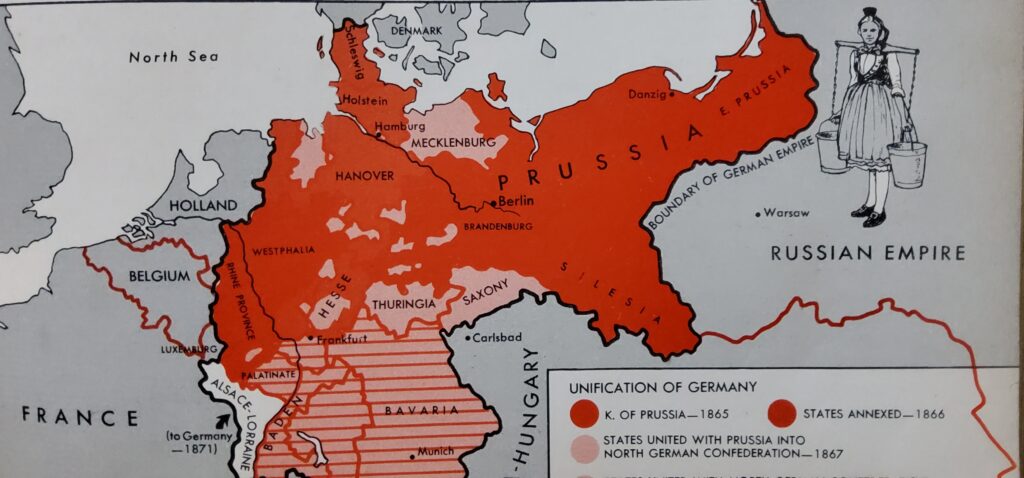
In 1864, Bismarck and Austria attacked the little state of Denmark over Schleswig and Holstein, two duchies or dominions belonging to the king of Denmark, but inhabited largely by Germans. Prussia and Austria soon destroyed the Danish defenses. Bismarck avoided making a final settlement, but set up a joint control of Schleswig and Holstein with Austria, so he would have a pretext for a fight whenever he wanted one. He soon wanted one.
The second war came in 1866 and lasted about seven weeks. It is commonly called the Seven Weeks’ War. Bismarck believed that Austria must be forced out of the German Confederation before he could unify Germany. He got his war with Austria by showing concern over her rule in Holstein and then moving troops into Holstein. Defeating Austria, Prussia took Schleswig under her wing and dissolved the old German Confederation. In place of it, Bismarck organized the North German Federation, shutting out Austria and four of the German states.
The chancellor then used the Franco-Prussian War as the third step in his unification of German states. The war came in 1870. France was crushingly defeated. During the war, the remaining German states — Hesse, Bavaria, Württemberg, and Baden — were inspired by strong national feeling to unite with Prussia. With every obstacle to unity removed, the German Empire was proclaimed in January of 1871, at Versailles in defeated France. Inspite of the declared wishes of the people, Alsace-Lorraine was made a part of the German Empire. The Prussian king took the title of German emperor.
Bismarck attempted to conciliate his former enemies.
Bismarck knew that the French were smarting under defeat and that they might seek revenge, so he sought to isolate France and prevent her from forming an alliance with other powers. He persistently sought the friendship of Austria, whose connecticn with the German states had been broken in 1866. In 1867, Austria had formed the Dual Monarchy, joining the Austrian Empire with the Kingdom of Hungary. Each part had its own constitution, but the emperor Francis Joseph ruled over both: in Austria as emperor and in Hungary as king. While united in such common matters as foreign affairs and military services, each had its own government and control of its internal affairs.
Bismarck’s diplomatic maneuvers went so well, that in 1873 the rulers of Germany, Russia and Austria, met in Berlin and formed the Three Emperors’ League for mutual protection. A few years later, when Russia defeated Turkey in the Russo-Turkish War of 1877-78, the unhappy Chancellor Bismarck had to choose between the friendship of Austria and that of Russia. Russia wanted to gain control of Constantinople and the Straits of the Bosporus, but Austria opposed this expansion. Trusting Germanic Austria more than Slavic Russia, Bismarck supported Austria and antagonized the Russians. When the latter acted coldly toward Germany in 1879, Austria and Germany concluded a military alliance, of which Italy became a member in 1882. The Triple Alliance thus formed, lasted until the outbreak of the First World War. Russia relented and the Three Emperors’ League was re-established for several years, but Russia soon withdrew. By being nimble on his diplomatic feet, Bismarck maintained German leadership from 1871 to 1890.
Industry and trade prospered under Bismarck’s long administration.
Although the German Empire faced many domestic problems between 1871 and 1890, Bismarck solved many of them and influenced the whole life of the nation. During the 1870’s, he had a commission improve the civil and criminal codes. He had measures adopted to unify the German railway systems; he created a new system of coinage and founded a central bank. Alert to the army’s needs, he saw to it that men and money were available to keep it up-to-date. The wily chancellor worked first with one group, then another. Thinking that the Catholic states rights party was a threat to his program, he supported laws intended to reduce the power of the Church. Members of Roman Catholic orders were forbidden to teach in German schools. In Prussia, the state took over the appointment of the clergy and made civil marriages compulsory. Catholics who protested or refused to obey these laws were fined, imprisoned or exiled. To protect their interests, German Catholics strengthened their political party, until it became one of the strongest in the Reichstag (parliament) and most of the anti-Catholic laws were repealed or allowed to lapse.
Bismarck saw a new danger in the rapid growth of socialism. Socialistic ideas appealed to workmen who believed the Industrial Revolution was working hardships upon them. By 1870, the Social Democrat party had gained twelve seats in the Reichstag. Socialists, many of whose ideas came from the writings of Karl Marx, opposed the expansion of the army. They wanted new forms of taxation, social legislation and demanded that every man have the right to take part in government.
Bismarck tried to deal with the Socialists by suppressing them. Socialist literature was seized and destroyed. Socialist meetings were broken up and Socialist speakers imprisoned. The movement went underground and its propaganda continued to spread. Finally, Bismarck decided to combat socialism, with socialism. He sponsored a law which provided compensation for workers, in case of sickness or accident. This was the first social-security law on the books of a modern nation. Later, provision was made for the payment of pensions to retired workers. After Bismarck’s time, more provisions were made for the financial and social security of the German workers, until they were among the best cared-for workers in the world.
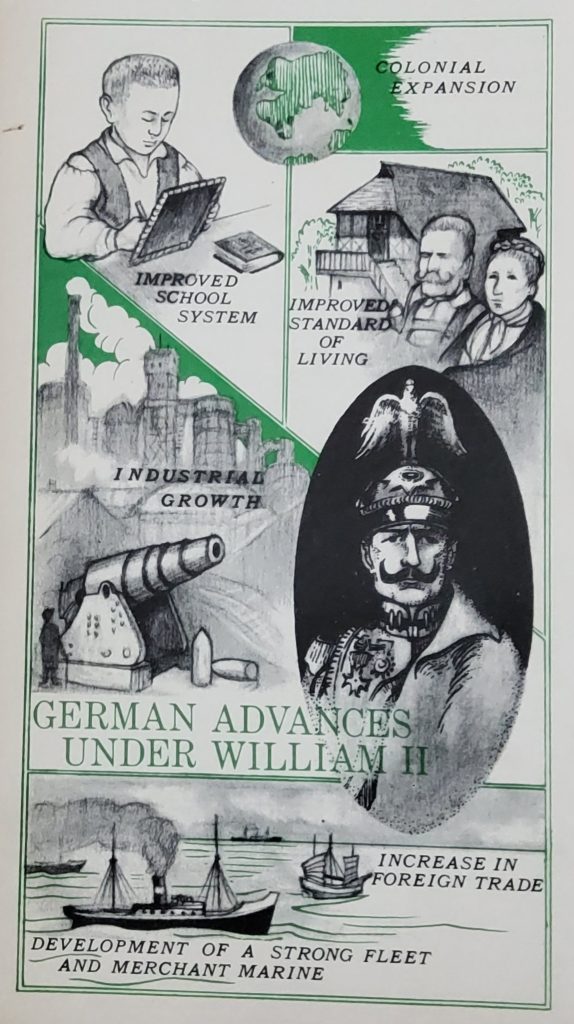
William II assumed active direction of German affairs.
William II (1859 – 1941), the grandson of William I, was well-educated, pious, arrogant, emotionally unstable and militaristic. Believing in the divine right of kings, he came to the throne determined to rule Germany personally. As Kaiser or Emperor, he was to stamp his ideas upon German history between 1890 and 1910; as Bismarck had stamped his beliefs upon history, between 1871 and 1890.
The Kaiser had ruled less than two years when he dismissed Bismarck and began to run things through ministers who were little more than “yes men” and figureheads. William was a hard worker and his sense of duty was exceptional. The material prosperity that his country had enjoyed under Bismarck, continued during his reign. German industries grew rapidly and foreign trade increased. The Germans saw to it that their representatives knew the language of the people, whose business they tried to obtain. They made a special effort, to find out what customers wanted and then produced goods, to meet the demand. By 1900, the Germans were cutting into the markets of Great Britain, France and the United States. By 1910 their trade was so vast, that competing nations were greatly worried. This concern was increased when the Germans developed a strong merchant marine and a fleet, second in Europe only to that of Great Britain.
William II was aggressive in obtaining colonies; because Germany was late in entering the colonial race, William II insisted on working rapidly. In the latter part of the nineteenth century, Germany obtained Togoland and Cameroon in Africa and the important port of Kiaochow, in China. Germany also obtained Pacific island groups, like the Marshalls and the Carolines.
The steadily improving standard of living of the German people, was accompanied by a steady growth of the population, which increased from about 40 million in 1870, to approximately 65 million in 1910. By 1900, Germany could boast a superior school system, superior industrial achievements, a strong merchant marine, a powerful navy and the strongest army, in Europe. Germany under William II faced the twentieth century with the determination to prove to the world, that it was second to no other nation.
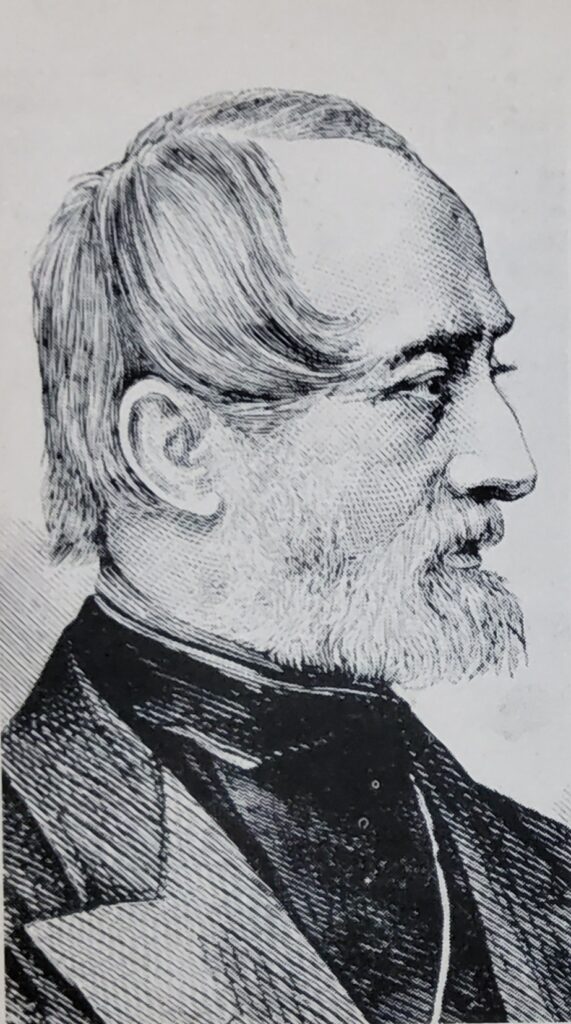
GIUSEPPE MAZZINI — (1805 – 1872)
Giuseppe Mazzini was a poetic idealist who influenced men of action. As a young man, he joined the Carbonari, a revolutionary group devoted to the unification of Italy. For this act, he was exiled and forced to live elsewhere for eighteen years, during which time he supported himself by his literary talents as a journalist and essayist.
Mazzini’s ideas and enthusiasm brought him a following which was called “Young Italy.” He returned to Italy in 1848, when revolutions swept many European countries and helped organize a Roman Republic. When a French army attacked this new government and took the city of Rome, Mazzini again lived in Switzerland and in London. He lived to receive recognition for his work from a united Italy, but he was disheartened because the republic of his dreams had not been achieved. Instead Italy had become a monarchy, with the king of Sardinia on the throne. It was not until after World War II, that the dream of Italian republicans was realized.
THE STRUGGLE TO UNITE ITALY
The king of Sardinia tried his hand at unifying the Italian states.
Several times after 1815, groups of Italians had tried to throw off the heavy hand of Metternich and work for a unified Italian state. When the Revolution of 1848 forced Metternich to seek refuge in England, the Italians of Milan and Venice took advantage of the situation and revolted against Austrian rule. The king of Sardinia, who had given his people a constitution, decided to support the war for independence. Sardinia was a small and weak country, but the chances of success seemed good, when every part of the Hapsburg empire was in turmoil.
The early successes of the Italian patriots, were reversed when the Austrians unexpectedly rallied and crushed the Sardinians in two battles. The king of Sardinia abdicated and his son Victor Emmanuel II became ruler. French troops captured Rome and restored the pope to his temporal rule.
Austria demanded that Victor Emmanuel, abolish the constitution his father had granted. The king replied:
What my father has sworn to, I will maintain. If you wish a war to the death, so be it. . . . If I must fail, it will be without shame; my House knows the road to exile, but not to dishonor.
In time, the Austrians were able to undo most of what the Italian patriots had accomnlished. Only one constitution remained: the one granted by the king of Sardinia and defended by his son. Later this became the constitution of united Italy.
Count Cavour became the leader of the unification movement.
Born of a noble family in Sardinia, Count Camillo Benso di Cavour (1810 – 1861), became a Liberal after traveling in Switzerland, France and England. Then he founded a newspaper with which to spread his nationalist ideas.
Sardinia was assuming a place in Italian affairs corresponding to Prussia’s place in German affairs. In 1852, Cavour became prime minister in Sardinia and in a sense, became the Italian Bismarck. It may be pointed out, that his task was more difficult than Bismarck’s, who relied upon the Prussian army to attain his objectives. Lacking armed strength, Cavour was compelled to rely upon his diplomatic skill to obtain powerful allies.
In 1854, the Crimean War gave him a chance to bring Italian problems before the warring powers. He surprised Europe by joining Sardinia’s forces with those of England and France. The allies, successful in their war with Russia, were obliged to listen to Cavour outline Italy’s grievances at the Congress of Paris, which followed the war fought in 1856.
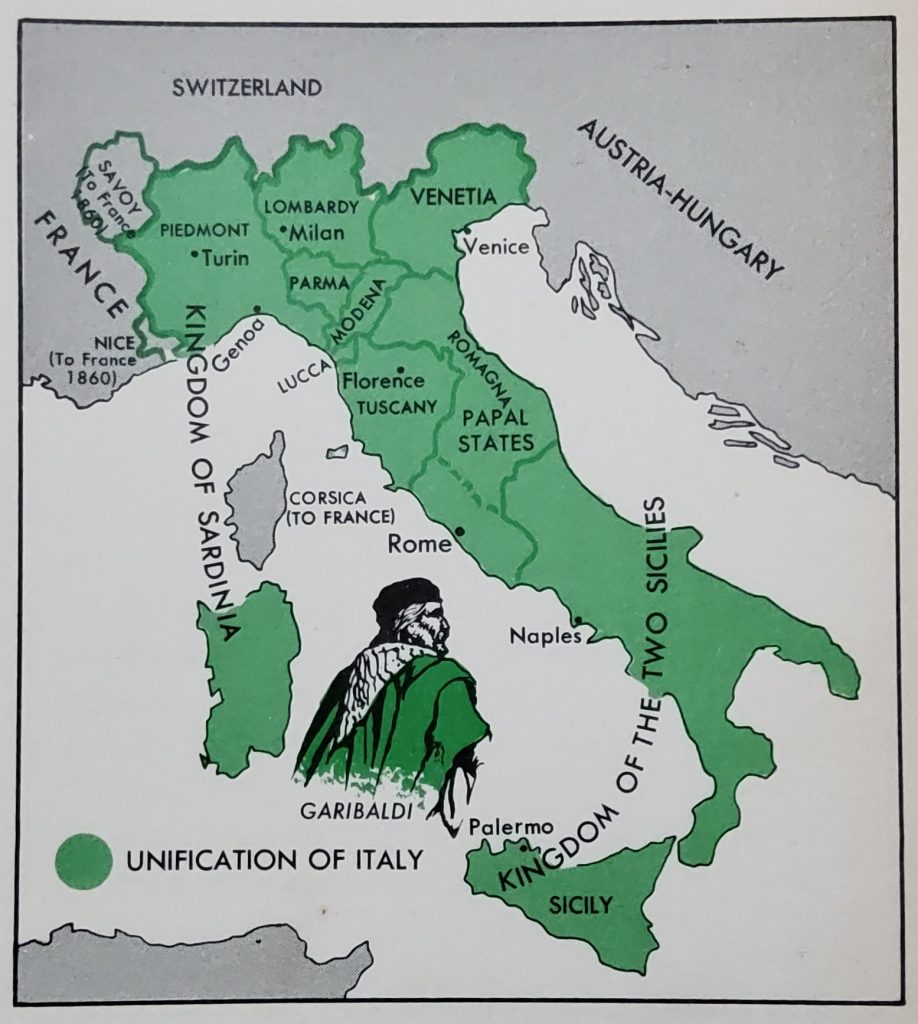
Cavour’s speech must have touched Napoleon III, for the two men later met secretly and made an agreement. It was understood that if Sardinia should become involved in a war with Austria, France would come to her aid and drive the Austrians from Lombardy and Venetia. These areas would then go to Sardinia, while France would be “compensated” by receiving Nice and Savoy, the province which for centuries, had been the domain of Victor Emmanuel’s family.
By magnifying a touchy situation, Cavour succeeded in getting Austria to attack Piedmont. The French rushed to help the Italians. The Austrians were defeated in two bloody battles. Then something took place in Napoleon III’s mind. Although he had stated that he would free Italy from the Alps to the Adriatic, he became alarmed and arranged an armistice with Austria. (Perhaps he had not intended to create a strong neighbour to France.) Without consulting the enraged Cavour, Napoleon agreed that Austria should keep Venetia and only Lombardy should go to Sardinia. The small states of Parma, Modena, Tuscany and Romagna, which had exiled their Hapsburg rulers, were to be given back to their rulers.
The people of northern Italy refused to accept a return of their rulers. Instead, they and part of the Papal States, adopted the Sardinian constitution in 1859. Having secured Savoy and Nice, Napolcon eventually approved these additions to Italy.
Cavour’s work was aided by the writings of Giuseppe Mazzini, a brilliant thinker who roused his fellow Italians to action. As indicated by the biographical sketch, Mazzini sacrificed his own career in the interests of Italian unification.
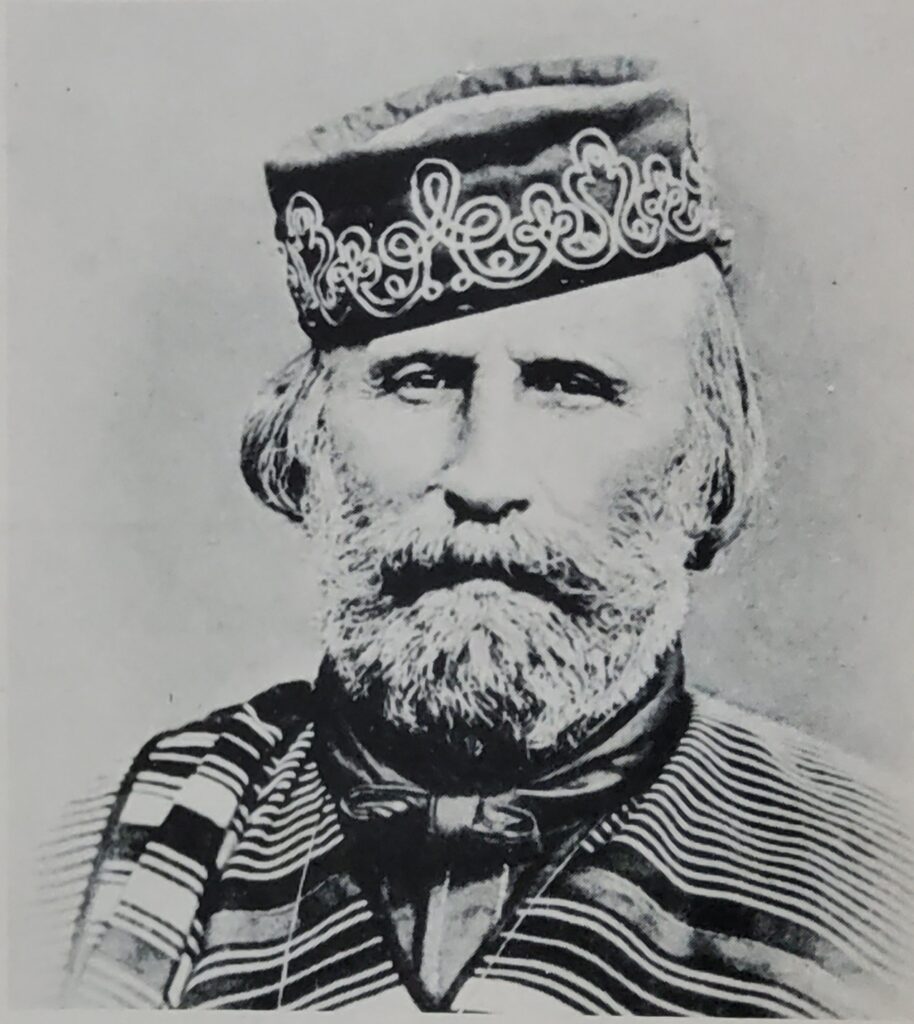
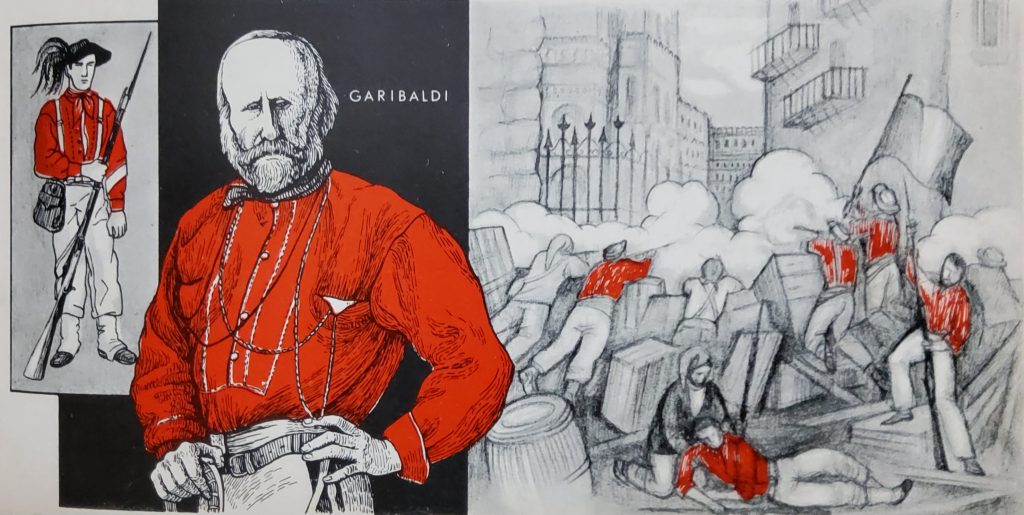
Giuseppe Garibaldi played an important role in freeing southern Italy.
This picturesque swashbuckler remains one of the most popular of Italian heroes. As a young man, his participation in movements for Italian freedom, led to exile. He became a soldier of fortune in South America and for a time lived in the United States. In 1860, the people of Sicily revolted against their Bourbon king. Subsidized by Cavour, Garibaldi recruited a thousand adventurers (known as the Red Shirts), they invaded and conquered Sicily, then crossed to the mainland and entered the city of Naples. The king fled and Garibaldi easily gained control of southern Italy. Cavour sent troops to Naples and Garibaldi reluctantly turned Naples and Sicily over to the king of Sardinia. Napoleon III permitted the king, Victor Emmanuel II, to take the northern part of the Papal States, but not the territory around Rome.
The first parliament to represent the new Italian nation, assembled in Turin in 1861. Victor Emmanuel assumed the title of King of Italy. In 1866, Italy joined Prussia in her war against Austria and was rewarded by the cession of Venetia. A few years later, Napoleon III needed his troops for the war against Prussia and withdrew the Roman garrison. In 1870, by vote of the people, Rome and the remainder of the Papal States became part of the Italian kingdom and Rome became the capital city.
The political and religious traditions of Rome came into conflict.
The new state was a limited monarchy, with the right to vote restricted to men who owned property and paid taxes. The parliament consisted of a senate and a house of representatives elected by the voters. The pope, unhappy over the loss of the Papal States, considered himself the prisoner of the Italian state and would not go beyond the grounds surrounding his palace. To appease him, the Italian parliament passed the Law of Papal Guarantees in 1871.
This act pledged the Italian government to look upon the pope as a sovereign ruler; to permit his use of the Italian railway, telegraph and postal services; and to receive and send ambassadors without interference by the Italian government. He was to have his own court and receive an annual payment of more than $500,000, to make up for his loss of possessions. The pope rejected these offers, believing that acceptance could be regarded as an acknowledgement that a satisfactory adjustment had been made. An acceptable solution of the “Roman question”, was not forthcoming until 1929.
The Italians became ambitious for military and colonial power.
They wanted their country to be rich and powerful like England, France and Germany. There were serious obstacles to realization of this hope. Many of the problems facing the new kingdom were economic, some were geographic. Italy lacked coal and iron, the basis of modern industrialism. In general the farmland, the large cities, the railroads and the factories, were located in northern Italy. In southern Italy, the land and the people were very poor. Hardly one person in ten could read and write.
The new government wished to be fair to all Italians and to all sections of the country. It wanted to equalize expenditures and taxation in the various regions. This was hard to do, because most of the taxes had to come from the well-to-do North, but much of the money collected, had to be spent in the South.
In order to bring about economic unity, the government built thousands of miles of railways, highways and canals. These and other public works made high taxes necessary. There was grumbling on the part of both the wealthy factory owners and the poor farmers. Not all of the Italian people accepted the costs and hardships of their political and economic progress. Many who found the struggle for existence too trying, left Italy. Many thousands came to America, where they played an important part in the industrial development of the country. Despite this great migration, the high birth rate in Italy caused the population to grow.
Italy was “bitten by the bug” of colonialism. This was natural since she lacked the natural resources necessary to sustain a large population. The world had been well picked over and few areas of value remained unclaimed. Italy wanted Tunis, but the French acquired that in 1881. The Italians sought Ethiopia, but lost prestige there, when their armies were beaten by the natives. Altogether, their efforts at that time did little more, than put Italy’s colour on the map of Africa.
Within the nineteenth century, the Italians had won their freedom from autocratic rulers and established their own representative government, but unification proved to be no panacea. Money needed for economic and social progress was diverted to the “equipment” of a great power — unnecessarily large military forces and colonial ventures. Italians were still frustrated when they compared their shabby present, with the glories of the Renaissance and ancient Rome.
The La Scala opera in Milan, is to the opera singer what the National Open is to the golfer. Singers of all nationalities, dream of a debut before that critical audience. To walk out on that stage, is literally to follow in the footsteps of the great singers of many generations.
The large, prosperous city of Milan has long commanded the best Italian composers as well as performers. The first performances of many operas occurred at La Scala. These works were published by the Milan firm, Casa Ricordi, which kept the original manuscripts in its vaults.
Recently, musicians have found evidence that there are serious errors in the printed scores of many famous operas. A demand has been made that the manuscripts be brought out and used in correcting the present scores. This demand may open the way for music lovers to hear operas sung, as the composers intended they should be performed.