West Dominates the World (1763 – 1899 A. D.)
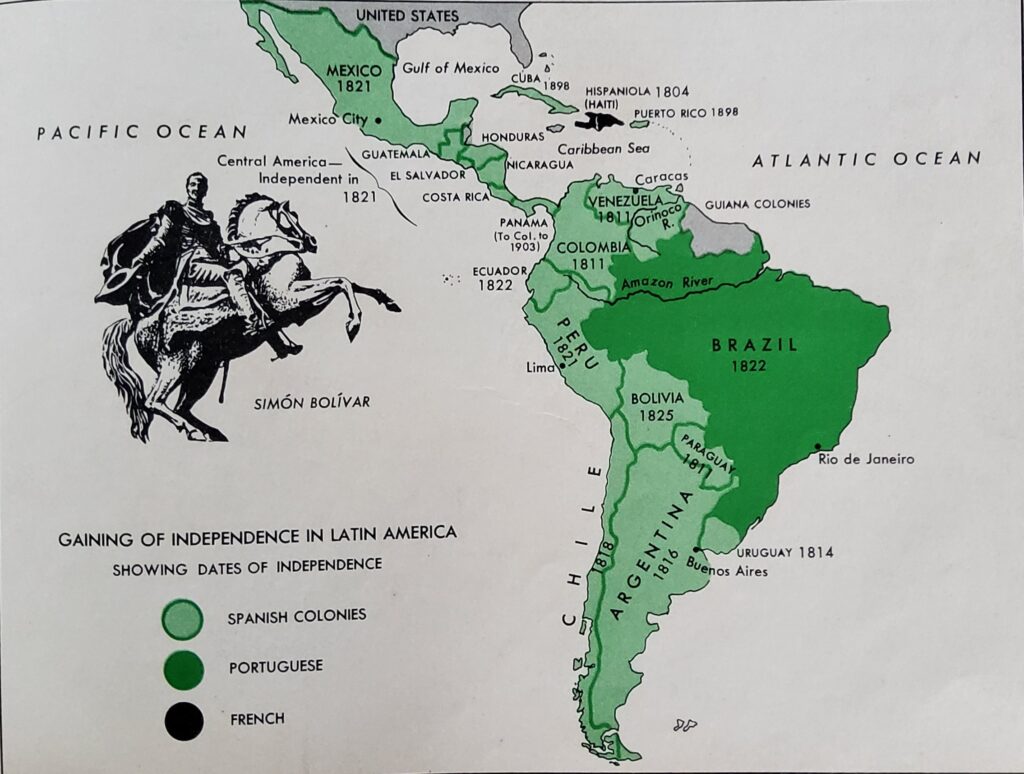
Nations of Latin America ‐ this subject includes the Latin American independence, international relations and life in Latin America, during this period. The revolt of the Spanish colonists in Central and South America, was in some ways similar to the United States Revolution, which partly inspired it. It is important to understand the differences in background and motives, which led the southern neighbours in political and economic directions, unlike to those taken by American democracy in the 1800’s.
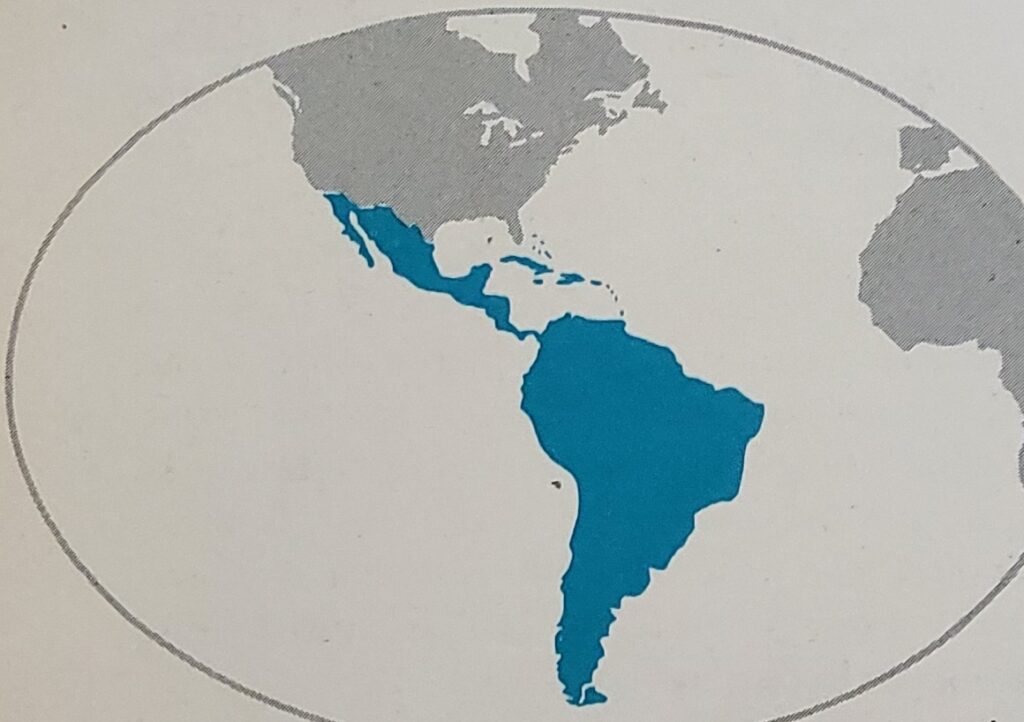
The story of nineteenth-century Latin America is an unhappy one: of political disunity, economic weakness and interference by foreigners. It is important to understand why that interference made the American neighbours feel “touchy”, about alleged “imperialism;” why they viewed the Monroe Doctrine differently from the way Americans viewed it.
The chief idea is that the Latin Americans have developed a culture that is unique. Ever since 1933, when the Good Neighbour Policy was instituted, the United States and the republics to the south, have co-operated in a program of common defense and economic interdependence. Americans worked together now under the Organization of American States (OAS). It was important that North Americans made an effort to understand the customs, culture and problems of Latin Americans. It was essential that they helped them in their efforts to erase poverty and ignorance, thus reducing the possibility of their accepting communism, as a way of life.
LATIN AMERICAN INDEPENDENCE
The revolutionary movements of the eighteenth-century affected Europe, North America and South America.
The Revolution in England (1688), the American Revolution (1775) and the French Revolution (1789), were high-points in the advancement toward freedom and representative government, which culminated in the establishment of individual republics in South and Central America.
At the opening of the 1800’s, the tendency in Spain and Portugal was to send better viceroys and other officials to the colonies and to increase colonial trade, but the ferment of liberal and reformist ideas was at work in the colonies, as well as in Europe. The Creoles (Spaniards born in the colonies) resented the haughty officials sent out from Spain, who grabbed almost all the best positions in government. It is said that some of the young Creoles drank deeply of the ideas of Montesquieu, Rousseau and Voltaire, when they could get copies of their writings. These young intellectuals resented the censorship and restrictions which put such writings on the forbidden list, so the books had to be smuggled into the colonies, read on the sly and passed on without catching the eye of the Holy Office. The Declaration of the Rights of Man and the Citizen, was eagerly read in the colonies, but a native of Bogatá, spent ten years in prison for translating a copy of it and for having it printed on his own printing press.
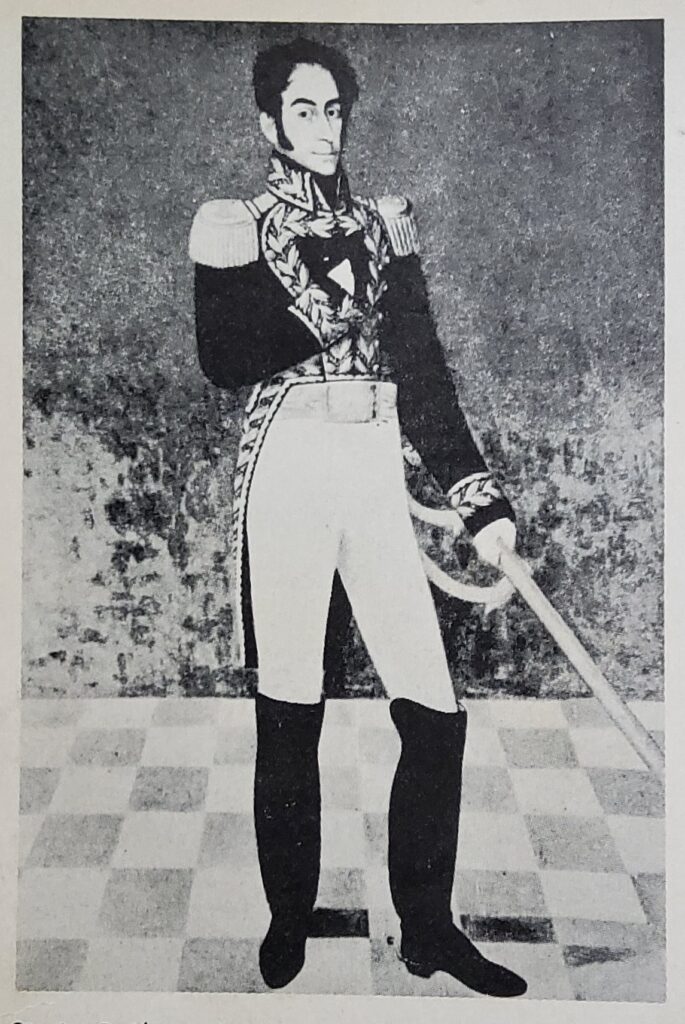
Thoughts of independence were on many young minds at the beginning of the 1800’s, when Napoleon Bonaparte set-off uprisings in South America, by tossing out the Bourbons and putting his brother Joseph on the throne of Spain. The resentful colonists dubbed their new ruler “Joe Bottles” and claimed to be loyal to their king, Ferdinand VII, then interned in France. In several colonies, liberal Creoles rose up, deposed the Spanish viceroys and captains-general, to set up local juntas or councils. These early revolts accomplished little more than to sow the seeds of rebellion. The reaping of independence came under the leadership of Simón Bolívar (1783 – 1830), a native of Caracas in Venezuela.
Bolívar was to South America, what George Washington was to the United States.
He is described as a born actor, with much personal charm, who was well-travelled and a crusader for independence. In winning independence for the Spanish colonies in northern South America, he used up the large fortune he had inherited from his Spanish parents.
After two unsuccessful attempts to make a republic of his native Venezuela, Bolívar came back in 1817, with a small force and succeeded. His most spectacular feat was guidance of his troops across the icy passes of the Andes, into New Granada (Colombia). There he won a real victory and established the Republic of Great Colombia, which at first included Venezuela and Ecuador. After liberating Ecuador, Bolívar went to Guayaquil, to meet José de San Martin (1778 – 1850), another revolutionary leader.
San Martin was quite unlike Bolívar. A reserved man of few words, he cared nothing about praise or blame so long as he was sure he was fighting for a just cause. An Argentinean, he had already liberated Chile by making a terrible three weeks march over the Andes, to surprise and defeat the Spanish forces in that country. Then he had declared the independence of Peru, before meeting Bolívar.
San Martin had been aided in freeing Chile by Bernardo O’Higgins, the son of an rishman who had emigrated to Chile. From humble beginnings as a shopkeeper, road builder and engineer, the elder O’Higgins rose to be viceroy of Peru. He was an able administrator and his son inherited his abilities. The younger O’Higgins became the first president of Chile.
After the meeting with Bolívar, San Martin retired from Peru, leaving the victories for which he had been preparing to be won by Bolívar. It is said that the two men did not agree on strategy; that Bolívar wanted to be the hero in each situation, so San Martin simply withdrew from the fleld and spent the rest of his life abroad. Today his greatness is appreciatad and his life is studied in Argentinean schools along with those of other South American heroes.
After San Martin’s withdrawal, Bolivar went on and won a victory over the last Spanish viceroy in South America on a battleground some 12,000 feet above sea level. By 1825, Bolivia also had been liberated and the revolution was over.
The Portuguese colony, Brazil, likewise was involved in the revolutionary movement.
When in 1807, the government of Portugal was overthrown by Napoleon, the royal family escaped to Brazil. After Napoleon’s defeat, Prince John, who was regent, returned to Portugal. His son Dom Pedro remained in Brazil and in 1822, declared Brazil to be an empire independent of Portugal.
When Pedro abdicated in 1831, his son became emperor, as Pedro II. He was a man of broad culture and was considered one of the most enlightened monarchs of the nineteenth century. During his long reign, Brazil made economic progress and added to its territories. Pedro opened the Amazon to commerce and his daughter, worked for the abolition of Negro slavery. The latter action, brought about a revolution in 1889. Pedro was sent into exile and a federal republic was proclaimed.
Mexico’s first revolts were failures, but Independence was ultimately gained.
Thousands flocked to the standard of Miguel Hidalgo, a priest, who is said to have called the people to arms by ringing the bell of his parish church. Chiefly Indians and untrained farmers, the revolutionists were routed and the leaders were captured and executed. Hidalgo’s failure was followed by others, but after the Revolution of 1820 in Spain, Mexico’s ruling class decided to separate from the mother country.
In 1821 a plan of government was drawn up, that provided for a constitutional monarchy under an emperor whose name was Agustín de lturbide. The viceroy, Juan O’Donojú accepted the plan, but the revolutionary government in Spain, refused to accept the decision. Since Spain was not in a position to send an army to suppress the revolt, lturbide proclaimed himself emperor. Mexico thus gained its independence exactly 300 years after its conquest by Cortes.
Spain lost control of Central America and her islands in the Caribbean Sea.
The five Provinces of the captaincy-general of Guatemala, organized themselves as a federal republic after Mexico had won its independence. In 1824, slavery was abolished, the first action of this kind taken by any country of the New World, south of Canada. In 1832, religious freedom was proclaimed. These liberal advances were met with opposition from strong religious and political factions, within the union and in 1838, the union was split. Five independent states were El Salvador, Honduras, Nicaragua, Costa Rica and Guatemala.
Two independent states emerged on the island of Hispaniola: Haiti on the west and the Dominican Republic on the east. Haiti was under French domination for more than a century and so French, became the official language. Today, a French dialect known as Creole is spoken by the majority of the people. The population of Haiti, is predominantly Negro and mulatto.
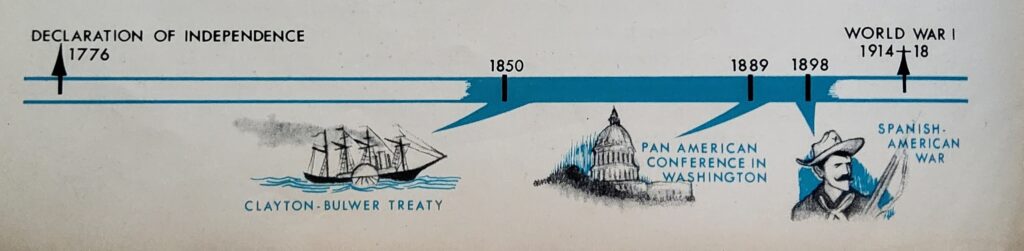
Cuba, the “Pearl of the Antilles” and Puerto Rico, remained under the control of Spain in spite of uprisings. The United States offered to purchase Cuba, but the spanish government refused to sell. Revolutions in Cuba and a growing sentiment in the United States, in favour of intervention, were the factors underlying the United States’ war with Spain in 1898. As a result of this war, Puerto Rico was ceded to the United States and Cuba came under American influence.
Latin American independence was accompanied by dictatorships and revolutions.
Most of the former Spanish colonies became republics and adopted constitutions modelled upon those of the United States and France. Unfortunately, the peoples of these countries had no experience with representative government, or democratic procedures, hence political matters had little meaning or importance for the great mass of Latin Americans. A small group of wealthy landowners, chiefly descendants from the original Spanish settlers, were the real rulers in most of the new republics. Elections were held, but these were usually won by the candidate with the strongest army. “Revolutions” were frequent, but not the kind of revolutions in which a majority of the people took part. They were usually army revolts by which some “strong man” rose to power.
As time went on, some of the Latin American countries made significant progress both politically and economically. This was especially true in the countries of the temperate zone — Chile, Argentina and Uruguay. In Mexico a skillful dictator, Porfirio Diaz (1830 – 1915), held power for almost half a century. He invited foreigners and their capital to Mexico, made many improvements, but failed to bring any relief to the poverty-stricken peasant class. He was overthrown by a revolution in 1911, followed by a civil war and social revolution. When it ended, a new government tried to modernize the country and educate the people — no easy task, as the problems still faced by the Mexican government indicate.
The ideal of having a United States of Latin America was not realized.
The Spaniards had found it necessary to govern their vast and diverse colonial empire, through a number of separate units and capitals. In general, these boundaries became the basis for the new states, although far-sighted leaders, such as Bolívar, saw the advantages of larger combinations of territory. In time, strong nationalistic feelings developed. Wars, boundary disputes and rivalries, appeared as they had in Europe. The failure to unite, accentuated the economic and political problems of the new nations.
INTERNATIONAL RELATIONS
The United States generally assumed the role of a protector.
The Monroe Doctrine served its purpose in blocking the European intervention, which might have crushed the independence movement in the Spanish colonies. It is unfortunate that it was not followed by an agreement, that would have drawn all the countries of the hemisphere together. Bolívar wanted to see the Latin American nations bound in a close union and called a conference for that purpose in Panama. Only four of the newly independent states sent delegates to the first Pan American conference in 1826; little was accomplished. The delegates from the United States failed to appear at all.
A more successful conference was held in 1889, when James G. Blaine, United States’ Secretary of State, invited nineteen Latin American states to meet in Washington, for a discussion of commercial problems. Trade agreements were signed and later abandoned by the United States, but no move was made toward a confederation. After the meeting, a bureau was organized as the Pan American Union and twenty-one republics ultimately joined. Andrew Carnegie gave it a beautiful building in Washington, D.C., as headquarters. Later in the twentieth-century, came more developments along this line and the Good Neighbour Policy was promoted by Franklin D. Roosevelt.
A real challenge to the Monroe Doctrine came in the 1860’s and again in the 1890’s.
While the hands of the United States were tied by internal conflict, the armies of Napoleon III conquered Mexico. Maximilian, brother of the [Austrian] Emperor Francis Joseph, was set up as puppet emperor of Mexico. In 1865, with the war at an end, the United States warned Napoleon that it would not tolerate the continued presence of a French army in Mexico. The French ruler decided to withdraw his troops and to leave Maximilian to his own devices. Defeated and captured by those who opposed him, Maximilian was condemned to death and shot. The leader of the opposition was an Indian, Benito Juárez, who received much needed military supplies from the United States. Juárez, is one of the national heroes of his country and is known as the “Mexican Lincoln.”
The demands of foreign investors became a threat to the Monroe Doctrine, towards the end of the century. Some of the republics which were careless about repaying their foreign loans, found themselves in serious trouble. Injured investors usually appealed to their governments for help. Diplomatic representatives were kept busy writing letters over debt claims, especially in the chief lending countries — Great Britain, the United States, Germany, France, Italy and Spain. Finally, an international episode demonstrated what can happen over a bad debt.
To remind the dictator of Venezuela that he must repay his loans from some of their citizens, Great Britain, Germany and Italy joined, in forcing him to do so. They blockaded Venezuelan ports and fired upon some coastal forts. The dictators punishment was interrupted by president Theodore Roosevelt, who decided that no European nation, should be allowed to invade this hemisphere. He told them to resort to diplomacy.
The Europeans gave him to understand that if he would not let them protect their investors, the United States must do it. As a result, Roosevelt said that if a Latin American country persisted in “chronic wrongdoing,” we might have to police her, for her own protection; that is, move in and see that her obligations were met. We would do this, rather than let Europeans send warships or troops. As an example of what he meant, we set up offices to help collect customs in Nicaragua, Haiti and the Dominican Republic — customs that could be used for debt payments. Some of the United States’ Latin American friends, set to wondering if the United States had other intentions, than to help them. The Good Neighbour Policy, soon dissolved their fears.
The building of the Panama Canal was preceded by a long period of diplomatic maneuvering.
In 1846, the United States and Colombia (then called New Granada) concluded a treaty which granted the United States, amongst other things, the right of way across the Isthmus of Panama, for either a railroad or a canal.
The British immediately protested. They had long been interested in the Caribbean area — from the days when such buccaneers as Sir Henry Morgan, had terrorized Spanish commerce. Before the seventeenth century opened, British ships had carried large quantities of goods between Europe, the West Indies and the Spanish Main. After the British captured Jamaica in 1655, they began to establish colonies on certain islands and on the mainland at Belize, British Honduras, what is now British Guiana and on the Mosquito Coast of Nicaragua.
The discovery of gold in California in 1849, led to a search for a way to cross the Isthmus of Panama and shorten the distance, between the Atlantic and Pacific oceans. One route made use of the San Juan River and Lake Nicaragua. One route led across the Isthmus. Businessmen began to talk about the need for a canal at one of these points and about Britain’s position, in the Caribbean.
So it was that in 1850, the United States entered into the Clayton-Bulwer Treaty with Great Britain. It was agreed that the British would withdraw their protectorate over the Mosquito Indians and that neither nation should obtain or maintain, exclusive control over any ship-canal in any part of Central America. It was further agreed that any canal constructed in Central America, would be open to all; that neither signer would ever “occupy, or fortify, or colonize, or assume or exercise any dominion over Nicaragua, Costa Rica, the Mosquito Coast, or any part of Central America.”
After the United States war with Spain in 1898, a canal connecting the Atlantic and the Pacific became increasingly necessary, since the United States had acquired possessions in both oceans: but the Clayton-Bulwer Treaty tied the United States government’s hands. Fortunately, the British agreed to a change, whereby the United States was given the right to build a canal and to defend it. The United States agreed that this canal should be open to all nations on equal terms. A route across Panama was chosen. This involved negotiations with Colombia, to which Panama belonged and later, the recognition of the republic of Panama as an independent state; when Colombia refused the terms that were acceptable to the United States’ government.
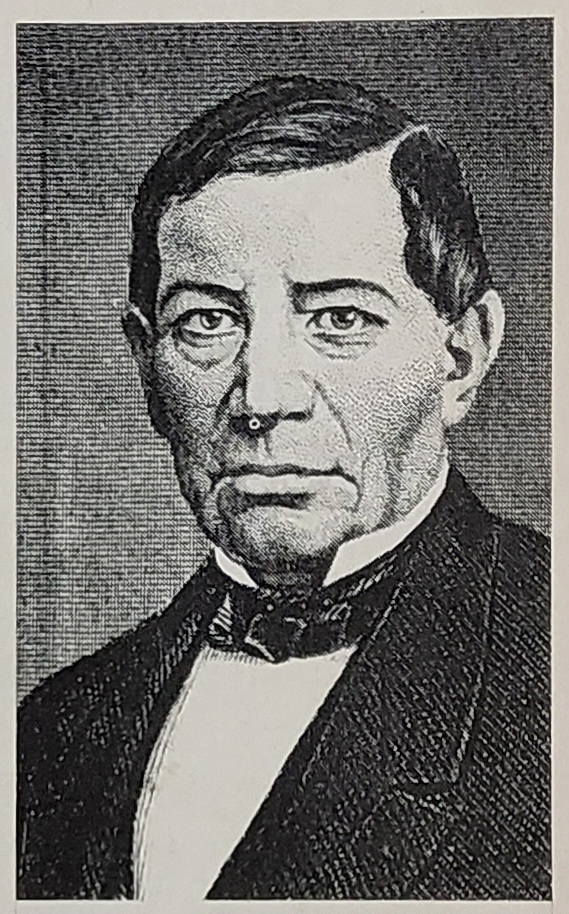
BENITO JUÁREZ — (1806 – 1872)
In the early years of the Latin American republics, men of Spanish descent were the political leaders. The Indian population of some of these countries, had little opportunity to become educated. It was remarkable, then, that an Indian, Benito Juárez, became President of Mexico in 1857.
The problems faced by this man, were even greater than those faced by his contemporary, Abraham Lincoln. Mexico had had fifty years of almost unbroken war and revolution. Almost immediately, Juárez faced an invasion of foreign powers, supported by his own political enemies. Most of Mexico was conquered by French troops who set up the puppet emperor, Maximilian. After the French withdrew in 1867, internal disorder continued.
This man who suffered so many disheartening defeats and failures, is considered by the Mexican people as the real founder of their nation. Forty years after his death, sweeping reforms in government and society, made his visions a reality.
LIFE IN LATIN AMERICA
The economic system of Latin America lagged behind those of the United States and Europe.
The nineteenth century, brought no sudden change in the economic life of the Latin American countries. Mining continued to be a major occupation, just as it had been in colonial times. In time, the mining of copper and nitrates became more important, than the mining of silver and gold. These minerals are today important exports, particularly from Chile. Oil is an important export from Mexico and Venezuela.
To the colonists, mining had been more attractive than farming, but farming had been encouraged and was the predominant occupation. Prospective farmers, sometimes received free transportation to Latin America and even free farms. Labour was provided at first by Indians and later by Negro slaves. During the nineteenth century, slavery was prohibited everywhere in Latin America, but Negroes and Indians, continued to do most of the heavy work. In general, agriculture continued to be primitive and simple tools were used long after better plows, cultivators and drills, had been introduced into England and the United States.
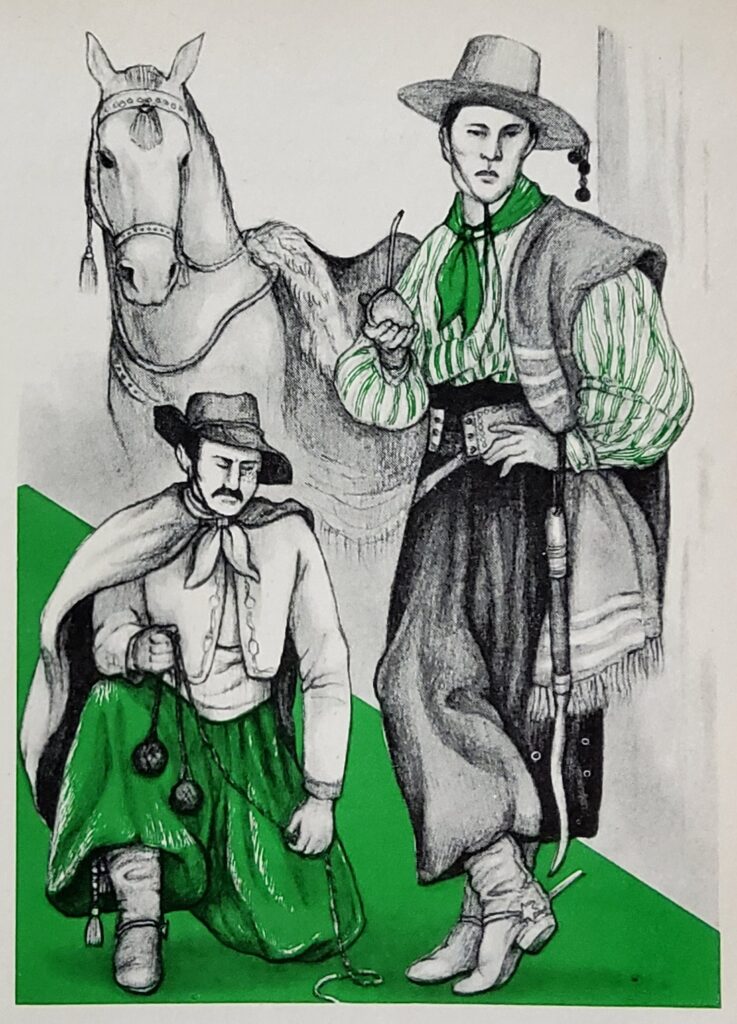
Stock raising became extremely important in parts of Latin America. European live stock multiplied rapidly on the wide pampas (grasslands). In time horses, cattle and pigs, ran wild. Argentina had so many of these animals that the gaucho (cowboy), felt free to kill a cow or capture a wild horse whenever he chose. Meat was so plentiful that hides, horns and hoofs, were considered the most valuable products of the range.
Throughout the nineteenth century, most of the Latin American countries had serious economic problems, in spite of the fact that they originally had abundant wealth in minerals, fertile soil, grasslands and forests. They lacked coal, were seemingly short on iron; and did not develop their fertile areas in Argentina, Uruguay and Brazil, until the latter part of the century.
There were many reasons for the situation, some of them historical. The Industrial Revolution moved into high gear, just after the Latin Americans achieved independence. The manufacturers of Europe and later of the United States, needed: raw materials and markets in which to sell their products. Investors looked for places to put their capital and to gain large returns.
Logically, both manufacturers and investors, looked to the new republics of Latin America. These were not yet ready to industrialize, but some of the governments created by revolutions and eager to fil their pockets, granted concessions to foreign companies for cash. Some of the concessions were fairly administered; some were exploited. Sometimes, after revolts, the new governments that came to power, repudiated the debts of their predecessors. Too often, governments drained their treasuries. In such ways, the politicians bartered away much of their nations’ natural resources and brought their countries into disrepute, for failing to pay their debts.
In general, Latin America still imports manufactured goods and exports grain, meat, meat products, plantation crops, nitrates and oil. For many years, Latin America’s best customers were Europeans, who needed both food and raw materials, but in recent years Latin America has depended more heavily upon the United States. One big weakness showed up on exports: most countries depended upon a single product or only a few products for outside income. Cuba depended upon sugar, Mexico on oil and silver, Bolivia on tin, Brazil on coffee, Argentina on meat and wheat, Venezuela on oil; several Central American republics and Ecuador, on bananas. Chile, well endowed by nature with agricultural lands, enjoyed fair prosperity.
The chief economic problem of every Latin American country, is to provide a better standard of living for the great masses of its people. In the modern world, this is hard to do in countries which export raw materials and import manufactured articles. A high standard of living, goes with a high degree of industrialization. Yet, in their underdeveloped resources — human, vegetable and mineral – the Latin American countries, particularly those of South America, possess boundless possibilities for the future.
The people of South America remained Latin in tradition.
For the most part, there was no mass immigration as experienced by the United States. Immigrants came mainly from countries where the Romance languages are spoken: Spain, Portugal, Italy. Besides their Latin tradition, the people of Latin America became the product of various influences, including their environment. The mountains and the pampas, the hot tropical regions, the cold regions of the highlands, the lush forests, the beautiful harbours — all of these geographical features have played their part in moulding the character and the culture of our southern Americans. Another strong influence has been the native Indian cultures.
Spanish and Portuguese influence is still seen in the architecture, especially in the churches. It appears in the laws and customs, in the religion of the people, in their language, literature and music. Other foreign influences have been felt: the French, Germans, Italians, Chinese and Japanese, have each introduced some element of their culture. The literature, art, political and social ideas of the French especially, have made a deep impression. From the days of Louis XIV, Paris was a cultural centre for Latin Americans. Bourbons ruled in Spain and Italy: consequently, French was generally spoken among Latin Americans, French books read, French art purchased. Wealthy Latin Americans went to school in France.
The United States had penetrated all of Latin America with its automobiles, radios, TV and movies — with the thousand and one gadgets, for which Americans are known the world around. Even the English language is spoken by many persons in these countries, south of the United States border.
The Roman Catholic Church became an influential institution, throughout the Latin American countries.
Its clergy, performed duties and enjoyed certain privileges, not usually associated with the Church in non-Catholic countries. They conducted schools of various kinds, orphanages and hospitals, administered law courts, collected tithes, maintained a censorship of the press and came into possession of considerable wealth, especially in the form of land, which served as an endowment for these institutions.
In the nineteenth century, opposition to the Roman Catholic Church developed in various parts of Latin America. Conservatives generally supported the Church and its rights and privileges, in state affairs. Liberals favoured limiting the Church to its pure religious duties and services; and to treating it as one, of a number of churches.
In settling these matters, the republics of Latin America adopted different policies: though in general, these were in the direction of reducing the powers of the Church. Mexico the quarrel between Church and State became especially acute and, in the twentieth centurv. led to oven conflict.
Public education made slow progress in Latin America.
Although the United States’ neighbours adapted many of those institutions and ideas to their needs, education remained largely in the hands of the Church. Some of their educational institutions are very old. The University of Mexico was founded in 1551, almost a hundred years before Harvard, United States’ oldest college. Other ancient universities are located in Ciudad Trujillo, Dominican Republic; Lima, Peru; Córdoba, Argentina; Bogotá, Colombia; Santiago, Chile; and Guatemala City, Guatemala.
For many years the illiteracy rate was very high among the poorer classes of people in Latin America and in some countries, illiteracy probably continues to exceed 50 per cent. In the nineteenth century, considerable educational progress was made and this progress has continued at a faster rate, during the twentieth century. This has been accomplished by increased public spending for education, by a greatly increased number of rural schools and by improvement in the preparation of teachers. A recent important development has been the growth of public high schools, providing a level of education previously available only to children of well-to-do families.
Nineteenth-century Latin American literature and other arts were derivative.
It is uncommon to find people who have just become independent, from immediately producing great works of art. They continue to rely upon the mother country for a time, for their: literature, art and music. Then original forms start to evolve.
Well-to-do Latin Americans were people of good taste, who had travelled in Europe and the United States; and were frequently, educated there. They patronized foreign artists or their pupils.
LINKING THE PAST AND THE PRESENT
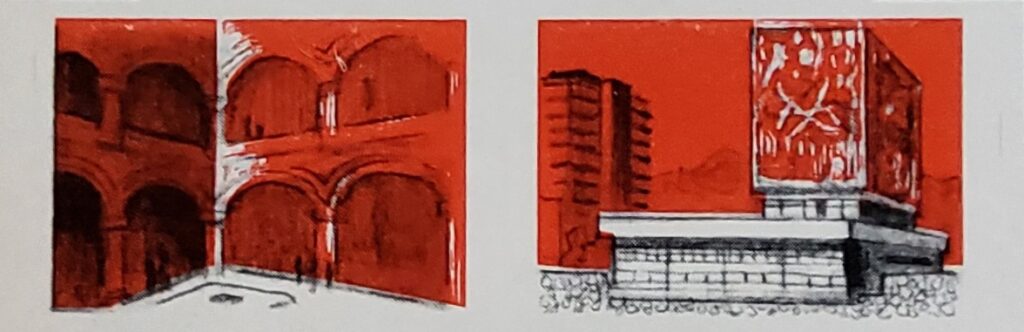
The University of Mexico was started in 1551, nearly a hundred years before the first lvy League college was founded. Its curriculum was patterned after the aristocratic, classical higher education studied currently, in Spain and the rest of Europe. Men educated at the University of Mexico and in other early Latin American schools, helped to establish Spanish culture in the New World in the same way, in which graduates of the United States’ early colleges, helped to eablish English culture in North America.
In recent years, the University of Mexico has been greatly expanded. Foremost architects and artists have made its campus one of the most beauliful in the world. The motif they selected for design and colour was not Spanish, but Aztec and Mayan. What might be called a pre-Colombian renaissance, reminds the student that civilization existed in Mexico, before the advent of Cortes.
The ideas of the Enlightenment and the American and French Revolutions inspired Creole leaders. The weakening of Spain and Portugal due to the Napoleonic Wars in Europe created an opportunity for colonies to revolt.
Simón Bolívar was called the Liberator of the north (Venezuela, Colombia, Ecuador, Peru, Bolivia). José de San Martín liberated the south (Argentina, Chile, Peru). In Mexico, independence was led by Miguel Hidalgo and later Agustín de Iturbide. In Brazil, independence was achieved peacefully under Dom Pedro I.
The US generally welcomed independence and announced the Monroe Doctrine (1823), which warned European powers not to interfere in the Americas. Later, US interest grew in the region, leading to involvement in the building of the Panama Canal and increased economic and political influence throughout the 1900-1972 period.